Upgrade & Secure Your Future with DevOps, SRE, DevSecOps, MLOps!
We spend hours scrolling social media and waste money on things we forget, but won’t spend 30 minutes a day earning certifications that can change our lives.
Master in DevOps, SRE, DevSecOps & MLOps by DevOps School!
Learn from Guru Rajesh Kumar and double your salary in just one year.
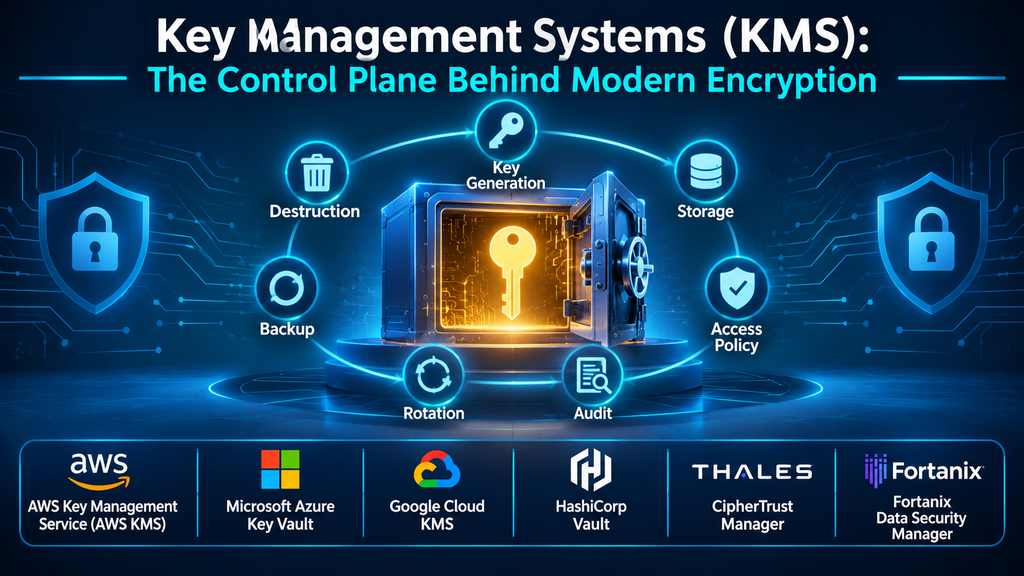
Key Management Systems (KMS): The Control Plane Behind Modern Encryption
A key management system (KMS) is the operational foundation that makes encryption manageable at scale. It governs how cryptographic keys are created, stored, accessed, rotated, backed up, and retired. Strong encryption algorithms matter, but without disciplined key management, encrypted information can still be exposed, become inaccessible, or fall outside an organization’s control.
Why key management deserves its own security strategy
Encryption transforms readable information into ciphertext. Decryption requires the right key, and that key becomes a critical security asset. If attackers obtain it, encryption may offer little protection. If an organization loses it, legitimate users may permanently lose access to protected data. If permissions are too broad, applications or administrators may use keys beyond their intended purpose.
A KMS addresses these operational risks by centralizing key lifecycle management and enforcing controlled access to cryptographic operations. Depending on the product, it may generate and store keys, perform encryption or signing operations, integrate with hardware security modules (HSMs), maintain audit records, and connect with cloud services or enterprise applications.
The important distinction is that a KMS does not automatically encrypt every system or database. It manages keys and cryptographic operations for services and applications that are configured to use it.
What a KMS actually manages
A mature key management program covers more than creating a key and putting it in a vault. It must manage the complete lifecycle.
- Generation: Create cryptographic keys using approved algorithms and suitable sources of randomness.
- Storage and protection: Keep key material within an appropriately protected boundary, potentially backed by an HSM.
- Access control: Define which identities can administer keys and which can use them for encryption, decryption, signing, or verification.
- Distribution and integration: Make keys or cryptographic operations available to authorized applications without unnecessary exposure of raw key material.
- Rotation and versioning: Introduce new key material and maintain the ability to process data protected by earlier versions.
- Backup and recovery: Preserve access to critical key material and configuration through tested recovery procedures.
- Revocation and destruction: Disable, schedule, or permanently destroy keys when policy and retention requirements permit.
- Auditing: Record key administration and cryptographic usage so unusual access can be investigated.
These functions are related but not identical across vendors. Buyers should check the exact supported key types, protection levels, interfaces, and lifecycle behavior rather than assuming that every product implements them in the same way.
KMS products and platforms worth evaluating
The products below represent different deployment models. Cloud-native services are often the natural fit for workloads already running in their ecosystems. Enterprise platforms may be more appropriate when key control must span multiple clouds, on-premises infrastructure, and third-party applications.
| Platform | Where it fits | Important consideration |
|---|---|---|
| AWS Key Management Service | AWS workloads and integrated services | Strong native integration; understand key policies, grants, and rotation eligibility |
| Microsoft Azure Key Vault and Managed HSM | Azure applications and customer-managed key scenarios | Choose the appropriate vault or dedicated HSM protection model |
| Google Cloud Key Management Service | Google Cloud workloads, CMEK, Cloud HSM, and external key options | External key arrangements introduce coordination responsibilities |
| HashiCorp Vault | Centralized secrets and cryptographic services across environments | Transit provides encryption services but does not store the submitted application data |
| Thales CipherTrust Manager | Enterprise and hybrid key lifecycle management | Evaluate integrations, deployment model, and HSM dependencies |
| Fortanix Data Security Manager | Hybrid and multicloud key management and data security | Assess supported interfaces, deployment choices, and application compatibility |
AWS Key Management Service
AWS Key Management Service (AWS KMS) is designed for creating and controlling cryptographic keys used by AWS services and applications. It provides centralized key administration, access policies, and integration with services that support AWS KMS keys.
One important operational detail is its distinction between key rotation and data re-encryption. For supported customer-managed symmetric keys using AWS-generated key material, automatic rotation creates new key material while retaining older material for decryption. AWS explains that this does not re-encrypt the data or rotate data keys generated by the KMS key. Teams must therefore understand which layer of their encryption architecture is being rotated.
AWS KMS is a strong candidate when most protected workloads are already on AWS and service-native integration is a priority. Organizations with complex external key custody or extensive on-premises requirements should assess the additional architecture and integrations needed.
Official documentation: AWS KMS concepts and AWS KMS key rotation.
Microsoft Azure Key Vault and Managed HSM
Azure Key Vault provides key and secret management capabilities for Azure applications and services. Azure Managed HSM is a distinct offering for organizations that require dedicated, single-tenant HSM-backed key protection and cryptographic operations.
The choice depends on the required security boundary, supported key operations, administrative model, and integration needs. Azure’s documentation describes automated key rotation policies, but the effect of rotation on an integrated Azure service depends on that service’s support and how quickly it detects and applies a new key version. Organizations should not assume that creating a new version immediately updates every dependent workload.
Azure is a logical choice for Microsoft-centric environments, especially where identity, access management, and service integration are already built around Azure. Teams should still test recovery, role assignments, key version handling, and application behavior before broad deployment.
Official documentation: Azure Key Vault keys and Managed HSM key rotation.
Google Cloud Key Management Service
Google Cloud KMS centralizes cryptographic key creation, import, management, and cryptographic operations. It supports customer-managed encryption key integrations, while Cloud HSM and Cloud External Key Manager (Cloud EKM) provide additional protection and custody choices.
Cloud EKM is particularly relevant when an organization wants to use externally managed key material with supported Google Cloud services. This model creates an operational dependency: key lifecycle actions such as rotation and destruction must be coordinated between the external key manager and Cloud KMS. The external key material is not exposed to Google, but the organization must ensure both sides remain correctly configured and available.
Google Cloud KMS is a natural fit for Google Cloud workloads. Its external key options may appeal to organizations with specific custody requirements, provided they are prepared to manage the added coordination and availability considerations.
Official documentation: Cloud KMS overview and Cloud External Key Manager.
HashiCorp Vault
HashiCorp Vault takes a broader approach to secrets and cryptographic services. Its Transit secrets engine can provide encryption as a service: an application sends data for cryptographic processing, and Vault returns the result without storing the submitted application data.
Transit supports encryption and decryption, signing and verification, hashing, HMAC operations, and key version management. Its rewrap operation can move ciphertext to a newer key version without returning plaintext to the requesting application. That can simplify certain migration workflows, although applications still need correct authorization, connectivity, and error handling.
Vault can be attractive when teams need a consistent cryptographic service across different infrastructure environments. However, it is not simply a drop-in equivalent to every cloud provider’s KMS. Its operational model, availability architecture, policy design, and integration patterns need to be assessed as part of the wider Vault deployment.
Official documentation: Vault Transit secrets engine.
Thales CipherTrust Manager
Thales CipherTrust Manager is an enterprise key management platform intended to centralize key lifecycle administration and policy control across supported environments. Its documented capabilities include key generation, rotation, destruction, import and export, role-based access controls, auditing, and integration with HSMs.
This type of platform is relevant to organizations managing encryption across multiple infrastructure layers, including on-premises systems and cloud services. Rather than evaluating it only as a key repository, buyers should examine the breadth of integrations required for their encryption products, databases, storage systems, and cloud environments.
The key purchasing question is whether centralized control reduces operational complexity without introducing a new management bottleneck or unsupported dependency.
Official product information: Thales CipherTrust Manager.
Fortanix Data Security Manager
Fortanix Data Security Manager (DSM) provides centralized management for cryptographic keys and related data security operations. Fortanix documents interfaces and integration options including REST APIs, PKCS#11, KMIP, Java Cryptography Architecture, and Microsoft cryptographic interfaces.
That interface breadth can matter when an organization needs to connect applications that were built around different cryptographic standards. Fortanix also positions DSM for hybrid and multicloud data security use cases, including key management and integrations with external cloud key management approaches.
Organizations should validate the exact interface, deployment model, HSM requirements, and application support needed for each workload. A long integration list is useful only when the relevant versions and operational workflows are supported in the target environment.
Official product information: Fortanix Data Security Manager and Fortanix Key Management Service.
The architecture concepts buyers must understand
Envelope encryption
Envelope encryption is a common pattern for protecting large volumes of data. An application uses a data encryption key (DEK) to encrypt the actual information. A key-encryption key (KEK), managed by the KMS, protects or wraps the DEK. The encrypted data and wrapped DEK can then be stored together, while access to the KMS controls whether an authorized application can unwrap the DEK.
This separates bulk data encryption from the management of the keys that protect those data keys. It can also reduce the need to send large data volumes to a centralized KMS for every encryption operation. The exact implementation depends on the cloud service or application architecture.
Customer-managed keys, BYOK, and external key custody
These terms describe different degrees of control and should not be treated as interchangeable.
- Customer-managed keys (CMK): The customer controls key configuration and permissions within a provider’s key management service. The provider may still operate the underlying infrastructure.
- Bring Your Own Key (BYOK): The customer imports key material into a supported service, subject to that service’s import and protection rules.
- External key management: Cryptographic key material remains in an external system while a cloud service uses a supported integration to request cryptographic operations or reference that key.
- Hold Your Own Key (HYOK): Often used to describe architectures in which the organization retains stronger control over key custody and use outside the cloud provider’s ordinary managed-key boundary. Exact implementation and product support vary.
A procurement team should ask where key material resides, who can authorize operations, which party can disable access, and what happens if the external key system becomes unavailable.
KMS, HSM, secrets management, and PKI are not the same
A KMS manages cryptographic keys and their lifecycle. An HSM is a hardware security device or service that protects key material and performs cryptographic operations within a defined hardware security boundary; a KMS may use an HSM as its root of trust. A secrets manager focuses on items such as passwords, API tokens, and application credentials, although products may overlap. PKI manages digital certificates and the public-key trust lifecycle, including issuance and revocation.
Some platforms combine several of these capabilities, but their underlying responsibilities remain distinct. This distinction becomes especially important when designing access policies, certificate renewal, application authentication, and disaster recovery.
Key rotation is not the same as re-encryption
Rotation usually introduces new key material or a new key version for future cryptographic operations. It does not necessarily rewrite every existing encrypted record. Depending on the product and encryption pattern, older key versions may need to remain available so that existing ciphertext can still be decrypted.
Re-encryption is a separate operation that decrypts or unwraps existing protected data and protects it again using a new key. Rewrapping a data key can sometimes avoid exposing the underlying plaintext data, but it is not the same as re-encrypting the data itself.
Before implementing a rotation schedule, teams should map which keys protect data directly, which keys wrap other keys, which systems retain historical key versions, and how dependent applications discover new versions. A rotation policy without a tested migration and recovery plan can create outages rather than reduce risk.
How to evaluate a KMS for your organization
Start with the workloads and obligations the system must support, not a feature checklist supplied by a vendor.
- Map the key estate. Identify keys in cloud services, databases, storage platforms, applications, backup systems, and on-premises infrastructure.
- Define custody requirements. Decide whether provider-managed, customer-managed, imported, HSM-backed, or externally held keys are appropriate for each data class.
- Review identity and authorization. Look for granular permissions, separation of duties, workload identities, administrative controls, and a clear break-glass process.
- Test application integration. Validate APIs, SDKs, KMIP or PKCS#11 support where relevant, latency, throughput, quotas, and failure behavior.
- Plan availability and recovery. Understand regional dependencies, backup and restore, external service dependencies, and what happens when key access is interrupted.
- Validate lifecycle workflows. Test rotation, version retention, revocation, import, export, backup, and destruction in a non-production environment.
- Check audit and compliance evidence. Confirm that key administration and usage events are available, retained, and integrated with the organization’s monitoring processes.
- Model total cost. Include key versions, cryptographic operations, HSM capacity, external key services, network traffic, support, integration effort, and operational staffing.
A proof of concept should include failure scenarios, not just a successful encryption demonstration. Disable a test key, rotate it, restore a backup, remove an application permission, and simulate loss of connectivity to an external key system. Observe whether alerts fire and whether recovery procedures work as expected.
Common KMS implementation mistakes
- Overly broad permissions: Giving applications key-administration rights when they only need encryption or decryption access.
- Unclear ownership: Failing to assign responsibility for key rotation, recovery, and emergency access.
- Premature key destruction: Deleting old key versions before confirming that backups, archives, and retained ciphertext no longer depend on them.
- Untested recovery: Assuming that a backup exists is not the same as proving that it can be restored and used.
- Single-provider assumptions: Designing a multicloud strategy without checking how keys and policies behave across provider boundaries.
- Ignoring service dependencies: Forgetting that applications may fail when a KMS endpoint, HSM, identity provider, or external key manager is unavailable.
- Confusing rotation with remediation: Rotating a wrapping key does not automatically neutralize a compromised data key or repair an exposure that has already occurred.
Final perspective: choose control that your teams can operate
The best key management system is not necessarily the one with the longest feature list. It is the platform—or combination of platforms—that provides the required custody model, integrates reliably with the organization’s applications, enforces least-privilege access, and supports recovery throughout the data lifecycle.
Cloud-native KMS services are often the simplest option for workloads deeply integrated with one cloud. HashiCorp Vault can be compelling when a centralized cryptographic service is needed across environments. Enterprise platforms such as Thales CipherTrust Manager and Fortanix DSM deserve consideration when key lifecycle control and integration across heterogeneous infrastructure are central requirements.
Ultimately, encryption is only as dependable as the systems and processes that protect its keys. A well-designed KMS turns key management from scattered administrative work into a governed, auditable security capability.
