Upgrade & Secure Your Future with DevOps, SRE, DevSecOps, MLOps!
We spend hours scrolling social media and waste money on things we forget, but won’t spend 30 minutes a day earning certifications that can change our lives.
Master in DevOps, SRE, DevSecOps & MLOps by DevOps School!
Learn from Guru Rajesh Kumar and double your salary in just one year.
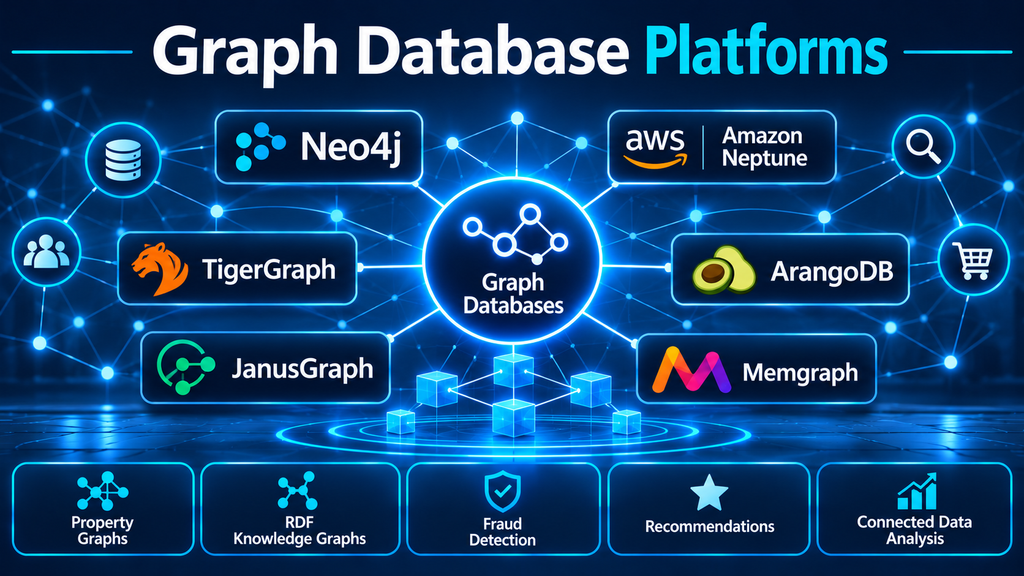
Graph Database Platforms: Mapping Relationships Across Connected Data
Graph database platforms are designed for applications in which relationships are as important as the individual records themselves. Rather than treating connections as something to reconstruct through repeated table joins, graph databases represent entities and their relationships directly. This makes them valuable for fraud investigation, recommendation engines, identity resolution, knowledge graphs, network analysis, and other systems that need to explore complex connections.
What is a graph database?
A graph database stores information using a graph structure made up of entities and the connections between them. In a property graph model, these elements are commonly represented as:
- Nodes: Represent entities such as people, products, accounts, devices, locations, or organizations.
- Relationships: Represent connections between nodes, such as owns, purchased, works for, transferred money to, or is connected to.
- Properties: Store descriptive attributes on nodes and relationships, such as names, dates, amounts, categories, or status.
- Labels and relationship types: Classify nodes and define the meaning of connections.
For example, a financial institution might represent customers, bank accounts, devices, and transactions as nodes. Relationships connect customers to accounts, accounts to transactions, and transactions to devices. Investigators can then explore paths that might reveal suspicious associations.
Graph databases are not all identical. Property graph systems and RDF databases use different data models and query approaches. Understanding this distinction is important when selecting a platform.
Major types of graph database models
Property graph databases
Property graph databases represent information using nodes, relationships, labels, and properties. Both nodes and relationships can carry descriptive attributes.
They are commonly used for operational applications that need to traverse connections, identify patterns, and retrieve related entities.
Examples include Neo4j, Amazon Neptune’s property-graph capabilities, TigerGraph, and Memgraph.
RDF graph databases
RDF databases represent information as triples consisting of a subject, predicate, and object. These triples describe facts and relationships in a standardized format.
For example:
- Subject: Customer A
- Predicate: purchased
- Object: Product B
RDF is particularly useful in semantic data integration, linked data, ontology-based systems, and knowledge graphs that need shared vocabularies and formal relationships.
SPARQL is a standard query language for RDF data. Platforms such as Amazon Neptune support RDF workloads, while specialist knowledge-graph platforms provide additional semantic capabilities.
Multi-model databases
Some databases support graph functionality alongside other data models, such as documents and key-value records. This can help organizations consolidate certain workloads within one database platform.
ArangoDB is an example of a multi-model database supporting graph, document, and key-value data.
A multi-model approach can reduce the number of separate systems an organization needs to operate, but the suitability of each model should still be evaluated against the actual workload.
Leading graph database platforms
Neo4j: A mature native graph database ecosystem
Neo4j is a widely recognized native graph database platform. It uses a property graph model and the Cypher query language, which provides a declarative way to describe graph patterns and relationships.
Its ecosystem includes database deployment options, development tools, graph visualization, and graph data science capabilities. Neo4j also offers AuraDB as a managed cloud service, alongside self-managed deployment choices.
Neo4j is worth evaluating for applications such as fraud detection, recommendation engines, identity resolution, knowledge graphs, and connected-data applications where graph traversal is central.
Its established developer ecosystem is an advantage, although organizations should assess the edition, deployment model, availability architecture, licensing, and operational requirements that apply to their intended use.
Official documentation: https://neo4j.com/docs/
Amazon Neptune: Managed graph database on AWS
Amazon Neptune is a fully managed graph database service within Amazon Web Services. It supports property graph and RDF workloads, with query-language options that include Gremlin, openCypher, and SPARQL.
This flexibility is useful for organizations that need to work with different graph models or integrate graph workloads into an AWS-based architecture.
Neptune can support applications involving fraud detection, recommendations, knowledge graphs, network security, and connected-data exploration. AWS also provides separate Neptune Database and Neptune Analytics capabilities, so teams should distinguish transactional database requirements from graph analytics workloads when evaluating the service.
Its managed-service approach reduces the need to administer the underlying database infrastructure, but organizations remain responsible for data modeling, access controls, application integration, query design, and cost management.
Official documentation: https://docs.aws.amazon.com/neptune/
TigerGraph: Graph analytics for connected data
TigerGraph focuses on graph data management and analytics. Its platform is designed to explore relationships and execute graph queries and analytical workloads across connected datasets.
Graph analytics can help organizations investigate patterns that are difficult to identify through isolated records. Examples include fraud rings, customer networks, supply-chain dependencies, and relationship-based recommendations.
TigerGraph is a candidate for organizations that need graph-oriented analytics as a major part of their data strategy. Evaluation should include the supported query and analytics capabilities, data ingestion approach, deployment options, scalability requirements, and the engineering skills needed to operate the environment.
Official website: https://www.tigergraph.com/
ArangoDB: Multi-model data management with graph capabilities
ArangoDB combines graph, document, and key-value data models within one database platform. Its query language, AQL, supports operations across these models.
This approach can be useful when an application needs to manage document-oriented records and graph relationships without introducing a separate database for every data type.
Potential use cases include application backends, connected product catalogs, recommendation systems, and knowledge-oriented applications.
The main evaluation question is whether a multi-model platform provides a better operational fit than using a dedicated graph database alongside a separate document or relational system.
Official documentation: https://docs.arangodb.com/
JanusGraph: Open-source graph database for distributed environments
JanusGraph is an open-source, distributed graph database designed to work with scalable storage backends. It uses Apache TinkerPop and the Gremlin graph traversal language.
Its architecture allows organizations to select compatible storage and indexing technologies rather than depending on a single fixed storage engine. This can be attractive when infrastructure flexibility and integration with an existing distributed data environment are priorities.
However, this flexibility creates additional architectural responsibilities. Teams need to understand the storage backend, indexing configuration, deployment topology, and operational dependencies. JanusGraph is best considered by organizations with the technical capability to design and maintain a distributed graph environment.
Official documentation: https://docs.janusgraph.org/
Graph database platforms compared
| Platform | Model or approach | Query language | Potential fit |
|---|---|---|---|
| Neo4j | Native property graph | Cypher | General graph applications and connected-data development |
| Amazon Neptune | Property graph and RDF | Gremlin, openCypher, SPARQL | Managed graph workloads in AWS |
| TigerGraph | Property graph and graph analytics | GSQL | Graph-centric analytics and enterprise connected-data workloads |
| ArangoDB | Multi-model database with graph support | AQL | Applications combining graph and document data |
| JanusGraph | Distributed property graph | Gremlin | Open-source distributed graph architectures |
This is an architectural comparison, not a universal performance ranking. Actual results depend on graph structure, query depth, data volume, concurrency, deployment configuration, and the operations being performed.
How graph databases work
Modeling entities and relationships
The first step is identifying the entities the application needs to represent and the relationships that connect them.
A retail application, for example, might include customers, products, orders, suppliers, and categories. Relationships could describe who purchased a product, which supplier provides it, and which products belong to a category.
The quality of the graph model determines how naturally the application can answer relationship-based questions.
Loading and integrating data
Graph databases can receive information from relational databases, files, APIs, event streams, and other operational systems. Data ingestion may involve mapping existing records to nodes and converting foreign-key relationships into graph edges.
Organizations should define entity identifiers, duplicate-resolution rules, relationship types, and data-quality checks before loading large datasets.
Querying graph relationships
Graph query languages allow applications to describe patterns and traverse connections.
For example, a fraud investigation might look for accounts that share devices, addresses, or transaction relationships. A recommendation engine might identify products purchased by customers with similar interests.
The important difference is that the query can follow relationships directly rather than repeatedly reconstructing the network from separate tables.
Analyzing graph structures
Some graph platforms provide analytical capabilities for examining network structure. Depending on the platform, these may include centrality calculations, community detection, path analysis, similarity, and other graph algorithms.
These methods can help identify influential entities, connected groups, unusual paths, or clusters of related activity.
Graph analytics should be selected based on the business question. An algorithm’s output is not automatically a business conclusion; results need appropriate interpretation and validation.
Where graph database platforms are used
Fraud detection and financial crime investigation
Fraud often involves relationships between accounts, people, devices, addresses, transactions, and organizations.
A graph database can help investigators explore these connections and identify patterns such as shared devices across supposedly unrelated accounts or unusual networks of transfers.
Graph analysis can complement transaction monitoring and conventional risk systems. It should not be treated as proof of wrongdoing without additional evidence and appropriate investigation.
Recommendation engines
Recommendation systems can use relationships among users, products, categories, purchases, and interests to identify relevant suggestions.
For example, a graph can reveal that customers who purchased one product also frequently purchased another related product. The platform can then support recommendation queries based on those connections.
Identity and access management
Organizations manage identities across employees, devices, applications, roles, groups, and permissions. Graph modeling can help explain how access is inherited and which paths connect a user to a sensitive resource.
This is useful for identity resolution, entitlement analysis, and investigation of complex access relationships.
Knowledge graphs and enterprise search
Knowledge graphs connect information from multiple systems into a structured network of entities and relationships.
They can help applications answer questions involving people, products, organizations, policies, technical assets, and other connected information.
RDF systems may be particularly relevant when semantic standards, ontologies, and linked data are important. Property graph systems can also support knowledge-oriented applications, depending on the required model and query capabilities.
Supply-chain visibility
Supply chains contain relationships among suppliers, manufacturers, components, warehouses, transportation providers, and customers.
Graph databases can help trace dependencies, explore alternative suppliers, and understand how disruptions may affect connected operations.
Network and IT operations
IT environments contain relationships among applications, servers, services, cloud resources, networks, and dependencies.
Representing these connections as a graph can help teams investigate service dependencies, identify potential failure paths, and understand the wider impact of infrastructure changes.
Graph databases versus relational databases
Relational databases organize information into tables connected through keys. They are excellent for structured records, transactional processing, constraints, and many business applications.
Graph databases organize information around entities and relationships. Their value becomes more apparent when applications frequently need to traverse multiple connections or discover patterns across networks.
A relational database can represent connected data using foreign keys and joins. For many workloads, that remains an effective solution. However, complex multi-hop relationship queries may become harder to express, maintain, or optimize as the number of connections grows.
Graph databases make those relationships explicit in the data model. This does not mean they replace relational systems. Many organizations retain relational databases for transactional records and use graph platforms for specialized connected-data applications.
The decision should depend on query patterns, relationship complexity, consistency requirements, operational expertise, and total cost.
How to choose the right graph database
Identify the graph use case
Start with the business problem. Is the goal real-time relationship traversal, graph analytics, semantic knowledge representation, identity resolution, or a combination of these
