Upgrade & Secure Your Future with DevOps, SRE, DevSecOps, MLOps!
We spend hours scrolling social media and waste money on things we forget, but won’t spend 30 minutes a day earning certifications that can change our lives.
Master in DevOps, SRE, DevSecOps & MLOps by DevOps School!
Learn from Guru Rajesh Kumar and double your salary in just one year.
NoSQL Database Platforms: Choosing Flexible Data Architectures for Modern Applications
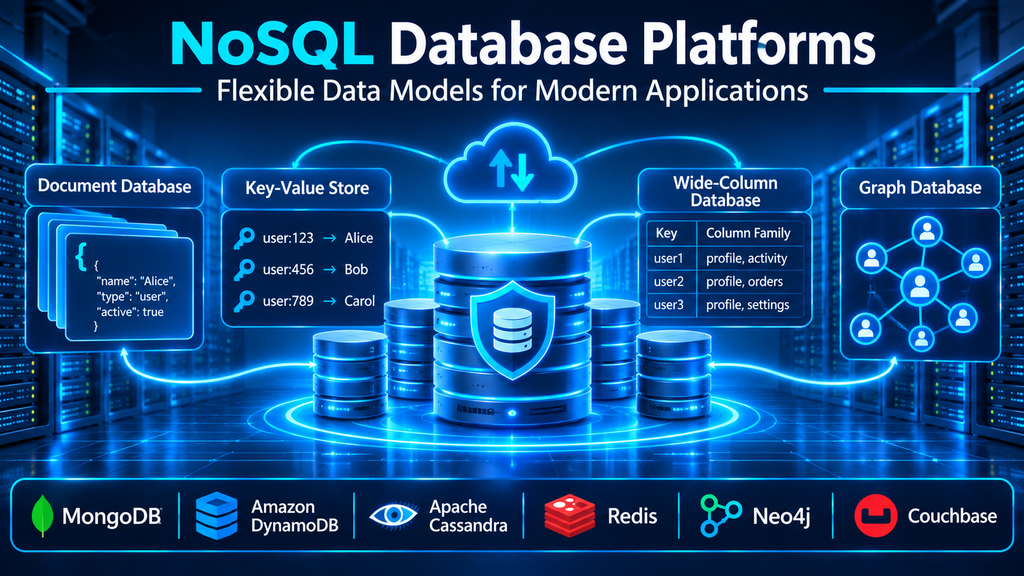
NoSQL database platforms support applications that need data models and access patterns beyond traditional relational tables. They include document, key-value, wide-column, and graph databases, each designed around different ways of storing and retrieving information. Choosing the right platform means matching the database model to the application’s workload, consistency needs, scaling strategy, and operational requirements—not simply choosing a product because it is described as flexible or scalable.
What are NoSQL database platforms?
NoSQL refers to a broad category of non-relational database systems. The term is commonly understood as “not only SQL,” reflecting the fact that these platforms use different data models and query approaches rather than relying exclusively on traditional relational tables.
A NoSQL database may store information as JSON-like documents, key-value pairs, wide-column records, or connected graph entities. Some systems are designed for high-volume distributed workloads; others specialize in fast lookups, flexible application data, or complex relationship traversal.
NoSQL does not mean that a database has no structure. Every production database needs a deliberate data model, even if the model is flexible or enforced primarily by application logic. Nor does NoSQL automatically mean faster, cheaper, or more scalable than an RDBMS. Those outcomes depend on workload design, architecture, and operational choices.
The four major NoSQL database models
Document databases
Document databases store records as documents, commonly using JSON-like structures. A document can contain fields, nested objects, arrays, and values of different types. Related information can often be stored together, which can reduce the need to assemble a record through multiple joins.
This model suits applications where records have varying attributes or naturally hierarchical structures. Examples include product catalogs, content platforms, user profiles, and application backends.
The flexibility has trade-offs. Teams must decide how to handle duplicated information, document growth, indexing, and changes to document structures. A document database can support relationships, but it does not necessarily enforce relational integrity in the same way as a traditional RDBMS.
Example platform: MongoDB. MongoDB stores data as BSON documents and supports queries, indexes, aggregation, transactions, and distributed deployments. Its document model is useful when application data maps naturally to nested records.
Official documentation: https://www.mongodb.com/docs/
Key-value databases
Key-value databases associate a unique key with a value. The application retrieves or updates information by using that key. The value may be a simple string, number, serialized object, or another supported structure.
This model is effective when the application knows the identifier of the information it needs. Common workloads include session storage, caching, shopping-cart state, feature flags, counters, and real-time application state.
The simplicity can deliver efficient direct lookups, but it may limit the ability to search or filter by arbitrary fields inside a stored value. Some platforms add richer data structures and query capabilities, so the actual feature set must be checked rather than inferred from the key-value label.
Example platforms: Amazon DynamoDB and Redis. DynamoDB supports key-value and document data models in a managed AWS service. Redis provides native data structures such as strings, hashes, lists, sets, sorted sets, streams, and more, making it useful for low-latency application workloads.
Official documentation:
- DynamoDB: https://docs.aws.amazon.com/amazondynamodb/latest/developerguide/Introduction.html
- Redis: https://redis.io/docs/latest/
Wide-column databases
Wide-column databases organize information into rows and flexible column groupings. Unlike a conventional relational design, different rows can contain different sets of columns. Data modeling is often driven by the queries the application needs to execute rather than by a normalized collection of entities joined at query time.
This model is commonly used for large distributed workloads involving high write volumes, time-oriented records, event data, and applications that need to distribute data across multiple nodes.
A critical design consideration is the partition key. It influences how records are distributed and accessed. Poor partition design can create hotspots, uneven resource use, or expensive queries. Teams generally need to design tables around known access patterns rather than expecting unrestricted ad hoc querying.
Example platform: Apache Cassandra. Cassandra is a distributed wide-column NoSQL database designed for scalable, highly available data storage. Its architecture and consistency options require careful consideration of replication, partitioning, and query design.
Official documentation: https://cassandra.apache.org/doc/stable/
Graph databases
Graph databases represent information as entities and relationships. In a property graph model, entities are nodes, connections are relationships, and both can carry properties.
This approach is particularly useful when the connections between records are as important as the records themselves. Examples include social networks, fraud detection, recommendation systems, identity relationships, supply-chain networks, and knowledge graphs.
A graph database can make relationship traversal more natural than repeatedly joining many relational tables. However, graph databases are not automatically the best option for every connected-data problem. The query patterns, graph size, traversal depth, and operational requirements should justify the model.
Example platform: Neo4j. Neo4j uses a native graph model and provides the Cypher query language for working with nodes and relationships. It is suited to applications that need to explore connected information and relationship patterns.
Official documentation: https://neo4j.com/docs/
Leading NoSQL platforms compared
| Platform | Database model | Typical use cases | Important consideration |
|---|---|---|---|
| MongoDB | Document | Application data, catalogs, content, user profiles | Document design, indexes, and sharding strategy matter |
| Amazon DynamoDB | Key-value and document | Serverless application backends, high-scale key-based access | Access patterns and partition-key design are central |
| Apache Cassandra | Wide-column | Distributed write-heavy workloads and large datasets | Data modeling is query-driven; partition design is critical |
| Redis | Key-value and data structures | Caching, sessions, counters, queues, real-time state | Persistence, memory usage, and deployment configuration need review |
| Neo4j | Graph | Relationship analysis, fraud detection, recommendations | Graph modeling and traversal patterns determine suitability |
These products are not interchangeable. Each addresses a different data model and operating pattern, and product capabilities vary by deployment, edition, and service configuration.
Why organizations adopt NoSQL platforms
Flexible data structures
Applications often evolve faster than their original data models. Document and other flexible-schema databases can accommodate records with varying attributes without requiring every change to follow the same table-alteration process used in a conventional relational design.
Flexibility still requires governance. Teams should define required fields, validation rules, naming conventions, and compatibility expectations so that different application versions do not create inconsistent records.
Horizontal scaling
Many NoSQL platforms are designed to distribute data and workload across multiple nodes. This can help applications grow beyond the practical limits of a single server.
Horizontal scaling is not automatic. Data distribution, partition keys, replication, network traffic, consistency settings, and workload balance all affect the result. A poorly designed partition strategy can limit the benefits of adding capacity.
Workload-specific performance
A database designed around a particular access pattern can be highly efficient for that workload. Key-value systems can serve direct lookups, wide-column stores can support distributed data access, and graph databases can handle relationship traversal naturally.
Performance should be measured against representative application operations. A platform optimized for one access pattern may be less suitable for a different query style.
Distributed availability
Distributed NoSQL systems often provide replication and deployment options designed to keep data accessible across nodes or locations. These capabilities can support resilient architectures, but they introduce trade-offs involving consistency, latency, conflict resolution, and recovery.
Organizations should evaluate the exact guarantees provided by the selected database and configuration rather than assuming that every distributed NoSQL system behaves the same way.
NoSQL versus relational databases
The decision between NoSQL and relational databases should be based on data requirements and application behavior.
Relational databases organize information into tables with defined relationships, constraints, and SQL operations. They are often a strong fit for structured business records, complex joins, and transactional workflows that depend on relational integrity.
NoSQL platforms offer alternative models that can better fit document-oriented data, direct key-based access, large distributed workloads, or highly connected information. Their schema and query approaches vary significantly by category.
The distinction is not absolute. Modern relational systems can support JSON and distributed architectures, while some NoSQL platforms provide transactional features. Many organizations use both approaches: a relational database for authoritative transactional records and a NoSQL platform for caching, session data, search-oriented access, or specialized application workloads.
How to choose the right NoSQL database
Begin with the access patterns
List the operations the application performs most frequently. Does it retrieve records by a known key? Search within nested documents? Read large volumes of partitioned records? Traverse complex relationships?
The answers help identify the database model that naturally supports the workload. Avoid choosing a platform first and trying to force every application operation into its data model afterward.
Define consistency and transaction requirements
Determine how quickly updates must become visible, how concurrent writes should behave, and whether operations across multiple records need transactional guarantees. Review the database’s consistency options, transaction scope, replication behavior, and conflict-resolution mechanisms.
A system supporting eventual consistency may be appropriate for some distributed workloads, while applications involving financial or inventory state may require stronger guarantees for particular operations. The decision should be made at the operation level, not through broad assumptions about all NoSQL systems.
Evaluate distribution and growth
Estimate record volume, request rates, storage growth, geographic distribution, and peak workloads. Understand how the platform partitions data, handles node failures, replicates records, and scales capacity.
For managed services, examine throughput or capacity models, service limits, regional availability, backup options, and network costs. For self-managed systems, include cluster operations, upgrades, capacity planning, and incident response.
Examine query and indexing capabilities
Review the supported query language, secondary indexes, aggregation functions, sorting, filtering, and pagination behavior. Confirm that the required queries can be executed efficiently without excessive application-side processing or duplicated data.
Consider developer and operational expertise
A technically suitable database can still be a poor organizational choice if the team cannot operate it reliably. Evaluate driver availability, programming-language support, administration tools, observability, documentation, training, support, and the availability of experienced engineers.
Calculate total cost of ownership
Compare more than storage prices. Include compute, memory, requests, replication, backups, data transfer, managed-service charges, support, engineering time, and operational overhead. A database with a low entry price can become expensive when usage grows or application access patterns are inefficient.
Security and governance for NoSQL environments
Flexible data models do not remove the need for strong data governance. NoSQL databases can hold sensitive customer, financial, operational, and identity information, so access and protection must be designed carefully.
Use least-privilege roles and separate application identities from administrative accounts. Apply authentication controls, protect credentials and secrets, and restrict database network access. Enable encryption in transit and at rest where supported and appropriate to the deployment.
Review backup and restore procedures, retention requirements, audit capabilities, and data deletion processes. For distributed systems, confirm how security settings and access policies apply across replicas, regions, and cluster nodes.
Application validation is also important. A flexible schema can allow inconsistent or unexpected fields to enter the database if the application does not enforce appropriate validation. Define data contracts and test them across application releases.
Common NoSQL implementation mistakes
Choosing a database because it is fashionable: A NoSQL platform should solve a real data-model or workload problem. If a relational database already meets the requirements, switching may add unnecessary complexity.
Ignoring data access patterns: Some NoSQL systems require query-driven data modeling. Designing tables or partitions without understanding application queries can lead to inefficient access and expensive redesigns.
Assuming flexible schema means no governance: Without validation and clear data contracts, different application components can produce inconsistent records.
Underestimating distributed-system complexity: Replication, partitioning, consistency, failover, and recovery need careful planning and testing.
Overlooking cost at scale: Request volume, memory consumption, replication, network transfer, and inefficient queries can materially change operating costs.
Treating every NoSQL platform as equivalent: Document, key-value, wide-column, and graph databases solve different problems. Their data models and query capabilities should guide selection.
The role of NoSQL in modern data architectures
NoSQL platforms increasingly operate alongside relational databases, analytical warehouses, search systems, and event-processing infrastructure. A single application may use different storage systems for different responsibilities rather than expecting one database to serve every workload.
For example, an application might keep core customer and payment records in a relational database, use Redis for short-lived session state, store flexible product details in MongoDB, and use Neo4j to analyze complex relationships. Such an architecture can be effective when each component has a clearly defined purpose and the engineering team can manage the additional integration and operational complexity.
The goal is not to maximize the number of database technologies. It is to select the smallest practical set of systems that meets the application’s requirements reliably.
Conclusion
NoSQL database platforms provide alternatives to traditional relational storage for applications with flexible document structures, key-based access patterns, distributed wide-column workloads, and complex relationships. MongoDB, Amazon DynamoDB, Apache Cassandra, Redis, and Neo4j illustrate how different NoSQL models serve different technical needs.
The best platform is determined by the application’s data shape, access patterns, consistency requirements, scaling strategy, security needs, and operating budget. A disciplined evaluation—and realistic workload testing—helps organizations gain the benefits of NoSQL without introducing unnecessary complexity.
