Upgrade & Secure Your Future with DevOps, SRE, DevSecOps, MLOps!
We spend hours scrolling social media and waste money on things we forget, but won’t spend 30 minutes a day earning certifications that can change our lives.
Master in DevOps, SRE, DevSecOps & MLOps by DevOps School!
Learn from Guru Rajesh Kumar and double your salary in just one year.
Introduction
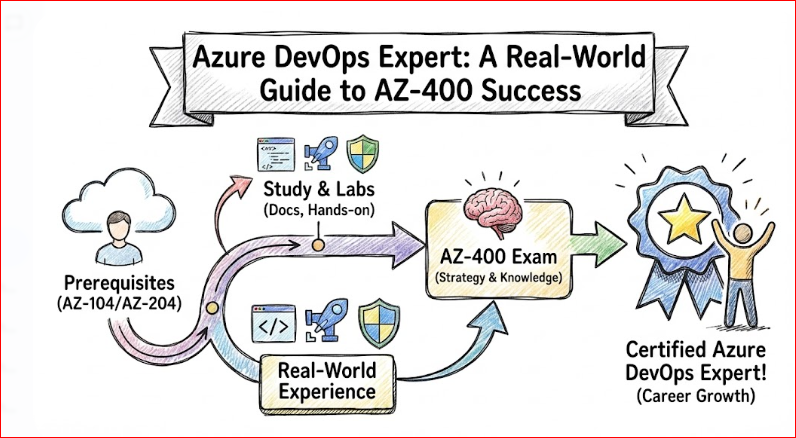
Modern engineering teams are expected to ship changes quickly, but also keep systems stable and secure. That balance breaks when delivery depends on manual steps, unclear approvals, weak testing, or fragile deployments. Azure DevOps Engineer Expert (AZ-400) is designed for professionals who want to fix this by building a reliable delivery system that teams can trust every day. This certification is not only about tools. It is about creating a repeatable way to move code from idea to production using strong Git practices, automated CI/CD pipelines, controlled environments, and clear feedback from releases. It also helps you think like an owner—someone who cares about quality gates, security checks, release safety, and continuous improvement.
Why AZ-400 matters in real jobs
Most engineering problems are not about writing code—they are about shipping changes safely, repeatedly, and without drama. AZ-400 pushes you to think like a system owner who cares about quality gates, environment design, approvals, and measurable outcomes. In real companies, DevOps maturity is visible through stable pipelines, fewer failed deployments, faster recovery, and better collaboration. This certification matters because it trains you to build that kind of delivery system, not just talk about it.
What you will learn (high level)
You will learn how to design a delivery process that teams can follow consistently, even when projects and people change. You will practice building CI pipelines that compile, test, scan, and publish artifacts in a repeatable way. You will also learn how CD pipelines promote changes across environments with approvals, checks, and rollback thinking. Finally, you’ll connect delivery to monitoring and feedback so releases become safer over time instead of riskier.
Certification table (tracks, level, skills, order)
Only the official certification link provided is included in the “Link” column. Other links are intentionally not included.
| Certification | Track | Level | Who it’s for | Prerequisites | Skills covered | Recommended order |
|---|---|---|---|---|---|---|
| Azure DevOps Engineer Expert (AZ-400) | DevOps | Expert | DevOps engineers, platform engineers, release engineers, cloud engineers, managers leading delivery | Practical Azure basics + Git + CI/CD fundamentals; comfort with scripts/YAML and permissions | DevOps strategy, CI/CD, release governance, IaC approach, security checks, monitoring and continuous improvement | After you can build basic CI pipelines and understand environments |
| Azure Administrator (AZ-104) | Cloud | Associate | Cloud engineers, sysadmins, platform engineers | Basic networking, identity, compute, storage understanding | Azure administration, IAM, compute, storage, monitoring foundations | Before AZ-400 if you are infra-first |
| Azure Developer (AZ-204) | Dev | Associate | App developers, backend engineers, cloud developers | Programming basics and cloud app concepts | Build and deploy apps on Azure, services and integration basics | Before AZ-400 if you are dev-first |
| Security-focused path (example) | DevSecOps | Intermediate | Security engineers and DevOps engineers adding security depth | CI/CD basics + IAM + secrets handling | Secure pipeline stages, checks, governance mindset, audit readiness | After AZ-400 fundamentals |
| SRE-focused path (example) | SRE | Intermediate | SRE and ops engineers improving release safety | Monitoring, incident basics, reliability thinking | SLIs/SLOs, release safety, operational readiness, incident learning loops | Parallel with AZ-400 |
| AIOps/MLOps bridge (example) | AIOps/MLOps | Intermediate | Teams using automation and telemetry at scale | CI/CD + monitoring basics | Automated detection, smarter operations, controlled model/service delivery | After AZ-400 concepts |
| DataOps bridge (example) | DataOps | Intermediate | Data engineers and analytics engineers | Git + pipelines + data fundamentals | Data pipeline quality gates, controlled releases, reliability of data delivery | After AZ-400 concepts |
| FinOps bridge (example) | FinOps | Intermediate | FinOps practitioners and engineering leaders | Cloud cost basics and governance awareness | Cost guardrails, tagging discipline, budget controls linked to delivery | After AZ-400 concepts |
About the certification: Azure DevOps Engineer Expert (AZ-400)
What it is
Azure DevOps Engineer Expert (AZ-400) validates your ability to implement DevOps practices using Microsoft tooling and Azure services. It focuses on creating dependable CI/CD pipelines, integrating security controls, and building reliable feedback loops. The goal is consistent delivery that reduces production risk while improving speed and quality.
Who should take it
This is a strong fit for DevOps engineers who already touch pipelines and want a structured way to level up. Platform engineers benefit because AZ-400 aligns well with building internal delivery platforms and reusable pipeline templates. Cloud engineers gain value when they want to move from “infrastructure setup” to “full delivery ownership.” Engineering managers also benefit because it teaches how to lead delivery improvements using practical standards and metrics.
Skills you’ll gain
- CI pipeline design: build, unit tests, packaging, artifact publishing
- CD pipeline design: stages, approvals, checks, deployment patterns
- Git workflows: branching strategy, PR policies, code review discipline
- Environment strategy: variables, secrets, service connections, permissions
- Secure delivery basics: secrets handling, gated releases, access controls
- Feedback loops: release health signals, monitoring, continuous improvement
Real-world projects you should be able to do after it
- Build a CI pipeline for a service that runs tests, builds artifacts, and blocks bad merges using quality gates
- Create multi-stage CD pipelines for dev → test → staging → production with approvals and environment checks
- Implement safe secrets handling using secure variables and correct access permissions for pipeline execution
- Automate environment provisioning and configuration so deployments are consistent and repeatable
- Add security and compliance checks into the pipeline without slowing down developers unnecessarily
- Create release dashboards and simple operational signals to judge whether a release is healthy
Preparation plan (7–14 days / 30 days / 60 days)
7–14 days (fast track, if you already do DevOps daily)
This plan works if you already build pipelines at work and only need to structure your knowledge for the exam. Focus on rebuilding one complete CI/CD system end-to-end and documenting what you did. Spend time on permissions, secrets, approvals, and deployment checks because these areas cause most real failures. Finish with mock questions and review weak areas by doing small hands-on fixes.
30 days (balanced plan for most working engineers)
Week 1 is for Git discipline, repo structure, branching strategy, and pipeline basics so your foundation is stable. Week 2 goes deep into CI: testing strategy, caching, triggers, artifact handling, and repeatability standards. Week 3 focuses on CD: multi-stage design, environment strategy, approvals, and release safety patterns. Week 4 covers security integration, monitoring signals, full project rebuild, and exam-style revision.
60 days (career switchers or people new to Azure delivery tooling)
This plan is ideal when you lack Azure basics or have not built real pipelines before. Spend early weeks learning identity, permissions, environments, and how deployments behave. Then build confidence by creating simple CI pipelines first, then gradually expanding to CD stages with approvals and checks. In the final weeks, build a capstone project that looks like real work, and revise by fixing mistakes and improving documentation.
Common mistakes
- Building pipelines without standards, naming discipline, or reusable templates
- Skipping test strategy and relying too much on manual checks
- Mixing environments and permissions, which leads to confusing deployment failures
- Handling secrets poorly by hardcoding values or sharing credentials across teams
- Overcomplicating pipelines instead of keeping steps clear and maintainable
- Ignoring feedback loops, so the same deployment problems repeat every release
Best next certification after this
1) Same track (deeper DevOps)
Go next for a certification that strengthens your Azure foundation so you can design better environments, permissions, networking, and production-ready deployments. This helps you move from “pipeline builder” to “end-to-end delivery owner” who can troubleshoot real cloud deployment issues faster.
2) Cross-track (broaden into security or reliability)
If your projects involve governance and risk, your best next move is a DevSecOps-focused certification path that deepens scanning, policy enforcement, secrets management, and compliance thinking. If your main pain is outages and release risk, a reliability/SRE-focused certification helps you master SLOs, incident response, and release safety patterns that make pipelines safer at scale.
3) Leadership track (engineering management growth)
If you lead teams or want to lead soon, choose a leadership/architecture-style certification path that improves system design, delivery metrics, and operating models. This helps you drive DevOps transformation across teams, not just implement pipelines in one project.
Choose your path (6 learning paths)
DevOps Path
This path is best for engineers who want to own delivery systems and improve release speed without losing quality. You focus on building strong CI/CD foundations, standard templates, and repeatable deployment patterns. You also learn to measure outcomes such as deployment success rate and lead time for changes. Over time, your role becomes “delivery enabler” for multiple teams, not just one project.
DevSecOps Path
This path is for people who want to embed security into pipelines so teams stay fast but safer. You focus on secrets handling, access control, approval workflows, and adding security checks into build and release stages. The goal is to catch risk early and keep compliance manageable without creating heavy process overhead. This path is strong for security engineers who want more engineering influence and for DevOps engineers who want governance depth.
SRE Path
This path is for reliability-first engineers who want delivery to be safe, predictable, and measurable. You connect pipelines to service health by using release checks, operational readiness, and clear rollback strategies. You focus on reliability signals, alert discipline, and incident learning so delivery improves stability over time. This path fits well when your organization has critical systems where uptime and recovery time matter.
AIOps/MLOps Path
This path is for teams that use telemetry, automation, and intelligent operations to reduce manual work. You learn how delivery and operations data can detect issues early and prevent repeated incidents. You focus on automation around alerts, detection, and release verification, so failures are caught quickly. This path suits teams running many services where human monitoring alone is not enough.
DataOps Path
This path is ideal for data engineers who want data pipelines to be as disciplined as software pipelines. You apply Git workflows, quality gates, and controlled releases to data assets and transformations. You focus on reducing broken pipelines, improving data trust, and making deployments repeatable. This path becomes valuable when your organization relies on analytics and data products for decisions.
FinOps Path
This path is for engineers and leaders who want cost control to be a normal part of delivery, not a monthly surprise. You learn how tagging, guardrails, and budget signals can be built into engineering workflows. You focus on accountability, visibility, and reducing waste without blocking innovation. This path is useful when cloud spend is growing and teams need practical cost discipline.
Role → Recommended certifications mapping
| Role | Recommended certifications (path guidance) |
|---|---|
| DevOps Engineer | Build Azure + Git + CI/CD foundations → AZ-400 as the core validation → deepen into platform practices |
| SRE | AZ-400 for delivery discipline + reliability practices like SLOs, alert tuning, incident learning loops |
| Platform Engineer | AZ-400 + strong environment strategy + reusable pipeline templates + internal platform enablement |
| Cloud Engineer | Azure administration or development foundation first → AZ-400 to operationalize delivery end-to-end |
| Security Engineer | Security fundamentals + pipeline security integration → grow into DevSecOps practices after AZ-400 concepts |
| Data Engineer | Data fundamentals + CI/CD mindset → DataOps patterns using quality gates and controlled releases |
| FinOps Practitioner | Cloud billing basics + governance thinking → connect cost guardrails to delivery practices |
| Engineering Manager | AZ-400 concepts for delivery leadership + metrics mindset to guide teams using outcomes |
Next certifications to take (3 options)
Same track (deeper DevOps)
Go deeper into delivery architecture by building standardized pipeline templates, environment governance, and release policies that scale across teams. Focus on improving artifact strategies, deployment checks, and automation for common workflows. This makes you valuable as a platform-style DevOps leader who reduces delivery friction for many teams. Your growth comes from building systems that others rely on daily.
Cross-track (broaden your impact)
If security incidents or compliance pressure is high, move toward DevSecOps by integrating checks and governance into pipelines. If downtime or release risk is a major pain, move toward SRE practices that connect delivery to service health and operational readiness. If cloud cost is a growing concern, add FinOps controls like tagging discipline and guardrails that align with engineering workflows. Cross-track skills make you effective in complex organizations where delivery affects many stakeholders.
Leadership (engineering effectiveness)
If you want to lead teams, focus on delivery metrics, operating models, and enablement rather than only tool usage. Build a strong internal playbook: standards, templates, training, and clear ownership. Learn to guide teams using outcome measures like deployment frequency, change failure rate, and recovery speed. Leadership growth is about improving the system around delivery, not just the pipeline itself.
Top institutions that help with training-cum-certification support
DevOpsSchool provides structured AZ-400 preparation with a strong focus on practical CI/CD implementation, real project-style labs, and clear learning paths for working professionals. Many learners use it to build portfolio-ready pipelines and strengthen interview confidence through hands-on outcomes.
Cotocus typically supports learners with industry-aligned workshops and mentoring style guidance that helps connect exam topics to real delivery challenges. It’s helpful if you want practical direction and a structured way to practice consistently.
Scmgalaxy is known for training support around DevOps workflows, version control discipline, and release automation concepts that map well to AZ-400 preparation. It works well when you want step-by-step learning that reinforces fundamentals.
BestDevOps focuses on practical DevOps skill-building with a job-focused approach, helping learners practice pipelines, deployments, and troubleshooting patterns. It’s useful if your goal is to show real working examples beyond theory.
devsecopsschool.com is helpful for learners who want to strengthen secure delivery thinking alongside AZ-400 skills. It supports DevOps-to-DevSecOps progression by emphasizing secure pipeline habits and governance mindset.
sreschool.com supports AZ-400 learners who also want reliability and operational readiness depth. It is useful if you want to connect delivery pipelines with stability practices like release safety checks and incident learning.
aiopsschool.com fits learners who want to connect monitoring signals and automation with DevOps delivery practices. It helps you understand how telemetry-driven operations can improve deployment outcomes at scale.
dataopsschool.com is relevant if your work involves data pipelines and you want to apply CI/CD discipline to data workflows. It supports DataOps-style thinking like quality gates, controlled releases, and reliable data delivery practices.
finopsschool.com helps learners who want to align engineering delivery with cloud cost visibility and governance. It is useful when you want to build cost-aware delivery habits such as tagging discipline and guardrails that match real organizational needs.
Testimonials
Rohit: “Before this, our releases were stressful. After building a structured multi-stage pipeline with approvals, deployments became predictable and easier to trust.”
Meera: “The biggest improvement was environment strategy and secrets handling. Once those were clean, many ‘random’ deployment failures disappeared.”
Amit: “I built a small portfolio project and documented the pipeline flow. That made interviews easier because I could explain real decisions.”
Sneha: “As a manager, I learned what good delivery standards look like. It helped me guide the team without micromanaging technical details.”
FAQs — difficulty, time, prerequisites, sequence, value, outcomes
1) Is AZ-400 hard for beginners?
It can feel hard if you are new to Git workflows, YAML pipelines, and Azure permissions. However, it becomes manageable when you first understand how CI builds artifacts and how CD promotes artifacts safely. The best approach is to learn by building one simple pipeline end-to-end, then improving it step by step.
2) How long does it take to prepare?
Most working engineers can prepare in about 30 days with consistent daily practice. If you already build pipelines at work, a focused 7–14 day sprint can work. If you are switching careers or new to Azure tooling, 60 days gives enough time to build confidence and hands-on skill.
3) Do I need strong coding skills?
You do not need advanced programming, but you should be comfortable with scripts and reading configuration files. You will often work with YAML, pipeline variables, and command-line steps. The real skill is troubleshooting: reading logs, finding the failure point, and fixing it in a clean way.
4) What prerequisites are truly required?
You should understand Git basics, branching, pull requests, and how CI/CD works conceptually. You also need basic Azure knowledge like identity, permissions, and environments because deployments depend on these. If you lack one area, you can still learn, but you must spend more time on hands-on practice.
5) Should I learn Azure basics first?
Yes, if Azure is new to you, basic identity and resource concepts will save you time. Many pipeline failures happen due to permissions and environment access, not because the pipeline logic is wrong. Even simple knowledge of how Azure resources connect is very helpful during preparation.
6) Is this certification useful for engineering managers?
Yes, because it teaches how delivery systems should be structured and governed. Managers learn how approvals, checks, and quality gates protect production without slowing teams. It also helps you ask better questions about release risk, reliability, and measurable delivery outcomes.
7) Will AZ-400 help me get a DevOps job?
It helps when you pair it with a small portfolio project that shows real pipeline work. Recruiters often respect the certification, but interviewers usually want to see practical decisions and troubleshooting ability. A well-documented CI/CD project plus AZ-400 can make your profile stronger and clearer.
8) What is the best sequence: cloud first or DevOps first?
If you come from operations or infrastructure, learn Azure administration basics first, then take AZ-400 to operationalize delivery. If you come from development, start with CI/CD and Git discipline first, then learn Azure deployment basics as you build pipelines. Both sequences work, but your starting point should match your background.
9) What kind of projects should I build to prove skills?
Build one complete flow: repo → CI build/test → artifact publish → CD deploy across dev/test/stage/prod. Add approvals, secrets handling, and at least one quality gate so it looks like real work. Document decisions like branching strategy, environment setup, and rollback plan so reviewers can understand your thinking.
10) What topics usually trip learners up?
Permissions, service connections, and secrets management are common pain points. People often build pipelines that “work once” but fail later because access is inconsistent. Another challenge is unclear environment design, which leads to messy configurations and unpredictable deployments. Fixing these areas improves both exam readiness and real performance.
11) Does AZ-400 cover security well enough?
It gives strong foundations for secure delivery, such as secrets handling, approvals, and gated releases. However, deep DevSecOps expertise comes from practicing scanning, policy enforcement, and compliance workflows in real projects. Think of AZ-400 as your secure delivery baseline, then expand based on your organization’s needs.
12) What career outcomes are realistic after AZ-400?
You can move into stronger DevOps roles, platform responsibilities, release ownership, and delivery leadership tasks. Many engineers become the “pipeline owner” who improves team speed and stability. It also supports transitions into SRE or DevSecOps when you add reliability or security depth. The key outcome is confidence in production delivery.
FAQs — Azure DevOps Engineer Expert (AZ-400)
1) What should I master first: CI or CD?
Start with CI because it produces reliable artifacts that CD can deploy safely. CI teaches you build discipline, test strategy, and quality gates. Once CI is stable, CD becomes easier because you deploy consistent artifacts. This reduces release chaos and makes troubleshooting clearer.
2) How do I avoid pipelines becoming messy over time?
Use templates, naming standards, and reusable steps so every project follows a similar structure. Keep pipelines small and readable, and avoid adding random steps without documenting why. Create ownership rules so someone maintains pipeline health like normal code. Clean pipelines save time every week, not only during exams.
3) What is the biggest real-world benefit of AZ-400?
It helps you build delivery systems that teams can trust, not pipelines that work only for one person. You learn standards like approvals, checks, and environment separation that reduce production risk. Over time, you also learn how to measure whether delivery is improving. This turns DevOps into a repeatable practice, not a one-time setup.
4) How important is Git discipline for AZ-400?
It is extremely important because Git is the start of the delivery chain. Branching strategy, PR quality, and merge policies directly affect how stable releases are. Poor Git discipline leads to unstable builds and difficult rollbacks. Strong Git discipline makes everything downstream simpler and safer.
5) What should I do if deployments keep failing?
First check permissions, service connections, environment configuration, and secrets because many failures start there. Then verify artifact versions and ensure the correct artifact is being deployed. Review logs step by step to find the earliest failure point. Consistent debugging habits are more valuable than memorizing commands.
6) Do I need deep infrastructure as code skills?
You need enough to create repeatable environments and reduce drift between dev, test, and production. Deep expertise depends on your role, but a basic IaC approach is important for reliable delivery. Even simple infrastructure automation improves consistency and reduces manual errors. Focus on clarity and repeatability rather than complexity.
7) How do I prove skills beyond the certificate?
Build a portfolio project with a clear CI/CD pipeline, environment design, secrets handling, and documentation. Add a simple release dashboard or notes showing how you measure success and failures. Interviewers trust clear project evidence and your ability to explain decisions. The certificate is stronger when backed by real work.
8) What’s the best next step right after passing?
Apply what you learned in your current job or a personal project immediately. Standardize one pipeline, create one reusable template, and improve secrets handling. Track one improvement metric so you can show impact clearly. This turns the certification into visible career growth.
Conclusion
AZ-400 is best viewed as a practical roadmap for building stable, secure, and repeatable software delivery. When you prepare properly, you learn how to design CI/CD pipelines that teams can maintain, how to protect production with approvals and checks, and how to handle permissions and secrets with confidence. You also learn to connect releases to feedback so the delivery system improves over time instead of becoming fragile. If you want stronger DevOps roles, platform ownership, or delivery leadership responsibilities, AZ-400 is a solid step. Build a real project, document it clearly, and keep refining your process with measurable outcomes.