Upgrade & Secure Your Future with DevOps, SRE, DevSecOps, MLOps!
We spend hours scrolling social media and waste money on things we forget, but won’t spend 30 minutes a day earning certifications that can change our lives.
Master in DevOps, SRE, DevSecOps & MLOps by DevOps School!
Learn from Guru Rajesh Kumar and double your salary in just one year.
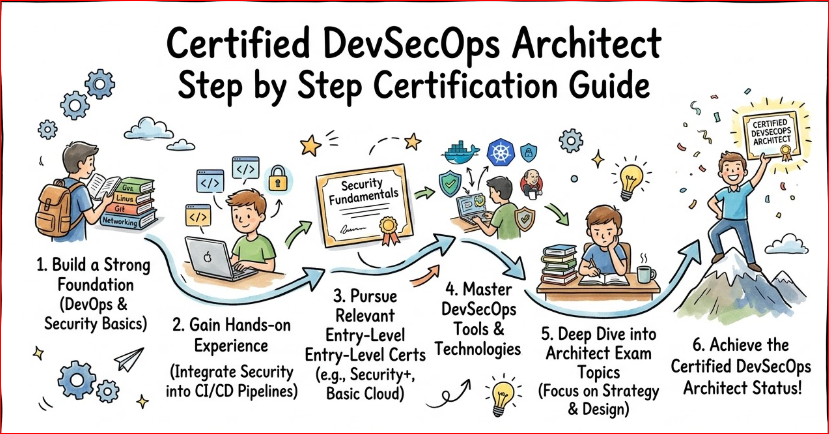
Software today is built and released faster than ever, but security risks are also growing every day. Certified DevSecOps Architect is a program that helps you design systems where security, automation, and compliance are all built into your pipelines and platforms from the start, not added later. This guide is written for working engineers, architects, and managers who want clear, practical direction on how this certification works, what skills it builds, and how it can support your long‑term career in DevOps, security, and cloud.
Why this Guide Matters for Working Professionals
Many engineers know DevOps tools and many security teams know standards, but there is a big gap when it comes to joining both into one clear architecture. Certified DevSecOps Architect helps you fill this gap. As an architect, you are expected to: design secure CI/CD pipelines, define guardrails, choose tools, handle audits, and reduce risk without slowing delivery. This guide will show you how the certification can support those goals and how to plan your learning path.
Key Outcomes of Certified DevSecOps Architect
After this certification, you should be able to:
- Design security‑first CI/CD pipelines across cloud and on‑prem platforms.
- Apply shift‑left security practices in architecture and development.
- Implement automated security controls for containers, Kubernetes, microservices, and serverless workloads.
- Align architectures with frameworks like NIST, OWASP SAMM, and SLSA while meeting regulations such as ISO 27001 or GDPR.
- Build “security as code” and “compliance as code” into your DevOps toolchain.
- Lead DevSecOps adoption and culture change in engineering teams.
Deep Dive: Certified DevSecOps Architect
What it is
Certified DevSecOps Architect is an advanced certification focused on designing end‑to‑end DevSecOps architectures, not only using tools. It covers secure SDLC, CI/CD security, cloud‑native security, threat modeling, governance, and automated compliance in real environments.
Who should take it
- DevOps engineers moving into security architecture roles
- Security engineers who work closely with DevOps or cloud teams
- SREs and platform engineers responsible for reliability and security
- Cloud architects and solution architects in regulated domains
- Engineering managers and tech leads who own security outcomes
Skills you will gain
- Designing secure SDLCs and integrating security gates into pipelines
- Architecting secure CI/CD for multi‑cloud and hybrid setups
- Container and Kubernetes security patterns, including secrets and policies
- Threat modeling and risk‑based design decisions
- Security as code and compliance as code implementation
- Governance frameworks, controls, and audit‑friendly architectures
- Leading DevSecOps adoption across teams and business units
Real‑world projects you should be able to do
- Design a secure CI/CD pipeline for a multi‑service, container‑based application.
- Build a reference DevSecOps architecture for a regulated industry (finance, health, government).
- Implement policy‑as‑code to enforce security baselines in Kubernetes clusters.
- Define a security blueprint for a cloud migration initiative.
- Map security controls to standards like ISO 27001, SOC 2, or GDPR in a DevOps environment.
Preparation plan
Use this as a simple template and adjust to your schedule.
- 7–14 days (intensive track)
- 30 days (standard track)
- For working engineers with good hands‑on skills but limited architecture exposure.
- Week 1: DevSecOps principles, secure SDLC, shift‑left concepts, security gates.
- Week 2: Containers, Kubernetes, secrets, and cloud‑native security patterns.
- Week 3: Threat modeling, policy as code, governance, and compliance.
- Week 4: Architecture scenarios, trade‑offs, incident response, and full revision.
- 60 days (deep track)
Common mistakes
- Treating DevSecOps Architect as only a “tool list” instead of an architecture mindset.
- Ignoring business, risk, and compliance requirements while focusing only on pipelines.
- Over‑engineering security controls that slow delivery and lose stakeholder support.
- Skipping threat modeling and jumping directly into tool configuration.
- Not documenting patterns, decisions, and trade‑offs for future teams.
Best next certification after this
After Certified DevSecOps Architect, you can choose:
- Same track: a hands‑on DevSecOps practitioner or engineer‑level certification to go deeper into tooling and labs.
- Cross track: SRE, observability, or cloud architect certifications to broaden your platform view.
- Leadership: security leadership, governance, or risk management programs to move towards head‑of‑security or platform leadership roles.
Certification Table: DevSecOps Architect in Your Learning Path
Below is a simple reference table that places Certified DevSecOps Architect in a larger learning journey. Values are indicative for guidance.
Choose Your Path: 6 Learning Paths after DevSecOps Architect
1. DevOps Path
If you want to remain strongly focused on delivery speed, reliability, and automation, the DevOps path is ideal. You can add certifications in advanced CI/CD, infrastructure as code, and platform engineering to complement your DevSecOps architecture skills.
2. DevSecOps Path
Stay in the DevSecOps lane to become the go‑to person for secure architecture, tooling, and governance. Combine this certification with practitioner‑level DevSecOps courses that give you deeper hands‑on exposure to security tools and pipelines.
3. SRE Path
If you enjoy reliability, SLIs, SLOs, and incident response, move into SRE next. Your DevSecOps architecture background will help you design systems that balance security, reliability, and performance.
4. AIOps/MLOps Path
For engineers who like automation and data‑driven operations, AIOps/MLOps is a strong cross‑track option. You can apply DevSecOps principles to machine learning pipelines, model deployment, and intelligent monitoring tools.
5. DataOps Path
Data platforms also need DevSecOps. With a DataOps‑focused path, you design secure data pipelines, govern access, and align with privacy and compliance rules across data lakes and warehouses.
6. FinOps Path
FinOps is about cloud cost governance. Combining DevSecOps architecture with FinOps gives you the ability to design systems that are secure, compliant, and cost‑efficient at the same time.
Role → Recommended Certifications
Use this as a quick mapping to see how Certified DevSecOps Architect fits your role.
| Role | How this certification helps | Recommended certifications mix (including this) |
|---|---|---|
| DevOps Engineer | Adds deep security patterns to your pipelines and automation | Core DevOps cert → Certified DevSecOps Architect → SRE or cloud platform cert |
| SRE | Helps you design secure, reliable, and compliant infrastructures | SRE cert → Certified DevSecOps Architect → observability or incident response specialization |
| Platform Engineer | Strengthens your ability to build secure shared platforms and guardrails | Cloud/platform cert → Certified DevSecOps Architect → Kubernetes or service mesh certifications |
| Cloud Engineer | Connects cloud services with end‑to‑end DevSecOps architectures | Cloud associate/professional → Certified DevSecOps Architect → security specialty on your main cloud provider |
| Security Engineer | Teaches DevOps ways of working and modern delivery models | Security baseline cert → Certified DevSecOps Architect → hands‑on DevSecOps practitioner |
| Data Engineer | Helps apply DevSecOps to data platforms, ETL, and streaming systems | Data engineering cert → Certified DevSecOps Architect → DataOps or privacy/compliance certifications |
| FinOps Practitioner | Adds secure, compliant architecture insight to cost‑focused decisions | FinOps cert → Certified DevSecOps Architect → cloud governance or security risk management |
| Engineering Manager | Provides language and frameworks to shape secure delivery practices and teams | Management/leadership cert → Certified DevSecOps Architect → governance, risk, or enterprise architecture cert |
Top Institutions for Training and Certification Support
DevOpsSchool
DevOpsSchool provides practical, hands‑on training with strong focus on real projects and labs. It is useful if you want guided practice, doubt‑clearing, and support from mentors who work on real DevOps and DevSecOps implementations.
Cotocus
Cotocus is known for corporate upskilling and consulting‑style programs. They help teams move from traditional models to modern DevSecOps ways of working with workshops, coaching, and tailored content.
ScmGalaxy
ScmGalaxy works like a large knowledge library plus training provider. Apart from formal programs, you get access to many articles, tutorials, and ongoing learning content to support you after training.
BestDevOps
BestDevOps focuses on clear, direct training designed for busy professionals. Courses aim to cover the most important parts of tools and practices quickly so you can apply them on the job.
devsecopsschool.com
DevSecOpsSchool is a specialized provider focusing on security in DevOps and cloud environments. It is a strong option if you want a full DevSecOps roadmap, from fundamentals to advanced architect‑level content.
sreschool.com
SRESchool is focused on Site Reliability Engineering and related skills. It is a good complement to DevSecOps Architect if you want to design systems that are both secure and highly reliable under failure and load.
aiopsschool.com
AIOpsSchool concentrates on AI‑driven operations, monitoring, and automation. It is helpful when you want to extend DevSecOps architectures with intelligent detection, anomaly spotting, and self‑healing systems.
dataopsschool.com
DataOpsSchool helps you apply DevOps and security thinking to data pipelines and analytics platforms. For architects working with data lakes, warehouses, or streaming pipelines, this is a natural extension of DevSecOps skills.
finopsschool.com
FinOpsSchool is dedicated to cloud financial management and cost optimization. It is well aligned with DevSecOps Architect for roles where you must balance cost, risk, and security in large cloud estates.
FAQs on Certified DevSecOps Architect (Certification‑Focused)
- Is Certified DevSecOps Architect difficult for working engineers?
It is advanced but manageable if you already understand DevOps, cloud basics, and application security at a practical level. Most content builds on real‑world use cases, not only theory. - How much time should I plan for preparation?
Many professionals complete focused preparation in 30 days with steady effort, or 7–14 days if they have strong prior experience. If you are changing roles, a 60‑day plan is safer. - What are the main prerequisites?
You should know CI/CD concepts, basic cloud services, and have some exposure to security topics like vulnerabilities, scanning, and access control. Architecture experience is helpful but not mandatory. - What sequence should I follow in my career?
A common sequence is: base DevOps/cloud certification → role‑specific experience → Certified DevSecOps Architect → specialization in SRE, cloud security, or governance. - What real career value does this certification provide?
It signals that you can think at architecture level and integrate security into delivery models. This is important for senior engineering, architect, lead, or manager roles overseeing modern platforms. - What kind of roles can benefit the most?
DevOps engineers, SREs, cloud engineers, security engineers, platform engineers, and engineering managers involved in design and operations of digital systems benefit strongly. - Does it focus only on tools or also on principles?
The content combines tools with principles like secure SDLC, threat modeling, governance, and compliance as code. The goal is to enable you to choose and apply tools in a sound architecture. - How does it help with compliance and audits?
You learn how to align architectures with frameworks and standards, and how to automate many checks using pipelines and policies. This reduces manual audit pain and improves consistency. - Is this suitable for managers, or only for hands‑on engineers?
Managers and leads can use this to understand patterns, trade‑offs, and constraints when guiding teams, while engineers use it for detailed design and implementation. - Can this certification help in a cloud‑only or SaaS environment?
Yes, most scenarios assume cloud‑native, containerized, and SaaS‑style environments with multi‑cloud or hybrid patterns. - What typical mistakes should I avoid when preparing?
Do not skip fundamentals of DevOps and cloud; do not rely only on reading without drawing architectures; and do not ignore case studies or scenarios. - How will this certification impact my long‑term career?
It helps you move from tool‑centric roles to architecture and leadership‑oriented roles in security, platform, and reliability domains. This usually opens doors to higher‑impact and higher‑responsibility positions.
FAQs on Certified DevSecOps Architect
1. What real problems does Certified DevSecOps Architect help to solve?
This certification helps you solve problems like insecure pipelines, weak cloud configurations, and last‑minute security fixes that delay releases. It trains you to design systems where security checks are built into every stage of delivery.
2. How is a DevSecOps Architect role different from a normal DevOps Engineer?
A DevOps Engineer usually focuses on CI/CD, automation, and deployments. A DevSecOps Architect focuses on how the whole system is designed so that security, compliance, and governance are part of the architecture, not an afterthought.
3. Do I need hands‑on coding experience to benefit from this certification?
You do not need to be a full‑time programmer, but you should be comfortable reading scripts, YAML files, pipeline definitions, and configuration files. This helps you understand how security controls are actually implemented in real systems.
4. Can this certification help me move from pure security into DevOps roles?
Yes. If you are currently in a security role, this certification gives you a clear path into DevOps and platform teams. It shows that you understand pipelines, cloud, and automation, not only security policies and audits.
5. Is Certified DevSecOps Architect useful in a small startup environment?
It is useful even in small startups because many startups run fully on cloud and ship features quickly. With this knowledge, you can design lightweight but secure pipelines and guardrails without slowing down the team.
6. How does this certification support hybrid or multi‑cloud environments?
The concepts you learn apply across different clouds and on‑prem setups. You will learn to think in terms of patterns: identity, network zones, secrets, scanning, and policy‑as‑code that can be adapted to AWS, Azure, GCP, and on‑prem.
7. What kind of projects should I add to my portfolio after doing this certification?
You can add projects like a secure CI/CD pipeline design, a secure Kubernetes platform blueprint, or a security‑as‑code setup for an existing application. These show employers that you can apply DevSecOps Architect concepts in real life.
8. How do I keep my DevSecOps Architect skills updated after certification?
You can stay current by following security incident reports, cloud and Kubernetes security updates, and new DevSecOps tools and patterns. Regularly reviewing your organization’s pipelines and architectures also keeps your skills practical and relevant.
Conclusion
Certified DevSecOps Architect is a powerful step for engineers and managers who want to move from isolated security practices to fully integrated, secure‑by‑design architectures across the software lifecycle. It brings together DevOps speed, cloud flexibility, and strong security governance into one practical learning path.
If you are already working in DevOps, security, SRE, or cloud, this certification can help you move into higher‑impact architecture and leadership roles while keeping your skills closely tied to real production systems.