Upgrade & Secure Your Future with DevOps, SRE, DevSecOps, MLOps!
We spend hours scrolling social media and waste money on things we forget, but won’t spend 30 minutes a day earning certifications that can change our lives.
Master in DevOps, SRE, DevSecOps & MLOps by DevOps School!
Learn from Guru Rajesh Kumar and double your salary in just one year.
Introduction
Modern software teams are releasing features, fixes, and experiments at a very high speed. At the same time, they face constant pressure from security incidents, data breaches, and compliance requirements from regulators and customers. In this situation, companies need leaders who know how to keep the speed of DevOps while making security and compliance part of everyday work, not just a yearly audit task.
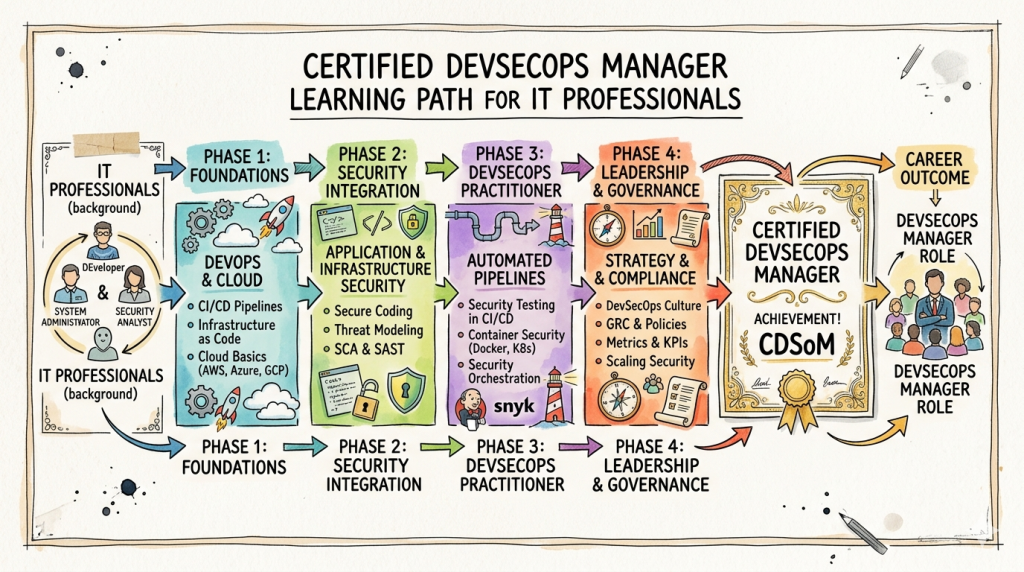
The Certified DevSecOps Manager certification is built exactly for this purpose. It focuses on the skills you need to set direction, define guardrails, and build a culture where developers, operations, and security teams all work together. Instead of treating security as a separate gate, you learn how to embed it into pipelines, platforms, and processes in a practical way. For working engineers, software developers, SREs, platform engineers, security professionals, and managers in India and across the world, this certification becomes a structured path to move from “I know tools” to “I can own secure delivery end‑to‑end.” If you want to move into roles like DevSecOps Manager, Head of DevSecOps, or a security‑focused Engineering Manager, this guide will walk you through what the certification is, who it is for, how to prepare, and how to connect it to your long‑term career path.
Certification Overview Table
| Certification name | Track | Level | Who it’s for | Key skills covered |
|---|---|---|---|---|
| DevOps Foundation | DevOps | Foundation | Beginners, junior DevOps / sysadmins | DevOps basics, CI/CD concepts, version control |
| DevOps Professional | DevOps | Professional | Mid-level DevOps / platform engineers | Advanced CI/CD, IaC, containers, orchestration |
| Certified DevSecOps Manager | DevSecOps | Manager | Leads, architects, engineering managers | DevSecOps strategy, governance, policy as code, risk |
| SRE Specialist | SRE | Specialist | SREs, reliability and production engineers | SLOs/SLIs, error budgets, incident response |
| AIOps / MLOps Specialist | AIOps/MLOps | Specialist | ML/data engineers, platform engineers | ML pipelines, model deployment, AIOps automation |
| DataOps Specialist | DataOps | Specialist | Data and analytics engineers | Data pipelines, data quality, secure data handling |
| FinOps Practitioner | FinOps | Practitioner | Cloud, finance, and platform teams | Cloud cost management, budgeting, cost governance |
What it is
Certified DevSecOps Manager is a role‑ready certification that teaches you how to manage secure software delivery across multiple teams and products. It brings together DevOps, security engineering, compliance, and people leadership so you can design and run real DevSecOps programs, not just talk about best practices. By the end, you should be able to make informed decisions about policies, tools, and processes that match your company’s risk and business goals.
Who should take it
This certification is ideal for:
- DevOps engineers who already build pipelines, manage automation, and work closely with developers and operations teams, and now want to take responsibility for security controls and compliance outcomes.
- Security engineers who want to move from reactive activities (like scanning and audits) into proactive, integrated security that is baked into the development and release process.
- SREs and platform engineers who run production systems, handle incidents, and manage shared platforms, and now want to add strong security and compliance capabilities into those platforms.
- Software engineers or tech leads who want to step into a security‑aware leadership role, guiding teams on how to write secure code, use secure defaults, and respond to vulnerabilities.
- Engineering managers and architects who need a structured way to connect business requirements, risk appetite, regulations, and day‑to‑day engineering practices through a DevSecOps lens.
If you are already influencing technical direction, leading small teams, or planning to move into a leadership role within the next 1–2 years, this certification fits well into your journey.
Skills you’ll gain
By completing this certification, you can expect to build skills in:
- Strategic DevSecOps leadership – understanding how to design a DevSecOps vision and operating model that fits your organization’s size, maturity, domain, and regulatory needs. You learn how to define clear goals, success metrics, and a roadmap.
- Security governance and risk management – learning how to define policies, standards, and exceptions, and how to translate these into practical controls and workflows. You also learn to prioritize risks based on impact, not just technical severity.
- Policy‑as‑code and automated controls – gaining the ability to use code, configuration, and automation to enforce security and compliance rules in pipelines, infrastructure, and platforms, instead of manual checklists.
- Vulnerability management and triage – understanding how to manage vulnerabilities discovered by scanners, bug bounties, or audits, and how to build processes that focus your teams on fixing what truly matters first.
- Secure SDLC and secure pipeline design – learning how to integrate checks such as SAST, DAST, SCA, container scanning, and IaC scanning at the right stages of your development and deployment lifecycle.
- Cultural change and stakeholder communication – learning how to work with developers, operations teams, security teams, leadership, and even business stakeholders, to build trust and reduce friction around security controls.
- Roadmap planning and KPI definition – being able to create 6–12 month and multi‑year DevSecOps roadmaps, define measurable KPIs and OKRs, and track progress in a way that is visible and meaningful to leadership.
Real‑world projects you should be able to do after it
- Designing a secure CI/CD pipeline blueprint for your company, where you decide which checks run at commit, build, test, pre‑production, and production stages, and how failures are handled without blocking teams unnecessarily.
- Creating a DevSecOps operating model that defines who is responsible, accountable, consulted, and informed (RACI) for different security activities, and how different teams collaborate during development, review, release, and incident response.
- Implementing policy‑as‑code using tools that can encode rules for access, approvals, deployment conditions, and compliance checks, and then integrating these rules into your CI/CD and platform components.
- Building a vulnerability management process that covers intake (from scanners, reports, pentests), triage (risk‑based prioritization), assignment, remediation tracking, and reporting back to leadership and auditors.
- Preparing a DevSecOps maturity assessment and roadmap where you measure your current state across people, process, and technology, identify gaps, and then propose a realistic, phased improvement plan.
- Defining security KPIs and dashboards which may include metrics like mean time to remediate vulnerabilities, percentage of pipelines with security checks, policy violations, and compliance coverage.
Preparation plan (expanded: 7–14 / 30 / 60 days)
7–14 days: Expert Sprint
This plan is for people who are already in leadership roles or are very strong in DevOps and security.
- Daily time: 3–4 focused hours per day.
- Day 1–3: Carefully read the official curriculum and outline all major topics (governance, risk, pipelines, culture). Map each topic to your current real‑world experience. Where you already have deep experience, note quick examples you can recall.
- Day 4–6: Deep dive on weaker areas, such as policy‑as‑code, specific compliance frameworks, or culture change. Use whiteboarding or note‑taking to design sample operating models and architectures.
- Day 7–10: Practice scenario‑based questions and case studies. For each scenario, force yourself to think about stakeholders, risks, trade‑offs, and realistic constraints, not just “ideal” answers.
- Day 11–14 (optional): Do 2–3 full revision passes over all topics, re‑write your own summary notes, and take mock assessments if available.
30 days: Balanced Professional Track
This is the sweet spot for most working engineers and managers.
- Week 1: Fundamentals refresh
- Revisit DevOps and CI/CD concepts: pipelines, branching strategies, environment promotion, infrastructure as code, and configuration management.
- Review security basics: common vulnerability types, authentication and authorization concepts, encryption basics, and secure coding foundations.
- Week 2: DevSecOps frameworks and governance
- Study DevSecOps and secure SDLC frameworks, and understand how they fit into your existing software lifecycle.
- Learn about typical maturity models and where your current organization might stand.
- Create one sample DevSecOps reference architecture for a simple product and a second one for a more complex, multi‑service environment.
- Week 3: Risk, compliance, and automation
- Focus on risk management concepts: risk registers, risk scoring, and mapping technical issues to business impact.
- Understand how compliance requirements (like ISO, SOC, or regional data protection laws) translate into technical and process controls.
- Explore policy‑as‑code and automated enforcement, and design rules that would fit into your pipelines and infrastructure.
- Week 4: Scenarios, projects, and review
- Build one end‑to‑end sample project: define an operating model, pipeline, controls, metrics, and roadmap for a fictional or real team.
- Practice explaining your design choices in simple language that a non‑technical stakeholder could understand.
- Do a full revision of all topics and ensure you have at least one example or story for each key area.
60 days: Deep Mastery Track
Use this if you are newer to either DevOps or security or if you prefer slower, deeper learning.
- Weeks 1–2: Technical foundations
- Strengthen knowledge in Linux basics, containers, CI/CD tools, infrastructure as code, and cloud platforms.
- In parallel, study security fundamentals: OWASP Top 10, basic cryptography, identity and access management, and incident response basics.
- Weeks 3–4: DevSecOps in practice
- Learn about integrating SAST, DAST, SCA, container scanning, and IaC scanning into pipelines.
- Explore how security and reliability work together: limiting blast radius, least privilege, and secure defaults in platform design.
- Weeks 5–6: Leadership, governance, and projects
- Shift focus to culture, processes, and decision‑making. Study examples of organizations that implemented DevSecOps successfully.
- Build at least two complete “playbooks”: one for designing a DevSecOps program from scratch and another for improving an existing DevOps setup.
- Use the last 7–10 days for revision, practice questions, and refining your own notes and diagrams.
Common mistakes
Candidates often struggle because of a few recurring mistakes:
- Treating it as a purely technical exam – focusing only on tools, commands, or product features and ignoring governance, risk, and culture topics that form a large part of real DevSecOps management.
- Over‑focusing on a single tool – believing that knowing one scanner or one security platform in detail is enough, instead of understanding how to choose and combine tools inside an overall strategy.
- Ignoring real‑world constraints – giving “ideal” answers that require unlimited budget, infinite time, or perfect teams, instead of realistic plans that account for legacy systems, skills, and politics.
- Not practicing scenarios – reading theory but not working through end‑to‑end case studies where you design pipelines, models, or roadmaps under constraints.
- Underestimating fundamentals – skipping basic DevOps, cloud, or security topics, which then makes advanced concepts much harder to understand during the exam or in real work.
Best next certification after this
Once you complete Certified DevSecOps Manager, you can choose one of three clear directions:
- Same track – deepen DevSecOps skills
- Here you focus on lab‑heavy practitioner or professional certifications that prove you can build and operate secure pipelines and platforms yourself.
- This path is ideal if you want to lead by example and still stay very close to hands‑on implementation.
- Cross‑track – broaden technical foundation
- You might choose SRE, cloud architect, or container/security certifications that give you deeper knowledge about large‑scale systems.
- This path is useful if you want to lead complex platforms, multi‑cloud environments, or multi‑region deployments where reliability and security are tightly connected.
- Leadership – expand governance and business influence
- Here you target certifications that cover information security management, governance, or broader technical leadership.
- This path is right if you aim to grow toward roles like Director of Engineering, Head of Security, or eventually C‑level roles where strategy and communication dominate.
Choose Your Path: 6 Learning Paths
1. DevOps path
If you come from a DevOps background, your path may look like this:
- Start with a general DevOps or cloud certification where you learn automation, CI/CD, infrastructure as code, and monitoring.
- Gain 1–3 years of experience building and maintaining pipelines, working closely with developers and operations teams.
- Add Certified DevSecOps Manager when you are ready to take responsibility for defining how security fits into your pipelines, tools, and processes, and you want to influence standards and policies.
2. DevSecOps path
If you are already interested in security inside DevOps:
- Begin with a basic DevSecOps or secure coding course that introduces scanners, secure SDLC, and common vulnerabilities.
- Work with at least a few security tools hands‑on (for example, SAST, DAST, SCA, container scanners, and secrets scanners).
- Use Certified DevSecOps Manager to step up from “I run tools” to “I design the whole DevSecOps system for multiple teams,” including governance and culture.
3. SRE path
For SREs and reliability engineers:
- Build strong foundations in SLOs, error budgets, incident response, and large‑scale reliability.
- Understand how outages, security incidents, and compliance failures affect availability and business risk.
- Add Certified DevSecOps Manager so you can design reliability approaches that also meet security and compliance expectations in a balanced way.
4. AIOps/MLOps path
If you work with AI, ML, or advanced observability:
- Learn how AI/ML pipelines, model deployment, and monitoring work in production.
- Understand unique risks around data quality, model drift, and misuse of models.
- Combine those skills with Certified DevSecOps Manager to create secure, compliant governance around AI systems, including access control, auditing, and safe rollout processes.
5. DataOps path
For data engineers and analytics professionals:
- Gain experience with data pipelines, ETL/ELT processes, data lakes, and warehouses.
- Learn about data governance topics like data classification, lineage, and access controls.
- Use Certified DevSecOps Manager to bring strong security and compliance practices into your data pipelines, especially around sensitive and regulated data.
6. FinOps path
If you are focused on cloud cost and financial governance:
- Build knowledge in cloud billing, usage patterns, and cost optimization strategies.
- Understand which security and compliance tools add cost and how they provide value.
- Combine FinOps skills with Certified DevSecOps Manager to design security programs that are both robust and cost‑effective, showing leadership clear trade‑offs between risk and spend.
Role → Recommended Certifications
| Role | Recommended certifications path (including Certified DevSecOps Manager) |
|---|---|
| DevOps Engineer | 1) Core DevOps / Cloud certification → 2) Hands‑on DevSecOps / security practitioner cert → 3) Certified DevSecOps Manager for leadership in secure delivery. |
| SRE | 1) SRE / Reliability certification → 2) Security / compliance fundamentals → 3) Certified DevSecOps Manager to align reliability, security, and audits. |
| Platform Engineer | 1) Cloud / Kubernetes / platform certs → 2) Container / cloud security cert → 3) Certified DevSecOps Manager to define secure platform standards. |
| Cloud Engineer | 1) Cloud architect / administrator cert → 2) Cloud security specialist cert → 3) Certified DevSecOps Manager to own end‑to‑end secure deployments. |
| Security Engineer | 1) General security / SOC / ethical hacking certs → 2) DevSecOps / secure SDLC cert → 3) Certified DevSecOps Manager to influence engineering practices. |
| Data Engineer | 1) Data engineering / DataOps cert → 2) Data governance / privacy / cloud security cert → 3) Certified DevSecOps Manager to secure data pipelines. |
| FinOps Practitioner | 1) FinOps / cloud cost management cert → 2) Cloud / platform fundamentals → 3) Certified DevSecOps Manager to balance security, risk, and cost. |
| Engineering Manager | 1) Leadership / agile / project management cert → 2) DevOps / cloud fundamentals → 3) Certified DevSecOps Manager to lead secure software delivery. |
Top Institutions for Training and Certification Support
You can keep the same list but use slightly longer descriptions in your blog:
- DevOpsSchool – Offers structured DevOps, SRE, and DevSecOps training that includes real projects, assignments, and mentorship. They are suitable if you want a guided path and community support around certifications like Certified DevSecOps Manager.
- Cotocus – Provides consulting‑style training that often connects directly to real client situations. This is helpful if your company is doing a DevOps or DevSecOps transformation and you want training that fits into that journey.
- ScmGalaxy – Has strong roots in source control, build, and release management, and extends this knowledge into modern DevOps and DevSecOps. It is a good choice if your work involves complex pipelines and configuration management.
- BestDevOps – Acts as a hub for DevOps and DevSecOps content, training options, and community discussions. You can use it to discover training paths and stay updated on industry trends while preparing.
- devsecopsschool.com – The main provider for Certified DevSecOps Manager, offering dedicated security‑focused DevOps courses, labs, and roadmaps tailored to both engineers and managers.
- sreschool.com – Focuses on Site Reliability Engineering, giving you deep understanding of availability, performance, and incident response, which combine naturally with DevSecOps leadership.
- aiopsschool.com – Specializes in AIOps and MLOps training, useful if you want to apply DevSecOps principles to highly automated or AI‑driven environments.
- dataopsschool.com – Concentrates on DataOps, data engineering, and analytics pipelines. Pairing it with Certified DevSecOps Manager helps you design secure, compliant data systems.
- finopsschool.com – Teaches cloud cost management and financial governance for engineering teams. Together with DevSecOps management skills, it prepares you for roles where you must balance risk, security, and cost.
FAQs on Certified DevSecOps Manager
- Is Certified DevSecOps Manager difficult?
It is designed to be challenging enough for experienced professionals. If you already understand DevOps, cloud, and basic security concepts, the difficulty is manageable with a structured plan. The main challenge is not the individual topics but connecting them together into realistic, end‑to‑end solutions. - How much time do I need to prepare?
Most working professionals can prepare comfortably in 30–60 days with 1–2 hours per day. If you are very strong already, you may compress this into 7–14 intensive days. Your background, familiarity with security, and comfort with scenario‑based thinking will decide the exact time. - What are the prerequisites?
There is no strict formal prerequisite, but you should know fundamental DevOps concepts such as CI/CD, basic networking, and one major cloud provider. If you also have some exposure to vulnerabilities, access control, encryption, or compliance discussions at work, that will make the learning smoother. - Do I need to be a programmer?
You do not need advanced programming skills, but you should be able to understand simple scripts, pipeline configurations, and policy definitions. The exam expects you to reason about architecture and workflows rather than write complex code from scratch. - Is this certification useful for managers?
Yes, this program is especially valuable for team leads and managers who are responsible for secure delivery outcomes. It helps you learn the language of both security and engineering teams, and gives you frameworks to manage risk, timelines, and expectations from leadership. - What career roles can this certification help me reach?
It can help you move into or strengthen roles such as DevSecOps Manager, Security‑focused Engineering Manager, DevSecOps Program Lead, or Head of DevSecOps. It also makes you a stronger candidate for senior engineering roles where secure delivery and compliance are major parts of the job. - How does this certification compare to purely technical DevSecOps certificates?
Many technical DevSecOps certifications focus mostly on hands‑on labs, tools, and specific product knowledge. Certified DevSecOps Manager, in contrast, focuses more on big‑picture design, governance, trade‑offs, and culture. Ideally, you should combine both types over time. - Can SREs and platform engineers benefit from this?
Absolutely. SREs and platform engineers handle availability, performance, and reliability at scale. This certification helps them weave strong security and compliance guarantees into their platforms and services, making them more effective leaders and architects. - Does this certification help with audits and compliance?
Yes, because it teaches you how to design processes and systems that are “audit‑friendly” by default. You learn to map regulatory requirements into technical controls and documentation, which makes recurring audits less stressful and more predictable. - Is there a specific sequence of topics I should follow?
A practical order is: (1) DevOps and cloud basics, (2) secure SDLC and DevSecOps fundamentals, (3) risk and compliance, and (4) leadership and culture. Most good training programs and self‑study plans will follow a similar progression to build your understanding step by step. - How does this help my salary and growth?
Roles that combine security, DevOps, and leadership are in short supply, especially in large and regulated organizations. By demonstrating that you can manage secure delivery and talk confidently with both engineers and executives, you become more valuable in the market. - Can I combine this with FinOps or DataOps career paths?
Yes, combining DevSecOps leadership with either FinOps or DataOps makes you highly relevant to cloud‑heavy and data‑driven companies. You can design strategies that control risk, cost, and data protection at the same time, which is extremely attractive for modern businesses.
FAQs
1. What is the Certified DevSecOps Manager certification?
Certified DevSecOps Manager is a professional‑level certification that focuses on managing secure software delivery across development, operations, and security teams. It trains you to design DevSecOps strategies, governance models, and workflows instead of only learning individual tools.
2. Who should take Certified DevSecOps Manager?
This certification is ideal for DevOps engineers, SREs, platform engineers, security engineers, software architects, and engineering managers who want to lead secure delivery. It is especially useful for professionals already involved in CI/CD, cloud platforms, or security reviews who now want to move into a leadership or manager‑type role.
3. What skills will I gain from this certification?
You gain skills in DevSecOps strategy, secure SDLC design, security governance, risk management, policy‑as‑code, and vulnerability management. You also learn how to drive culture change, set clear security KPIs, and communicate effectively with both engineering teams and business stakeholders.
4. Are there any prerequisites for this certification?
There are no strict mandatory prerequisites, but you should be comfortable with basic DevOps concepts like CI/CD, version control, and one major cloud platform. Some prior exposure to security topics—such as vulnerabilities, access control, or compliance requirements—will make the learning path much smoother.
5. How long does it usually take to prepare?
Most working professionals need around 30–60 days with 1–2 hours of focused study per day. If you already have strong DevOps and security experience, you may be able to prepare in 7–14 intensive days with a structured revision and scenario‑based practice plan.
6. How is this certification different from a hands‑on DevSecOps or security certificate?
Hands‑on DevSecOps certificates mainly test your ability to use tools and perform technical tasks in pipelines. Certified DevSecOps Manager focuses more on leadership, governance, risk‑based decision‑making, and designing end‑to‑end DevSecOps operating models for teams and organizations.
7. What kind of roles can this certification help me get?
This certification supports roles such as DevSecOps Manager, Security Program Lead, Security‑focused Engineering Manager, or Head of DevSecOps. It also strengthens your profile for senior DevOps, SRE, platform, or cloud leadership positions where secure and compliant delivery is a major responsibility.
8. Is this certification useful if my company has not started DevSecOps yet?
Yes, it is very useful in that case. The concepts, frameworks, and sample roadmaps you learn can be used to propose a practical DevSecOps strategy, get stakeholder buy‑in, and start small pilot initiatives inside your organization, even if you are the first person driving this change.
Next Certifications to Take After Certified DevSecOps Manager
1. Same track – DevSecOps depth
If you want to go deeper into DevSecOps itself:
- Pick a hands‑on DevSecOps practitioner/professional certification that focuses strongly on labs and real pipelines.
- Target programs that cover SAST, DAST, SCA, container security, IaC scanning, and policy‑as‑code in practical environments.
- This option is ideal when you want to be a manager who still stays close to implementation, able to review designs, pipelines, and security controls in detail.
2. Cross‑track – technical breadth (SRE / Cloud / Security)
If you want broader technical coverage around DevSecOps:
- Choose an SRE or reliability certification to strengthen your skills in availability, incident response, and service‑level objectives.
- Or choose a cloud architect / cloud security certification to deepen your understanding of large‑scale, multi‑cloud architectures and shared responsibility models.
- This option is best if you aim to become a platform, cloud, or reliability leader who can design secure, scalable systems across many teams.
3. Leadership – governance and executive‑level roles
If your long‑term goal is higher management or executive roles:
- Go for information security management / governance‑oriented certifications (for example, those focused on security management frameworks, risk management, or enterprise governance).
- These programs help you speak the language of CISOs, CTOs, and business leaders, covering policies, risk appetite, budgets, and compliance at the organization level.
- This path is ideal if you want to grow into Head of Engineering, Head of Security, Director, or C‑level positions where strategy, communication, and governance are your main responsibilities.
Conclusion
Certified DevSecOps Manager is more than just another line on your resume. It is a practical framework for becoming the person who can own secure software delivery across teams, products, and platforms. By combining DevOps speed with thoughtful security and compliance, you become a key decision‑maker in how your organization ships value to customers. For working engineers and managers, this certification can mark the shift from doing tasks to shaping strategy. With a clear preparation plan, a suitable learning path for your role, and support from focused training institutions, you can use this program to upgrade both your skills and your career trajectory. If you invest the time to apply these ideas to your real projects, the value will go far beyond the exam itself.