Upgrade & Secure Your Future with DevOps, SRE, DevSecOps, MLOps!
We spend hours scrolling social media and waste money on things we forget, but won’t spend 30 minutes a day earning certifications that can change our lives.
Master in DevOps, SRE, DevSecOps & MLOps by DevOps School!
Learn from Guru Rajesh Kumar and double your salary in just one year.
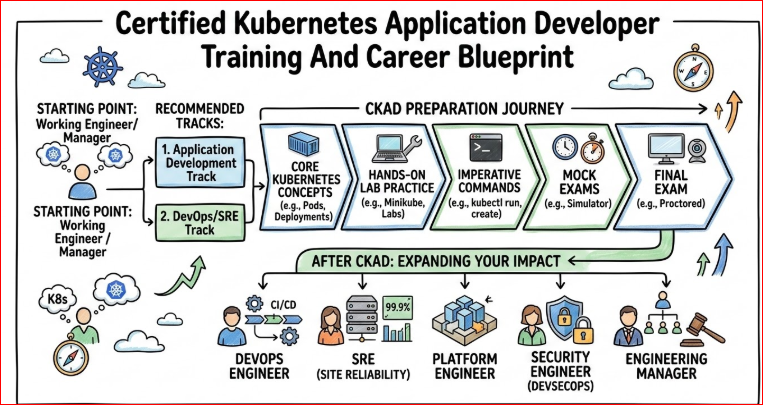
Introduction
Kubernetes has completely transformed how we ship, scale, and maintain software. If you are a software engineer, engineering manager, or aspiring cloud-native practitioner, simply writing code is no longer enough. You need to know how your code runs, scales, and survives in a distributed Kubernetes environment. In my experience working with enterprise deployments and mentoring teams globally, I have seen a clear pattern: engineers who understand how to natively design applications for Kubernetes build more resilient systems and accelerate their careers much faster. The Certified Kubernetes Application Developer (CKAD) is the industry gold standard for proving exactly that.
The Kubernetes Certification Landscape
Before diving into CKAD, it is helpful to see where it fits within the broader ecosystem of cloud-native certifications. Below is a quick overview of the most popular Kubernetes tracks.
| Track | Level | Who it’s for | Prerequisites | Skills covered | Recommended order |
|---|---|---|---|---|---|
| CKAD | Intermediate | Software Engineers, App Developers | Linux CLI, Container basics | Pod design, Deployments, Observability, Services | 1st or 2nd |
| CKA | Intermediate | DevOps, SysAdmins, SREs | Linux CLI, Networking basics | Cluster architecture, Installation, Troubleshooting | 1st or 2nd |
| CKS | Advanced | Security Engineers, DevSecOps | Active CKA Certification | Cluster setup, Workload security, Network policies | 3rd |
Deep Dive: Certified Kubernetes Application Developer (CKAD)
The CKAD is widely considered one of the most practical and respected certifications in the software engineering world. Here is exactly what it entails.
What it is
The Certified Kubernetes Application Developer (CKAD) is a 100% hands-on, command-line exam. It tests your ability to design, build, configure, and expose cloud-native applications for Kubernetes.
Who should take it
This certification is built for software engineers, backend developers, and application architects. Engineering managers who want a deep, practical understanding of modern application deployment will also benefit greatly from preparing for it.
Skills you’ll gain
- Building and modifying container images.
- Choosing the right workload resources (Deployments, DaemonSets, CronJobs).
- Managing persistent and ephemeral storage volumes.
- Implementing application observability, probes, and health checks.
- Using ConfigMaps and Secrets for secure configuration.
- Exposing applications using Services and Ingress rules.
Real-world projects you should be able to do after it
- You can confidently migrate a legacy monolithic application into a microservices architecture running on Kubernetes.
- You can design self-healing applications that automatically restart when a failure occurs.
- You can implement zero-downtime rolling updates and rollback strategies for your production services.
- You can securely pass database credentials to your applications without hardcoding them in your source code.
Preparation plan
7-14 Days (The Fast Track):
This is for engineers who already use Kubernetes daily. Spend your first few days reviewing the exam syllabus to identify knowledge gaps. Dedicate the remaining days strictly to timed practice using mock exams. Speed on the command line is your primary goal here.
30 Days (The Standard Plan):
Ideal for developers with basic Docker knowledge. Spend weeks one and two learning the core primitives (Pods, ReplicaSets, Deployments, Services). In week three, focus on advanced topics like persistent volumes, network policies, and observability. Use the fourth week exclusively for hands-on labs and time management practice.
60 Days (The Part-Time Plan):
Perfect for busy managers or engineers learning from scratch. Spend the first month getting comfortable with Linux basics, Docker, and containerization concepts. In the second month, follow the 30-day plan mentioned above, dedicating 1-2 hours an evening to practical labs.
Common mistakes
- Relying on YAML files from scratch: Typing YAML in the exam wastes time. Always use imperative commands (
kubectl run,kubectl create) with the--dry-run=client -o yamlflag to generate templates. - Poor time management: Getting stuck on a 4% weight question for 20 minutes will ruin your chances of passing. Flag difficult questions and move on.
- Ignoring namespaces: Many candidates fail tasks simply because they create perfectly valid resources in the wrong namespace. Always double-check your current context.
- Not using aliases: Failing to set up basic aliases (like
alias k=kubectl) will cost you precious minutes over the 2-hour exam.
Best next certification after this
Once you have mastered application deployment with CKAD, the most logical next step is the Certified Kubernetes Administrator (CKA). It will teach you how to build and maintain the actual clusters your applications are running on.
Choose Your Path
Kubernetes is a foundational skill. Depending on your career goals, CKAD can act as a springboard into several specialized domains.
DevOps
If your goal is DevOps, CKAD gives you the developer’s perspective. You will understand how developers need their applications to behave. This makes you much better at building CI/CD pipelines that actually serve the engineering team’s needs, rather than just throwing code into production blindly.
DevSecOps
Security cannot be an afterthought in containerized environments. By understanding how applications are configured via CKAD, you can better implement security guardrails. You will know exactly where to enforce security policies, how to scan images, and how to restrict Pod privileges without breaking the application.
SRE
Site Reliability Engineering is all about keeping systems up and running. CKAD teaches you how to implement health checks, probes, and resource limits. These are the exact tools an SRE uses to ensure an application remains resilient, observable, and capable of self-healing during sudden traffic spikes.
AIOps/MLOps
Machine learning models are increasingly deployed as microservices on Kubernetes. As an MLOps engineer, you need to know how to package these models into containers and deploy them efficiently. CKAD provides the exact workload management skills needed to serve AI models reliably in production.
DataOps
Modern data pipelines often run on containerized infrastructure. Tools like Apache Spark or Airflow are heavily integrated with Kubernetes. A DataOps professional with CKAD skills can efficiently manage the compute resources, storage volumes, and CronJobs required to keep massive data pipelines flowing smoothly.
FinOps
Cloud costs can spiral out of control if applications are poorly configured. By understanding concepts like resource requests, limits, and quotas covered in the CKAD, a FinOps practitioner can work directly with engineering teams to right-size workloads and drastically reduce cloud infrastructure bills.
Role → Recommended Certifications Mapping
| Role | Recommended certifications (in order) |
|---|---|
| DevOps Engineer | CKAD → CKA → AWS Certified DevOps Engineer – Professional |
| SRE | CKA → CKAD → Advanced Observability / Monitoring certifications |
| Platform Engineer | CKA → HashiCorp Terraform Associate → CKS |
| Cloud Engineer | Cloud Architect Associate (AWS/Azure/GCP) → CKAD → CKA |
| Security Engineer | Security+ (or equivalent) → CKA → Certified Kubernetes Security Specialist |
| Data Engineer | CKAD → Cloud Data Engineer / Data Analytics certification |
| FinOps Practitioner | FinOps Certified Practitioner → Cloud Practitioner → CKAD |
| Engineering Manager | Agile/Scrum certification → CKAD → Cloud Solutions Architect – Associate |
Next Certifications to Take
Once you have your CKAD, you should strategically choose your next goal based on where you want to go next.
Same Track
Certified Kubernetes Administrator (CKA). If you want to stay strictly within the Kubernetes ecosystem and learn how to administer the clusters from the ground up, this is the definitive next step.
Cross-Track
AWS Certified DevOps Engineer – Professional (or Azure equivalent). Taking your Kubernetes knowledge and combining it with deep, platform-specific cloud architecture skills makes you incredibly valuable to enterprise organizations.
Leadership
ITIL 4 Managing Professional or Engineering Leadership programs. If you want to move away from the command line and into management, use your solid technical foundation to transition into process, service delivery, and team leadership.
Top Institutions for CKAD Training and Certification
Choosing the right training partner is critical for a hands-on exam like CKAD. Here are the top platforms that provide excellent training and certification support.
DevOpsSchool
DevOpsSchool is a premier training provider known for its rigorous, project-based curriculum. They offer highly interactive sessions tailored for both freshers and seasoned professionals. Their focus on real-world scenarios makes them an excellent choice for CKAD preparation.
Cotocus
Cotocus specializes in consulting and corporate training, helping large teams upskill in cloud-native technologies. Their CKAD training is heavily focused on best practices and enterprise-grade deployment strategies. They provide excellent sandbox environments for safe, practical learning.
Scmgalaxy
Scmgalaxy is a robust community-driven platform offering extensive resources, tutorials, and structured training programs. Their approach to CKAD emphasizes continuous hands-on practice. They have a rich library of practice questions that mirror the actual exam difficulty.
BestDevOps
BestDevOps offers streamlined, focused bootcamp-style training for busy professionals. Their CKAD modules are designed to cut out the fluff and focus exactly on what you need to pass the exam and succeed at work. They are highly rated for their expert instructors.
devsecopsschool.com
While their primary focus is security, devsecopsschool.com provides fantastic foundational Kubernetes training. Their CKAD instruction is unique because it teaches application deployment with a strong underlying emphasis on secure coding and secure container configurations.
sreschool.com
SRE School focuses on reliability and observability. Their CKAD training is perfect for engineers who want to learn how to build resilient applications. They heavily emphasize the troubleshooting, logging, and monitoring aspects of the CKAD syllabus.
aiopsschool.com
For those bridging the gap between AI and infrastructure, aiopsschool.com offers specialized perspectives. Their Kubernetes training helps data scientists and ML engineers understand how to containerize and deploy their models using the concepts taught in the CKAD curriculum.
dataopsschool.com
DataOps School caters to data engineers moving into the cloud-native space. Their CKAD preparation focuses heavily on managing stateful applications, persistent volumes, and running heavy data processing workloads inside Kubernetes clusters.
finopsschool.com
FinOps School provides a unique angle on Kubernetes by focusing on cost optimization. Their training helps you understand the CKAD syllabus through the lens of resource management, ensuring you know how to build applications that are both highly available and cost-efficient.
Frequently Asked Questions (FAQs)
1. Is the CKAD exam multiple-choice?
No. The CKAD is a 100% performance-based, command-line exam. You will be given a set of tasks to solve directly in a live Kubernetes environment.
2. How long is the CKAD exam?
You have exactly 2 hours to complete the performance-based tasks. Time management is generally the biggest challenge for candidates.
3. Do I need to know how to code in a specific language?
No. CKAD is language-neutral. You need to understand containerization, YAML, and how applications interact with the operating system, but you will not be asked to write Java, Python, or Go code.
4. What is the passing score for CKAD?
Historically, the passing score for the CKAD exam is 66%. However, you should aim to master all domains as the Linux Foundation occasionally updates the exam rubrics.
5. Are there any prerequisites for taking the CKAD?
There are no formal prerequisites to purchase or sit for the exam. However, a solid working knowledge of Docker, Linux command line, and basic networking is highly recommended.
6. Can I use the official Kubernetes documentation during the exam?
Yes. It is an open-book exam, but you are strictly limited to the official Kubernetes documentation (kubernetes.io). You cannot use Google, StackOverflow, or ChatGPT.
7. Should I take CKAD or CKA first?
If you are a software developer, take CKAD first. It focuses on how to use the cluster. If you are a system administrator or operations professional, CKA makes more sense as it focuses on building and managing the cluster.
8. How long is the CKAD certification valid?
The certification is valid for 24 months from the date you pass the exam.
9. Can I retake the exam if I fail?
Yes. Your exam purchase typically includes one free retake, which you can use if you do not pass on your first attempt.
10. Do I need a powerful computer to take the exam?
No. The exam is accessed via a web browser using a remote terminal. You only need a reliable internet connection, a webcam, and a microphone for the proctoring software.
11. Does CKAD help in getting a job?
Absolutely. It is highly respected because it cannot be passed by memorizing braindumps. Hiring managers know that a CKAD holder can genuinely operate a command line in a cloud-native environment.
12. How much time should I dedicate to studying?
Most working professionals need between 40 to 60 hours of dedicated hands-on practice to comfortably pass the exam.
FAQs on Certified Kubernetes Application Developer (CKAD)
1. Is the CKAD exam based on multiple-choice questions? No, it is not. The CKAD is a 100% performance-based exam. You are given a live Kubernetes cluster in a terminal and a set of real-world tasks to complete within two hours. This format ensures that anyone who passes actually knows how to work with the technology, not just memorize definitions.
2. How much time should I realistically set aside for preparation? For a working professional, I usually recommend a 30 to 45-day window. Spend the first two weeks getting comfortable with the core concepts and the remaining time doing intensive, hands-on labs. The key is building muscle memory for the kubectl command line so you don’t have to think twice during the exam.
3. What is the most common reason people fail the CKAD? Time management is the biggest hurdle. Most people who fail actually know the answers, but they run out of time. I always advise my mentees to master imperative commands and aliases (like alias k=kubectl) to save precious seconds on every task. If a question takes more than 5 minutes, flag it and move on.
4. Can I use any resources during the exam? You are allowed to have one additional browser tab open to access the official Kubernetes documentation (kubernetes.io/docs). Being able to navigate this documentation quickly is a vital skill. I suggest bookmarking key pages like “Cheat Sheet” or specific resource YAML templates during your study phase.
5. How does CKAD differ from the CKA (Administrator) exam? Think of CKAD as the “User” level and CKA as the “Builder” level. CKAD focuses on designing, building, and fixing applications running on Kubernetes. CKA focuses on installing, configuring, and managing the cluster itself. If you are a developer, start with CKAD; if you are an operations person, start with CKA.
6. Do I need to be an expert in Linux to pass? You don’t need to be a kernel developer, but you should be very comfortable with the Linux command line. You need to know how to navigate directories, use a text editor like Vim or Nano, and understand basic concepts like environment variables and file permissions.
7. Is the certification recognized globally for job roles? Yes, it is the industry standard. Whether you are in India, Europe, or the US, the CNCF (Cloud Native Computing Foundation) badge is highly respected. Large enterprises and startups alike use it as a benchmark to ensure their engineering teams are capable of handling modern cloud-native workloads.
8. What happens if I don’t pass on my first attempt? Don’t be discouraged; many top-tier engineers need a second try. Most exam registrations include one free retake. Use your first attempt to understand the exam’s flow and identify your weak spots, then use the retake to bridge those gaps and secure your certification.
Testimonials
“I always felt intimidated by our platform team’s Kubernetes setups. Preparing for the CKAD completely demystified the process for me. I now write my own deployment manifests and troubleshoot my pods without needing to open a Jira ticket for the ops team.”
— Software Engineer, Fintech
“As an Engineering Manager, I was tired of just nodding along during architecture meetings. Taking the CKAD gave me the vocabulary and the practical understanding to actually guide my team’s cloud-native strategy. It was the best technical investment I made this year.”
— Engineering Manager, E-commerce
“The hands-on nature of the CKAD is what makes it valuable. I took the training through DevOpsSchool, and the focus on pure command-line speed changed the way I work daily. It’s not just a certificate; it’s a massive productivity boost.”
— Backend Developer, SaaS Startup
Conclusion
The Certified Kubernetes Application Developer (CKAD) certification is more than just a badge for your resume; it is a rigorous validation of your ability to survive and thrive in a modern cloud-native environment. For software engineers, it bridges the gap between writing code and successfully running that code in production. For engineering managers, it provides the deep technical context required to lead high-performing teams.