Upgrade & Secure Your Future with DevOps, SRE, DevSecOps, MLOps!
We spend hours scrolling social media and waste money on things we forget, but won’t spend 30 minutes a day earning certifications that can change our lives.
Master in DevOps, SRE, DevSecOps & MLOps by DevOps School!
Learn from Guru Rajesh Kumar and double your salary in just one year.
Introduction
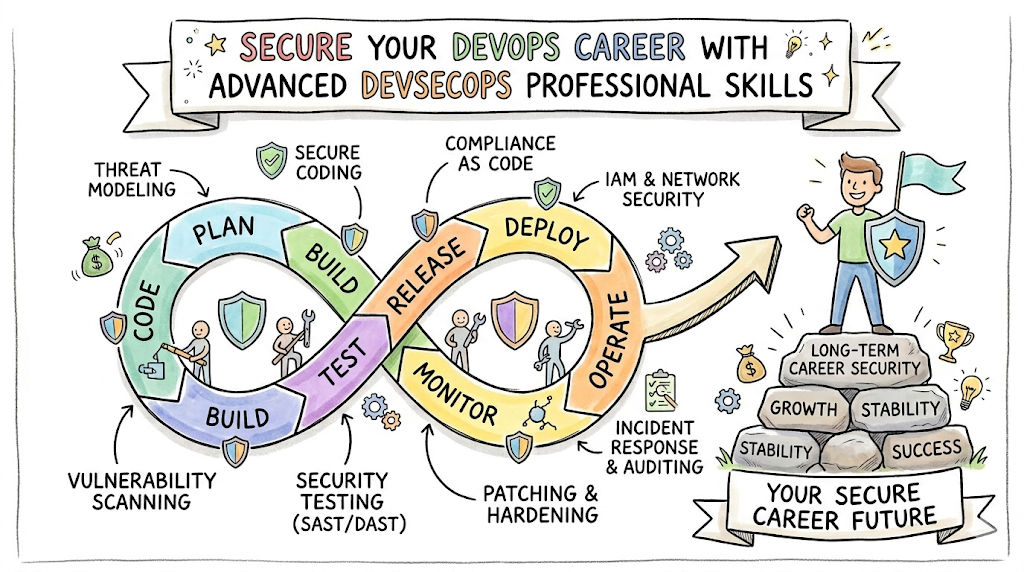
The Certified DevSecOps Professional is a comprehensive program designed by DevSecOpsSchool to bridge the gap between traditional software development and secure production operations. This guide is crafted for engineers and technical managers who recognize that security is no longer an afterthought but a core component of the delivery pipeline. By positioning this certification within the broader landscape of DevOps, cloud-native engineering, and platform stability, we aim to provide a roadmap for long-term career growth. Whether you are looking to pivot from a pure security role or want to enhance your DevOps expertise, this guide offers an unbiased look at how to navigate the program effectively. Modern enterprises are moving away from siloed security teams toward a model where every engineer is responsible for the security posture of their applications. This document helps professionals evaluate the curriculum against their current skill sets and long-term goals, ensuring they make an informed decision about their professional development and learning investment.
What is the Certified DevSecOps Professional?
The Certified DevSecOps Professional represents a shift in how technical proficiency is measured in the modern engineering landscape, moving away from multiple-choice theory toward practical application. It exists to address the critical shortage of engineers who understand how to automate security within high-velocity CI/CD environments without slowing down the release cycle. This certification focuses on “Security as Code” and the technical implementation of security guardrails throughout the software development lifecycle.
In a real-world production environment, knowing the definitions of security threats is insufficient; engineers must be able to configure tools that detect and mitigate these threats automatically. The program aligns with modern enterprise practices by teaching candidates how to integrate Static Application Security Testing (SAST), Dynamic Application Security Testing (DAST), and Software Composition Analysis (SCA) into automated workflows. It prioritizes the creation of resilient, self-healing systems that maintain a high security bar even as features are deployed multiple times a day.
Who Should Pursue Certified DevSecOps Professional?
This program is primarily designed for DevOps engineers, Site Reliability Engineers (SREs), and Cloud Architects who want to formalize their security expertise. It is equally beneficial for Security Engineers who need to understand the automation and orchestration side of modern software delivery to better collaborate with development teams. Engineering managers and technical leaders also find value in this certification as it provides the necessary vocabulary and strategic oversight to build secure engineering cultures.
For professionals in India and other global tech hubs, the certification serves as a powerful differentiator in a competitive job market where specialized skills are highly rewarded. Beginners with a strong foundation in Linux and basic scripting can use this as a gateway to high-paying security-focused roles, while experienced veterans use it to stay relevant as infrastructure becomes increasingly software-defined. Regardless of your current level, if your role involves deploying or maintaining cloud-native applications, this certification provides the practical edge needed to excel.
Why Certified DevSecOps Professional is Valuable Today and Beyond
The demand for integrated security is growing exponentially as cyber threats become more sophisticated and regulatory requirements like GDPR and SOC2 become stricter. This certification offers longevity because it focuses on the principles of automation and security integration rather than just specific vendor tools that may change every few years. Enterprises are increasingly adopting DevSecOps as a standard operating model, ensuring that professionals with these skills will remain in high demand for the foreseeable future.
Investing time in this certification provides a significant return on career investment by opening doors to specialized roles such as Security Architect or DevSecOps Lead. As organizations continue to migrate to the cloud and adopt microservices, the complexity of securing these environments increases, making the “Security as Code” mindset indispensable. By mastering these competencies, you transition from being a generalist to a specialist who can protect an organization’s most valuable digital assets while maintaining delivery speed.
Certified DevSecOps Professional Certification Overview
The program is delivered via the Certified DevSecOps Professional official course page and is hosted on the DevSecOpsSchool website. It utilizes a multi-tiered assessment approach that combines theoretical knowledge with rigorous hands-on labs to ensure candidates can perform in real-world scenarios. The certification ownership lies with industry experts who update the curriculum frequently to reflect the latest trends in container security, cloud-native threats, and automation frameworks.
The structure is designed to be practical, focusing on the tools and methodologies used by top-tier engineering organizations globally. Unlike academic certifications, this program is rooted in the needs of the industry, emphasizing the “how-to” of security integration. Candidates are expected to demonstrate proficiency in various domains, ranging from pre-commit hooks to production monitoring, ensuring a holistic understanding of the entire secure delivery pipeline.
Certified DevSecOps Professional Certification Tracks & Levels
The certification is structured into Foundation, Professional, and Advanced levels to cater to engineers at different stages of their career journey. The Foundation level introduces core concepts of security integration and automation, making it ideal for those transitioning into the field. The Professional level dives deeper into complex orchestration and multi-tool integration, while the Advanced level focuses on architectural design, strategy, and leading large-scale DevSecOps transformations.
Specialization tracks are also available to help professionals align their certification with specific career paths such as SRE, FinOps, or Cloud Security. These tracks ensure that the learning remains relevant to the candidate’s daily responsibilities and long-term career aspirations. By following these levels, an engineer can logically progress from a tactical contributor to a strategic leader within their organization, building a robust portfolio of verified skills along the way.
Complete Certified DevSecOps Professional Certification Table
| Track | Level | Who it’s for | Prerequisites | Skills Covered | Recommended Order |
| Core Security | Foundation | Junior Engineers, Managers | Basic Linux, CI/CD | SAST, DAST, SCA Basics | 1 |
| Engineering | Professional | DevOps/SRE Engineers | 2+ Years Experience | Pipeline Security, Vault | 2 |
| Architecture | Expert | Lead Engineers, Architects | Professional Cert | Compliance as Code, IAM | 3 |
| SRE Focus | Specialized | SREs, Platform Engineers | DevOps Foundation | Monitoring, SLOs, Drills | 4 |
| Governance | Leadership | Directors, CTOs | Engineering Lead Exp | Policy Design, Risk Mgmt | 5 |
Detailed Guide for Each Certified DevSecOps Professional Certification
Certified DevSecOps Professional – Foundation
What it is
This certification validates a candidate’s understanding of basic security principles and their ability to identify where security fits into a standard DevOps pipeline. It acts as the entry point for those new to the integrated security model.
Who should take it
It is suitable for junior developers, system administrators, and technical managers who need a solid grounding in DevSecOps terminology and basic automation tools.
Skills you’ll gain
- Understanding the DevSecOps lifecycle
- Implementing basic pre-commit hooks
- Running vulnerability scans on source code
- Understanding the role of secrets management
Real-world projects you should be able to do
- Integrate a basic SAST tool into a GitHub Actions pipeline
- Conduct a manual security audit of a small web application
- Configure basic alerts for insecure dependencies in a repository
Preparation plan
- 7-14 days: Review official documentation and familiarize yourself with DevSecOps terminology.
- 30 days: Complete all foundational labs and build a simple secure pipeline from scratch.
- 60 days: Not required for this level unless the candidate has zero prior IT experience.
Common mistakes
- Focusing too much on tool names instead of the underlying security principles.
- Neglecting the cultural aspects of DevSecOps in favor of pure technical configuration.
Best next certification after this
- Same-track option: Certified DevSecOps Professional – Professional
- Cross-track option: SRE Foundation
- Leadership option: Certified DevOps Manager
Certified DevSecOps Professional – Professional
What it is
This level validates advanced technical skills in building and maintaining enterprise-grade secure pipelines. It proves the candidate can handle complex integrations and secure containerized workloads in production.
Who should take it
Intermediate DevOps and Security engineers with at least two years of experience who are responsible for maintaining CI/CD systems and cloud infrastructure.
Skills you’ll gain
- Advanced Docker and Kubernetes security
- Dynamic analysis and penetration testing automation
- Implementing HashiCorp Vault for secrets management
- Infrastructure as Code (IaC) scanning and remediation
Real-world projects you should be able to do
- Secure a Kubernetes cluster using network policies and admission controllers
- Build a multi-stage pipeline that blocks builds based on custom security thresholds
- Automate the rotation of API keys and database credentials using Vault
Preparation plan
- 7-14 days: Only for those with heavy production experience in security automation.
- 30 days: Recommended for most; focus on advanced labs and edge-case scenarios in CI/CD.
- 60 days: Ideal for engineers moving from a different domain like pure development or QA.
Common mistakes
- Underestimating the complexity of secrets management and credential leakage.
- Failing to understand how to interpret and filter tool results to reduce false positives.
Best next certification after this
- Same-track option: Certified DevSecOps Professional – Expert
- Cross-track option: Certified SRE Professional
- Leadership option: DevSecOps Architect
Choose Your Learning Path
DevOps Path
The DevOps path focuses on the seamless integration of development and operations with a heavy emphasis on speed and reliability. For this path, the certification helps you add a layer of security that does not compromise deployment frequency. You will learn how to make security a self-service capability for developers, ensuring that the path to production is always secure by default. This path is ideal for those who want to build the underlying platforms that power modern digital businesses.
DevSecOps Path
This is the core specialization for professionals who want to become experts in security automation and “Shift Left” methodologies. The focus here is entirely on the intersection of security and the delivery pipeline, covering everything from threat modeling to automated incident response. You will gain deep expertise in various security tools and how to orchestrate them to create a continuous security feedback loop. This path leads directly to specialized roles like DevSecOps Engineer or Security Automation Lead.
SRE Path
The Site Reliability Engineering path emphasizes the reliability, scalability, and performance of production systems, with security being a critical component of “availability.” In this path, you will learn how to apply SRE principles—such as error budgets and toil reduction—to security operations. The certification teaches you how to handle security incidents as a type of system failure and how to build resilient systems that can withstand attacks. It is perfect for those who enjoy the intersection of software engineering and systems administration.
AIOps Path
The AIOps path is designed for engineers looking to apply artificial intelligence and machine learning to IT operations. In the context of this certification, the focus is on using AI to detect security anomalies and automate the analysis of massive security logs. You will learn how to build systems that can predict potential security breaches before they occur based on historical patterns. This is a forward-looking path for engineers who want to work at the cutting edge of automated operations.
MLOps Path
The MLOps path focuses on the unique security challenges associated with machine learning pipelines and model deployment. This path teaches you how to secure data lineages, protect models from adversarial attacks, and ensure the integrity of the training environment. By combining this certification with ML expertise, you can ensure that an organization’s AI initiatives are both high-performing and secure. It is an essential path for engineers supporting data science teams in highly regulated industries.
DataOps Path
DataOps focuses on the secure and automated flow of data throughout an organization, emphasizing data quality and governance. This path uses the certification to address data security at rest, in transit, and during processing, ensuring compliance with global data protection laws. You will learn how to automate data masking, encryption, and access controls within the data pipeline. This is the ideal route for professionals working with large-scale data warehouses and analytics platforms.
FinOps Path
The FinOps path integrates financial accountability into the cloud-native world, ensuring that security measures are cost-effective and transparent. This path explores the intersection of cloud spending and security infrastructure, helping you balance the cost of security tools against the risks they mitigate. You will learn how to optimize security configurations for cost without compromising the organization’s defensive posture. This is a growing field for those who want to bridge the gap between engineering, security, and finance.
Role → Recommended Certified DevSecOps Professional Certifications
| Role | Recommended Certifications |
| DevOps Engineer | Certified DevSecOps Professional – Professional |
| SRE | Certified DevSecOps Professional – Professional + SRE Foundation |
| Platform Engineer | Certified DevSecOps Professional – Expert |
| Cloud Engineer | Certified DevSecOps Professional – Professional |
| Security Engineer | Certified DevSecOps Professional – Expert |
| Data Engineer | Certified DevSecOps Professional – Foundation + DataOps Cert |
| FinOps Practitioner | Certified DevSecOps Professional – Foundation + FinOps Cert |
| Engineering Manager | Certified DevSecOps Professional – Foundation |
Next Certifications to Take After Certified DevSecOps Professional
Same Track Progression
After completing the professional level, the logical step is to move toward the Expert or Architect levels. This allows you to deepen your technical expertise in complex areas like service meshes, advanced container security, and custom security tool development. Deep specialization ensures that you become the “go-to” person for the most challenging security problems within your organization, often leading to principal-level roles or high-value consulting opportunities.
Cross-Track Expansion
If you want to broaden your impact, consider certifications in SRE, FinOps, or MLOps to understand how security interacts with other domains. For example, moving into SRE helps you understand security through the lens of system reliability, while FinOps helps you manage the budget of security operations. Broadening your skills makes you a more versatile engineer who can contribute to high-level strategic discussions across the entire technology department.
Leadership & Management Track
For those looking to move away from daily coding and into strategy, transition toward certifications focused on DevOps management or IT leadership. These programs build on your technical foundation but add skills in team building, budget management, and organizational change. This path is essential for those who want to lead DevSecOps transformations at the enterprise level, moving from individual contributor roles to positions like Director of Engineering or VP of Security.
Training & Certification Support Providers for Certified DevSecOps Professional
DevOpsSchool
DevOpsSchool is a leading platform dedicated to providing high-quality training in DevOps and security methodologies. They offer a range of courses that are deeply rooted in practical industry requirements, ensuring that students do not just learn the theory but also gain hands-on experience. Their instructors are often seasoned professionals with decades of experience in the field, providing learners with insights that go beyond the textbook. The school emphasizes real-world labs and project-based learning, which is essential for mastering the complex integrations required in a modern DevSecOps environment. By focusing on the entire software delivery lifecycle, they help engineers build a cohesive skill set that is highly valued by global employers.
Cotocus
Cotocus is known for its specialized focus on cloud-native technologies and site reliability engineering, providing robust support for those pursuing advanced security certifications. They offer tailored mentorship and hands-on training sessions that help professionals bridge the gap between their current skills and the requirements of top-tier tech companies. Their curriculum is designed to be agile, frequently updated to reflect the latest changes in the cloud landscape and security threats. Cotocus prides itself on creating a learning environment that mimics actual production scenarios, allowing students to practice incident response and security automation in a safe yet challenging setting. This approach makes them a preferred choice for engineers looking for deep technical immersion and career-focused training.
Scmgalaxy
Scmgalaxy is a prominent community and training hub that has been at the forefront of the DevOps movement for many years. They provide extensive resources, including tutorials, forums, and specialized training programs that cover everything from configuration management to advanced DevSecOps. Their strength lies in their massive community of practitioners who share knowledge and best practices, making it an excellent place for networking and continuous learning. Scmgalaxy’s training modules are designed to be modular and accessible, catering to both beginners and seasoned veterans. By offering a blend of community-driven content and structured professional training, they ensure that learners have a comprehensive support system throughout their certification journey and their wider career.
BestDevOps
BestDevOps focuses on delivering premium training experiences that prioritize the most in-demand skills in the current market. Their programs are specifically designed to help engineers master the tools and workflows used by high-performing engineering organizations. They offer a range of certification support services, including mock exams, technical workshops, and one-on-one coaching sessions. BestDevOps places a high value on the quality of their instructional material, ensuring that every lesson is clear, concise, and directly applicable to professional work. Their goal is to empower engineers to take control of their career paths by providing them with the technical confidence and verified credentials needed to excel in a rapidly evolving technological landscape.
This platform is the primary authority for the Certified DevSecOps Professional program, offering the most direct and up-to-date resources for the certification. It serves as a central hub for the global DevSecOps community, providing access to official curriculum, certified instructors, and advanced laboratory environments. The site is dedicated to the mission of integrating security into every aspect of the development process, offering specialized tracks for various roles and industries. Learners benefit from a structured path that takes them from foundational concepts to expert-level architectural design. The platform’s commitment to excellence ensures that its certified professionals are among the most knowledgeable and capable security practitioners in the industry today.
sreschool.com
SRESchool focuses on the intersection of reliability engineering and security, providing a unique perspective for those looking to build stable and secure systems. Their training programs emphasize the importance of observability, incident management, and post-mortem analysis in the context of security operations. By teaching engineers how to apply SRE principles to the DevSecOps lifecycle, they help organizations create systems that are not only secure but also highly resilient to failure. The school offers a range of courses that cover the technical and cultural aspects of SRE, making it an essential resource for platform engineers and SREs who want to formalize their security expertise.
aiopsschool.com
AIOpsSchool is dedicated to the emerging field of artificial intelligence in IT operations, offering cutting-edge training for the next generation of engineers. Their curriculum explores how machine learning and data analytics can be used to automate complex operational tasks, including security monitoring and anomaly detection. By providing a bridge between traditional DevOps and data science, they help professionals stay ahead of the curve in an increasingly automated world. Their courses are designed to be practical, focusing on the implementation of AI models within existing IT infrastructure to improve efficiency and security. This makes them a vital resource for anyone looking to specialize in the future of automated operations.
dataopsschool.com
DataOpsSchool addresses the growing need for secure and efficient data management in modern enterprises. Their training programs focus on the automation of data pipelines, ensuring that data is delivered with high quality and strong security guardrails. They offer specialized courses in data governance, privacy, and the security of large-scale analytics platforms. By teaching the principles of DataOps, they help engineers and data scientists collaborate more effectively while maintaining compliance with strict regulatory requirements. Their mission is to turn data into a strategic asset by ensuring its flow is both fast and secure, making them a key partner for organizations undergoing digital transformation.
finopsschool.com
FinOpsSchool provides the essential training needed to manage the financial aspects of cloud-native engineering and security. Their programs teach professionals how to align engineering decisions with business goals, ensuring that cloud spending is optimized and transparent. In the context of security, they help engineers understand the cost-benefit analysis of various security tools and infrastructure configurations. By fostering a culture of financial accountability, they enable organizations to get the most value out of their cloud investments. The school offers a range of certifications and workshops that cover the technical, financial, and cultural aspects of FinOps, making it an indispensable resource for technical leaders.
Frequently Asked Questions (General)
1. How difficult is the certification exam?
The difficulty varies by level, but it is generally considered moderate to high because it focuses on practical skills rather than just memorization. You should be prepared to solve real-world problems in a timed lab environment.
2. How much time does it take to prepare?
Most professionals spend between 30 and 60 days preparing, depending on their prior experience with Linux and CI/CD tools. The Foundation level can often be completed in a few weeks of dedicated study.
3. Are there any specific prerequisites?
While there are no hard barriers for the Foundation level, the Professional level strongly recommends at least two years of experience in DevOps or systems administration.
4. What is the return on investment for this certification?
Professionals often report significant salary increases and access to more specialized, high-ranking roles after becoming certified. It is a recognized credential that proves you can handle modern security challenges.
5. In what order should I take these certifications?
It is highly recommended to start with the Foundation level to ensure a solid grasp of the terminology before moving into the more technical Professional and Expert levels.
6. Does the certification expire?
Yes, like most industry certifications, it typically requires renewal or continuing education every few years to ensure your skills remain current with the latest technology trends.
7. Can I take the exam online?
Yes, the program is designed to be accessible globally, with online proctored exams and cloud-based lab environments that you can access from anywhere.
8. Is there a community for certified professionals?
Yes, there is a vibrant global community where you can network with other certified professionals, share job opportunities, and discuss the latest industry trends.
9. Are the labs included in the course fee?
In most cases, access to the lab environment is included for a specific duration as part of the training package, allowing you to practice without additional costs.
10. Is this certification recognized globally?
Yes, it is highly regarded by enterprises around the world, particularly those in the financial, healthcare, and technology sectors that prioritize security.
11. What kind of tools will I learn?
The curriculum covers a wide range of industry-standard tools including Jenkins, GitLab, Docker, Kubernetes, Vault, and various open-source security scanners.
12. Can this help me pivot from a non-tech role?
It is a great way to enter the field if you have a basic understanding of IT, but you should expect a steeper learning curve than those already working in engineering.
FAQs on Certified DevSecOps Professional
- How does this certification differ from a standard security cert?
Standard security certifications often focus on manual auditing and policy, whereas this program is specifically about the automation of security within the engineering pipeline.
2. Is coding knowledge required?
Yes, you will need a basic understanding of scripting languages like Python or Bash, as well as an understanding of YAML for configuration.
3. How often is the curriculum updated?
The curriculum is reviewed and updated regularly to include new security threats and the latest versions of popular automation tools.
4. What is the format of the practical assessment?
The assessment typically involves a live lab where you must fix security vulnerabilities in a provided pipeline or configure a secure environment from scratch.
5. Are there group discounts for corporate teams?
Many training providers offer group rates for organizations looking to upskill their entire engineering or security department at once.
6. Does it cover cloud-specific security like AWS or Azure?
Yes, it covers the principles of cloud security that are applicable across all major providers, with specific examples often provided for AWS and Kubernetes.
7. What is the passing score?
While the exact score may vary, you generally need to demonstrate a high level of proficiency (usually 70% or higher) in both theoretical and practical components.
8. Can I retake the exam if I fail?
Yes, there is usually a policy in place that allows for retakes after a certain waiting period, though additional fees may apply.
Final Thoughts: Is Certified DevSecOps Professional Worth It?
From a mentor’s perspective, the value of a certification isn’t found in the digital badge itself, but in the structured learning path it forces you to follow. The Certified DevSecOps Professional program is exceptionally relevant because it addresses the single biggest bottleneck in modern software delivery: integrated security. If you are an engineer who wants to be more than just a “tool operator” and instead become a vital protector of your organization’s infrastructure, this investment is absolutely worth it. The industry is moving toward a future where “DevOps” and “Security” are no longer separate conversations. By gaining this certification, you are essentially future-proofing your career against the eventual obsolescence of siloed roles. My advice is to approach the labs with a curiosity to understand the “why” behind every security check, not just the “how.” In the long run, the technical depth and systems-thinking mindset you develop here will be your greatest professional assets.