Upgrade & Secure Your Future with DevOps, SRE, DevSecOps, MLOps!
We spend hours scrolling social media and waste money on things we forget, but won’t spend 30 minutes a day earning certifications that can change our lives.
Master in DevOps, SRE, DevSecOps & MLOps by DevOps School!
Learn from Guru Rajesh Kumar and double your salary in just one year.
Introduction
Finite Element Analysis, or FEA, is an engineering simulation method used to predict how a product, structure, or component behaves under real-world conditions. In simple terms, FEA breaks a design into many small elements and calculates how each part responds to forces, heat, vibration, pressure, contact, fatigue, and deformation.
FEA matters in 2026+ because companies need safer products, faster design cycles, lower prototype costs, better material usage, and stronger digital validation. Instead of waiting for expensive physical tests, engineering teams can identify weak points, compare design options, and improve performance earlier in the development process.
Common real-world use cases include:
- Stress and deformation analysis
- Thermal and heat transfer simulation
- Vibration, modal, and frequency analysis
- Fatigue and durability prediction
- Crash, impact, and nonlinear contact simulation
- Structural validation for aerospace, automotive, civil, medical, and industrial products
Buyers should evaluate:
- Solver accuracy and validation depth
- Linear and nonlinear analysis capabilities
- Contact, fatigue, thermal, and dynamic analysis support
- Meshing quality and automation
- CAD and PLM integration
- HPC and cloud simulation options
- Ease of setup and result interpretation
- Reporting and visualization tools
- Security and access controls
- Licensing cost, modules, and support quality
Best for: mechanical engineers, structural analysts, product designers, simulation teams, R&D groups, automotive engineers, aerospace teams, civil engineers, manufacturing companies, medical device firms, and enterprises that need reliable digital validation.
Not ideal for: teams that only need basic drafting, simple 3D modeling, visual rendering, or rough hand calculations. For very simple designs, built-in CAD checks, basic calculators, or outsourced simulation may be enough.
Key Trends in Finite Element Analysis (FEA) Software
- AI-assisted simulation setup is growing: Modern FEA tools are starting to support smarter geometry cleanup, mesh generation, load setup, result review, and design recommendations.
- Simulation is moving earlier in product design: Design engineers now run basic structural checks before handing models to specialist analysts.
- Cloud and hybrid compute are becoming more common: Large assemblies, nonlinear models, and design studies need scalable compute beyond a single workstation.
- Nonlinear analysis is more important: Real-world products often involve contact, large deformation, plasticity, rubber-like materials, composites, and complex loading.
- Multiphysics workflows are expanding: Teams increasingly combine structural analysis with thermal, fluid, electromagnetic, acoustic, and motion simulation.
- Design optimization is becoming standard: Topology optimization, parametric studies, lightweighting, and automated design exploration are now key buying factors.
- Digital twins are increasing simulation value: FEA models can support predictive maintenance, performance monitoring, and lifecycle engineering when connected with real-world data.
- CAD and PLM integration is essential: Teams want fewer file transfer issues and better traceability between design changes and simulation results.
- Security expectations are rising: Engineering models often include sensitive intellectual property, so buyers ask about MFA, SSO, encryption, permissions, and audit logs.
- Flexible licensing matters: Buyers compare subscriptions, tokens, solver modules, cloud credits, HPC licensing, and enterprise agreements before committing.
How We Selected These Tools
The tools below were selected using a practical engineering software evaluation approach:
- Strong recognition in FEA, structural simulation, multiphysics, or engineering analysis
- Adoption across industries such as aerospace, automotive, manufacturing, energy, civil engineering, electronics, and research
- Feature completeness across linear, nonlinear, static, dynamic, thermal, fatigue, and contact analysis
- Solver maturity, accuracy reputation, and real-world production usage
- CAD, PLM, meshing, HPC, and cloud integration strength
- Fit for different users, including freelancers, SMBs, mid-market teams, enterprise analysts, and researchers
- Availability of documentation, training, onboarding, professional support, and community resources
- Deployment flexibility across desktop, cloud, hybrid, and open-source environments
- Practical value for both design engineers and specialist simulation analysts
- Conservative treatment of security, compliance, and public rating information
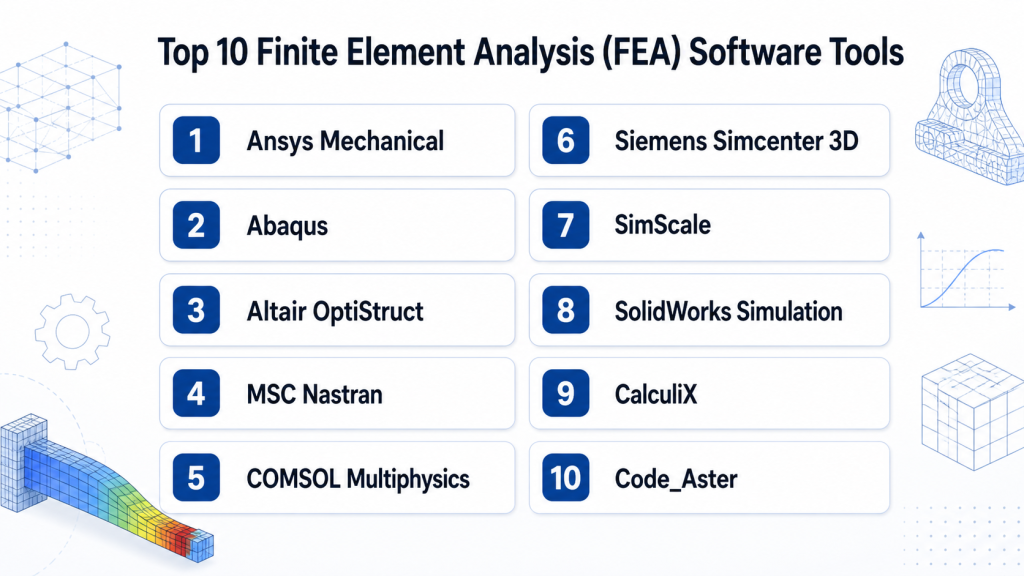
Top 10 Finite Element Analysis (FEA) Software Tools
#1 — Ansys Mechanical
Short description: Ansys Mechanical is a widely used FEA platform for structural, thermal, vibration, fatigue, contact, and nonlinear analysis. It is commonly used by enterprise engineering teams that need robust simulation across product development and validation workflows.
Key Features
- Linear and nonlinear structural analysis
- Thermal, vibration, fatigue, and dynamic simulation
- Contact and large deformation analysis
- Advanced meshing and solver controls
- High-performance computing support
- Integration with the broader Ansys ecosystem
- Design exploration and optimization workflows
Pros
- Strong general-purpose FEA capability
- Mature solver ecosystem for complex engineering problems
- Good fit for enterprise simulation and multiphysics workflows
Cons
- Licensing and HPC usage can be expensive
- Learning curve can be high for new users
- Requires trained analysts for advanced nonlinear work
Platforms / Deployment
Windows / Linux
Deployment: Desktop / Cloud-connected / Hybrid depending on setup
Security & Compliance
Security and compliance details such as SSO, SAML, MFA, RBAC, audit logs, encryption, SOC 2, ISO 27001, GDPR, and HIPAA should be verified for the selected Ansys product and deployment. If not confirmed for the specific plan, write Not publicly stated.
Integrations & Ecosystem
Ansys Mechanical fits well into mature engineering environments where structural analysis connects with CAD, CFD, electronics, optimization, and enterprise simulation workflows.
- CAD geometry workflows
- Ansys Workbench ecosystem
- HPC and cluster workflows
- Thermal and multiphysics workflows
- Design optimization workflows
- Automation and scripting options
Support & Community
Ansys Mechanical has extensive documentation, training resources, professional support, partner services, and a large global user community. Support depth depends on license type, region, and enterprise agreement.
#2 — Abaqus
Short description: Abaqus is an advanced FEA solution known for nonlinear structural analysis, contact, large deformation, material modeling, and complex mechanical behavior. It is often used in automotive, aerospace, manufacturing, consumer products, life sciences, and research environments.
Key Features
- Advanced nonlinear finite element analysis
- Complex contact and large deformation modeling
- Advanced material behavior simulation
- Static, dynamic, and thermal-mechanical analysis
- Explicit and implicit analysis workflows depending on setup
- Strong solver capability for demanding mechanical problems
- Integration with Dassault Systèmes simulation workflows
Pros
- Excellent for complex nonlinear structural problems
- Strong material and contact modeling capabilities
- Widely used in advanced engineering and research
Cons
- Requires strong simulation expertise
- Learning curve can be steep for beginners
- Licensing and enterprise setup may be costly
Platforms / Deployment
Windows / Linux
Deployment: Desktop / Enterprise / Hybrid depending on setup
Security & Compliance
Security and compliance details such as SSO, SAML, MFA, RBAC, audit logs, encryption, SOC 2, ISO 27001, GDPR, and HIPAA are Not publicly stated unless confirmed for the exact Dassault Systèmes product environment and deployment.
Integrations & Ecosystem
Abaqus works well for engineering teams that need solver depth, nonlinear analysis, and advanced simulation workflows.
- Dassault Systèmes ecosystem
- CAD and geometry workflows
- Material modeling workflows
- Scripting and automation
- HPC workflows
- Structural simulation pipelines
Support & Community
Abaqus has strong technical documentation, professional support options, training providers, academic adoption, and a large advanced simulation user base. Support availability depends on license, region, and agreement.
#3 — Altair OptiStruct
Short description: Altair OptiStruct is an FEA solver known for structural analysis, optimization, lightweighting, and design exploration. It is commonly used in automotive, aerospace, manufacturing, and product engineering environments where performance and weight reduction matter.
Key Features
- Linear and nonlinear structural analysis
- Topology, size, and shape optimization
- Modal, buckling, and dynamic analysis
- Fatigue and durability workflows depending on setup
- Design exploration and lightweighting
- Integration with Altair HyperWorks ecosystem
- HPC and solver scalability support
Pros
- Strong optimization and lightweighting capabilities
- Good fit for simulation-driven design
- Useful for automotive, aerospace, and performance-focused engineering
Cons
- Best value comes with Altair ecosystem knowledge
- Advanced workflows require training
- Licensing and modules should be reviewed carefully
Platforms / Deployment
Windows / Linux
Deployment: Desktop / Cloud-connected / Hybrid depending on setup
Security & Compliance
Security and compliance details such as SSO, SAML, MFA, RBAC, audit logs, encryption, SOC 2, ISO 27001, GDPR, and HIPAA are Not publicly stated unless confirmed directly for the selected Altair environment.
Integrations & Ecosystem
OptiStruct fits well in engineering teams that focus on structural optimization, advanced CAE, and simulation-driven product development.
- Altair HyperWorks workflows
- CAD import workflows
- HPC workflows
- Optimization workflows
- Fatigue and durability workflows
- Manufacturing and lightweighting workflows
Support & Community
Altair provides documentation, learning resources, professional support, training, and enterprise services. Support depth depends on product package, region, and agreement.
#4 — MSC Nastran
Short description: MSC Nastran is a mature FEA solver used for structural analysis, dynamics, vibration, aeroelasticity, and high-end engineering validation. It is especially common in aerospace, automotive, defense, and complex structural simulation workflows.
Key Features
- Linear and nonlinear structural analysis
- Dynamics, vibration, and modal analysis
- Aeroelasticity and advanced structural validation workflows
- Large model solving capability
- Buckling and frequency response analysis
- Integration with pre-processing and post-processing tools
- Strong use in regulated engineering environments
Pros
- Mature solver for large structural models
- Strong fit for aerospace and automotive validation
- Reliable for dynamics and structural analysis workflows
Cons
- Not beginner-friendly as a standalone workflow
- Often needs additional pre/post-processing tools
- Best suited for experienced simulation teams
Platforms / Deployment
Windows / Linux
Deployment: Desktop / Enterprise / HPC / Hybrid depending on setup
Security & Compliance
Security and compliance information such as SSO, SAML, MFA, RBAC, audit logs, encryption, SOC 2, ISO 27001, GDPR, and HIPAA is Not publicly stated unless confirmed for the selected deployment.
Integrations & Ecosystem
MSC Nastran is commonly part of larger CAE pipelines where solver reliability and structural validation are central.
- Pre-processing and post-processing workflows
- Aerospace analysis workflows
- Automotive durability workflows
- HPC environments
- FEA model workflows
- Enterprise CAE pipelines
Support & Community
MSC Nastran has long-standing professional usage, documentation, training resources, and support channels through the vendor ecosystem. Support depends on license and agreement.
#5 — COMSOL Multiphysics
Short description: COMSOL Multiphysics is a flexible simulation platform used for FEA and coupled physics problems. It is popular with researchers, R&D teams, and engineering groups that need structural simulation connected with thermal, fluid, electrical, acoustic, or chemical effects.
Key Features
- Structural mechanics and multiphysics analysis
- Thermal, fluid, electromagnetic, acoustic, and chemical coupling options depending on modules
- Equation-based modeling flexibility
- Parametric studies and optimization
- Application Builder for custom simulation apps
- CAD import and geometry tools
- Server deployment options depending on setup
Pros
- Excellent for coupled physics problems
- Flexible modeling environment for advanced users
- Strong fit for research, R&D, and custom simulation workflows
Cons
- Requires technical understanding for complex models
- Module selection and licensing need careful review
- May be more than needed for routine structural FEA
Platforms / Deployment
Windows / macOS / Linux
Deployment: Desktop / Server / Hybrid depending on setup
Security & Compliance
Security and compliance details such as SSO, SAML, MFA, RBAC, audit logs, encryption, SOC 2, ISO 27001, GDPR, and HIPAA are Not publicly stated unless confirmed for the exact product and server deployment.
Integrations & Ecosystem
COMSOL is strong for teams that need flexible FEA with multiphysics modeling and custom simulation applications.
- CAD import workflows
- MATLAB integration options depending on setup
- Application Builder
- Server deployment options
- Optimization workflows
- Custom equation-based modeling
Support & Community
COMSOL has strong documentation, example models, training resources, webinars, professional support, and a strong academic and research community.
#6 — Siemens Simcenter 3D
Short description: Siemens Simcenter 3D is an engineering simulation platform for structural analysis, durability, acoustics, motion, thermal, and multiphysics workflows. It is suited for companies that want simulation connected with CAD, testing, and PLM.
Key Features
- Structural, thermal, durability, and acoustics simulation
- Motion and multiphysics workflows depending on setup
- Integration with Siemens NX and Teamcenter
- Advanced meshing and pre/post-processing tools
- Test and simulation data workflows
- Design validation and engineering analysis
- Enterprise digital engineering support
Pros
- Strong connection with Siemens engineering ecosystem
- Good fit for enterprise simulation and product development
- Useful for teams combining simulation and test data
Cons
- Best value often comes in Siemens-centered environments
- Implementation can be complex
- Requires structured training and rollout
Platforms / Deployment
Windows / Linux support may vary by product
Deployment: Desktop / Enterprise / Hybrid
Security & Compliance
Security and compliance details such as SSO, SAML, MFA, RBAC, audit logs, encryption, SOC 2, ISO 27001, GDPR, and HIPAA should be verified directly for the chosen Siemens deployment. If not confirmed, write Not publicly stated.
Integrations & Ecosystem
Simcenter 3D is useful for organizations that want simulation connected with design, testing, and lifecycle management.
- Siemens NX workflows
- Teamcenter PLM workflows
- CAD integrations
- Test data workflows
- HPC workflows
- Systems engineering workflows
Support & Community
Siemens provides enterprise support, documentation, training resources, partner services, and implementation support. Support depth depends on product package and enterprise agreement.
#7 — SimScale
Short description: SimScale is a cloud-native simulation platform that supports structural, thermal, and fluid simulation through a browser-based workflow. It is useful for startups, SMBs, distributed teams, and design engineers who want simulation without maintaining heavy local infrastructure.
Key Features
- Browser-based simulation workflow
- Cloud compute resources
- Structural and thermal simulation options
- CAD import and geometry preparation
- Meshing and result visualization in the cloud
- Collaboration and project sharing
- Useful for distributed engineering teams
Pros
- No heavy workstation or local solver setup required
- Good collaboration for remote teams
- Easier access for early-stage simulation users
Cons
- Cloud workflow may not fit every security policy
- Advanced FEA specialists may need deeper solver control
- Cost depends on plan, usage, and project size
Platforms / Deployment
Web
Deployment: Cloud
Security & Compliance
Security features may vary by plan. Details such as SSO, SAML, MFA, RBAC, audit logs, encryption, SOC 2, ISO 27001, GDPR, and HIPAA should be verified directly for the selected plan. If not confirmed, write Not publicly stated.
Integrations & Ecosystem
SimScale is practical for teams that want accessible simulation with cloud-based collaboration and fast project sharing.
- CAD import workflows
- Web-based collaboration
- Cloud compute
- Structural and thermal simulation workflows
- Result sharing
- API or automation options may vary by plan
Support & Community
SimScale has documentation, tutorials, learning resources, user support, and community content. Support depth may vary between free, professional, and enterprise plans.
#8 — SolidWorks Simulation
Short description: SolidWorks Simulation is an FEA tool integrated with SolidWorks CAD. It helps product designers and engineers test stress, displacement, thermal behavior, vibration, fatigue, and design performance inside a familiar CAD environment.
Key Features
- CAD-integrated structural simulation
- Static stress and displacement analysis
- Thermal, frequency, buckling, and fatigue options depending on package
- Design studies and optimization support
- Easy setup for SolidWorks users
- Reporting and visualization tools
- Product design validation workflow
Pros
- Familiar environment for SolidWorks users
- Good for early design validation
- Practical for SMBs and product engineering teams
Cons
- Not as deep as specialist enterprise FEA tools
- Advanced nonlinear and complex workflows may require higher packages or other tools
- Best value depends on SolidWorks adoption
Platforms / Deployment
Windows
Deployment: Desktop / CAD-integrated
Security & Compliance
Security and compliance details such as SSO, SAML, MFA, RBAC, audit logs, encryption, SOC 2, ISO 27001, GDPR, and HIPAA are Not publicly stated for standard product usage unless confirmed directly with the vendor or reseller.
Integrations & Ecosystem
SolidWorks Simulation is best for teams already working inside SolidWorks and wanting simulation during product design.
- SolidWorks CAD integration
- SolidWorks PDM workflows depending on setup
- Design study workflows
- Engineering reports
- CAD model updates
- Product development handoff
Support & Community
SolidWorks Simulation benefits from SolidWorks documentation, reseller support, training providers, tutorials, and a large engineering user community. Support quality may vary by reseller and plan.
#9 — CalculiX
Short description: CalculiX is an open-source FEA package used for solving structural and field problems through the finite element method. It is useful for researchers, advanced users, students, and technical teams that want a low-cost solver workflow.
Key Features
- Open-source FEA solver
- Linear and nonlinear structural analysis
- Thermal analysis capabilities
- Abaqus-style input workflow similarity
- Command-line and technical workflow orientation
- Useful for learning and research
- Can be used with third-party pre/post-processing tools
Pros
- Free and open-source
- Useful for technical users familiar with solver input files
- Good option for research and learning
Cons
- Not beginner-friendly for non-technical users
- Limited commercial-style support
- Requires setup, validation, and workflow discipline
Platforms / Deployment
Linux / Windows options may vary
Deployment: Self-hosted / Open-source
Security & Compliance
As an open-source tool, built-in enterprise security features such as SSO, SAML, MFA, RBAC, audit logs, SOC 2, ISO 27001, GDPR, and HIPAA are Not publicly stated. Security depends on the user’s infrastructure and deployment practices.
Integrations & Ecosystem
CalculiX is useful for technical users who want open-source FEA and are comfortable building their own workflow.
- Solver input workflows
- Third-party pre-processing tools
- Third-party post-processing tools
- Linux-based workflows
- Research and education workflows
- Custom automation scripts
Support & Community
CalculiX has documentation and community support, but it does not offer the same vendor-led onboarding model as commercial enterprise FEA platforms.
#10 — Code_Aster
Short description: Code_Aster is an open-source finite element solver used for structural mechanics, thermal analysis, acoustics, seismic simulation, and advanced engineering calculations. It is suitable for researchers, advanced analysts, and technical organizations that can manage open-source CAE workflows.
Key Features
- Open-source finite element solver
- Structural mechanics and thermomechanical simulation
- Material behavior and advanced analysis options
- Thermal, acoustic, and seismic workflows depending on setup
- Integration with open-source pre/post-processing environments
- Suitable for research and advanced engineering
- Flexible solver-oriented workflow
Pros
- Free and open-source
- Strong for advanced technical users
- Useful for research, education, and specialized simulation workflows
Cons
- Steep learning curve for beginners
- Requires internal expertise for setup and validation
- Commercial-style support may depend on third-party providers
Platforms / Deployment
Linux / Windows options may vary
Deployment: Self-hosted / Open-source
Security & Compliance
As an open-source solver, built-in enterprise features such as SSO, SAML, MFA, RBAC, audit logs, SOC 2, ISO 27001, GDPR, and HIPAA are Not publicly stated. Security depends on the organization’s own infrastructure, access controls, and deployment practices.
Integrations & Ecosystem
Code_Aster fits technical teams that need an open FEA solver and are comfortable building workflows around it.
- Open-source simulation workflows
- Pre/post-processing tools
- Linux-based deployment
- Scripting and automation
- Research workflows
- Advanced structural analysis workflows
Support & Community
Code_Aster has documentation, technical community resources, and third-party support options in some markets. It is best for teams with internal simulation expertise.
Comparison Table
| Tool Name | Best For | Platform(s) Supported | Deployment | Standout Feature | Public Rating |
|---|---|---|---|---|---|
| Ansys Mechanical | Enterprise structural, thermal, nonlinear, and multiphysics FEA | Windows, Linux | Desktop / Hybrid | Broad FEA solver ecosystem | N/A |
| Abaqus | Advanced nonlinear structural and contact analysis | Windows, Linux | Desktop / Enterprise / Hybrid | Strong nonlinear material and contact modeling | N/A |
| Altair OptiStruct | Optimization-driven structural analysis | Windows, Linux | Desktop / Hybrid | Topology and structural optimization | N/A |
| MSC Nastran | Aerospace, automotive, dynamics, and structural validation | Windows, Linux | Desktop / HPC / Hybrid | Mature structural FEA solver | N/A |
| COMSOL Multiphysics | Coupled physics and R&D simulation | Windows, macOS, Linux | Desktop / Server / Hybrid | Flexible multiphysics modeling | N/A |
| Siemens Simcenter 3D | Enterprise simulation connected with CAD, test, and PLM | Windows, Linux support may vary | Desktop / Enterprise / Hybrid | Simulation connected with lifecycle workflows | N/A |
| SimScale | Cloud-based structural and thermal simulation | Web | Cloud | Browser-based simulation workflow | N/A |
| SolidWorks Simulation | CAD-integrated FEA for product design teams | Windows | Desktop / CAD-integrated | Simulation inside SolidWorks CAD | N/A |
| CalculiX | Open-source FEA for technical users and researchers | Linux, Windows options vary | Self-hosted / Open-source | Free solver with technical workflow flexibility | N/A |
| Code_Aster | Open-source advanced structural and thermomechanical simulation | Linux, Windows options vary | Self-hosted / Open-source | Open-source advanced mechanics solver | N/A |
Evaluation & Scoring of Finite Element Analysis (FEA) Software
| Tool Name | Core (25%) | Ease (15%) | Integrations (15%) | Security (10%) | Performance (10%) | Support (10%) | Value (15%) | Weighted Total (0–10) |
|---|---|---|---|---|---|---|---|---|
| Ansys Mechanical | 10 | 6 | 10 | 8 | 9 | 9 | 6 | 8.45 |
| Abaqus | 10 | 5 | 8 | 7 | 9 | 8 | 6 | 7.90 |
| Altair OptiStruct | 9 | 6 | 9 | 7 | 9 | 8 | 7 | 8.00 |
| MSC Nastran | 9 | 5 | 8 | 6 | 9 | 8 | 6 | 7.45 |
| COMSOL Multiphysics | 8 | 6 | 8 | 6 | 8 | 8 | 7 | 7.40 |
| Siemens Simcenter 3D | 9 | 6 | 10 | 8 | 9 | 9 | 6 | 8.25 |
| SimScale | 7 | 8 | 7 | 7 | 8 | 7 | 8 | 7.40 |
| SolidWorks Simulation | 7 | 8 | 8 | 6 | 7 | 8 | 8 | 7.40 |
| CalculiX | 7 | 4 | 6 | 5 | 7 | 6 | 10 | 6.50 |
| Code_Aster | 8 | 4 | 6 | 5 | 8 | 6 | 10 | 6.90 |
These scores are comparative and should be used as a decision guide, not a universal ranking. An enterprise aerospace team may rank Ansys Mechanical, Abaqus, MSC Nastran, or Siemens Simcenter 3D higher because of solver maturity and validation needs. A product design team may prefer SolidWorks Simulation because it fits existing CAD workflows. A technical research team may value CalculiX or Code_Aster because of open-source flexibility and cost control. Always test tools with your own geometry, materials, loads, constraints, mesh needs, and validation data.
Which Finite Element Analysis (FEA) Software Tool Is Right for You?
Solo / Freelancer
Solo engineers and independent consultants usually need a balance of capability, cost, and client compatibility.
Good choices:
- SolidWorks Simulation for product design work inside SolidWorks
- SimScale for cloud-based structural and thermal simulation
- CalculiX for technical open-source workflows
- Code_Aster for advanced users who can manage open-source setup
- COMSOL Multiphysics for multiphysics consulting work
Freelancers should choose based on client deliverables. If clients expect a specific solver or report format, compatibility may matter more than cost.
SMB
Small and mid-sized engineering companies need practical simulation tools that support product design, validation, and faster design decisions.
Good choices:
- SolidWorks Simulation for CAD-integrated product validation
- SimScale for cloud-based simulation and collaboration
- Ansys Mechanical for broader FEA requirements
- Altair OptiStruct for optimization and lightweighting
- COMSOL Multiphysics for coupled physics and R&D work
SMBs should avoid implementing too many tools at once. Start with the most common analysis type, then expand into advanced workflows after the team builds confidence.
Mid-Market
Mid-market teams often need stronger solver depth, repeatable workflows, and integration with CAD, PLM, and test data.
Recommended options:
- Ansys Mechanical for broad structural and thermal FEA
- Abaqus for nonlinear contact and material behavior
- Altair OptiStruct for optimization-driven design
- Siemens Simcenter 3D for enterprise-connected simulation
- MSC Nastran for structural validation and dynamics
At this stage, teams should standardize mesh quality rules, material libraries, load cases, reporting templates, and peer review processes.
Enterprise
Enterprise buyers need validated solvers, strong support, governance, security, HPC integration, and lifecycle workflow alignment.
Strong enterprise-fit options:
- Ansys Mechanical for broad FEA and multiphysics workflows
- Abaqus for complex nonlinear structural simulation
- Siemens Simcenter 3D for CAD, test, and PLM-connected simulation
- Altair OptiStruct for optimization and lightweighting
- MSC Nastran for aerospace, automotive, and structural validation
Enterprise teams should validate license scalability, role-based access, solver governance, security controls, support agreements, and integration with PLM, PDM, and HPC systems.
Budget vs Premium
Budget-sensitive users may consider CalculiX, Code_Aster, or SimScale depending on technical skill and project needs. Open-source tools can reduce licensing cost but require internal expertise.
Premium tools such as Ansys Mechanical, Abaqus, Altair OptiStruct, MSC Nastran, COMSOL Multiphysics, and Siemens Simcenter 3D may justify their cost when solver accuracy, support, validation, and enterprise reliability are critical.
Feature Depth vs Ease of Use
If feature depth is the priority, Ansys Mechanical, Abaqus, Altair OptiStruct, MSC Nastran, and Siemens Simcenter 3D are strong options. These tools support advanced workflows but require trained analysts.
If ease of use matters more, SolidWorks Simulation and SimScale may be better starting points. They can help design engineers perform useful checks without building a full specialist CAE environment immediately.
Integrations & Scalability
Integration needs depend on your engineering environment.
- CAD-heavy teams should check native CAD workflows and geometry update handling.
- Enterprise teams should check PLM, PDM, HPC, and license management.
- Product teams should check reporting, design studies, and CAD-integrated validation.
- Aerospace and automotive teams should check dynamics, fatigue, nonlinear, and solver validation workflows.
- Research teams should check scripting, customization, and solver transparency.
Scalability depends on more than software features. It also depends on training, templates, material data, validation rules, compute infrastructure, and internal simulation governance.
Security & Compliance Needs
FEA models can contain sensitive product IP, aerospace structures, defense-related parts, medical devices, industrial equipment, customer drawings, and proprietary material data.
Important security questions include:
- Does the platform support MFA?
- Is SSO or SAML available?
- Are role-based permissions available?
- Are audit logs available?
- Is data encrypted in transit and at rest?
- Where is cloud simulation data stored?
- Can projects be restricted by user, team, or client?
- Are SOC 2, ISO 27001, GDPR, or HIPAA details clearly documented?
- Can the tool support internal IT and customer security reviews?
- Is local or self-hosted processing possible for sensitive models?
If security details are unclear, mark them as Not publicly stated and verify with the vendor before deployment.
Frequently Asked Questions
What is Finite Element Analysis software?
Finite Element Analysis software helps engineers simulate how a product or structure behaves under forces, heat, vibration, pressure, and other conditions. It divides the geometry into small elements and solves engineering equations across the model.
What is FEA used for?
FEA is used for stress analysis, thermal analysis, fatigue prediction, vibration analysis, crash simulation, structural validation, and product durability testing.
Which FEA software is best for beginners?
SolidWorks Simulation and SimScale may be easier starting points for many users. However, beginners still need to understand loads, constraints, materials, mesh quality, and result validation.
Which FEA software is best for enterprise teams?
Ansys Mechanical, Abaqus, Siemens Simcenter 3D, Altair OptiStruct, and MSC Nastran are strong enterprise options. The best choice depends on industry, solver needs, and workflow integration.
Which FEA tool is best for nonlinear analysis?
Abaqus and Ansys Mechanical are strong options for nonlinear contact, large deformation, and advanced material behavior. The right choice depends on model type, solver requirements, and team expertise.
Which FEA software is best for optimization?
Altair OptiStruct is especially strong for topology, size, and shape optimization. Ansys and Siemens tools also support design exploration and optimization depending on setup.
Is open-source FEA software good?
Open-source tools like CalculiX and Code_Aster can be powerful for technical users. They require more setup, validation, and internal expertise than many commercial tools.
Can FEA replace physical testing?
FEA can reduce physical testing and improve design confidence, but it usually does not replace all physical tests. Critical products still require validation, certification, and real-world testing.
What are common mistakes in FEA?
Common mistakes include poor mesh quality, wrong boundary conditions, unrealistic loads, incorrect material data, ignoring contacts, and trusting results without validation.
How important is mesh quality in FEA?
Mesh quality is very important. A poor mesh can cause inaccurate stress results, solver errors, or misleading conclusions, especially near contact areas, holes, fillets, and load points.
Is cloud FEA secure?
Cloud FEA can be secure when properly managed, but teams should verify access controls, encryption, data storage, audit logs, compliance documentation, and project permissions before uploading sensitive models.
How much does FEA software cost?
Pricing varies widely. Some tools are open-source, while commercial platforms may use subscriptions, modules, tokens, cloud credits, maintenance plans, or enterprise agreements.
Can design engineers use FEA software?
Yes, many design engineers use simplified FEA tools for early checks. However, important design decisions should be reviewed by trained simulation specialists.
What are alternatives to FEA software?
Alternatives include physical testing, hand calculations, spreadsheets, simplified CAD simulation, lab testing, empirical formulas, and outsourced engineering simulation services.
Conclusion
Finite Element Analysis software helps engineering teams make safer, stronger, and more reliable products by testing designs digitally before physical validation. The best FEA tool depends on your project type, industry, budget, team skill, solver needs, and security requirements. Ansys Mechanical is strong for broad enterprise FEA. Abaqus is excellent for nonlinear structural analysis. Altair OptiStruct is powerful for optimization-driven design. MSC Nastran remains important for structural validation and dynamics. COMSOL Multiphysics fits coupled physics and R&D workflows, while Siemens Simcenter 3D supports enterprise simulation connected with CAD, testing, and PLM. SimScale and SolidWorks Simulation are practical for more accessible workflows, and CalculiX and Code_Aster offer open-source flexibility for technical teams.
