Upgrade & Secure Your Future with DevOps, SRE, DevSecOps, MLOps!
We spend hours scrolling social media and waste money on things we forget, but won’t spend 30 minutes a day earning certifications that can change our lives.
Master in DevOps, SRE, DevSecOps & MLOps by DevOps School!
Learn from Guru Rajesh Kumar and double your salary in just one year.
Introduction
Recruiting Platforms are software systems that help companies attract, manage, evaluate, and hire candidates more efficiently. In simple English, they help recruiters and hiring managers manage the full hiring process from job posting and candidate sourcing to interview scheduling, offer management, and hiring analytics.
Recruiting platforms matter more now because hiring has become faster, more competitive, more data-driven, and more compliance-sensitive. Companies need better candidate experience, structured interview workflows, AI-assisted screening, stronger collaboration between recruiters and hiring managers, and clean reporting on hiring performance.
Common real-world use cases include applicant tracking, candidate pipeline management, interview scheduling, job posting distribution, referral hiring, talent pool management, offer workflows, and recruitment analytics.
Buyers should evaluate:
- Applicant tracking and pipeline management
- Candidate sourcing and job distribution
- Interview scheduling and collaboration
- AI-assisted screening and automation
- Reporting and recruiting analytics
- Candidate experience
- Integrations with HRIS and payroll tools
- Security and role-based access
- Scalability for different hiring volumes
- Ease of use for recruiters and hiring managers
Best for: recruiters, talent acquisition teams, HR leaders, founders, staffing teams, hiring managers, and companies that need a structured way to manage hiring. Recruiting platforms are useful for startups, SMBs, mid-market companies, and large enterprises.
Not ideal for: very small teams hiring only one or two people occasionally may not need a full recruiting platform. In such cases, basic spreadsheets, email workflows, or job board tools may be enough until hiring volume increases.
Key Trends in Recruiting Platforms
AI-assisted candidate screening: Recruiting platforms are adding AI to summarize resumes, match candidates to jobs, suggest next actions, and reduce manual screening effort.
- Candidate experience as a hiring advantage: Companies are focusing on faster communication, smoother applications, interview reminders, and transparent hiring stages to avoid losing good candidates.
- Structured interviews and scorecards: More platforms now support standardized evaluation forms to reduce bias and improve hiring quality.
- Deeper HRIS integration: Recruiting tools are expected to connect smoothly with HRIS, onboarding, payroll, identity management, and workforce planning systems.
- Talent CRM capabilities: Companies are using recruiting platforms not only for active applicants but also for long-term talent pipelines, alumni candidates, referrals, and passive talent.
- Recruiting analytics and funnel visibility: Teams want clear data on source quality, time to hire, interview conversion, offer acceptance, recruiter performance, and hiring bottlenecks.
- Automation for repetitive tasks: Scheduling, candidate follow-ups, interview reminders, rejection emails, and stage changes are increasingly automated.
- Security and compliance expectations: Candidate data includes personal information, so buyers now expect permissions, audit logs, data retention controls, consent management, and privacy support.
- Flexible hiring models: Platforms are supporting internal hiring, external hiring, contract hiring, campus hiring, remote hiring, and global recruiting workflows.
- Better collaboration tools: Hiring managers, recruiters, interviewers, and executives need shared visibility without depending on long email threads.
How We Selected These Tools
The following recruiting platforms were selected using practical buyer-focused evaluation logic:
- Market adoption and mindshare: Tools widely recognized by recruiters, HR teams, talent acquisition leaders, and fast-growing companies were prioritized.
- Feature completeness: Platforms with strong applicant tracking, sourcing, scheduling, collaboration, reporting, and automation were considered stronger.
- Customer fit: The list includes tools for startups, SMBs, mid-market companies, and enterprises.
- Scalability: Tools that can support growing teams, multi-role hiring, and structured recruiting workflows were prioritized.
- Security posture signals: Platforms with access controls, permission models, and enterprise security features received stronger consideration.
- Integration ecosystem: Tools with integrations across HRIS, job boards, calendars, email, assessments, background checks, and onboarding systems were favored.
- Recruiter and hiring manager usability: Ease of use matters because recruiting success depends on adoption by both HR teams and interviewers.
- Automation and analytics: Tools with workflow automation, pipeline visibility, and hiring reporting were evaluated more favorably.
- Candidate experience: Platforms that support smooth communication and branded hiring journeys were prioritized.
- Balanced category coverage: The final list includes enterprise ATS tools, modern recruiting suites, SMB-friendly platforms, and AI-assisted recruiting systems.
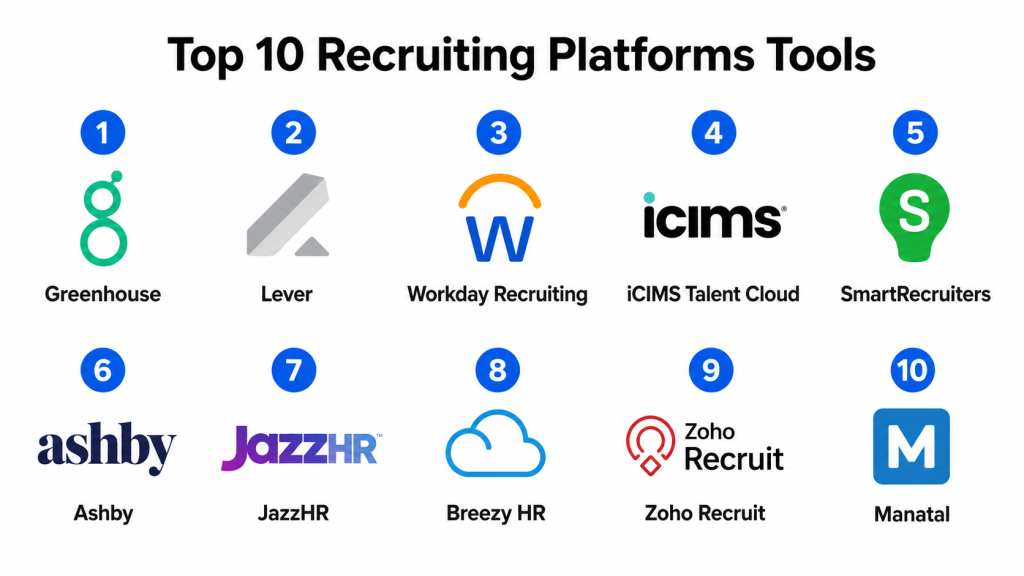
Top 10 Recruiting Platforms Tools
#1 — Greenhouse
Short description: Greenhouse is a widely used recruiting platform focused on structured hiring, applicant tracking, interview planning, scorecards, candidate experience, and recruiting analytics. It is especially strong for mid-market and enterprise teams that want disciplined hiring workflows.
Key Features
- Applicant tracking and pipeline management
- Structured interview kits and scorecards
- Job posting and career page support
- Candidate communication workflows
- Recruiting analytics and hiring reports
- Interview scheduling and team collaboration
- Integrations with HR, sourcing, and assessment tools
Pros
- Strong structured hiring approach for consistent candidate evaluation.
- Good collaboration features for recruiters and hiring managers.
- Strong ecosystem of recruiting and HR integrations.
Cons
- May feel complex for very small hiring teams.
- Advanced configuration may require setup time.
- Pricing may be better suited for growing or established companies.
Platforms / Deployment
Web / iOS / Android
Cloud
Security & Compliance
Greenhouse supports common enterprise recruiting security needs such as user permissions and access controls. Specific certifications and compliance details should be verified during vendor review.
SOC 2 / ISO 27001 / GDPR / HIPAA: Not publicly stated.
Integrations & Ecosystem
Greenhouse has a strong recruiting ecosystem and is often connected with HRIS, assessment, sourcing, background check, onboarding, and calendar systems.
- HRIS platforms
- Job boards
- Candidate assessment tools
- Background check providers
- Calendar and email tools
- Onboarding systems
Support & Community
Greenhouse offers documentation, onboarding resources, customer support, and a strong user community. Support quality may vary by plan and customer size.
#2 — Lever
Short description: Lever is a recruiting platform that combines applicant tracking with candidate relationship management. It is useful for companies that want to manage both active applicants and long-term talent pipelines.
Key Features
- Applicant tracking system
- Candidate relationship management
- Talent pipeline management
- Interview scheduling and feedback workflows
- Hiring analytics and reporting
- Email campaign support
- Collaboration tools for recruiters and hiring teams
Pros
- Strong for proactive recruiting and talent nurturing.
- Useful for teams managing passive candidates.
- Clean workflow for recruiter and hiring manager collaboration.
Cons
- May require process discipline to get full CRM value.
- Smaller teams may not need all pipeline features.
- Some advanced functionality may depend on package level.
Platforms / Deployment
Web
Cloud
Security & Compliance
Lever supports role-based access patterns and recruiting data controls. Specific certifications, audit features, and compliance coverage should be confirmed directly with the vendor.
SOC 2 / ISO 27001 / GDPR / HIPAA: Not publicly stated.
Integrations & Ecosystem
Lever integrates with recruiting, HRIS, calendar, email, assessment, sourcing, and background check tools. It is especially useful when candidate relationship management is important.
- HRIS tools
- Job boards
- Sourcing platforms
- Calendar and email tools
- Assessment tools
- Background check services
Support & Community
Lever provides documentation, onboarding assistance, support resources, and customer success options. Support experience may depend on subscription level and company size.
#3 — Workday Recruiting
Short description: Workday Recruiting is part of the broader Workday HCM ecosystem. It is designed for organizations that want recruiting connected closely with HR, workforce planning, employee data, and enterprise reporting.
Key Features
- Applicant tracking and requisition management
- Candidate pipeline and hiring workflows
- Job posting and offer management support
- Integration with Workday HCM data
- Recruiting analytics and reporting
- Manager and recruiter collaboration
- Enterprise workforce planning alignment
Pros
- Strong fit for companies already using Workday HCM.
- Good alignment between recruiting and employee lifecycle data.
- Useful for enterprise-grade workforce planning and reporting.
Cons
- Less suitable for teams not using Workday ecosystem.
- Implementation can be complex.
- May feel heavy for smaller hiring teams.
Platforms / Deployment
Web / iOS / Android
Cloud
Security & Compliance
Workday Recruiting benefits from enterprise security patterns within the Workday ecosystem, including access controls and role-based permissions. Specific certifications should be confirmed during procurement.
SOC 2 / ISO 27001 / GDPR / HIPAA: Not publicly stated.
Integrations & Ecosystem
Workday Recruiting works best within the Workday ecosystem but can also connect with recruiting-related tools, assessments, background checks, and job distribution platforms.
- Workday HCM
- Job boards
- Assessment tools
- Background check providers
- Onboarding workflows
- Reporting and analytics systems
Support & Community
Workday provides enterprise support, implementation partners, documentation, and customer success programs. Support experience may vary by contract and partner model.
#4 — iCIMS Talent Cloud
Short description: iCIMS Talent Cloud is an enterprise-focused recruiting platform that supports applicant tracking, candidate engagement, career sites, recruitment marketing, analytics, and hiring workflows.
Key Features
- Applicant tracking and requisition management
- Candidate relationship management
- Recruitment marketing tools
- Career site support
- Interview and offer workflows
- Recruiting analytics
- Integration marketplace
Pros
- Strong for enterprise recruiting and high-volume hiring.
- Good candidate engagement and recruitment marketing capabilities.
- Scalable for larger talent acquisition teams.
Cons
- May be more complex than needed for smaller companies.
- Implementation and configuration can take time.
- User experience may depend heavily on setup.
Platforms / Deployment
Web / iOS / Android
Cloud
Security & Compliance
iCIMS supports enterprise recruiting security patterns such as permissions, data controls, and access management. Specific certifications and compliance claims should be validated directly.
SOC 2 / ISO 27001 / GDPR / HIPAA: Not publicly stated.
Integrations & Ecosystem
iCIMS has a broad recruiting ecosystem across HRIS, job boards, assessments, background checks, onboarding, and recruitment marketing tools.
- HRIS systems
- Job board networks
- Assessment platforms
- Background check tools
- Recruitment marketing systems
- Onboarding platforms
Support & Community
iCIMS offers customer support, documentation, implementation assistance, and enterprise service options. Support depth can vary by package and organization size.
#5 — SmartRecruiters
Short description: SmartRecruiters is a recruiting platform built for collaborative hiring, candidate experience, job distribution, applicant tracking, and recruitment marketing. It serves growing and enterprise hiring teams.
Key Features
- Applicant tracking and candidate pipeline management
- Job advertising and distribution
- Career site and candidate experience tools
- Interview scheduling and collaboration
- Offer management workflows
- Recruiting analytics
- Marketplace integrations
Pros
- Strong focus on collaborative hiring and candidate experience.
- Useful job distribution and recruitment marketing capabilities.
- Good fit for companies scaling hiring operations.
Cons
- Some advanced features may require higher-tier plans.
- Configuration may take time for complex workflows.
- Smaller teams may find simpler tools easier to manage.
Platforms / Deployment
Web / iOS / Android
Cloud
Security & Compliance
SmartRecruiters supports common enterprise security needs such as permissions and access control. Exact certifications and compliance details should be confirmed during buyer evaluation.
SOC 2 / ISO 27001 / GDPR / HIPAA: Not publicly stated.
Integrations & Ecosystem
SmartRecruiters offers integrations across job boards, HRIS, assessment, background checks, onboarding, and recruitment marketing tools.
- Job boards
- HRIS platforms
- Assessment providers
- Background check providers
- Interview scheduling tools
- Onboarding systems
Support & Community
SmartRecruiters provides documentation, customer support, onboarding resources, and partner ecosystem access. Support quality may depend on plan and implementation scope.
#6 — Ashby
Short description: Ashby is a modern recruiting platform focused on applicant tracking, scheduling, recruiting analytics, pipeline visibility, and hiring operations. It is popular with high-growth teams that care deeply about data and workflow quality.
Key Features
- Applicant tracking and pipeline management
- Interview scheduling automation
- Recruiting analytics and dashboards
- Candidate relationship management
- Structured interview workflows
- Email and communication tools
- Hiring team collaboration
Pros
- Strong analytics and reporting for recruiting operations.
- Modern interface and workflow design.
- Good fit for fast-growing companies and talent teams.
Cons
- May require setup effort to fully customize workflows.
- Smaller teams may not need the full analytics depth.
- Some enterprise requirements should be validated carefully.
Platforms / Deployment
Web
Cloud
Security & Compliance
Ashby supports common recruiting platform security controls such as access management and permissions. Specific compliance certifications should be verified with the vendor.
SOC 2 / ISO 27001 / GDPR / HIPAA: Not publicly stated.
Integrations & Ecosystem
Ashby integrates with HRIS, job boards, calendars, sourcing tools, assessments, and other recruiting systems. It is useful for teams that want strong data visibility.
- HRIS platforms
- Calendar and email tools
- Job boards
- Sourcing tools
- Assessment platforms
- Analytics workflows
Support & Community
Ashby provides product documentation, onboarding support, and customer support resources. Community strength is growing, especially among modern talent operations teams.
#7 — JazzHR
Short description: JazzHR is an SMB-friendly recruiting platform focused on applicant tracking, job posting, interview workflows, candidate communication, and hiring team collaboration. It is useful for smaller companies building a more structured hiring process.
Key Features
- Applicant tracking system
- Job posting and distribution
- Candidate pipeline management
- Interview scheduling and feedback
- Offer and approval workflows
- Hiring team collaboration
- Basic recruiting reporting
Pros
- Practical for small and growing businesses.
- Easier to adopt than many enterprise recruiting suites.
- Good fit for teams moving away from manual hiring workflows.
Cons
- May not fit complex enterprise recruiting operations.
- Analytics and automation depth may be limited compared with larger platforms.
- Some integrations may depend on package or setup.
Platforms / Deployment
Web
Cloud
Security & Compliance
JazzHR supports basic recruiting platform security and user access controls. Specific security certifications and compliance details should be validated during evaluation.
SOC 2 / ISO 27001 / GDPR / HIPAA: Not publicly stated.
Integrations & Ecosystem
JazzHR integrates with job boards, HR tools, background checks, assessments, and communication systems. It is useful for SMBs that want a practical recruiting stack.
- Job boards
- HR software
- Background check tools
- Assessment platforms
- Email and calendar tools
- Onboarding tools
Support & Community
JazzHR provides documentation, support resources, and onboarding assistance. It is generally positioned for teams that want practical guidance without heavy enterprise implementation.
#8 — Breezy HR
Short description: Breezy HR is a recruiting platform designed for small and mid-sized teams that need applicant tracking, visual pipelines, career pages, job distribution, scheduling, and candidate communication.
Key Features
- Visual candidate pipeline
- Job posting and career page tools
- Candidate messaging and email templates
- Interview scheduling
- Team collaboration and scorecards
- Automation rules
- Basic reporting and analytics
Pros
- Simple and visual hiring workflow.
- Good fit for SMBs and startups.
- Easy for hiring managers to understand and use.
Cons
- May not support complex enterprise workflows.
- Advanced analytics may be limited compared with enterprise tools.
- Some features may require higher plans.
Platforms / Deployment
Web / iOS / Android
Cloud
Security & Compliance
Breezy HR supports common user access and recruiting data controls. Specific certifications and compliance details should be confirmed during vendor review.
SOC 2 / ISO 27001 / GDPR / HIPAA: Not publicly stated.
Integrations & Ecosystem
Breezy HR connects with job boards, HR tools, calendars, assessments, background checks, and communication tools. Its ecosystem is suitable for smaller teams building a connected hiring workflow.
- Job boards
- Calendar systems
- Assessment tools
- Background checks
- HRIS platforms
- Communication tools
Support & Community
Breezy HR provides product documentation, support resources, and onboarding help. Community strength is stronger among SMB and startup users.
#9 — Zoho Recruit
Short description: Zoho Recruit is a recruiting platform for corporate HR teams and staffing agencies. It supports applicant tracking, candidate sourcing, job posting, interview management, client submissions, and automation.
Key Features
- Applicant tracking and candidate database
- Job posting and sourcing support
- Workflow automation
- Resume parsing
- Interview scheduling
- Staffing agency workflows
- Integration with Zoho ecosystem
Pros
- Strong value for teams already using Zoho products.
- Flexible for both in-house recruiting and staffing agencies.
- Good automation and workflow customization options.
Cons
- Interface may require learning for new users.
- Advanced customization can take setup time.
- Enterprise-grade needs should be validated carefully.
Platforms / Deployment
Web / iOS / Android
Cloud
Security & Compliance
Zoho Recruit supports user permissions and account-level security controls. Specific compliance certifications and data residency requirements should be confirmed during vendor evaluation.
SOC 2 / ISO 27001 / GDPR / HIPAA: Not publicly stated.
Integrations & Ecosystem
Zoho Recruit connects strongly with the broader Zoho ecosystem and also supports integrations with job boards, email, calendar, assessments, and business tools.
- Zoho CRM and business apps
- Job boards
- Email and calendar tools
- Assessment platforms
- Background check tools
- HR and onboarding systems
Support & Community
Zoho provides documentation, support resources, training materials, and a broad product community. Support experience may vary by plan and region.
#10 — Manatal
Short description: Manatal is a recruiting platform focused on applicant tracking, candidate sourcing, AI-assisted recommendations, CRM-style candidate management, and recruitment workflows. It is used by companies and recruitment agencies looking for a modern, practical recruiting system.
Key Features
- Applicant tracking and pipeline management
- AI-assisted candidate recommendations
- Candidate relationship management
- Resume parsing and enrichment features
- Job posting support
- Collaboration and activity tracking
- Recruiting reports and dashboards
Pros
- Useful AI-assisted features for candidate matching and sourcing.
- Practical for recruitment agencies and growing HR teams.
- Generally easier to adopt than larger enterprise systems.
Cons
- May not fit very complex enterprise recruiting requirements.
- Buyers should validate integration depth for their exact stack.
- Advanced governance needs should be reviewed carefully.
Platforms / Deployment
Web
Cloud
Security & Compliance
Manatal supports common recruiting platform security features such as user permissions and data controls. Specific compliance certifications should be confirmed directly with the vendor.
SOC 2 / ISO 27001 / GDPR / HIPAA: Not publicly stated.
Integrations & Ecosystem
Manatal integrates with job boards, email, calendar tools, sourcing workflows, and recruitment-related systems. It is useful for teams that want a practical recruiting platform with AI-assisted workflow support.
- Job boards
- Email tools
- Calendar systems
- Candidate sourcing tools
- Recruitment agency workflows
- Reporting systems
Support & Community
Manatal provides documentation, support resources, and onboarding assistance. Community strength is growing among recruitment agencies and small-to-mid-sized hiring teams.
Comparison Table
| Tool Name | Best For | Platform(s) Supported | Deployment | Standout Feature | Public Rating |
|---|---|---|---|---|---|
| Greenhouse | Structured hiring for mid-market and enterprise teams | Web, iOS, Android | Cloud | Interview scorecards and hiring process control | N/A |
| Lever | Talent CRM and applicant tracking | Web | Cloud | Candidate relationship management | N/A |
| Workday Recruiting | Enterprise recruiting connected to HCM | Web, iOS, Android | Cloud | Workday HCM ecosystem alignment | N/A |
| iCIMS Talent Cloud | Enterprise and high-volume recruiting | Web, iOS, Android | Cloud | Recruitment marketing and scalable ATS | N/A |
| SmartRecruiters | Collaborative hiring and job distribution | Web, iOS, Android | Cloud | Candidate experience and marketplace ecosystem | N/A |
| Ashby | Data-driven recruiting operations | Web | Cloud | Recruiting analytics and scheduling workflows | N/A |
| JazzHR | SMB applicant tracking | Web | Cloud | Simple hiring workflow for growing teams | N/A |
| Breezy HR | Startups and SMB hiring teams | Web, iOS, Android | Cloud | Visual hiring pipeline | N/A |
| Zoho Recruit | Corporate HR and staffing agencies | Web, iOS, Android | Cloud | Recruiting automation within Zoho ecosystem | N/A |
| Manatal | AI-assisted recruiting for agencies and SMBs | Web | Cloud | AI candidate recommendations | N/A |
Evaluation & Scoring of Recruiting Platforms
The scoring below is comparative and based on practical recruiting platform evaluation criteria. A higher score does not mean a tool is the best for every company. It means the platform performs strongly against this model. Your final selection should depend on hiring volume, company size, workflow complexity, integrations, budget, security needs, and candidate experience goals.
| Tool Name | Core (25%) | Ease (15%) | Integrations (15%) | Security (10%) | Performance (10%) | Support (10%) | Value (15%) | Weighted Total (0–10) |
|---|---|---|---|---|---|---|---|---|
| Greenhouse | 9.2 | 8.0 | 9.0 | 8.6 | 8.8 | 8.4 | 7.8 | 8.56 |
| Lever | 8.8 | 8.2 | 8.6 | 8.4 | 8.5 | 8.2 | 7.8 | 8.35 |
| Workday Recruiting | 8.7 | 7.2 | 8.7 | 8.8 | 8.8 | 8.3 | 7.4 | 8.23 |
| iCIMS Talent Cloud | 8.9 | 7.4 | 8.6 | 8.7 | 8.7 | 8.2 | 7.5 | 8.29 |
| SmartRecruiters | 8.7 | 8.1 | 8.6 | 8.4 | 8.5 | 8.1 | 7.9 | 8.38 |
| Ashby | 8.8 | 8.5 | 8.5 | 8.2 | 8.5 | 8.0 | 8.0 | 8.46 |
| JazzHR | 7.6 | 8.7 | 7.5 | 7.8 | 8.0 | 7.8 | 8.5 | 7.98 |
| Breezy HR | 7.7 | 8.8 | 7.6 | 7.8 | 8.0 | 7.8 | 8.4 | 8.03 |
| Zoho Recruit | 8.0 | 8.0 | 8.1 | 7.9 | 8.1 | 7.8 | 8.6 | 8.10 |
| Manatal | 7.9 | 8.4 | 7.6 | 7.8 | 8.0 | 7.7 | 8.5 | 8.01 |
Use these scores as a practical comparison guide, not as a universal ranking. Greenhouse, iCIMS, and Workday Recruiting are stronger for structured or enterprise hiring. Ashby is strong for recruiting analytics and fast-growing teams. JazzHR, Breezy HR, Zoho Recruit, and Manatal can be better for SMBs or agencies that need faster adoption and better value. Always validate pricing, integrations, security documentation, and implementation effort before making a final decision.
Which Recruiting Platforms Tool Is Right for You?
Solo / Freelancer
Solo professionals usually do not need a full recruiting platform unless they are running a recruiting agency or hiring regularly for clients. For occasional hiring, simple job boards, email, spreadsheets, or project management tools may be enough.
If you work as an independent recruiter, a lightweight platform like Zoho Recruit, Manatal, or Breezy HR can help manage candidates, communication, and client workflows more professionally.
SMB
Small and growing companies should focus on ease of use, quick setup, job posting, candidate pipeline management, interview feedback, and basic reporting. JazzHR, Breezy HR, Zoho Recruit, Manatal, and BambooHR-style recruiting tools can be good fits.
SMBs should avoid choosing a platform only because it has many features. A simpler tool that the whole hiring team actually uses is often better than a complex system that stays underused.
Mid-Market
Mid-market companies usually need stronger workflow automation, better reporting, structured interviews, HRIS integrations, approval flows, and hiring manager collaboration. Greenhouse, Lever, SmartRecruiters, Ashby, and iCIMS can be strong options.
At this stage, recruiting teams should also look at candidate experience, compliance, reporting, and how easily the platform connects with onboarding and HRIS systems.
Enterprise
Enterprise companies need scalability, permissions, compliance support, auditability, global workflows, structured reporting, and integrations with HR, finance, identity, and workforce planning systems. Workday Recruiting, iCIMS Talent Cloud, Greenhouse, SmartRecruiters, and SAP-style enterprise recruiting modules are usually stronger fits.
Enterprise buyers should plan for change management, process standardization, data migration, governance, and integration architecture before rollout.
Budget vs Premium
Budget-focused teams should look for platforms that cover core applicant tracking, job posting, candidate communication, and basic reporting without heavy implementation effort. JazzHR, Breezy HR, Zoho Recruit, and Manatal may offer better practical value for smaller teams.
Premium platforms make sense when hiring volume is high, workflows are complex, compliance needs are stronger, and recruiting leaders need advanced analytics, integrations, and structured hiring controls.
Feature Depth vs Ease of Use
Feature-rich recruiting platforms give more control, reporting, and customization, but they may require more training and setup. Simpler platforms are faster to adopt but may have limits as hiring processes become more complex.
Choose feature depth if your company has multiple recruiters, many open roles, structured interviews, approvals, and compliance needs. Choose ease of use if speed, simplicity, and hiring manager adoption matter most.
Integrations & Scalability
Recruiting platforms should connect with HRIS, onboarding, payroll, calendars, email, job boards, assessments, background checks, and analytics tools. If integrations are weak, recruiters may end up doing manual data entry.
Growing companies should choose platforms that can scale from basic hiring to structured recruiting operations without forcing a painful migration too soon.
Security & Compliance Needs
Recruiting platforms store resumes, contact details, work history, interview feedback, compensation discussions, and sometimes sensitive candidate documents. Security should be a serious buying criterion.
Look for role-based access, SSO, MFA, audit logs, permission controls, data retention options, privacy support, and clear vendor security documentation. For regulated industries, security review should happen before signing the contract.
Frequently Asked Questions
1. What is a recruiting platform?
A recruiting platform is software that helps companies manage hiring workflows. It usually includes applicant tracking, job posting, candidate communication, interview scheduling, feedback collection, and recruiting reports.
2. How is a recruiting platform different from an ATS?
An ATS mainly tracks applicants and hiring stages. A modern recruiting platform may include ATS features plus sourcing, CRM, automation, analytics, career sites, recruitment marketing, and onboarding integrations.
3. How much does a recruiting platform cost?
Pricing varies by vendor, company size, number of users, number of jobs, feature modules, and support level. Some tools are priced for SMBs, while enterprise platforms often use custom pricing.
4. How long does implementation take?
Implementation depends on data migration, hiring workflow complexity, integrations, approval flows, and user training. Simple tools can be deployed faster, while enterprise platforms need a structured rollout plan.
5. What is the most common mistake when choosing recruiting software?
The most common mistake is selecting a platform without mapping the hiring process first. Teams should define stages, roles, approvals, scorecards, integrations, and reporting needs before buying.
6. Are recruiting platforms secure?
Recruiting platforms can be secure when they include strong access controls, permissions, data protection, and audit-friendly workflows. Buyers should always review vendor security documentation and privacy controls.
7. Can recruiting platforms integrate with HRIS tools?
Yes, many recruiting platforms integrate with HRIS tools so candidate data can move smoothly into employee records after hiring. Integration depth varies by vendor and package.
8. Do recruiting platforms support AI features?
Many modern recruiting platforms include AI-assisted features such as resume parsing, candidate matching, job description assistance, candidate summaries, and workflow suggestions. Buyers should review how AI is used and whether it fits compliance expectations.
9. When should a company switch recruiting platforms?
A company should consider switching when its current process causes poor candidate experience, manual tracking, weak reporting, missed follow-ups, poor integrations, or lack of visibility into hiring performance.
10. What are alternatives to recruiting platforms?
Alternatives include spreadsheets, job boards, email workflows, CRM tools, HRIS recruiting modules, staffing agency systems, or project management tools. These may work for small teams but can become difficult at scale.
Conclusion
Recruiting platforms help companies move from scattered hiring activity to a more structured, measurable, and candidate-friendly process. The right platform can improve recruiter productivity, hiring manager collaboration, candidate communication, interview consistency, and reporting visibility. However, there is no single best recruiting platform for every company. A startup may need a simple and affordable applicant tracking system, while a mid-market company may need better automation and analytics. An enterprise may need advanced permissions, compliance support, global workflows, and deep HRIS integration.
