Upgrade & Secure Your Future with DevOps, SRE, DevSecOps, MLOps!
We spend hours scrolling social media and waste money on things we forget, but won’t spend 30 minutes a day earning certifications that can change our lives.
Master in DevOps, SRE, DevSecOps & MLOps by DevOps School!
Learn from Guru Rajesh Kumar and double your salary in just one year.
Introduction
Web Application Firewall platforms protect websites, web apps, APIs, login pages, checkout pages, dashboards, and customer portals from harmful web traffic. In simple words, a WAF checks requests before they reach your application and blocks suspicious activity such as SQL injection, cross-site scripting, malicious bots, fake login attempts, scraping, API abuse, and other application-layer threats.
WAF platforms matter because businesses now depend heavily on digital applications. Customers use online portals, mobile apps, payment pages, SaaS tools, and APIs every day. If these applications are attacked, companies can face downtime, data exposure, compliance issues, and loss of trust.
Common use cases include ecommerce protection, SaaS application security, API protection, login abuse prevention, payment page security, healthcare portal protection, and banking application defense.
Buyers should evaluate detection quality, false positive control, API security, bot protection, deployment model, performance impact, reporting, integrations, compliance support, ease of use, and support quality.
Best for: Security teams, DevOps teams, platform engineers, SaaS companies, ecommerce businesses, financial services, healthcare organizations, and enterprises with public-facing applications.
Not ideal for: Very small static websites, low-risk personal blogs, or teams that only need basic hosting protection. A WAF also cannot replace secure coding, vulnerability testing, identity security, and patch management.
Key Trends in Web Application Firewall Platforms
- API protection is becoming a core WAF requirement because many modern attacks now target API endpoints instead of traditional web pages.
- Bot management is becoming closely connected with WAF as businesses face credential stuffing, scraping, fake accounts, spam, and automated abuse.
- AI-assisted threat detection is improving response quality by helping security teams identify unusual traffic patterns faster.
- Cloud and edge deployment models are becoming more common because companies want faster protection without managing heavy infrastructure.
- WAAP platforms are gaining popularity because they combine WAF, API security, bot protection, and DDoS protection in one security layer.
- False positive reduction is a major buying factor because blocking real customers can damage revenue and user experience.
- Compliance reporting is becoming more important for finance, healthcare, ecommerce, SaaS, and public-sector applications.
- DevSecOps integration is growing as teams want WAF alerts connected to SIEM, SOAR, ticketing, observability, and incident response workflows.
- Multi-cloud and hybrid support matter more because many companies run applications across cloud, on-premises, and edge environments.
- Usage-based pricing needs careful review because high traffic, bot attacks, and API growth can affect total cost.
How We Selected These Tools
The following Web Application Firewall platforms were selected using a practical product-analysis approach:
- Market adoption and strong recognition among security and cloud teams.
- Core WAF capabilities such as traffic inspection, managed rules, custom rules, and attack blocking.
- API security features for modern application environments.
- Bot protection and abuse prevention capabilities.
- Deployment flexibility across cloud, edge, hybrid, and self-hosted environments.
- Performance and reliability signals for high-traffic applications.
- Security posture signals such as access control, logs, policy management, and encryption support.
- Integration ecosystem with SIEM, cloud, DevOps, observability, and security tools.
- Fit for different business sizes, from SMBs to large enterprises.
- Practical usability for real security operations and application teams.
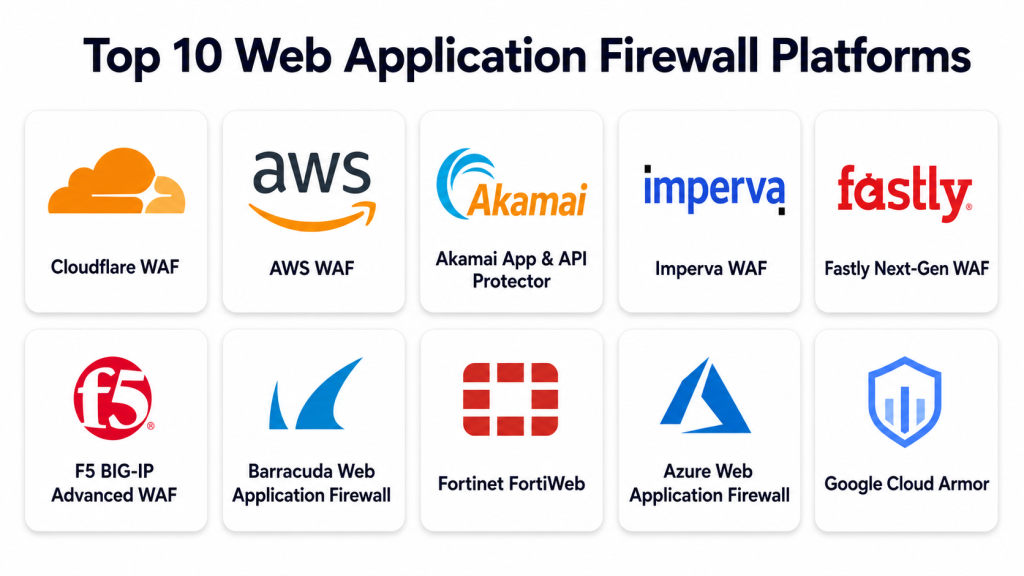
Top 10 Web Application Firewall Platforms
#1 — Cloudflare WAF
Short description:
Cloudflare WAF is a cloud-based web application firewall built into Cloudflare’s global edge network. It helps protect websites, APIs, ecommerce platforms, SaaS applications, and customer portals from common web attacks. It is suitable for SMBs, growing digital businesses, and large enterprises that need fast deployment and strong edge protection. Cloudflare is often chosen by teams that want WAF, CDN, bot protection, DDoS protection, and performance features in one platform.
Key Features
- Managed WAF rules for common web application attacks.
- Custom firewall rules for flexible traffic control.
- API protection and rate limiting.
- Bot management capabilities.
- DDoS protection through edge infrastructure.
- Security analytics and event visibility.
- CDN and performance optimization features.
Pros
- Easy to start compared with many enterprise WAF tools.
- Strong global edge network with performance benefits.
- Suitable for websites, APIs, SaaS apps, and ecommerce platforms.
Cons
- Advanced features may require higher-tier plans.
- Rule tuning may still be needed for complex applications.
- Pricing can vary based on traffic, features, and business needs.
Platforms / Deployment
Web / Cloud
Security & Compliance
Cloudflare supports enterprise security controls such as encryption, access controls, logging, and policy management. Specific compliance details vary by product and plan. If not clearly confirmed for a specific use case, mark as Not publicly stated.
Integrations & Ecosystem
Cloudflare has a broad ecosystem covering DNS, CDN, Zero Trust, analytics, developer tools, and security workflows.
- SIEM integrations
- API access
- CDN and DNS services
- Terraform support
- Bot protection ecosystem
- Security event logging
Support & Community
Cloudflare has strong documentation, a large user community, and enterprise support options. Smaller teams can usually start with documentation and standard support resources.
#2 — AWS WAF
Short description:
AWS WAF is a cloud-native web application firewall designed for applications running in the AWS ecosystem. It helps protect web applications and APIs from common exploits, unwanted traffic, and abusive requests. It works well with services such as Amazon CloudFront, Application Load Balancer, API Gateway, and AppSync. AWS WAF is best suited for cloud, DevOps, and platform teams already using AWS infrastructure.
Key Features
- Web ACLs for traffic filtering.
- AWS managed rule groups.
- Custom rule creation.
- Rate-based rules for abusive traffic.
- Bot control options.
- Integration with AWS security services.
- Logging and monitoring through AWS tools.
Pros
- Strong fit for AWS-hosted applications.
- Flexible rule management.
- Good integration with AWS-native security and monitoring services.
Cons
- Best suited for AWS environments.
- Requires AWS knowledge for proper setup and tuning.
- Pricing may become complex with rules, requests, and managed features.
Platforms / Deployment
Web / Cloud
Security & Compliance
AWS WAF uses AWS security controls and integrates with AWS identity, logging, and monitoring services. Specific compliance posture depends on configuration, region, and workload requirements. If details are not clearly confirmed, use Not publicly stated.
Integrations & Ecosystem
AWS WAF fits naturally into AWS cloud architecture and security operations.
- Amazon CloudFront
- Application Load Balancer
- Amazon API Gateway
- AWS Shield
- Amazon CloudWatch
- AWS Firewall Manager
Support & Community
AWS provides detailed documentation, strong community knowledge, and support options based on the customer’s AWS support plan.
#3 — Akamai App & API Protector
Short description:
Akamai App & API Protector is an enterprise-grade WAF and API security platform built for large-scale web applications and digital services. It helps protect applications, APIs, and high-traffic websites through Akamai’s edge infrastructure. It is suitable for enterprises, financial services, ecommerce companies, media platforms, and organizations with complex application security needs. It is often considered when performance, scale, and advanced protection are important.
Key Features
- Web application firewall protection.
- API discovery and protection capabilities.
- Edge-based traffic inspection.
- Bot visibility and mitigation support.
- Adaptive security controls.
- Advanced security analytics.
- Enterprise policy management.
Pros
- Strong fit for large enterprises and high-traffic applications.
- Mature edge security and delivery ecosystem.
- Useful for complex application and API portfolios.
Cons
- May be too complex for smaller teams.
- Enterprise pricing may not suit smaller businesses.
- Requires careful onboarding and policy tuning.
Platforms / Deployment
Web / Cloud / Hybrid
Security & Compliance
Akamai provides enterprise security controls such as policy management, logging, access control, and traffic protection. Specific certifications and compliance details should be validated for the required product and region. If unknown, use Not publicly stated.
Integrations & Ecosystem
Akamai integrates well with enterprise security, delivery, and monitoring workflows.
- SIEM integrations
- API security workflows
- CDN and edge delivery
- Bot protection tools
- Security analytics
- Enterprise reporting systems
Support & Community
Akamai offers enterprise onboarding, technical support, and documentation. It is best suited for teams with mature security and platform operations.
#4 — Imperva WAF
Short description:
Imperva WAF is a mature web application firewall platform focused on protecting applications, websites, and APIs from application-layer attacks. It is commonly used by enterprises, regulated industries, ecommerce companies, and organizations with strong security requirements. Imperva combines WAF protection with bot mitigation, DDoS protection options, and security analytics. It is a strong option for teams that need detailed visibility and enterprise-grade protection.
Key Features
- Protection against common web application attacks.
- API security support.
- Bot mitigation capabilities.
- DDoS protection options.
- Managed and custom security rules.
- Security analytics and reporting.
- Support for cloud and enterprise environments.
Pros
- Strong application security focus.
- Good fit for regulated and enterprise environments.
- Broad protection for websites, apps, and APIs.
Cons
- May need careful rule tuning.
- Advanced use cases may increase cost and complexity.
- Smaller teams may need support during setup.
Platforms / Deployment
Web / Cloud / Hybrid
Security & Compliance
Imperva supports enterprise security controls such as logging, policy management, access control, and traffic protection. Specific compliance details should be verified for the selected product and plan. Use Not publicly stated where information is not clear.
Integrations & Ecosystem
Imperva fits into enterprise security operations and application security workflows.
- SIEM tools
- API security workflows
- Bot management
- DDoS protection ecosystem
- Cloud security tools
- Reporting and alerting systems
Support & Community
Imperva provides enterprise documentation, support, onboarding, and security expertise. It has strong recognition among application security teams.
#5 — Fastly Next-Gen WAF
Short description:
Fastly Next-Gen WAF is designed for modern web applications and APIs, with a focus on accurate detection and reduced operational friction. It is often used by developer-first teams, SaaS companies, ecommerce platforms, and businesses that value performance with security. Fastly’s approach is useful for teams that want protection without heavy rule maintenance. It can be a strong fit where APIs, edge delivery, and DevSecOps workflows are important.
Key Features
- Web application and API protection.
- Signal-based attack detection.
- Lower false-positive approach.
- Edge deployment support.
- Security analytics and observability.
- Custom policy controls.
- DevOps-friendly workflows.
Pros
- Good fit for developer and platform teams.
- Strong balance of performance and security.
- Useful for API-heavy applications.
Cons
- Best value may come when used with Fastly’s broader ecosystem.
- Advanced setup may need security expertise.
- Pricing depends on traffic, features, and business requirements.
Platforms / Deployment
Web / Cloud / Edge
Security & Compliance
Fastly provides security controls such as encryption support, policy management, logging, and access controls. Specific certifications and compliance details should be validated directly. If unclear, use Not publicly stated.
Integrations & Ecosystem
Fastly works well with modern application delivery, observability, and DevSecOps workflows.
- CDN and edge services
- API security workflows
- Logging platforms
- SIEM tools
- DevOps pipelines
- Observability tools
Support & Community
Fastly has strong technical documentation and support options. It is especially useful for teams comfortable with developer-focused platforms.
#6 — F5 BIG-IP Advanced WAF
Short description:
F5 BIG-IP Advanced WAF is an enterprise web application firewall designed for complex, high-control application environments. It is commonly used by large organizations with hybrid infrastructure, data centers, cloud workloads, and strict security requirements. F5 is well suited for teams that need deep traffic inspection, strong policy control, and integration with application delivery infrastructure. It is powerful but may require experienced administrators.
Key Features
- Advanced WAF policy management.
- Bot defense capabilities.
- API protection support.
- Application-layer attack mitigation.
- Behavioral analytics features.
- Hybrid deployment support.
- Integration with F5 application delivery tools.
Pros
- Strong fit for enterprise and hybrid environments.
- Deep control over application traffic and policies.
- Mature application delivery and security ecosystem.
Cons
- Can be complex to deploy and manage.
- May require trained administrators.
- Not ideal for small teams with simple websites.
Platforms / Deployment
Web / Self-hosted / Hybrid / Cloud options vary
Security & Compliance
F5 supports enterprise controls such as RBAC, logging, encryption, and policy governance. Specific compliance details vary by deployment and configuration. Use Not publicly stated when not clearly confirmed.
Integrations & Ecosystem
F5 integrates strongly with enterprise networking, application delivery, and security operations.
- Load balancing
- Application delivery controllers
- SIEM integrations
- API protection workflows
- Hybrid cloud environments
- Security analytics tools
Support & Community
F5 has mature documentation, enterprise support, training resources, and a strong professional community.
#7 — Barracuda Web Application Firewall
Short description:
Barracuda Web Application Firewall helps protect websites, applications, and APIs from attacks, data exposure, and unauthorized traffic. It is suitable for mid-market and enterprise organizations that want practical WAF protection with flexible deployment options. Barracuda offers cloud, virtual, and appliance-based deployment models. It is a good fit for teams that want application protection without unnecessary complexity.
Key Features
- Protection against common web attacks.
- API security capabilities.
- Bot and DDoS protection options.
- Data leakage prevention features.
- Authentication and access control support.
- Reporting and logging.
- Flexible deployment models.
Pros
- Good deployment flexibility.
- Practical for mid-market and enterprise teams.
- Balanced feature set for application protection.
Cons
- Advanced use cases may require tuning.
- Ecosystem may be narrower than large cloud-native platforms.
- Interface and management experience may vary by deployment.
Platforms / Deployment
Web / Cloud / Virtual / Hardware / Hybrid
Security & Compliance
Barracuda supports common enterprise security controls such as access control, logging, policy enforcement, and encryption. Specific certifications should be validated for the selected product and plan. Use Not publicly stated where details are unclear.
Integrations & Ecosystem
Barracuda fits into common infrastructure and security environments.
- SIEM tools
- Authentication systems
- Cloud platforms
- Logging systems
- API security workflows
- Network security tools
Support & Community
Barracuda provides documentation, support plans, and partner support. Community visibility is moderate compared with larger cloud-native platforms.
#8 — Fortinet FortiWeb
Short description:
Fortinet FortiWeb is a web application firewall designed to protect web applications and APIs from known and unknown threats. It is a good fit for organizations already using Fortinet security products or those needing flexible deployment models. FortiWeb combines WAF protection with bot mitigation, API protection, machine learning-assisted detection, and security analytics. It is often selected by enterprises that prefer integrated security platforms.
Key Features
- WAF protection for applications and APIs.
- Machine learning-assisted threat detection.
- Bot mitigation features.
- API discovery and protection options.
- Threat intelligence integration.
- Flexible deployment options.
- Security analytics and reporting.
Pros
- Strong fit for Fortinet ecosystem users.
- Multiple deployment models.
- Useful for enterprise security teams.
Cons
- Best value may come inside Fortinet’s ecosystem.
- Configuration may require security knowledge.
- Smaller teams may find it more advanced than needed.
Platforms / Deployment
Web / Cloud / Self-hosted / Virtual / Hardware / Hybrid
Security & Compliance
FortiWeb supports security features such as access control, logging, encryption, and policy management. Specific compliance claims should be verified for the exact deployment. Use Not publicly stated when details are not confirmed.
Integrations & Ecosystem
FortiWeb integrates closely with Fortinet’s broader security ecosystem.
- Fortinet Security Fabric
- SIEM integrations
- Cloud platforms
- Threat intelligence feeds
- API security workflows
- Network security tools
Support & Community
Fortinet has broad enterprise support, partner networks, documentation, and training resources.
#9 — Azure Web Application Firewall
Short description:
Azure Web Application Firewall is Microsoft’s cloud-native WAF service for applications hosted on Azure. It helps protect web applications from common threats and works with Azure Application Gateway and Azure Front Door. It is suitable for businesses already using Microsoft Azure for apps, portals, APIs, and enterprise services. Azure WAF is especially useful for teams that want security controls inside the Microsoft cloud ecosystem.
Key Features
- Managed WAF rules.
- Custom rules and exclusions.
- Protection for Azure-hosted applications.
- Integration with Azure Front Door.
- Integration with Azure Application Gateway.
- Logging and monitoring through Azure tools.
- Policy-based security management.
Pros
- Strong fit for Azure environments.
- Good integration with Microsoft cloud and security services.
- Useful for centralized cloud security management.
Cons
- Best suited for Azure workloads.
- Requires Azure knowledge for correct configuration.
- Rule tuning may be needed to reduce false positives.
Platforms / Deployment
Web / Cloud
Security & Compliance
Azure WAF depends on Azure security configuration, identity controls, logging, monitoring, and policy setup. Microsoft cloud services offer enterprise-grade security controls, but WAF-specific compliance details should be verified. Use Not publicly stated where uncertain.
Integrations & Ecosystem
Azure WAF works well inside Microsoft cloud and security operations.
- Azure Front Door
- Azure Application Gateway
- Microsoft Sentinel
- Azure Monitor
- Microsoft Defender ecosystem
- Azure Policy
Support & Community
Microsoft provides extensive documentation and cloud support options. Community knowledge is strong because of wide Azure adoption.
#10 — Google Cloud Armor
Short description:
Google Cloud Armor is a cloud-native security service that helps protect applications running on Google Cloud. It provides WAF capabilities, DDoS defense, rate limiting, and policy-based traffic control for internet-facing workloads. It is best suited for teams using Google Cloud infrastructure, global load balancing, and cloud-native applications. Google Cloud Armor helps security and platform teams apply protection close to Google’s edge network.
Key Features
- WAF rules for common web threats.
- DDoS protection support.
- Custom security policies.
- Rate limiting capabilities.
- Integration with Google Cloud Load Balancing.
- Adaptive protection features.
- Logging and monitoring through Google Cloud tools.
Pros
- Strong fit for Google Cloud workloads.
- Good edge-based protection model.
- Useful for cloud-native application teams.
Cons
- Best suited for Google Cloud environments.
- Requires cloud security knowledge.
- Less ideal for teams not using Google Cloud.
Platforms / Deployment
Web / Cloud
Security & Compliance
Google Cloud Armor works with Google Cloud security, identity, logging, encryption, and policy controls. Specific WAF-related compliance details should be validated for each workload. Use Not publicly stated where not clearly confirmed.
Integrations & Ecosystem
Google Cloud Armor integrates with Google Cloud infrastructure and security operations.
- Google Cloud Load Balancing
- Cloud Logging
- Cloud Monitoring
- Security Command Center
- Cloud CDN
- Google Cloud IAM
Support & Community
Google Cloud provides documentation, support plans, and growing community knowledge among cloud-native teams.
Comparison Table
| Tool Name | Best For | Platform(s) Supported | Deployment | Standout Feature | Public Rating |
|---|---|---|---|---|---|
| Cloudflare WAF | SMBs, SaaS, ecommerce, enterprises | Web | Cloud | Edge-based WAF with CDN, bot, and DDoS protection | N/A |
| AWS WAF | AWS-based applications | Web | Cloud | Native integration with AWS services | N/A |
| Akamai App & API Protector | Large enterprises and high-traffic apps | Web | Cloud / Hybrid | Enterprise edge protection for apps and APIs | N/A |
| Imperva WAF | Regulated industries and enterprise security teams | Web | Cloud / Hybrid | Mature application and API protection | N/A |
| Fastly Next-Gen WAF | Developer-first and API-heavy teams | Web | Cloud / Edge | Signal-based detection with lower false positives | N/A |
| F5 BIG-IP Advanced WAF | Large hybrid enterprises | Web | Self-hosted / Hybrid / Cloud options vary | Deep traffic control and policy management | N/A |
| Barracuda Web Application Firewall | Mid-market and enterprise teams | Web | Cloud / Virtual / Hardware / Hybrid | Flexible deployment options | N/A |
| Fortinet FortiWeb | Fortinet ecosystem users and enterprises | Web | Cloud / Self-hosted / Hybrid | Integrated WAF inside Fortinet security ecosystem | N/A |
| Azure Web Application Firewall | Microsoft Azure workloads | Web | Cloud | Native Azure security integration | N/A |
| Google Cloud Armor | Google Cloud workloads | Web | Cloud | Edge-based protection for Google Cloud applications | N/A |
Evaluation & Scoring of Web Application Firewall Platforms
| Tool Name | Core (25%) | Ease (15%) | Integrations (15%) | Security (10%) | Performance (10%) | Support (10%) | Value (15%) | Weighted Total (0–10) |
|---|---|---|---|---|---|---|---|---|
| Cloudflare WAF | 9 | 9 | 9 | 9 | 9 | 8 | 9 | 8.85 |
| AWS WAF | 8 | 7 | 9 | 8 | 8 | 8 | 8 | 8.05 |
| Akamai App & API Protector | 9 | 7 | 8 | 9 | 9 | 9 | 7 | 8.25 |
| Imperva WAF | 9 | 7 | 8 | 9 | 8 | 8 | 7 | 8.05 |
| Fastly Next-Gen WAF | 8 | 8 | 8 | 8 | 9 | 8 | 8 | 8.10 |
| F5 BIG-IP Advanced WAF | 9 | 6 | 8 | 9 | 8 | 9 | 7 | 7.95 |
| Barracuda Web Application Firewall | 8 | 7 | 7 | 8 | 7 | 8 | 8 | 7.55 |
| Fortinet FortiWeb | 8 | 7 | 8 | 8 | 8 | 8 | 8 | 7.85 |
| Azure Web Application Firewall | 8 | 7 | 9 | 8 | 8 | 8 | 8 | 8.05 |
| Google Cloud Armor | 8 | 7 | 8 | 8 | 8 | 8 | 8 | 7.90 |
These scores are comparative, not absolute. A higher score does not automatically mean the tool is the best for every business. Cloud-native teams may prefer native WAF services, while enterprises may need deeper policy control and hybrid deployment. Always validate cost, integrations, security requirements, support quality, and false positive handling before final selection.
Which Web Application Firewall Platform Is Right for You?
Solo / Freelancer
Solo users and freelancers usually need simple setup, low maintenance, and affordable protection. Cloudflare WAF is often a practical option because it combines DNS, CDN, WAF, and basic security controls in one place. If the application is already hosted on AWS, Azure, or Google Cloud, the native WAF service may also be easier to manage.
SMB
SMBs should focus on easy onboarding, managed rules, reporting, and predictable cost. Cloudflare WAF, Barracuda Web Application Firewall, AWS WAF, Azure WAF, and Google Cloud Armor can all work depending on infrastructure. The best choice is usually the platform that fits the company’s hosting environment and team skill level.
Mid-Market
Mid-market companies usually need stronger API protection, bot management, SIEM integration, and better reporting. Fastly Next-Gen WAF, Imperva WAF, Fortinet FortiWeb, and Barracuda WAF can be strong options. These teams should test alert quality, rule tuning, and support responsiveness before committing.
Enterprise
Enterprises need advanced policy control, hybrid support, audit logs, compliance workflows, high availability, and strong support. Akamai App & API Protector, Imperva WAF, F5 BIG-IP Advanced WAF, Fortinet FortiWeb, and Cloudflare enterprise offerings are strong candidates. The final decision should match application complexity, cloud strategy, and security operating model.
Budget vs Premium
Budget-focused teams should start with platforms that match their existing infrastructure and avoid unnecessary advanced features. Premium buyers should look for API discovery, bot protection, managed security services, compliance reporting, enterprise support, and advanced analytics. The lowest price is not always the best value if the tool creates operational gaps.
Feature Depth vs Ease of Use
Cloudflare WAF and cloud-native WAF tools are usually easier to start with. F5, Akamai, Imperva, and Fortinet offer deeper enterprise controls but may require more expertise. Teams should choose based on their ability to manage the tool properly, not only on feature lists.
Integrations & Scalability
AWS WAF is a strong fit for AWS workloads. Azure WAF is suitable for Microsoft Azure environments. Google Cloud Armor is practical for Google Cloud teams. Cloudflare, Akamai, Fastly, Imperva, and F5 may suit multi-cloud, high-traffic, or complex enterprise environments.
Security & Compliance Needs
Regulated businesses should focus on audit logs, access control, encryption, reporting, policy governance, and vendor compliance documentation. Security teams should also validate alert workflows, evidence collection, incident response integration, and support commitments.
Frequently Asked Questions
What is a Web Application Firewall?
A Web Application Firewall protects web applications and APIs by inspecting traffic and blocking harmful requests. It helps reduce risks from common web attacks and abusive automated traffic.
How is a WAF different from a normal firewall?
A normal firewall protects networks and ports. A WAF protects application-layer traffic such as URLs, forms, cookies, headers, login pages, and API requests.
Do small businesses need a WAF?
Small businesses need a WAF if they run ecommerce sites, login pages, customer portals, payment pages, or public applications. Very simple low-risk websites may not need advanced WAF protection.
What pricing models do WAF platforms use?
Pricing varies by vendor. Common models include traffic volume, number of applications, rule usage, request volume, advanced security features, and support level.
Is WAF deployment difficult?
Cloud WAF tools are usually easier to deploy. Hybrid or self-hosted WAF platforms may require more planning, testing, policy design, and security expertise.
What are common WAF implementation mistakes?
Common mistakes include using only default rules, ignoring false positives, not protecting APIs, skipping log review, and failing to connect alerts with incident response workflows.
Can a WAF protect APIs?
Yes, many modern WAF platforms include API protection features. However, API security depth varies, so buyers should check API discovery, schema validation, rate limiting, and abuse detection.
Does a WAF stop all cyberattacks?
No. A WAF reduces web application risk, but it does not replace secure coding, vulnerability testing, patching, identity security, monitoring, or incident response.
Why is bot protection important in WAF platforms?
Bot protection helps reduce scraping, fake accounts, credential stuffing, spam, checkout abuse, and automated attacks. It is especially important for ecommerce, SaaS, finance, and ticketing platforms.
Can I switch from one WAF platform to another?
Yes, but switching requires planning. Teams should review DNS changes, rule migration, certificates, logging, integrations, API coverage, and testing before migration.
What alternatives exist to a WAF?
Alternatives or complements include API gateways, DDoS protection, bot management, runtime protection, vulnerability scanning, secure coding, and cloud security posture tools.
How should I test a WAF before buying?
Shortlist two or three tools, run a pilot on real traffic, test false positives, validate integrations, review reporting, and confirm security and compliance needs.
Conclusion
Web Application Firewall platforms are now an important part of modern application security. They help protect websites, APIs, SaaS platforms, ecommerce stores, customer portals, and digital services from common web attacks and abusive traffic. However, the best WAF depends on context. Cloudflare may suit teams that want simple edge protection, AWS WAF may fit AWS workloads, Azure WAF may fit Microsoft cloud environments, and Google Cloud Armor may fit Google Cloud applications. Enterprises with complex environments may prefer Akamai, Imperva, F5, Fortinet, Fastly, or Barracuda depending on deployment needs, compliance requirements, and internal expertise.
