Upgrade & Secure Your Future with DevOps, SRE, DevSecOps, MLOps!
We spend hours scrolling social media and waste money on things we forget, but won’t spend 30 minutes a day earning certifications that can change our lives.
Master in DevOps, SRE, DevSecOps & MLOps by DevOps School!
Learn from Guru Rajesh Kumar and double your salary in just one year.
Introduction
Multi-factor Authentication, commonly called MFA, is a security method that asks users to prove their identity using more than one factor. Instead of relying only on a password, MFA may use a mobile app approval, one-time passcode, hardware key, biometric check, device trust, or risk-based verification.
MFA matters because password attacks, phishing, account takeover, remote work risks, and cloud application misuse continue to grow. A strong MFA platform helps businesses reduce unauthorized access and protect employees, customers, administrators, and sensitive systems.
Common use cases include secure employee login, cloud application protection, VPN access, privileged account protection, customer portal security, and compliance-driven access control.
Buyers should evaluate authentication methods, phishing resistance, SSO integration, device support, adaptive policies, admin controls, reporting, user experience, API support, pricing, and compliance needs.
Best for: IT teams, security teams, DevOps teams, SaaS companies, financial services, healthcare, education, government, and enterprises managing sensitive access.
Not ideal for: Very small teams with only basic app access needs, personal users who only need a simple authenticator app, or companies that need full identity governance instead of MFA alone.
Key Trends in Multi-factor Authentication Platforms
- Passwordless MFA is growing because organizations want to reduce password-related attacks and improve login experience.
- Phishing-resistant authentication is becoming more important, especially with hardware keys, passkeys, and FIDO-based authentication.
- Adaptive MFA is now a major requirement because access decisions need to consider device, location, user behavior, and risk signals.
- MFA is becoming part of Zero Trust security, where every access request is verified based on identity, device, and context.
- Cloud-first MFA adoption is increasing as teams protect SaaS apps, remote work tools, cloud platforms, and admin consoles.
- User experience matters more than before because poor MFA design can create login fatigue and support tickets.
- MFA fatigue attacks are pushing better controls, such as number matching, push limits, risk-based prompts, and stronger authentication methods.
- Compliance requirements are driving MFA adoption in finance, healthcare, education, government, and enterprise SaaS.
- Integration with IAM and SSO platforms is critical because MFA works best when connected with centralized identity policies.
- Machine and privileged access protection is expanding as teams secure admin accounts, service access, and high-risk workflows.
How We Selected These Tools
The following MFA platforms were selected using practical product evaluation logic:
- Strong recognition among IT, security, and identity teams.
- Core MFA capabilities such as push approval, OTP, hardware key support, and adaptive authentication.
- Integration with SSO, IAM, directories, VPNs, cloud platforms, and enterprise applications.
- Security posture signals such as risk-based access, audit logs, policy controls, and phishing-resistant methods.
- Fit for different company sizes, including SMBs, mid-market teams, and enterprises.
- Support for workforce, admin, remote access, and customer-facing authentication use cases.
- Ease of deployment and management for IT teams.
- User experience across mobile, desktop, cloud, and hybrid environments.
- Reliability and performance expectations for login-critical systems.
- Support, documentation, and ecosystem maturity.
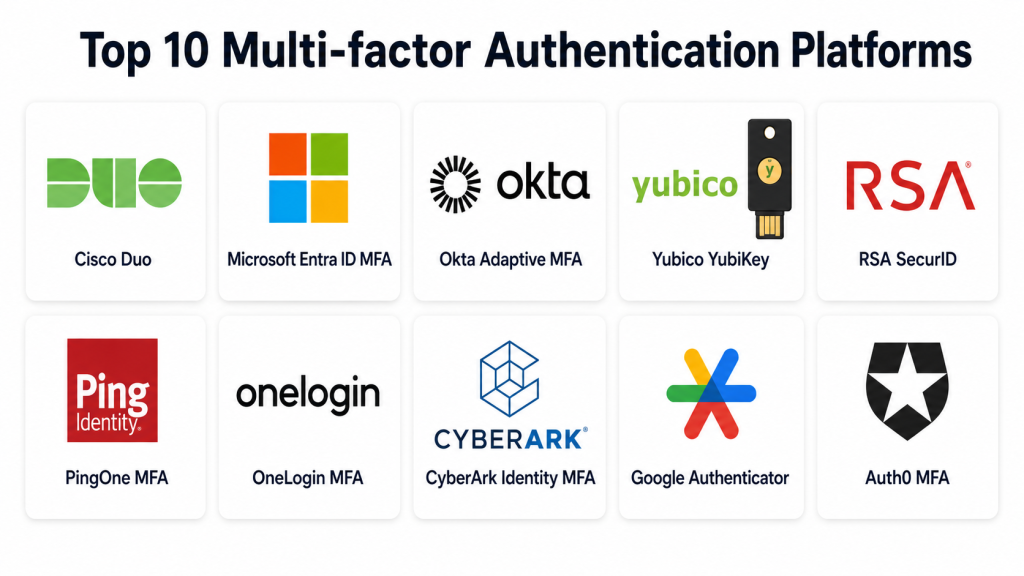
Top 10 Multi-factor Authentication Platforms
#1 — Cisco Duo
Short description:
Cisco Duo is a widely used MFA and secure access platform for workforce authentication. It helps organizations verify users, devices, and access requests before allowing login to applications, VPNs, cloud tools, and internal systems. Duo is suitable for SMBs, mid-market companies, education, healthcare, and enterprises. It is often chosen for its simple user experience, strong device visibility, and broad integration support.
Key Features
- Push-based MFA through mobile app.
- One-time passcodes and phone-based authentication options.
- Device trust and endpoint visibility.
- Adaptive access policies.
- SSO and application access support.
- VPN and remote access integrations.
- Admin reporting and access logs.
Pros
- Easy for users and IT teams to adopt.
- Strong fit for remote access and workforce MFA.
- Broad integration ecosystem.
Cons
- Advanced policies may require higher-tier plans.
- Some organizations may need deeper identity governance separately.
- Phone-based methods may not be ideal for high-security environments.
Platforms / Deployment
Web / Windows / macOS / Linux / iOS / Android / Cloud
Security & Compliance
Supports MFA, adaptive access, device trust, policy controls, audit logs, and encryption. Specific compliance details vary by plan and business requirements. Use Not publicly stated where not clearly confirmed.
Integrations & Ecosystem
Cisco Duo integrates with many common business, security, and infrastructure systems.
- VPNs
- Cloud applications
- SSO platforms
- Directory services
- Remote desktop tools
- Security monitoring workflows
Support & Community
Cisco Duo has strong documentation, onboarding resources, training content, and enterprise support options. Community adoption is broad across IT and security teams.
#2 — Microsoft Entra ID MFA
Short description:
Microsoft Entra ID MFA provides multi-factor authentication inside Microsoft’s identity platform. It is a strong choice for organizations already using Microsoft 365, Azure, Windows, and Microsoft security tools. It supports conditional access, risk-based authentication, passwordless options, and centralized identity policies. It is best suited for Microsoft-first organizations that want MFA connected with broader identity management.
Key Features
- MFA for Microsoft and third-party applications.
- Conditional Access policies.
- Passwordless authentication options.
- Risk-based access controls.
- Integration with Microsoft 365 and Azure.
- Admin reporting and sign-in logs.
- Security defaults and policy-based controls.
Pros
- Strong fit for Microsoft environments.
- Works well with Conditional Access.
- Useful for centralized cloud identity security.
Cons
- Best value is usually inside Microsoft ecosystems.
- Advanced features may require specific licensing.
- Policy design can become complex for large organizations.
Platforms / Deployment
Web / Windows / macOS / iOS / Android / Cloud / Hybrid
Security & Compliance
Supports MFA, Conditional Access, audit logs, RBAC, encryption, identity protection, and policy controls. Specific compliance coverage depends on Microsoft cloud services, licensing, and region. Use Not publicly stated where details are not confirmed.
Integrations & Ecosystem
Microsoft Entra ID MFA works deeply with Microsoft tools and many enterprise applications.
- Microsoft 365
- Azure
- Windows devices
- Microsoft Defender ecosystem
- Microsoft Sentinel
- SaaS application SSO
Support & Community
Microsoft provides extensive documentation, enterprise support plans, partner support, and a large global community.
#3 — Okta Adaptive MFA
Short description:
Okta Adaptive MFA helps organizations secure workforce access using context-aware authentication. It evaluates login risk based on factors such as device, location, network, user behavior, and application sensitivity. Okta Adaptive MFA is suitable for SaaS-heavy businesses, mid-market companies, and enterprises with many cloud applications. It is often selected by teams that want MFA connected with a strong identity and SSO platform.
Key Features
- Adaptive MFA based on risk signals.
- Push notification authentication.
- Support for one-time passcodes.
- Device and context-based policies.
- Integration with Okta SSO.
- User and admin reporting.
- Broad application ecosystem.
Pros
- Strong application integration ecosystem.
- Good fit for SaaS-heavy organizations.
- Useful adaptive policies for modern workforce security.
Cons
- Advanced MFA features may need specific plans.
- Best value comes when used with Okta identity products.
- Complex environments may need careful setup.
Platforms / Deployment
Web / iOS / Android / Cloud
Security & Compliance
Supports MFA, SSO, adaptive access, audit logs, policy controls, and encryption. Specific compliance details may vary by product and plan. Use Not publicly stated where not clearly confirmed.
Integrations & Ecosystem
Okta Adaptive MFA connects well with workforce identity and SaaS applications.
- SaaS applications
- Directory services
- HR systems
- SIEM tools
- API integrations
- SSO workflows
Support & Community
Okta offers documentation, training resources, onboarding support, and enterprise support options. Its partner and integration ecosystem is strong.
#4 — Yubico YubiKey
Short description:
Yubico YubiKey is a hardware-based authentication solution used for strong MFA and phishing-resistant access. It is popular with security teams, developers, administrators, regulated organizations, and high-risk users. YubiKeys support modern authentication standards and are often used to protect privileged accounts, cloud consoles, password managers, and enterprise applications. It is a strong option where security is more important than convenience alone.
Key Features
- Hardware security key authentication.
- Support for FIDO-based authentication.
- Phishing-resistant MFA.
- Works with many identity providers.
- USB and NFC form factors depending on model.
- Useful for privileged account protection.
- No battery required for most use cases.
Pros
- Strong protection against phishing.
- Excellent for admins and high-risk users.
- Works with many modern identity systems.
Cons
- Physical keys require purchase, distribution, and lifecycle management.
- Users may need training and backup key planning.
- Not a full IAM platform by itself.
Platforms / Deployment
Windows / macOS / Linux / iOS / Android / Hardware-based / Cloud integrations vary
Security & Compliance
Supports strong MFA and phishing-resistant authentication methods. Compliance depends on how the organization deploys and manages keys. Use Not publicly stated for broader platform compliance claims unless validated.
Integrations & Ecosystem
YubiKey integrates with many IAM, SSO, password manager, and cloud platforms.
- IAM platforms
- SSO providers
- Password managers
- Cloud consoles
- Developer platforms
- Enterprise login systems
Support & Community
Yubico provides documentation, enterprise support options, deployment guidance, and strong security community recognition.
#5 — RSA SecurID
Short description:
RSA SecurID is a long-standing MFA and identity security platform used by enterprises and regulated organizations. It supports secure access for employees, contractors, administrators, and remote users. RSA SecurID is suitable for companies with legacy systems, hybrid environments, and strict authentication requirements. It is often considered where mature enterprise authentication and strong policy control are important.
Key Features
- MFA for workforce access.
- Hardware and software token options.
- Risk-based authentication capabilities.
- Access policy controls.
- Cloud and hybrid deployment options.
- Admin reporting and monitoring.
- Enterprise application and VPN support.
Pros
- Mature enterprise authentication platform.
- Good fit for regulated and hybrid environments.
- Supports token-based and modern authentication needs.
Cons
- May feel complex for smaller teams.
- Legacy environments may require careful migration planning.
- User experience may vary by authentication method.
Platforms / Deployment
Web / Windows / macOS / iOS / Android / Cloud / Hybrid
Security & Compliance
Supports MFA, tokens, access policies, audit logs, encryption, and enterprise authentication controls. Specific certifications and compliance details should be verified. Use Not publicly stated where not confirmed.
Integrations & Ecosystem
RSA SecurID supports enterprise access and authentication environments.
- VPN systems
- Enterprise applications
- Cloud applications
- Directory services
- Security monitoring tools
- Hybrid identity environments
Support & Community
RSA provides enterprise documentation, support, partner services, and professional services. It is strongest in mature enterprise and regulated environments.
#6 — PingOne MFA
Short description:
PingOne MFA is a multi-factor authentication solution from Ping Identity for workforce and customer identity use cases. It helps organizations apply strong authentication with adaptive policies and identity orchestration. PingOne MFA is suitable for enterprises with complex access flows, hybrid identity environments, and customer-facing applications. It works well where authentication needs to be flexible and integrated with broader identity journeys.
Key Features
- MFA for workforce and customer identity.
- Adaptive authentication policies.
- Push, OTP, and other authentication methods.
- Identity orchestration support.
- Integration with Ping identity products.
- Risk-aware access controls.
- Reporting and monitoring.
Pros
- Strong fit for complex enterprise identity flows.
- Useful for workforce and customer authentication.
- Flexible integration with Ping ecosystem.
Cons
- May require identity expertise for advanced use cases.
- Best value often comes with broader Ping products.
- Smaller teams may find it more complex than needed.
Platforms / Deployment
Web / iOS / Android / Cloud / Hybrid
Security & Compliance
Supports MFA, adaptive access, policy controls, audit logs, and identity orchestration. Specific compliance details should be validated for the selected deployment. Use Not publicly stated where unclear.
Integrations & Ecosystem
PingOne MFA integrates with enterprise identity and access workflows.
- Ping Identity products
- SaaS applications
- Custom applications
- API-based integrations
- Directory services
- Customer identity systems
Support & Community
Ping provides enterprise documentation, support, implementation services, and professional guidance. It is strongest for mature identity teams.
#7 — OneLogin MFA
Short description:
OneLogin MFA provides multi-factor authentication as part of OneLogin’s workforce identity platform. It helps businesses secure application access with SSO, MFA, user provisioning, and context-aware policies. OneLogin MFA is suitable for SMBs, mid-market companies, and enterprises that need practical workforce authentication. It is often chosen by teams that want MFA tightly connected with SSO and application access management.
Key Features
- MFA for workforce applications.
- Push-based authentication.
- One-time password support.
- Context-aware access controls.
- SSO integration.
- Directory integration.
- User provisioning support.
Pros
- Practical for workforce access security.
- Good SSO and MFA combination.
- Useful for mid-market companies.
Cons
- Advanced governance depth may vary by requirement.
- Buyers should validate roadmap and packaging.
- Large enterprises may need deeper customization.
Platforms / Deployment
Web / iOS / Android / Cloud
Security & Compliance
Supports MFA, SSO, context-aware access, user provisioning, password policies, and access controls. Specific compliance details should be verified. Use Not publicly stated where not confirmed.
Integrations & Ecosystem
OneLogin MFA fits common workforce identity environments.
- SaaS applications
- Directory services
- HR systems
- MFA workflows
- SSO integrations
- API integrations
Support & Community
OneLogin provides documentation, support resources, and implementation guidance. Community visibility is moderate compared with larger identity ecosystems.
#8 — CyberArk Identity MFA
Short description:
CyberArk Identity MFA helps organizations protect workforce access with adaptive authentication and identity security controls. It is especially useful for enterprises that need to secure high-risk users, privileged access, and sensitive systems. CyberArk Identity MFA works well when MFA needs to connect with broader identity security and privileged access management. It is a strong option for security-led organizations with strict access control needs.
Key Features
- Adaptive MFA.
- SSO and secure application access.
- User behavior and risk signals.
- Directory integration.
- Access policy controls.
- Privileged access alignment.
- Reporting and audit visibility.
Pros
- Strong focus on identity security.
- Useful for privileged and high-risk access.
- Fits enterprise security operations.
Cons
- May be more advanced than small teams need.
- Best value may come with CyberArk ecosystem.
- Implementation can require security planning.
Platforms / Deployment
Web / iOS / Android / Cloud / Hybrid
Security & Compliance
Supports MFA, adaptive access, SSO, policy controls, logging, and identity security workflows. Specific certifications and compliance details should be verified. Use Not publicly stated where unclear.
Integrations & Ecosystem
CyberArk Identity MFA connects with identity security and privileged access ecosystems.
- Enterprise applications
- Directory services
- Privileged access tools
- HR systems
- SIEM tools
- Security analytics workflows
Support & Community
CyberArk provides enterprise documentation, support, partner services, and strong security expertise. It is best suited for mature security teams.
#9 — Google Authenticator
Short description:
Google Authenticator is a simple mobile authenticator app used to generate time-based one-time passcodes. It is widely used by individuals, small teams, and businesses that need basic MFA support. It is not a full enterprise MFA platform, but it works well as a lightweight authentication factor for many services. It is best for simple OTP-based MFA where advanced policy control is not required.
Key Features
- Time-based one-time passcodes.
- Mobile app-based authentication.
- Works with many services that support authenticator apps.
- Simple setup through QR code scanning.
- Offline code generation.
- Lightweight user experience.
- Suitable for basic MFA needs.
Pros
- Simple and widely familiar.
- No complex enterprise setup required.
- Works with many common apps and services.
Cons
- Not a full enterprise MFA management platform.
- Limited admin controls and reporting.
- Not ideal for advanced compliance or enterprise access policies.
Platforms / Deployment
iOS / Android
Security & Compliance
Supports OTP-based MFA for supported services. Enterprise compliance, audit logs, RBAC, and centralized admin controls are Not publicly stated for this app as a standalone MFA platform.
Integrations & Ecosystem
Google Authenticator works with services that support standard authenticator app-based OTP.
- SaaS applications
- Password managers
- Developer platforms
- Cloud accounts
- Consumer applications
- Admin consoles supporting OTP
Support & Community
Support is mostly documentation-based and service-specific. Community familiarity is high, but enterprise support is limited compared with dedicated MFA platforms.
#10 — Auth0 MFA
Short description:
Auth0 MFA is part of Auth0’s identity platform and is commonly used by developers and product teams to add secure authentication to customer-facing applications. It supports MFA options for applications, APIs, and digital products. Auth0 MFA is suitable for SaaS companies, startups, developer teams, and enterprises building login experiences for customers or users. It is often selected when authentication needs to be embedded into custom apps.
Key Features
- MFA for customer and application login flows.
- Push, OTP, and other authentication options depending on configuration.
- Adaptive MFA capabilities.
- Developer-friendly APIs.
- Customizable authentication flows.
- Integration with social and enterprise identity providers.
- Tenant-level configuration and logs.
Pros
- Strong fit for developers and SaaS products.
- Useful for customer-facing authentication.
- Flexible identity customization.
Cons
- Not always the simplest option for basic workforce MFA.
- Advanced customization may need developer effort.
- Pricing can vary based on usage and features.
Platforms / Deployment
Web / iOS / Android / Cloud
Security & Compliance
Supports MFA, identity provider integrations, encryption, logs, and configurable access flows. Specific compliance details depend on plan, tenant configuration, and deployment requirements. Use Not publicly stated where not confirmed.
Integrations & Ecosystem
Auth0 MFA is developer-friendly and fits application identity workflows.
- Web applications
- Mobile applications
- APIs
- Social login providers
- Enterprise identity providers
- Developer SDKs
Support & Community
Auth0 has strong developer documentation, community adoption, and support options. It is especially useful for product engineering teams.
Comparison Table
| Tool Name | Best For | Platform(s) Supported | Deployment | Standout Feature | Public Rating |
|---|---|---|---|---|---|
| Cisco Duo | Workforce MFA and device trust | Web / Windows / macOS / Linux / iOS / Android | Cloud | Easy MFA with device visibility | N/A |
| Microsoft Entra ID MFA | Microsoft-first organizations | Web / Windows / macOS / iOS / Android | Cloud / Hybrid | Conditional Access and Microsoft ecosystem fit | N/A |
| Okta Adaptive MFA | SaaS-heavy workforce identity | Web / iOS / Android | Cloud | Adaptive MFA with strong app integrations | N/A |
| Yubico YubiKey | Phishing-resistant hardware MFA | Windows / macOS / Linux / iOS / Android | Hardware / Cloud integrations vary | Hardware security keys | N/A |
| RSA SecurID | Enterprise and regulated access | Web / Windows / macOS / iOS / Android | Cloud / Hybrid | Mature token-based and modern MFA | N/A |
| PingOne MFA | Complex enterprise identity flows | Web / iOS / Android | Cloud / Hybrid | Identity orchestration with adaptive MFA | N/A |
| OneLogin MFA | Mid-market workforce access | Web / iOS / Android | Cloud | SSO-connected MFA | N/A |
| CyberArk Identity MFA | High-risk and privileged access | Web / iOS / Android | Cloud / Hybrid | MFA aligned with identity security | N/A |
| Google Authenticator | Basic OTP-based MFA | iOS / Android | Mobile app | Simple one-time passcodes | N/A |
| Auth0 MFA | Developer and customer authentication | Web / iOS / Android | Cloud | MFA for custom applications | N/A |
Evaluation & Scoring of Multi-factor Authentication Platforms
| Tool Name | Core (25%) | Ease (15%) | Integrations (15%) | Security (10%) | Performance (10%) | Support (10%) | Value (15%) | Weighted Total (0–10) |
|---|---|---|---|---|---|---|---|---|
| Cisco Duo | 9 | 9 | 9 | 9 | 9 | 8 | 8 | 8.70 |
| Microsoft Entra ID MFA | 9 | 8 | 9 | 9 | 9 | 9 | 8 | 8.65 |
| Okta Adaptive MFA | 9 | 8 | 9 | 9 | 8 | 8 | 8 | 8.45 |
| Yubico YubiKey | 8 | 7 | 8 | 10 | 9 | 8 | 8 | 8.20 |
| RSA SecurID | 8 | 7 | 8 | 9 | 8 | 8 | 7 | 7.85 |
| PingOne MFA | 8 | 7 | 8 | 9 | 8 | 8 | 7 | 7.85 |
| OneLogin MFA | 8 | 8 | 8 | 8 | 8 | 7 | 8 | 7.90 |
| CyberArk Identity MFA | 8 | 7 | 8 | 9 | 8 | 8 | 7 | 7.85 |
| Google Authenticator | 6 | 9 | 6 | 7 | 8 | 5 | 9 | 7.05 |
| Auth0 MFA | 8 | 7 | 9 | 8 | 8 | 8 | 8 | 8.05 |
These scores are comparative and should not be treated as universal rankings. A tool with a lower score may still be the right choice for a specific use case, such as basic OTP, hardware key security, or customer authentication. Enterprise buyers should focus on integrations, admin controls, reporting, and policy depth. Smaller teams should focus on ease of use, cost, and simple deployment.
Which Multi-factor Authentication Platform Is Right for You?
Solo / Freelancer
Solo users and freelancers usually need simple MFA for email, cloud storage, password managers, and business apps. Google Authenticator or hardware keys like YubiKey can be practical choices. If you manage client systems or sensitive admin access, hardware-based MFA is safer than relying only on OTP apps.
SMB
SMBs should focus on easy setup, low user friction, app integrations, and basic reporting. Cisco Duo, OneLogin MFA, Okta Adaptive MFA, and Microsoft Entra ID MFA can be strong choices depending on the existing tool stack. If the company already uses Microsoft 365, Microsoft Entra ID MFA may be the easiest path.
Mid-Market
Mid-market teams usually need MFA connected with SSO, directories, HR systems, VPNs, and cloud applications. Cisco Duo, Okta Adaptive MFA, Microsoft Entra ID MFA, PingOne MFA, and OneLogin MFA are practical options. The best choice depends on whether the company is Microsoft-first, SaaS-heavy, hybrid, or security-led.
Enterprise
Enterprises need adaptive policies, audit logs, high availability, privileged access protection, compliance support, and strong integrations. Microsoft Entra ID MFA, Cisco Duo, Okta Adaptive MFA, RSA SecurID, PingOne MFA, CyberArk Identity MFA, and YubiKey are strong candidates. Enterprises should test MFA fatigue controls, phishing resistance, admin workflows, and recovery processes before rollout.
Budget vs Premium
Budget-focused teams can start with built-in MFA from existing identity platforms or simple authenticator apps. Premium buyers should evaluate adaptive MFA, device trust, hardware key support, privileged access controls, reporting, and enterprise support. The best value depends on risk level, not only price.
Feature Depth vs Ease of Use
Cisco Duo, Microsoft Entra ID MFA, Okta Adaptive MFA, and OneLogin MFA provide strong balance between usability and security. RSA, PingOne, and CyberArk may offer deeper enterprise controls but need more planning. Google Authenticator is simple but lacks enterprise management depth.
Integrations & Scalability
Microsoft Entra ID MFA is strong for Microsoft ecosystems. Okta Adaptive MFA is practical for SaaS-heavy environments. Cisco Duo is strong for workforce, VPN, and device-aware access. Auth0 MFA is useful for developer-built customer applications. YubiKey works well across many identity providers as a hardware factor.
Security & Compliance Needs
High-security teams should prioritize phishing-resistant MFA, adaptive policies, logs, admin controls, and recovery workflows. Regulated industries should also validate reporting, audit evidence, identity lifecycle controls, and integration with SIEM or governance tools.
Frequently Asked Questions
What is Multi-factor Authentication?
Multi-factor Authentication is a login security method that requires more than one proof of identity. It usually combines something you know, something you have, or something you are.
Why is MFA important?
MFA helps protect accounts even when passwords are stolen or guessed. It reduces the risk of account takeover, phishing damage, and unauthorized access.
What are common MFA methods?
Common methods include push approvals, one-time passcodes, SMS codes, email codes, hardware keys, biometrics, passkeys, and risk-based prompts.
Is SMS-based MFA secure?
SMS MFA is better than no MFA, but it is weaker than app-based push, authenticator apps, passkeys, or hardware keys. High-risk users should use stronger methods.
What is adaptive MFA?
Adaptive MFA changes authentication requirements based on risk signals such as device, location, network, user behavior, and application sensitivity.
What is phishing-resistant MFA?
Phishing-resistant MFA uses methods that are harder to trick or intercept, such as hardware security keys and passkeys. It is recommended for admins and high-risk users.
How much do MFA tools cost?
Pricing varies by vendor, number of users, authentication methods, admin controls, integrations, and support level. Use Varies / N/A when pricing is not clearly available.
How long does MFA implementation take?
Small deployments may be quick, while enterprise rollouts can take longer due to user training, app integrations, policies, recovery workflows, and support planning.
What are common MFA rollout mistakes?
Common mistakes include forcing MFA without user education, relying only on SMS, ignoring recovery workflows, not protecting admin accounts first, and failing to monitor login issues.
Can MFA work with SSO?
Yes, MFA works best when integrated with SSO and IAM platforms. This allows centralized policies, better reporting, and consistent access control across applications.
Is MFA enough for complete security?
No. MFA is important, but it should be combined with secure passwords, SSO, device security, monitoring, least privilege, patching, and security awareness.
Can I switch MFA vendors later?
Yes, but switching needs planning. Teams should review app integrations, user enrollment, backup methods, recovery policies, admin access, and downtime risk.
Conclusion
Multi-factor Authentication platforms are now a key part of modern access security. They help organizations protect employees, customers, administrators, cloud systems, SaaS applications, VPNs, and sensitive data from password-based attacks and unauthorized access. However, the best MFA tool depends on context. Cisco Duo may be strong for simple workforce MFA and device trust, Microsoft Entra ID MFA may fit Microsoft-first companies, Okta Adaptive MFA may suit SaaS-heavy teams, YubiKey may be best for phishing-resistant access, and Auth0 MFA may work well for developer-built customer applications.
