Upgrade & Secure Your Future with DevOps, SRE, DevSecOps, MLOps!
We spend hours scrolling social media and waste money on things we forget, but won’t spend 30 minutes a day earning certifications that can change our lives.
Master in DevOps, SRE, DevSecOps & MLOps by DevOps School!
Learn from Guru Rajesh Kumar and double your salary in just one year.
Introduction
Records management and retention tools help organizations control business records from creation to final disposal. In simple terms, these tools help companies decide what information to keep, how long to keep it, who can access it, when it must be locked for legal reasons, and when it can be safely deleted.
This matters more now because companies are handling large volumes of emails, contracts, HR documents, financial files, customer data, chat records, scanned documents, and regulated content across cloud and hybrid systems. Without a proper retention process, teams can face compliance risk, storage overload, slow audits, legal discovery challenges, and poor information governance.
Common use cases include legal hold management, retention schedule automation, audit preparation, contract archiving, employee record retention, policy-based deletion, and regulated document lifecycle control.
Buyers should evaluate retention automation, legal hold support, search, audit trails, integrations, security controls, deployment flexibility, scalability, user experience, and compliance fit.
Best for: compliance teams, legal teams, records managers, IT leaders, government agencies, financial services, healthcare organizations, large enterprises, and regulated businesses.
Not ideal for: very small teams with limited records, simple file storage needs, or companies that only need basic document sharing instead of formal governance and retention.
Key Trends in Records Management & Retention Tools
AI-assisted classification is becoming more important for identifying records, sensitive data, duplicate files, and content that needs retention labels.
- In-place records management is growing because organizations want to manage content where it already lives instead of moving everything into one repository.
- Microsoft 365 governance alignment is a major priority for companies already using Teams, SharePoint, OneDrive, and Exchange.
- Legal hold automation is now expected in mature platforms, especially for regulated industries and litigation-heavy organizations.
- Retention policy automation is replacing manual folder-based records management.
- Audit-ready reporting is becoming a must-have for compliance, internal governance, and external audits.
- Hybrid deployment support remains important for government, banking, healthcare, and large enterprises with strict data control needs.
- Integration with business systems such as ERP, CRM, HR, email, file shares, and collaboration platforms is now a key buying factor.
- Defensible disposition is becoming a major requirement so organizations can prove why records were deleted or preserved.
- Role-based access and security controls are now core expectations, not optional features.
How We Selected These Tools
The tools below were selected using a practical buyer-focused evaluation approach:
- Market recognition and adoption across enterprise content, records, governance, and compliance use cases.
- Strength of retention, disposition, legal hold, audit, and policy management features.
- Fit for different company sizes, from SMBs to large regulated enterprises.
- Support for cloud, hybrid, or self-hosted deployment models where relevant.
- Integration depth with productivity suites, repositories, collaboration platforms, and business systems.
- Security posture signals such as access controls, audit logs, encryption, and governance features.
- Usability for records managers, legal teams, compliance teams, and IT administrators.
- Long-term scalability for high-volume records and complex organizational structures.
- Ecosystem maturity, partner support, documentation, and implementation resources.
- Practical value compared with complexity, cost, and operational overhead.
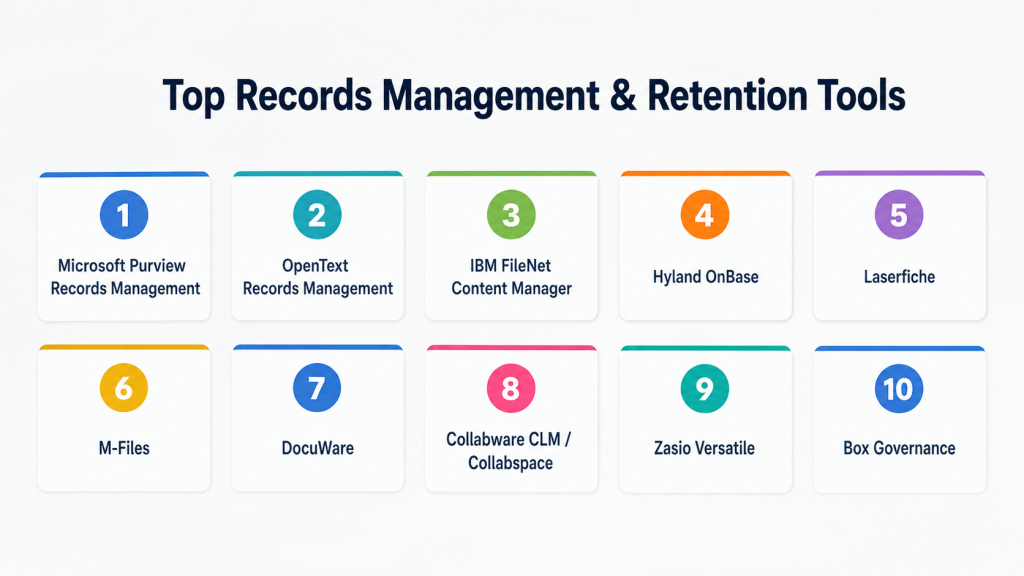
Top Records Management & Retention Tools
#1 — Microsoft Purview Records Management
Short description: Microsoft Purview Records Management helps organizations manage retention, labels, records declaration, disposition, and compliance across Microsoft 365 environments. It is best suited for companies already using Microsoft Teams, SharePoint, Exchange, and OneDrive.
Key Features
- Retention labels and retention policies for Microsoft 365 content.
- Records declaration and regulatory record support.
- Disposition review workflows for controlled deletion.
- Integration with Microsoft compliance and information protection features.
- Legal hold and eDiscovery alignment within the Microsoft ecosystem.
- Audit and activity tracking for governance teams.
- Strong fit for organizations standardized on Microsoft 365.
Pros
- Very strong option for Microsoft-heavy organizations.
- Reduces the need to move content into a separate records system.
- Good governance coverage across email, documents, collaboration, and cloud content.
Cons
- Best value is mainly inside the Microsoft ecosystem.
- Advanced configuration may require compliance expertise.
- Licensing and feature availability can be complex.
Platforms / Deployment
Web / Windows / macOS / iOS / Android
Cloud
Security & Compliance
Supports Microsoft security controls such as MFA, SSO, RBAC, audit logs, encryption, information protection, retention, and compliance workflows. Specific certifications vary by Microsoft cloud service and region.
Integrations & Ecosystem
Microsoft Purview works best as part of the Microsoft 365 and Azure ecosystem. It is suitable for organizations that want records, compliance, eDiscovery, data loss prevention, and information protection in a connected governance model.
- Microsoft Teams
- SharePoint Online
- OneDrive
- Exchange Online
- Microsoft Defender ecosystem
- Microsoft compliance and eDiscovery tools
Support & Community
Microsoft offers enterprise support options, documentation, partner implementation support, and a large admin community. However, proper setup often requires planning from compliance, legal, IT, and records teams.
#2 — OpenText Records Management
Short description: OpenText Records Management is an enterprise-grade records and information governance solution for large organizations with complex content environments. It is well suited for regulated industries, government, and enterprises with mature compliance needs.
Key Features
- Enterprise records lifecycle management.
- Retention schedules and disposition management.
- Physical and electronic records support.
- Legal hold and audit capabilities.
- Integration with OpenText content services and enterprise systems.
- Classification and metadata-driven governance.
- Strong support for complex enterprise information governance.
Pros
- Strong fit for large, regulated, and compliance-heavy organizations.
- Handles complex enterprise records programs.
- Works well in broader OpenText content management environments.
Cons
- Implementation can be complex.
- May require specialist administration and consulting support.
- Can be more than small teams need.
Platforms / Deployment
Web / Windows
Cloud / Self-hosted / Hybrid
Security & Compliance
Supports enterprise access controls, audit trails, retention governance, legal holds, and policy-based records handling. Specific certification details depend on deployment and product configuration.
Integrations & Ecosystem
OpenText has a broad enterprise ecosystem and is often used in organizations with large-scale ECM, ERP, and regulated document processes.
- OpenText content services
- SAP environments
- Microsoft 365
- Enterprise repositories
- Business process systems
- Capture and archiving solutions
Support & Community
OpenText provides enterprise support, professional services, documentation, training, and partner-led implementation. It is strongest where organizations can support a structured records management program.
#3 — IBM FileNet Content Manager
Short description: IBM FileNet Content Manager is a mature enterprise content and records platform used by organizations with complex document, workflow, compliance, and governance requirements. It is best for enterprises that need scalable content control and deep process integration.
Key Features
- Enterprise content repository and records management capabilities.
- Advanced metadata, classification, and workflow support.
- Retention and lifecycle management.
- Audit trails and access controls.
- Strong scalability for high-volume enterprise content.
- Integration with business process and case management workflows.
- Suitable for regulated industries and large organizations.
Pros
- Strong enterprise scalability and governance depth.
- Good fit for complex content and process-heavy environments.
- Mature platform for long-term enterprise records programs.
Cons
- Can require significant implementation planning.
- Administration may be complex for smaller teams.
- User experience depends heavily on configuration.
Platforms / Deployment
Web / Windows
Cloud / Self-hosted / Hybrid
Security & Compliance
Supports RBAC, audit trails, enterprise security models, retention controls, and governance workflows. Specific compliance certifications vary by deployment and IBM cloud configuration.
Integrations & Ecosystem
IBM FileNet is often used in broader enterprise architecture where records management connects with workflows, case management, capture, analytics, and business applications.
- IBM Cloud Pak ecosystem
- Business automation tools
- Case management systems
- Enterprise repositories
- Scanning and capture tools
- Custom APIs and enterprise integrations
Support & Community
IBM provides enterprise support, documentation, consulting partners, and professional services. It is best suited for organizations with strong IT governance and structured implementation capability.
#4 — Hyland OnBase
Short description: Hyland OnBase is a content services and process automation platform with records management capabilities. It is useful for organizations that need document management, workflow automation, retention, and compliance in one system.
Key Features
- Document and records lifecycle management.
- Workflow automation and process routing.
- Retention and disposition support.
- Case management and content services.
- Capture, indexing, and document storage.
- Audit and access control features.
- Strong industry use in healthcare, government, finance, and education.
Pros
- Combines records management with workflow automation.
- Strong fit for document-heavy operational processes.
- Mature enterprise content services platform.
Cons
- Can require careful implementation and configuration.
- May be too broad for teams needing only simple retention.
- Cost and complexity can vary by deployment.
Platforms / Deployment
Web / Windows / Mobile access varies
Cloud / Self-hosted / Hybrid
Security & Compliance
Supports access controls, audit trails, workflow governance, retention handling, and enterprise security features. Specific certifications vary by deployment and contract.
Integrations & Ecosystem
Hyland OnBase is often used as a central content and process platform that connects documents, records, forms, approvals, and business systems.
- ERP systems
- HR systems
- Healthcare systems
- Financial platforms
- Email and capture systems
- Custom APIs and connectors
Support & Community
Hyland provides documentation, enterprise support, partner support, training, and onboarding services. It has a mature ecosystem for enterprise content and records use cases.
#5 — Laserfiche
Short description: Laserfiche is a document management, workflow automation, and records management platform used by businesses, education, government, and public sector organizations. It is known for combining usability with process automation.
Key Features
- Records retention and disposition support.
- Document capture and indexing.
- Workflow automation and approvals.
- Search and metadata management.
- Audit trails and access permissions.
- Forms and process automation.
- Cloud and self-hosted deployment options.
Pros
- Strong balance of usability and governance.
- Good fit for public sector, education, and mid-market organizations.
- Workflow features help reduce manual records tasks.
Cons
- Advanced records programs may need careful setup.
- Pricing and packaging can vary.
- Some organizations may need partner support for implementation.
Platforms / Deployment
Web / Windows / iOS / Android
Cloud / Self-hosted / Hybrid
Security & Compliance
Supports access control, audit trails, encryption, retention policies, and records governance. Specific compliance certifications should be validated during procurement.
Integrations & Ecosystem
Laserfiche works well in document-heavy environments where records management connects with forms, workflows, approvals, and business applications.
- Microsoft 365
- ERP systems
- CRM systems
- Public sector systems
- Scanning and capture tools
- APIs and workflow extensions
Support & Community
Laserfiche offers documentation, training, customer support, user communities, and partner implementation services. It is often easier to adopt than highly complex enterprise ECM systems.
#6 — M-Files
Short description: M-Files is a metadata-driven document management and information governance platform. It helps organizations manage documents and records based on what the content is, rather than where it is stored.
Key Features
- Metadata-based document and records management.
- Retention and lifecycle workflows.
- Version control and permissions.
- AI-assisted classification and search capabilities.
- Integration with Microsoft 365 and business systems.
- Workflow automation and approval routing.
- Repository-neutral information management approach.
Pros
- Strong metadata model improves search and governance.
- Good fit for knowledge-heavy and document-heavy businesses.
- Useful for organizations with content spread across multiple systems.
Cons
- Metadata design requires planning.
- Users may need training to adopt the model properly.
- Advanced governance features may require configuration.
Platforms / Deployment
Web / Windows / iOS / Android
Cloud / Self-hosted / Hybrid
Security & Compliance
Supports access permissions, audit trails, encryption, metadata governance, and workflow controls. Specific compliance certifications should be validated based on deployment.
Integrations & Ecosystem
M-Files is strong when organizations want to connect content across multiple repositories without forcing users into one storage location.
- Microsoft 365
- SharePoint
- Salesforce
- DocuSign
- ERP and CRM systems
- APIs and connectors
Support & Community
M-Files provides documentation, implementation support, training, and partner services. Its community and ecosystem are strong for document management and information governance use cases.
#7 — DocuWare
Short description: DocuWare is a cloud document management and workflow automation platform with retention and archive capabilities. It is often used by SMBs and mid-market companies that want structured document storage, workflow, and compliance support.
Key Features
- Secure document storage and archiving.
- Workflow automation for approvals and routing.
- Retention and controlled document handling.
- Search, indexing, and metadata management.
- Capture and digital document processing.
- Permissions and audit trails.
- Cloud-first document management experience.
Pros
- Good fit for SMB and mid-market teams.
- Strong workflow and document archive capabilities.
- Easier to adopt than many large enterprise platforms.
Cons
- May not match the depth of large enterprise records platforms.
- Complex retention programs may need customization.
- Advanced integrations may require planning.
Platforms / Deployment
Web / Windows / Mobile access varies
Cloud / Self-hosted / Hybrid
Security & Compliance
Supports user permissions, audit logs, secure storage, encryption, and controlled access. Specific certifications should be confirmed during vendor evaluation.
Integrations & Ecosystem
DocuWare fits well into business document workflows such as invoices, contracts, HR files, finance records, and operational documents.
- Microsoft 365
- ERP systems
- Accounting systems
- Scanners and capture tools
- Email import
- APIs and workflow integrations
Support & Community
DocuWare offers customer support, documentation, partner services, onboarding, and training resources. It is practical for teams that need governance without enterprise-level complexity.
#8 — Collabware CLM / Collabspace
Short description: Collabware provides records management and information governance solutions focused on Microsoft environments and enterprise retention needs. It is often used by organizations that need stronger records control around Microsoft 365 and SharePoint content.
Key Features
- Records management for Microsoft 365 and SharePoint.
- Retention schedule management.
- Legal hold and disposition workflows.
- Audit and compliance reporting.
- In-place records management support.
- Classification and policy application.
- Governance support for regulated organizations.
Pros
- Strong fit for Microsoft-focused records programs.
- Useful for organizations needing deeper retention governance.
- Good focus on formal records management practices.
Cons
- Best suited for organizations with defined records governance needs.
- May be too specialized for simple document management.
- Implementation planning is important.
Platforms / Deployment
Web
Cloud / Hybrid
Security & Compliance
Supports records controls, audit trails, retention policies, legal hold workflows, and Microsoft ecosystem security alignment. Specific certifications are not publicly stated.
Integrations & Ecosystem
Collabware is designed for records and compliance teams that need governance around Microsoft-based content environments.
- Microsoft 365
- SharePoint
- Teams content governance
- Enterprise repositories
- Retention schedules
- Compliance workflows
Support & Community
Support and onboarding are generally enterprise-focused. Documentation, implementation guidance, and vendor support should be reviewed during evaluation.
#9 — Zasio Versatile
Short description: Zasio Versatile is a records management platform focused on electronic and physical records, retention schedules, legal holds, and information governance. It is useful for organizations that need formal records program control.
Key Features
- Electronic records management.
- Physical records tracking.
- Retention schedule management.
- Legal hold management.
- Disposition review and approval.
- Audit history and compliance reporting.
- Support for managing records in place across repositories.
Pros
- Strong focus on professional records management.
- Supports both physical and electronic record programs.
- Good fit for legal, compliance, and records teams.
Cons
- Less suited for teams needing broad collaboration features.
- May require records management knowledge to configure well.
- Interface and adoption should be tested during pilot.
Platforms / Deployment
Web
Cloud / Hybrid
Security & Compliance
Supports audit history, retention holds, disposition controls, and records governance workflows. Specific certifications are not publicly stated.
Integrations & Ecosystem
Zasio is designed for records teams that need to manage retention across different content sources while maintaining defensible records practices.
- Microsoft 365
- SharePoint
- Network file shares
- Cloud file storage
- Physical records workflows
- Custom integrations may vary
Support & Community
Zasio provides specialized records management support and expertise. It is strongest for teams that want a records-focused vendor rather than a general document management platform.
#10 — Box Governance
Short description: Box Governance extends Box’s cloud content management platform with retention, legal hold, disposition, and compliance capabilities. It is best for organizations already using Box for secure content collaboration.
Key Features
- Retention policies for Box content.
- Legal hold support.
- Disposition management.
- Audit trails and reporting.
- Secure cloud content collaboration.
- Access control and file-level governance.
- Integration with broader Box security and workflow capabilities.
Pros
- Strong fit for organizations already using Box.
- Good balance of collaboration and governance.
- Cloud-native experience with strong user adoption potential.
Cons
- Best value is within the Box ecosystem.
- Not a full replacement for complex enterprise records systems in every scenario.
- Advanced governance may require higher-tier plans.
Platforms / Deployment
Web / Windows / macOS / iOS / Android
Cloud
Security & Compliance
Supports SSO, MFA, encryption, audit logs, access controls, retention policies, and legal hold features. Specific certifications vary by Box service and plan.
Integrations & Ecosystem
Box Governance is useful when records management needs to work alongside secure content collaboration, file sharing, and cloud workflows.
- Microsoft 365
- Google Workspace
- Salesforce
- Slack
- Workflow and automation tools
- APIs and enterprise integrations
Support & Community
Box offers documentation, enterprise support, admin resources, customer success programs, and a broad partner ecosystem. It is practical for cloud-first organizations.
Comparison Table
| Tool Name | Best For | Platform(s) Supported | Deployment | Standout Feature | Public Rating |
|---|---|---|---|---|---|
| Microsoft Purview Records Management | Microsoft 365-heavy enterprises | Web, Windows, macOS, iOS, Android | Cloud | Native Microsoft 365 retention and records governance | N/A |
| OpenText Records Management | Large regulated enterprises | Web, Windows | Cloud, Self-hosted, Hybrid | Enterprise-grade records lifecycle governance | N/A |
| IBM FileNet Content Manager | Complex enterprise content environments | Web, Windows | Cloud, Self-hosted, Hybrid | Scalable enterprise content and records platform | N/A |
| Hyland OnBase | Document-heavy workflow environments | Web, Windows, mobile access varies | Cloud, Self-hosted, Hybrid | Records management with workflow automation | N/A |
| Laserfiche | Public sector, education, mid-market | Web, Windows, iOS, Android | Cloud, Self-hosted, Hybrid | User-friendly records and workflow automation | N/A |
| M-Files | Metadata-driven information governance | Web, Windows, iOS, Android | Cloud, Self-hosted, Hybrid | Repository-neutral metadata-based management | N/A |
| DocuWare | SMB and mid-market document archiving | Web, Windows, mobile access varies | Cloud, Self-hosted, Hybrid | Document workflow and secure archiving | N/A |
| Collabware CLM / Collabspace | Microsoft-focused records programs | Web | Cloud, Hybrid | Deep records governance for Microsoft content | N/A |
| Zasio Versatile | Formal records and retention teams | Web | Cloud, Hybrid | Physical and electronic records management | N/A |
| Box Governance | Cloud-first secure content collaboration | Web, Windows, macOS, iOS, Android | Cloud | Retention and legal hold inside Box | N/A |
Evaluation & Scoring of Records Management & Retention Tools
| Tool Name | Core (25%) | Ease (15%) | Integrations (15%) | Security (10%) | Performance (10%) | Support (10%) | Value (15%) | Weighted Total |
|---|---|---|---|---|---|---|---|---|
| Microsoft Purview Records Management | 9 | 7 | 9 | 9 | 8 | 8 | 8 | 8.25 |
| OpenText Records Management | 9 | 6 | 8 | 9 | 9 | 8 | 7 | 8.00 |
| IBM FileNet Content Manager | 9 | 6 | 8 | 9 | 9 | 8 | 7 | 8.00 |
| Hyland OnBase | 8 | 7 | 8 | 8 | 8 | 8 | 7 | 7.65 |
| Laserfiche | 8 | 8 | 7 | 8 | 8 | 8 | 8 | 7.85 |
| M-Files | 8 | 8 | 8 | 8 | 8 | 7 | 8 | 7.90 |
| DocuWare | 7 | 8 | 7 | 7 | 8 | 7 | 8 | 7.45 |
| Collabware CLM / Collabspace | 8 | 7 | 8 | 8 | 7 | 7 | 7 | 7.50 |
| Zasio Versatile | 8 | 7 | 7 | 8 | 7 | 7 | 7 | 7.35 |
| Box Governance | 7 | 8 | 8 | 8 | 8 | 8 | 8 | 7.65 |
These scores are comparative, not absolute. A higher score does not automatically mean the tool is the best choice for every organization. For example, Microsoft Purview may score very high for Microsoft 365 environments, while Zasio may be better for a dedicated records management team handling both physical and electronic records. Always validate features, licensing, integrations, security requirements, and user adoption through a pilot.
Which Records Management & Retention Tool Is Right for You?
Solo / Freelancer
Solo users usually do not need a full records management platform. A basic document management system, secure cloud storage, and simple retention discipline may be enough. However, freelancers working with legal, finance, healthcare, or government clients should still maintain organized records, access control, and deletion policies.
Good options to consider:
- Box Governance if content is already stored in Box.
- Microsoft Purview if working inside Microsoft 365.
- DocuWare if document archiving and workflow are needed.
SMB
Small and mid-sized businesses should focus on ease of use, document capture, workflow, and simple retention policies. They usually need practical governance without the heavy implementation burden of enterprise platforms.
Good options to consider:
- DocuWare for document archive and workflow.
- Laserfiche for records plus automation.
- M-Files for metadata-driven document control.
- Box Governance for cloud-first collaboration.
Mid-Market
Mid-market organizations often need stronger governance because content volume, compliance risk, and department-level workflows increase. They should choose tools that support retention, audit trails, role-based access, integrations, and scalable workflows.
Good options to consider:
- Laserfiche for balanced usability and governance.
- M-Files for metadata-driven information control.
- Hyland OnBase for workflow-heavy departments.
- Microsoft Purview for Microsoft 365 environments.
Enterprise
Enterprises need scalability, auditability, legal hold, policy consistency, multiple repositories, security controls, and integration with existing systems. They should evaluate implementation effort, administrator experience, and long-term governance maturity.
Good options to consider:
- Microsoft Purview for Microsoft-first enterprises.
- OpenText Records Management for complex enterprise governance.
- IBM FileNet Content Manager for large-scale content and process environments.
- Hyland OnBase for workflow and content services.
- Collabware for Microsoft-focused records programs.
Budget vs Premium
Budget-focused teams should avoid overbuying. If the records program is simple, choose a tool that is easier to implement and maintain. Premium enterprise platforms are better when compliance risk, legal exposure, content volume, and audit complexity are high.
Best budget-sensitive fit:
- DocuWare
- Laserfiche
- Box Governance
- M-Files
Best premium enterprise fit:
- OpenText
- IBM FileNet
- Microsoft Purview
- Hyland OnBase
Feature Depth vs Ease of Use
Feature-rich tools are powerful but often require planning, configuration, and training. Easier tools may improve adoption but may not cover every advanced records requirement.
Choose feature depth when:
- You have complex retention schedules.
- You manage regulated records.
- You need legal hold and audit readiness.
- You manage multiple repositories.
Choose ease of use when:
- Users are non-technical.
- Adoption speed matters.
- You need simple workflows.
- Records governance is still maturing.
Integrations & Scalability
Integrations are critical because records rarely live in one place. Evaluate how each tool connects with email, Microsoft 365, Google Workspace, ERP, CRM, HR systems, file shares, scanning tools, and business applications.
For Microsoft-heavy environments, Microsoft Purview and Collabware are strong candidates. For repository-neutral strategies, M-Files can be practical. For enterprise content ecosystems, OpenText, IBM FileNet, and Hyland OnBase may be better fits.
Security & Compliance Needs
Security-focused buyers should evaluate:
- SSO and MFA
- Role-based access control
- Encryption
- Audit logs
- Legal hold
- Retention labels
- Disposition approval
- Data residency
- Compliance reporting
- Administrator controls
Regulated industries should avoid choosing based only on interface or price. The tool must support defensible retention and provide clear evidence during audits or legal review.
Frequently Asked Questions
What is records management software?
Records management software helps organizations control business records through retention policies, legal holds, audit trails, access controls, and disposition workflows. It ensures important records are kept properly and deleted safely when allowed.
How is records management different from document management?
Document management focuses on storing, organizing, sharing, and finding documents. Records management goes further by applying legal, regulatory, and business rules for retention, preservation, and defensible deletion.
What is retention management?
Retention management is the process of deciding how long each type of record should be kept. It helps organizations avoid deleting records too early or keeping unnecessary data for too long.
What is legal hold?
Legal hold prevents records from being deleted when they may be needed for litigation, investigation, audit, or regulatory review. A good tool should track when holds are applied, changed, and released.
Are records management tools expensive?
Pricing varies widely. Some tools are included in broader enterprise platforms, while others require separate licenses, implementation fees, storage costs, or professional services. Always confirm pricing directly with the vendor.
How long does implementation take?
Implementation depends on content volume, retention policy complexity, integrations, user training, and migration needs. Simple setups may be faster, while enterprise programs can require phased rollout and governance planning.
What is the biggest mistake buyers make?
The biggest mistake is choosing software before defining retention policies, ownership, record categories, legal requirements, and disposition workflows. A tool cannot fix unclear governance by itself.
Can these tools manage email and chat records?
Many modern tools can manage email and collaboration content, especially inside platforms like Microsoft 365. However, support varies, so buyers should validate email, chat, and collaboration records during evaluation.
Do small businesses need records management software?
Not every small business needs a full enterprise records platform. However, SMBs in legal, healthcare, finance, education, construction, and government contracting may benefit from structured retention and audit controls.
Can records management tools support compliance audits?
Yes, strong tools can support audits through retention policies, audit trails, access logs, disposition records, and reporting. The quality of audit readiness depends on both the software and how well it is configured.
Is cloud records management safe?
Cloud records management can be safe when the platform supports strong security controls such as encryption, MFA, access control, audit logs, and compliance features. Buyers should review vendor security documentation before purchasing.
What are alternatives to records management software?
Alternatives include document management systems, enterprise content management platforms, cloud storage with governance features, archive tools, and manual retention processes. However, manual approaches become risky as content volume grows.
Conclusion
Records management and retention tools are no longer only back-office compliance systems. They are now essential governance platforms for organizations that want to control business records, reduce legal risk, improve audit readiness, and manage growing content volumes across cloud, hybrid, and enterprise systems. The best tool depends on your environment. Microsoft-heavy companies may prefer Microsoft Purview or Collabware. Large regulated enterprises may need OpenText, IBM FileNet, or Hyland OnBase. Mid-market teams may find Laserfiche, M-Files, DocuWare, or Box Governance easier to adopt.
