Upgrade & Secure Your Future with DevOps, SRE, DevSecOps, MLOps!
We spend hours scrolling social media and waste money on things we forget, but won’t spend 30 minutes a day earning certifications that can change our lives.
Master in DevOps, SRE, DevSecOps & MLOps by DevOps School!
Learn from Guru Rajesh Kumar and double your salary in just one year.
Introduction
In the last decade of building software delivery systems, I have seen one truth repeatedly: knowing the tools is easy, but mastering the workflow is hard. Microsoft Azure has become a dominant force in enterprise cloud, and the demand for engineers who can architect secure, scalable release pipelines on Azure is skyrocketing. This guide is not just about passing an exam. It is about becoming a “Master in Azure DevOps“—someone who can walk into any organization, assess their chaotic deployment process, and transform it into a smooth, automated machine. Whether you are a developer tired of manual deployments or a manager looking to standardize delivery, this certification program is your blueprint.
Certification at a Glance
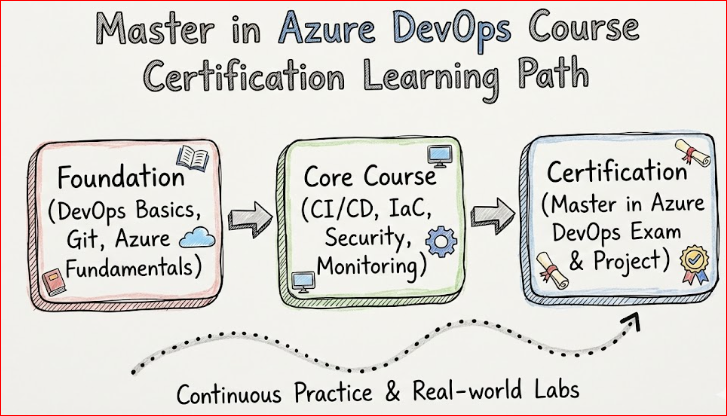
The Master in Azure DevOps program is designed to take you from a foundational understanding of cloud concepts to expert-level implementation of CI/CD, infrastructure automation, and reliability engineering using the Azure ecosystem.
| Track | Level | Who it’s for | Prerequisites | Skills Covered | Recommended Order |
|---|---|---|---|---|---|
| Cloud & DevOps | Expert | DevOps Engineers, SREs, Cloud Architects, Build Engineers | Basic knowledge of Linux/Windows admin & git. No coding mastery required, but scripting helps. | Azure Pipelines, Docker, Kubernetes, Terraform, Ansible, Git, Azure Boards, Monitoring | Take this after AZ-900 (optional) or directly if you have IT experience. |
Deep Dive: Master in Azure DevOps Certification
What it is
This is a comprehensive, hands-on certification program that validates your ability to design and implement DevOps processes and practices. It goes beyond simple “click-ops” in the Azure portal. It covers the entire software development lifecycle (SDLC), teaching you how to combine people, processes, and technologies to deliver value to users continuously. It aligns closely with industry standards and prepares you for the official Microsoft Certified: DevOps Engineer Expert (AZ-400) role.
Who should take it
- DevOps Engineers: Who need to formalize their skills and prove they can handle complex, enterprise-grade Azure environments.
- Software Engineers: Who want to stop throwing code “over the wall” and take ownership of how their applications are built, tested, and deployed.
- System Administrators: Looking to transition from racking servers to managing infrastructure as code and automated pipelines.
- Engineering Managers: Who need to understand the technical “how” behind the agile delivery promises they make to the business.
Skills you’ll gain
- Advanced Source Control: mastering Git branching strategies (GitFlow, Trunk-based), managing pull request policies, and enforcing code quality before merge.
- Continuous Integration (CI): Designing build pipelines that compile code, run unit tests, check for security vulnerabilities, and package artifacts automatically.
- Continuous Deployment (CD): Creating release pipelines that deploy safely to Dev, QA, and Production environments with approval gates and rollback capabilities.
- Infrastructure as Code (IaC): Using tools like Terraform and Azure Resource Manager (ARM) templates to provision servers, databases, and networks via code, not manual clicks.
- Containerization & Orchestration: Building Docker images for your apps and deploying them into Azure Kubernetes Service (AKS) for high availability.
- Observability: Configuring Azure Monitor and Application Insights to track application health, set up alerts, and debug issues in production real-time.
Real-world projects you should be able to do after it
- End-to-End CI/CD Pipeline: Build a pipeline that automatically triggers when a developer pushes code, runs tests, creates a Docker image, and deploys it to an Azure Web App.
- Zero-Downtime Deployment: Implement a “Blue-Green” or “Canary” deployment strategy where you release a new version to a small subset of users first to minimize risk.
- Infrastructure Provisioning: Write a Terraform script that spins up a full environment (Virtual Network, Load Balancer, 2 VMs, and a SQL Database) in under 10 minutes.
- Automated Security Audit: Integrate a security scanning tool (like SonarQube or OWASP Zap) into your pipeline to block builds that contain critical vulnerabilities.
- Kubernetes Cluster Management: Set up an AKS cluster, deploy a microservices application to it, and configure auto-scaling so the app handles traffic spikes automatically.
Preparation plan
To truly master this, you need a structured approach. Random YouTube videos won’t cut it.
- 7–14 Days (Fast Track): For experienced engineers. Spend days 1-3 on Azure Boards and Git. Days 4-8 on heavily practicing YAML pipelines. Days 9-12 on ARM templates/Terraform. Days 13-14 on practice exams and review.
- 30 Days (Recommended): For working professionals. Dedicate 1 week to Source Control & Planning. 1 week to CI/Build pipelines. 1 week to CD/Release strategies & IaC. 1 week for Monitoring, Security, and a Capstone project.
- 60 Days (Deep Dive): For beginners. Spend the first 2 weeks just on Azure Fundamentals and Linux basics. Then follow the 30-day plan but with double the time for hands-on labs. Do not rush the foundational concepts.
Common mistakes
- Ignoring the “Culture” aspect: DevOps is not just tools. Failing to understand how to communicate and collaborate using Azure Boards is a major gap.
- Relying on the UI: The graphical editor in Azure DevOps is nice, but the real world uses YAML. If you can’t write a pipeline in YAML, you aren’t ready.
- Skipping Security: treating security as an afterthought. You must know how to manage secrets (Azure Key Vault) and service connections securely.
- Overlooking Governance: Not knowing how to enforce policies (like “no deployments to Prod on Fridays”) using gates and approvals.
Best next certification after this
- Same Track: Certified Kubernetes Administrator (CKA) – Deepen your container orchestration skills, which are essential for modern Azure DevOps.
- Cross-Track: Certified DevSecOps Professional – Shift left and become a security expert within the pipeline.
- Leadership: Certified DevOps Manager – If you want to move away from the keyboard and lead the transformation strategy.
Choose Your Path
DevOps is broad. Once you master the Azure foundation, where do you go?
- DevOps Specialist: Focus purely on pipelines, automation, and speed. You make developers highly productive.
- DevSecOps Expert: You integrate security into every step. You are the reason the company doesn’t get hacked.
- Site Reliability Engineer (SRE): You care about stability. You write code to fix operational problems and manage incident response.
- AIOps/MLOps Engineer: You build pipelines specifically for Machine Learning models, automating the training and deployment of AI.
- DataOps Engineer: You apply DevOps principles to Data Engineering, ensuring data pipelines are reliable and tested.
- FinOps Practitioner: You optimize cloud costs. You ensure the speed of DevOps doesn’t bankrupt the company.
Role → Recommended Certifications
| Role | Recommended Certification path |
|---|---|
| DevOps Engineer | Master in Azure DevOps → CKA → Terraform Associate |
| SRE | Master in Azure DevOps → Certified SRE Professional → Python for DevOps |
| Platform Engineer | Master in Azure DevOps → CKA → AWS Certified Solutions Architect |
| Cloud Engineer | Azure Administrator (AZ-104) → Master in Azure DevOps |
| Security Engineer | Master in Azure DevOps → Certified DevSecOps Professional → AZ-500 |
| Data Engineer | Azure Data Engineer (DP-203) → Master in Azure DevOps (for DataOps) |
| FinOps Practitioner | Azure Fundamentals → Master in Azure DevOps → FinOps Certified Practitioner |
| Engineering Manager | Master in Azure DevOps → Certified Agile Leadership → PMP |
Top Institutions for Master in Azure DevOps Training
If you are looking for structured training with real-time projects, these institutions are the market leaders.
- DevOpsSchool: The premier choice. Known for its “Master in Azure DevOps” program with 200+ hours of rigorous training and lifetime support. They focus heavily on making you “job-ready.”
- Cotocus: Excellent for corporate training and consultancy-led learning. Good if you are looking for a customized team batch.
- Scmgalaxy: A community-driven platform that offers great resources and affordable training options for self-starters.
- BestDevOps: Focuses on niche tools and advanced DevOps workshops for experienced professionals.
- devsecopsschool: The go-to place if you want to specialize specifically in the security aspect of Azure DevOps.
- sreschool: Perfect if your goal is to transition from a DevOps role into a Site Reliability Engineering role.
- aiopsschool: Emerging leader for those wanting to combine DevOps with Artificial Intelligence workflows.
- dataopsschool: Specializes in the intersection of Big Data and DevOps practices.
- finopsschool: Focuses on cloud cost optimization and financial operations in the cloud.
Frequently Asked Questions (FAQs)
General FAQs
- Is this certification difficult for a beginner?
It can be challenging if you have zero IT experience. However, if you follow the “60-day plan” and focus on the basics of Linux and Cloud first, it is absolutely achievable. The key is consistency. - How long does it take to complete the training?
Most comprehensive courses, like the one from DevOpsSchool, run for about 6-8 weekends (approx. 2 months). Self-study might take 3-4 months depending on your discipline. - Do I need to know coding?
You do not need to be a developer. You don’t need to write Java or C# applications from scratch. However, you must be comfortable with scripting (Bash, PowerShell) and reading code to understand how to build it. - What is the value of this certification in the market?
It is one of the highest-paying IT skills. Companies are moving to Azure aggressively, and they are desperate for engineers who can manage that transition. It validates you are an expert, not just a user. - Is the “Master in Azure DevOps” different from Microsoft’s AZ-400?
The “Master” program usually covers the AZ-400 syllabus plus real-world tools that Microsoft doesn’t test on (like Terraform, Ansible, legacy migration scenarios). It prepares you for the job, not just the exam. - What is the sequence? Should I do AZ-104 (Admin) first?
Ideally, yes. AZ-104 gives you the “Ops” knowledge (virtual machines, networking). AZ-400 gives you the “Dev” process. Having both makes you lethal. - Can I get a remote job with this?
Absolutely. DevOps is one of the most remote-friendly roles in tech. You can manage pipelines and infrastructure from anywhere in the world. - Will this help me if I come from a non-technical background?
It is a steep hill to climb. You will need to put in double the effort to learn the operating system and networking basics first. But we have seen many people switch successfully. - Do I need a powerful computer for the labs?
No. Since you are working with the Cloud (Azure), the heavy lifting happens on Microsoft’s servers. A standard laptop with a good internet connection is enough. - How much does the exam cost?
The official Microsoft AZ-400 exam costs around $165 (pricing varies by country). The training program fees vary by provider. - Does this cover AWS or Google Cloud?
This specific program focuses on Azure. However, the concepts (CI/CD, containers, IaC) are 80% transferable to other clouds. - What if I fail the exam?
Don’t panic. Review your weak areas (the exam report tells you this). most training providers offer mock exams—do not attempt the real exam until you are scoring 85%+ on mocks consistently.
Specific Program FAQs (Master in Azure DevOps)
- What topics are covered in the syllabus?
It covers Azure Administration basics, Git, Build Pipelines, Release Pipelines, Docker, Kubernetes, Ansible, Terraform, and Azure Monitor. - Are the sessions recorded?
Yes, reputable providers like DevOpsSchool provide lifetime access to recordings, so you can revisit complex topics like Kubernetes networking anytime. - Is there job placement assistance?
Many providers offer resume building, mock interviews, and share your profile with their hiring network. However, no honest institute guarantees a job—your skills get you the job. - How many hands-on projects are included?
A good Master program includes at least 4-5 major projects, simulating real enterprise scenarios (e.g., “Migrate a monolithic app to microservices on AKS”). - Can I attend a demo class first?
Most institutes allow you to attend a first session or watch a recorded demo to check if the trainer’s style matches your learning speed. - Is the certification recognized globally?
The “Master” certificate from the institute is recognized as proof of training. The knowledge prepares you for the globally recognized Microsoft AZ-400 certification. - What happens if I get stuck during practice?
Look for a provider that offers “Lab Support.” You will get stuck. Having a mentor to unblock you during the week is worth the price of the course alone. - Is there a community or forum?
Yes, being part of a batch WhatsApp or Slack group is crucial. Learning from the questions of your peers accelerates your own learning significantly.
Testimonials
“I was stuck in a manual testing role for 4 years. This program opened my eyes. The project work on Kubernetes was tough but it gave me the confidence to crack a DevOps interview at a Big 4 firm.” — Rahul S., Senior DevOps Engineer
“The depth of the ‘Master in Azure DevOps’ course is unmatched. It didn’t just teach me how to pass AZ-400; it taught me how to actually set up a secure production environment. The Terraform modules were a game changer for my team.” — Sarah J., Cloud Architect
“I was skeptical about online training, but the mentor support was fantastic. They helped me debug my pipeline errors at 10 PM. That level of dedication is rare.” — Amit K., System Administrator
Conclusion
The journey to becoming a Master in Azure DevOps is not a sprint; it is a marathon of continuous learning. But the reward is a career that is future-proof, high-paying, and intellectually satisfying. You stop being the person who “fixes servers” and become the person who “builds the engines” that power the business. If you are ready to put in the work, the Master in Azure DevOps program is the structured path to get you there. Stop waiting for the “right time.” The technology is moving fast, and the best time to start was yesterday. The second best time is now.
