Upgrade & Secure Your Future with DevOps, SRE, DevSecOps, MLOps!
We spend hours scrolling social media and waste money on things we forget, but won’t spend 30 minutes a day earning certifications that can change our lives.
Master in DevOps, SRE, DevSecOps & MLOps by DevOps School!
Learn from Guru Rajesh Kumar and double your salary in just one year.
Introduction
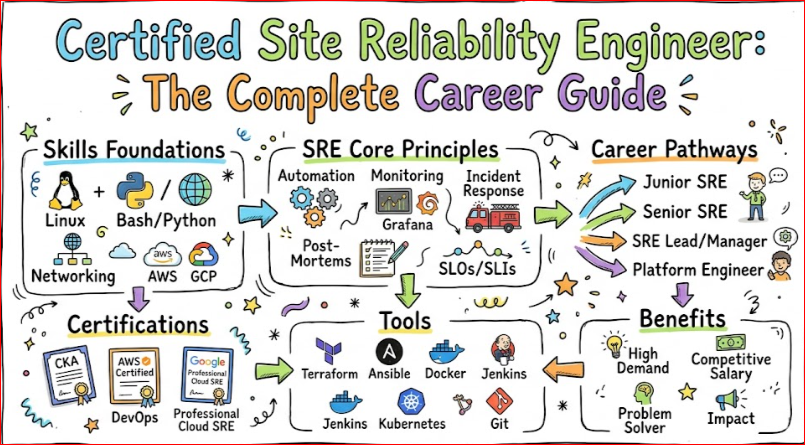
The modern digital landscape demands more than just uptime; it requires a disciplined approach to operations that treats infrastructure as code. The Certified Site Reliability Engineer program, hosted by Sreschool, serves as a definitive roadmap for professionals aiming to bridge the gap between software development and systems engineering. This guide is crafted for engineers who want to move beyond reactive troubleshooting and embrace proactive, data-driven reliability practices that define industry leaders today.
By pursuing this certification, you are positioning yourself at the intersection of DevOps, cloud-native architecture, and platform engineering. The curriculum is designed to help you navigate the complexities of distributed systems while maintaining the balance between feature velocity and system stability. This guide provides a clear look into the certification landscape, helping you decide where to invest your time and energy to maximize your long-term career impact.
Choosing a certification path can be daunting given the sheer number of options in the market. This breakdown clarifies how this specific credential validates your ability to manage large-scale production environments effectively. Whether you are an individual contributor or a technical leader, understanding the nuances of this program will help you make better informed decisions about your professional development.
What is the Certified Site Reliability Engineer?
The Certified Site Reliability Engineer designation represents a commitment to the engineering principles originally pioneered by major tech giants to handle massive scale. It is a production-focused validation that moves beyond theoretical knowledge, emphasizing the application of software engineering practices to infrastructure and operations tasks. This certification exists because the traditional divide between “builders” and “runners” is no longer sustainable in a world of microservices and continuous delivery.
The program aligns perfectly with modern engineering workflows by focusing on automation, monitoring, and the management of “error budgets.” Instead of just learning how to use specific tools, you learn the “why” behind reliability strategies, ensuring that you can adapt to any enterprise environment regardless of its specific tech stack. It bridges the gap between high-level architectural goals and the ground-level reality of maintaining 99.9% or higher availability in complex cloud environments.
Who Should Pursue Certified Site Reliability Engineer?
This certification is ideal for software engineers who want to specialize in systems and DevOps engineers who wish to deepen their understanding of reliability and scalability. Cloud architects, platform engineers, and even security professionals will find immense value in learning how to build resilient systems that can withstand the pressures of production traffic. It is particularly relevant for those working in high-growth startups or large enterprises where downtime translates directly to significant financial loss.
For beginners, it provides a structured entry point into the world of high-scale operations, while experienced engineers can use it to formalize their skills and fill in knowledge gaps. Engineering managers and technical leaders also benefit from this path, as it gives them the vocabulary and framework needed to lead SRE teams and set realistic performance targets. In the context of both the global and Indian markets, where the demand for specialized “Ops” talent is skyrocketing, this credential serves as a powerful signal of competence.
Why Certified Site Reliability Engineer is Valuable in 2026 and Beyond
As enterprises continue their journey into cloud-native and multi-cloud architectures, the complexity of managing these systems grows exponentially. The Certified Site Reliability Engineer credential provides long-term career longevity because it focuses on foundational engineering principles rather than fleeting tool sets. While tools like Kubernetes or Terraform may evolve, the core need for incident management, capacity planning, and post-mortem analysis remains constant and critical for business success.
Staying relevant in a fast-paced industry requires a shift from being a “tool operator” to a “problem solver.” This certification forces you to think about systems holistically, which is a skill that is highly sought after by top-tier employers. The return on your time and financial investment is significant, as professionals with verified reliability skills often command higher salaries and have access to more senior roles within platform and infrastructure teams.
Certified Site Reliability Engineer Certification Overview
The Certified Site Reliability Engineer program is delivered via a comprehensive digital platform and is officially hosted on Sreschool. The program is structured to accommodate various levels of expertise, starting from foundational concepts and moving into advanced, specialized engineering practices. Unlike traditional exams that focus on memorization, this certification often utilizes practical assessments to ensure candidates can actually perform the tasks required in a production setting.
The ownership and structure of the program are designed to mirror the actual lifecycle of an application, from deployment to long-term maintenance. Each level of the certification builds upon the last, creating a cumulative learning experience that reinforces best practices. By centering the curriculum on real-world scenarios, the program ensures that certified professionals are ready to hit the ground running in any professional environment.
Certified Site Reliability Engineer Certification Tracks & Levels
The certification is divided into three primary levels: Foundation, Professional, and Advanced. The Foundation level introduces the core vocabulary and concepts of SRE, such as SLIs, SLOs, and the concept of toil. The Professional level dives deeper into automation, incident response, and performance tuning, while the Advanced level focuses on architectural design, cost optimization, and leading large-scale reliability initiatives.
Beyond the standard levels, there are specialization tracks that allow engineers to align their learning with their specific career goals, such as SRE for FinOps or SRE for AI-driven systems. These tracks ensure that the certification remains flexible and relevant as the industry branches out into specialized domains. This tiered approach allows for clear career progression, helping professionals move from junior roles to principal-level engineering positions.
Complete Certified Site Reliability Engineer Certification Table
| Track | Level | Who it’s for | Prerequisites | Skills Covered | Recommended Order |
| Core SRE | Foundation | Beginners, Admins | Basic Linux/Cloud | SLIs/SLOs, Toil, Monitoring | 1 |
| Core SRE | Professional | SREs, DevOps | 2+ Years Exp | Automation, Incident Mgmt | 2 |
| Core SRE | Advanced | Lead Engineers | Professional Cert | Large-scale Architecture | 3 |
| Specialization | FinOps SRE | Managers, Leads | Professional Cert | Cloud Economics, SRE | 4 |
| Specialization | AI/ML SRE | Data Engineers | Foundation Cert | Model Reliability, Scaling | 4 |
Detailed Guide for Each Certified Site Reliability Engineer Certification
Certified Site Reliability Engineer – Foundation
What it is
This certification validates a foundational understanding of SRE principles and the core mindset required to manage reliable systems. It covers the basic definitions and metrics used by SRE teams to measure success and manage system health.
Who should take it
Aspiring SREs, junior developers, and systems administrators who want to understand the modern operations paradigm. It is also suitable for project managers who need to communicate effectively with engineering teams.
Skills you’ll gain
- Understanding Service Level Indicators (SLIs) and Objectives (SLOs).
- Identifying and reducing operational toil.
- Basic principles of monitoring and alerting.
- Knowledge of the SRE lifecycle and culture.
Real-world projects you should be able to do
- Create a basic dashboard monitoring system health.
- Draft an initial SLO document for a simple web application.
- Automate a repetitive manual task using a scripting language.
Preparation plan
- 7-14 Days: Focus on reading the core SRE handbook and understanding terminology.
- 30 Days: Complete the official foundation course and practice basic automation.
- 60 Days: Deep dive into case studies and take mock exams to solidify concepts.
Common mistakes
- Focusing too much on specific tools rather than the underlying principles.
- Underestimating the importance of cultural aspects like “blameless post-mortems.”
Best next certification after this
- Same-track option: Professional SRE Certification.
- Cross-track option: Cloud Practitioner Certification.
- Leadership option: Agile Project Management.
Certified Site Reliability Engineer – Professional
What it is
The Professional level validates the ability to implement SRE practices in a production environment. It focuses on the technical execution of automation, incident response, and scaling distributed systems.
Who should take it
Intermediate DevOps engineers, SREs with 2-3 years of experience, and platform engineers. It is for those who are actively managing production workloads and want to optimize their workflows.
Skills you’ll gain
- Advanced incident response and management techniques.
- Implementing Chaos Engineering to test system resilience.
- Managing complex infrastructure as code (IaC) pipelines.
- Fine-tuning performance for distributed microservices.
Real-world projects you should be able to do
- Lead a blameless post-mortem for a major production outage.
- Design and implement an automated rollback strategy for failed deployments.
- Build a self-healing system using orchestration and monitoring tools.
Preparation plan
- 7-14 Days: Review advanced automation patterns and incident response frameworks.
- 30 Days: Hands-on lab work with Kubernetes and cloud-native monitoring tools.
- 60 Days: Detailed study of error budget policies and high-availability design.
Common mistakes
- Ignoring the human element of incident management.
- Over-complicating automation scripts which can lead to more fragility.
Best next certification after this
- Same-track option: Advanced SRE Certification.
- Cross-track option: Security (DevSecOps) Certification.
- Leadership option: Technical Lead / Staff Engineer Path.
Certified Site Reliability Engineer – Advanced
What it is
This level focuses on the architectural and strategic side of reliability engineering. It validates the skill set required to design systems that are reliable by default and manage reliability across multiple global regions.
Who should take it
Senior engineers, principal SREs, and architects. This is for individuals responsible for the overall technical direction of their organization’s infrastructure and reliability posture.
Skills you’ll gain
- Designing global-scale, multi-region architectures.
- Strategizing long-term capacity planning and cost management.
- Developing organization-wide reliability standards and frameworks.
- Mentoring and leading high-performance SRE teams.
Real-world projects you should be able to do
- Architect a multi-cloud disaster recovery plan with near-zero RTO/RPO.
- Implement a standardized monitoring framework across all company microservices.
- Conduct an organizational audit of reliability practices and propose improvements.
Preparation plan
- 7-14 Days: Focus on high-level architectural patterns and disaster recovery strategies.
- 30 Days: Case study analysis of large-scale system failures and solutions.
- 60 Days: Deep dive into organizational change management for SRE adoption.
Common mistakes
- Losing sight of business goals in favor of perfect technical reliability.
- Failing to communicate technical risk to non-technical stakeholders.
Best next certification after this
- Same-track option: Continuous Specialization in FinOps or AIOps.
- Cross-track option: Enterprise Architecture Certification.
- Leadership option: CTO / Engineering Director Management Track.
Choose Your Learning Path
DevOps Path
The DevOps path focuses on the seamless integration of development and operations through automation. Engineers on this path will prioritize the “Certified Site Reliability Engineer” curriculum to understand how to build robust CI/CD pipelines that incorporate reliability testing. You will learn to treat the entire delivery process as a system that needs monitoring and constant optimization. This path is ideal for those who want to accelerate release cycles without sacrificing the stability of the production environment.
DevSecOps Path
In the DevSecOps path, reliability is viewed through the lens of security and compliance. By taking the “Certified Site Reliability Engineer” courses, security professionals learn how to automate security checks within the SRE framework. This ensures that security isn’t just a gate at the end, but a continuous component of a reliable system. Professionals on this path work on building resilient systems that can not only handle traffic spikes but also withstand sophisticated security threats.
SRE Path
The pure SRE path is for those who want to become specialists in the health and performance of systems. Following the “Certified Site Reliability Engineer” levels from Foundation to Advanced provides a complete roadmap for this career. You will master the balance between manual toil and automated solutions, becoming the go-to expert for high-scale architectural decisions. This path is highly valued by companies operating at massive scale, where even a few seconds of lag can be catastrophic.
AIOps Path
The AIOps path leverages artificial intelligence and machine learning to improve operational efficiency. By combining “Certified Site Reliability Engineer” principles with AI tools, you learn how to perform predictive maintenance and automated root cause analysis. This path is about moving from reactive monitoring to proactive, intelligent operations. It is perfect for engineers who are excited about using data science to solve complex infrastructure problems.
MLOps Path
The MLOps path focuses specifically on the reliability and scalability of machine learning models in production. Engineers here use “Certified Site Reliability Engineer” techniques to manage the lifecycle of ML models, ensuring they remain performant and accurate over time. This includes monitoring for model drift and automating the retraining and redeployment process. It is a critical path for organizations that rely on AI as a core part of their product offering.
DataOps Path
DataOps focuses on the reliability of data pipelines and the quality of the data flowing through them. By applying “Certified Site Reliability Engineer” concepts, data engineers can build “data reliability” into their architectures. This means using SLOs to measure data freshness and accuracy, ensuring that downstream consumers can trust the information provided. This path bridges the gap between traditional database management and modern, scalable data engineering.
FinOps Path
The FinOps path is about bringing financial accountability to the variable spend of the cloud. Utilizing the “Certified Site Reliability Engineer” framework helps FinOps practitioners understand the technical trade-offs between cost and reliability. You will learn how to optimize cloud resources to ensure that the organization is not overpaying for reliability that isn’t required by the business. This path is essential for managing the profitability of cloud-native enterprises.
Role → Recommended Certified Site Reliability Engineer Certifications
| Role | Recommended Certifications |
| DevOps Engineer | Foundation, Professional |
| SRE | Foundation, Professional, Advanced |
| Platform Engineer | Professional, Advanced |
| Cloud Engineer | Foundation, Professional |
| Security Engineer | Foundation, DevSecOps Specialty |
| Data Engineer | Foundation, DataOps Specialty |
| FinOps Practitioner | Foundation, FinOps Specialty |
| Engineering Manager | Foundation, Leadership Track |
Next Certifications to Take After Certified Site Reliability Engineer
Same Track Progression
Once you have completed the core levels, deep specialization is the logical next step. This might involve looking into niche areas such as chaos engineering certification or becoming a certified expert in a specific orchestration tool like Kubernetes. Deepening your knowledge in the same track establishes you as a subject matter expert and a technical authority within your organization. It allows you to take on the most complex reliability challenges that require years of dedicated practice and study.
Cross-Track Expansion
Broadening your skills by moving into adjacent tracks like security or data engineering can significantly increase your market value. For example, an SRE who understands the intricacies of data pipelines (DataOps) or security protocols (DevSecOps) is a rare and valuable asset. Cross-training allows you to see the “big picture” of how different engineering disciplines interact. This versatility makes you more adaptable to changing market trends and organizational needs as you progress in your career.
Leadership & Management Track
For those looking to move away from individual contributor roles, the transition to leadership involves focusing on people and process management. You might pursue certifications in engineering management, agile leadership, or strategic business management. This transition requires applying SRE principles like “data-driven decision making” and “error budgets” to team performance and project timelines. Leadership roles allow you to scale your impact by building and mentoring high-performing engineering cultures.
Training & Certification Support Providers for Certified Site Reliability Engineer
DevOpsSchool
DevOpsSchool provides a robust ecosystem for professionals seeking to master the intricacies of site reliability and continuous delivery. They offer a wide range of instructor-led and self-paced courses that focus on the practical application of tools and methodologies. Their curriculum is often updated to reflect the latest industry trends, ensuring that students are learning skills that are immediately applicable in the workplace. With a strong emphasis on hands-on labs, they help bridge the gap between theoretical knowledge and real-world execution for engineers at all levels.
Cotocus
Cotocus is known for its specialized training programs that cater to the needs of modern enterprise engineering teams. They focus on delivering high-quality education in areas like SRE, platform engineering, and cloud architecture. Their trainers are often industry veterans who bring a wealth of practical experience to the classroom, providing students with insights that go beyond standard textbooks. Cotocus prides itself on creating a learning environment that encourages critical thinking and problem-solving, which are essential traits for any successful site reliability engineer.
Scmgalaxy
Scmgalaxy has built a strong reputation as a comprehensive resource hub for everything related to software configuration management and DevOps. They provide a wealth of tutorials, community forums, and certification support for those looking to advance their careers in operations. Their approach is community-driven, offering a platform where engineers can share knowledge and stay updated on the latest tools and best practices. For someone pursuing SRE certification, Scmgalaxy offers the foundational resources and community support needed to navigate the complex world of modern infrastructure.
BestDevOps
BestDevOps focuses on providing curated training content that highlights the most effective practices in the industry today. They offer specialized tracks that align with the “Certified Site Reliability Engineer” curriculum, helping students focus on the skills that have the highest impact. Their courses are designed to be concise and high-impact, making them ideal for busy professionals who need to upskill quickly. By focusing on the “best” tools and strategies, they help engineers avoid the noise and focus on what truly matters for system reliability and performance.
devsecopsschool.com
Devsecopsschool.com is the go-to destination for engineers who want to integrate security into every stage of the software development lifecycle. They offer specialized training that combines SRE principles with advanced security practices, creating a holistic view of system health and safety. Their curriculum covers everything from automated security testing to compliance as code, ensuring that reliability engineers are also security-conscious. This platform is essential for those looking to excel in the growing field of DevSecOps and build truly resilient systems.
sreschool.com
Sreschool.com is the primary host and delivery platform for the “Certified Site Reliability Engineer” program, offering a dedicated environment for SRE education. The platform is designed specifically to meet the needs of reliability professionals, providing a structured and focused learning path. With a variety of levels and specialization tracks, it caters to both beginners and seasoned veterans. The focus here is entirely on production excellence, making it the most direct route for anyone looking to formalize their site reliability engineering skills.
aiopsschool.com
Aiopsschool.com addresses the intersection of artificial intelligence and operations, providing training on how to use ML to enhance system reliability. Their courses teach engineers how to leverage big data and machine learning algorithms to automate complex operational tasks like anomaly detection and incident prediction. As systems become more complex, the skills taught here become increasingly vital for maintaining uptime. This platform helps SREs transition into the next generation of operations where data-driven automation is the standard rather than the exception.
dataopsschool.com
Dataopsschool.com focuses on the emerging discipline of data operations, applying engineering rigor to data management. They provide training on how to build and maintain reliable data pipelines, ensuring that data is treated with the same level of care as production code. For SREs, this platform offers a way to extend their reliability practices into the world of data science and analytics. Their curriculum emphasizes the importance of monitoring, testing, and automating data workflows to ensure consistent quality and availability for the entire organization.
finopsschool.com
Finopsschool.com provides the necessary education for engineers and managers to master the financial aspects of cloud computing. They offer training on how to manage cloud costs without compromising on system performance or reliability. By integrating SRE concepts with financial management, they help professionals drive business value and ensure long-term sustainability. This platform is crucial for anyone involved in cloud architecture or engineering leadership who needs to balance the technical requirements of reliability with the fiscal realities of a business.
Frequently Asked Questions (General)
1. How difficult is the certification?
The difficulty depends on the level, with Foundation being accessible to beginners and Advanced requiring significant real-world experience.
2. What are the prerequisites for the professional level?
Typically, you need a Foundation cert or 2-3 years of direct experience in an operations or development role.
3. How long does it take to prepare?
Most candidates spend between 30 to 90 days preparing, depending on their existing technical background.
4. Is there a recertification requirement?
Yes, most professional-grade certifications require renewal every 2-3 years to ensure you stay current with new technologies.
5. Does this certification help with salary increases?
Market data consistently shows that specialized SRE certifications are linked to higher-than-average salary brackets in the tech industry.
6. Are the exams proctored or open-book?
Most levels involve proctored exams or practical lab assessments to ensure the integrity of the credential.
7. Can I skip the Foundation level?
If you have significant documented experience, some tracks allow you to jump straight to the Professional level, though Foundation is recommended.
8. Is the certification recognized globally?
Yes, the principles taught are based on global industry standards and are recognized by major tech employers worldwide.
9. Do I need to know a specific programming language?
While not strictly required for Foundation, a working knowledge of Python or Go is highly beneficial for the Professional and Advanced levels.
10. How does this differ from a standard DevOps certification?
This certification focuses more deeply on system reliability, metrics, and production health rather than just the CI/CD pipeline.
11. Are there group discounts for enterprise teams?
Most training providers like Sreschool offer group rates for companies looking to certify their entire engineering departments.
12. What is the passing score for the exams?
While it varies, most exams require a score of 70% or higher to demonstrate sufficient mastery of the material.
FAQs on Certified Site Reliability Engineer
1. What is the specific focus of the Certified Site Reliability Engineer program compared to others?
This program is uniquely tailored to the “Engineering” side of SRE, moving beyond just administrative tasks. It focuses on how software engineering can solve operational problems at scale. Unlike general cloud certs, it prioritizes the concepts of error budgets and toil reduction. This makes it highly practical for those who actually build and maintain systems. The focus is always on the production environment and the real-world challenges engineers face daily.
2. How does this certification address the needs of the Indian tech market?
The Indian market is currently undergoing a massive shift toward specialized platform engineering roles. Companies in India, from global GICs to local unicorns, are looking for engineers who can do more than just manage servers. This certification provides the specific skill set—automation, observability, and incident management—that is in high demand in Bangalore, Hyderabad, and Pune. It helps Indian professionals differentiate themselves in a highly competitive job market by proving they have world-class reliability engineering skills.
3. Can a traditional Systems Administrator transition to SRE using this certification?
Absolutely, this is one of the most common and successful use cases for the program. The Foundation and Professional levels provide the necessary bridge from manual system administration to automated engineering. It teaches sysadmins how to use code to manage infrastructure and how to shift their mindset from “fixing” to “engineering out” problems. By following the curriculum, a sysadmin can systematically build the coding and architectural skills required to be a successful site reliability engineer.
4. What role does automation play in the Certified Site Reliability Engineer curriculum?
Automation is the cornerstone of the entire program, but it is treated as a means to an end rather than the end itself. You will learn how to identify which tasks should be automated to provide the most value and reduce the most toil. The certification covers various automation domains, from infrastructure provisioning to automated incident response. It emphasizes creating “self-healing” systems that can handle common failures without human intervention, which is the ultimate goal of any SRE.
5. How is the concept of “Error Budgets” taught in this program?
Error budgets are taught as a tool for negotiation and decision-making between development and operations teams. The curriculum explains how to define an error budget based on business needs and how to use it to prioritize work. If the budget is full, the team can focus on new features; if it is depleted, the focus shifts to reliability. This practical approach helps engineers understand how to balance the need for speed with the necessity of stability in a business context.
6. Is hands-on lab work a significant part of the certification process?
Yes, the Professional and Advanced levels of the certification heavily emphasize practical, hands-on labs. You aren’t just asked to define a concept; you are often required to implement it in a sandbox environment. This might include setting up a monitoring stack, configuring a load balancer, or writing an automation script to resolve a simulated incident. This ensures that when you receive your certification, you have already proven that you can perform the work in a realistic scenario.
7. How does the certification stay updated with rapidly changing tools like Kubernetes?
While the certification focuses on core principles, the training and assessments are updated regularly to include the most relevant tools. This means that while you learn the theory of orchestration, your practical labs will likely involve Kubernetes or similar industry-standard technologies. The program is designed to be “tool-aware” but “principle-driven,” ensuring that your skills don’t become obsolete the moment a new tool becomes popular. This balance is key to providing long-term value to the certified professional.
8. What kind of career support is available for those who complete the certification?
Providers like Sreschool and DevOpsSchool often offer community support, job boards, and networking opportunities for their alumni. Being part of the “Certified Site Reliability Engineer” community gives you access to a network of professionals who are facing similar challenges. Many engineers find that the certification serves as a conversation starter with recruiters and hiring managers at top-tier companies. The community aspect provides ongoing learning and mentorship that extends far beyond the initial exam date.
Conclusion
In an era where digital services are the lifeblood of global business, the role of the Site Reliability Engineer has become indispensable. The Certified Site Reliability Engineer credential is more than just a piece of paper; it is a validation of a mindset that values stability, scalability, and engineering excellence. For the individual engineer, it provides a clear, structured path to some of the most challenging and rewarding roles in the industry. For the employer, it provides a reliable benchmark for identifying talent that can actually handle the pressures of modern production environments. Is it worth the time and effort? If you are looking to future-proof your career and move into high-impact, high-compensation roles, the answer is a resounding yes. The shift toward SRE is not a temporary trend; it is the natural evolution of how we build and run software at scale. By investing in this certification, you are choosing to lead that evolution rather than being left behind by it. Focus on the principles, master the automation, and let your work in production be the ultimate proof of your expertise.
