Upgrade & Secure Your Future with DevOps, SRE, DevSecOps, MLOps!
We spend hours scrolling social media and waste money on things we forget, but won’t spend 30 minutes a day earning certifications that can change our lives.
Master in DevOps, SRE, DevSecOps & MLOps by DevOps School!
Learn from Guru Rajesh Kumar and double your salary in just one year.
Introduction
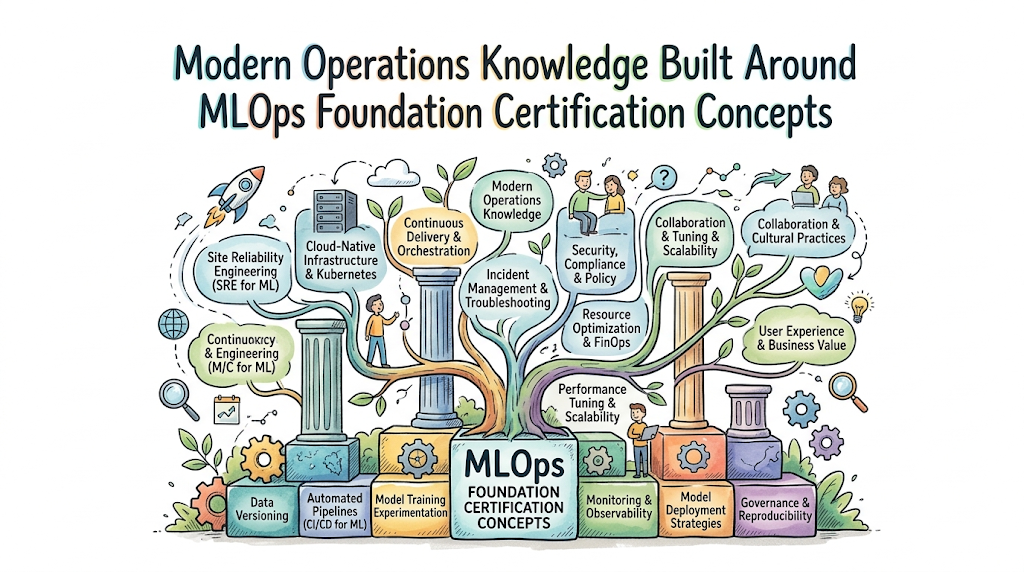
The MLOps Foundation Certification serves as a critical bridge between data science and production-grade software engineering. As enterprises shift from experimental machine learning to large-scale deployment, the need for standardized operational practices has become paramount for success. This guide is designed for professionals who want to master the art of automating and domesticating machine learning workflows within a cloud-native environment. Clarifying these pathways helps professionals avoid the “trial and error” phase of career development by providing a structured roadmap to seniority.
For DevOps engineers, SREs, and platform specialists, understanding the nuances of machine learning lifecycles is no longer optional. This roadmap, hosted by Aiopsschool, provides a structured approach to gaining the skills necessary to manage models as first-class citizens in a CI/CD pipeline. By following this guide, you will gain the clarity needed to transition from traditional software operations to the specialized field of machine learning operations. It ensures you understand how to align with enterprise-grade standards while managing the inherent volatility of data-centric systems.
Whether you are based in India or working within a global distributed team, the principles of MLOps are universal in their application to modern business problems. This certification helps professionals avoid the “technical debt” often associated with manual model deployments and ad-hoc data handling. It ensures that your career trajectory remains aligned with the most advanced automation trends in the technology landscape. By the end of this guide, you will have a clear decision-making framework to determine which learning path fits your current role and long-term aspirations.
What is the MLOps Foundation Certification?
The MLOps Foundation Certification represents a formal validation of an engineer’s ability to operationalize machine learning models using modern DevOps principles. It exists to bridge the gap between the experimental nature of data science and the rigorous requirements of production software environments. Unlike theoretical courses, this program emphasizes a production-first mindset where reproducibility and scalability are the primary goals. It is built to address the industry-wide problem where models fail to move past the laboratory phase due to a lack of operational rigor.
This certification focuses on the practical application of continuous integration, continuous delivery, and continuous training (CT) for machine learning. It aligns with modern engineering workflows by treating data, code, and models as integrated components of a single deployment pipeline. Enterprises value this certification because it ensures that engineers can maintain high availability for ML-powered features while managing underlying infrastructure. It establishes a benchmark for professional competence that goes beyond basic automation to include model lifecycle management.
By completing this program, professionals demonstrate that they understand how to handle the unique challenges of ML, such as data drift and model decay. It moves beyond simple scripting and dives into the architecture of automated retraining loops and feature stores. This foundation is essential for any organization looking to move away from “manual” machine learning toward a mature, automated ecosystem. It sets the stage for a sustainable engineering culture where machine learning is treated with the same discipline as microservices.
Who Should Pursue MLOps Foundation Certification?
Software engineers and DevOps professionals looking to pivot into the high-demand field of machine learning operations will find this certification highly beneficial. Site Reliability Engineers (SREs) who are tasked with maintaining the stability of ML services in production will gain the specific monitoring skills required for non-deterministic code. Cloud architects who need to design infrastructure that supports heavy GPU workloads and distributed training also fall into the primary target group. It provides a technical foundation that allows these professionals to communicate effectively with data science teams.
Data scientists and data engineers who want to understand the “operations” side of their work will find this program invaluable for improving their collaboration with engineering teams. It helps them move past the “it works on my machine” phase and into a mindset where code is written for scalability and maintainability. Managers and technical leaders should also consider this path to better understand the resources and timelines required for successful ML projects. By understanding the operational constraints, they can make more accurate commitments to business stakeholders.
In the Indian market, where global service providers and product startups are rapidly adopting AI-driven features, this certification offers a significant competitive advantage. Globally, the demand for MLOps talent far outstrips supply, making this an ideal pursuit for early-career professionals and veterans alike. It provides a common language for cross-functional teams to communicate and execute complex technical strategies. Whether you are a beginner looking for a starting point or an experienced engineer seeking specialization, this certification offers a clear path forward.
Why MLOps Foundation Certification is Valuable and Beyond
The value of the MLOps Foundation Certification lies in its focus on longevity and foundational principles that transcend specific tooling. While tools like Kubeflow or MLflow may evolve, the underlying concepts of versioning, automation, and monitoring remain constant. Professionals who hold this certification are seen as adaptable experts capable of navigating the shifting landscape of enterprise AI. It builds a skill set that is resistant to the rapid churn of the technology sector by focusing on architectural patterns.
Enterprise adoption of machine learning is no longer a luxury but a core business requirement for staying competitive in various sectors. As companies realize that a high percentage of ML models never reach production, they are aggressively hiring experts who can fix this “deployment gap.” This certification proves you have the skills to ensure that machine learning investments actually result in tangible business value through stable deployments. It offers a clear return on time and investment by placing you in a high-demand, high-compensation niche.
The longevity of this career path is secured by the fact that data-driven decision making is becoming the standard across all industries. This certification helps professionals stay relevant despite tool changes by emphasizing the “why” behind operational decisions. It ensures that you are not just a tool operator but a strategic engineer capable of building robust AI infrastructure. By mastering MLOps, you position yourself at the intersection of three massive trends: cloud computing, big data, and artificial intelligence.
MLOps Foundation Certification Overview
The program is delivered via the official website and is hosted on the Aiopsschool platform. It is structured as a comprehensive learning journey that combines technical theory with rigorous practical assessments to ensure skill retention. The certification ownership lies with industry experts who have designed the curriculum based on real-world failures and successes in the field. This ensures that the content remains grounded in the realities of enterprise production environments rather than academic theory.
The assessment approach is designed to test not just your knowledge of terminology, but your ability to solve production-level problems. It utilizes a modular structure, allowing learners to progress from basic concepts to complex pipeline architectures at their own pace. This ensures that every certified professional has a consistent and high-quality understanding of the MLOps lifecycle. The program focuses on creating a verifiable record of skill that employers can trust when making hiring or promotion decisions.
The certification is recognized by global technology partners and follows the best practices established by leading cloud providers. It focuses on a tool-agnostic approach, meaning the skills learned can be applied to AWS, Azure, Google Cloud, or on-premise Kubernetes clusters. This flexibility makes it one of the most practical and versatile certifications available for modern operations professionals. It provides a clear framework for professional growth and ongoing technical development in a rapidly changing field.
MLOps Foundation Certification Tracks & Levels
The certification hierarchy begins with the Foundation level, which establishes a baseline of knowledge regarding the ML lifecycle and automation needs. This level focuses on terminology, basic pipeline construction, and the cultural shifts required for MLOps. It is the mandatory starting point for anyone new to the discipline, regardless of their previous experience in traditional DevOps. By establishing this baseline, the certification ensures that all practitioners share a common vocabulary and set of principles.
The Professional level moves into the implementation of complex workflows, including automated testing for models and sophisticated monitoring strategies. At this stage, candidates are expected to handle multi-model deployments and manage model registries effectively. It aligns with the career progression of a mid-level engineer who is taking on more responsibility for production ML systems. This track dives deeper into the specific engineering challenges of scaling AI across large-scale distributed environments.
The Advanced level is intended for architects and lead engineers who design the entire MLOps ecosystem for an organization. This track covers governance, security in ML (MLSecOps), and large-scale cost optimization for AI workloads. Mastery at this level indicates a professional’s ability to lead digital transformation efforts and mentor junior staff in MLOps best practices. It prepares leaders to make high-stakes decisions regarding infrastructure, security compliance, and long-term operational strategy.
Complete MLOps Foundation Certification Table
| Track | Level | Who it’s for | Prerequisites | Skills Covered | Recommended Order |
|---|---|---|---|---|---|
| MLOps Core | Foundation | Beginners and DevOps Pros | Basic Linux and Python | ML Lifecycle, CI/CD, Versioning | First |
| MLOps Engineering | Professional | SREs and Data Engineers | Foundation Level | Kubeflow, MLflow, Feature Stores | Second |
| MLOps Architecture | Advanced | Tech Leads and Architects | Professional Level | Governance, Scale, MLSecOps | Third |
| AIOps Specialist | Professional | SREs and Ops Managers | Basic Automation | AI for Monitoring, Log Analysis | Optional |
| DataOps Specialist | Professional | Data Engineers | SQL and Cloud Basics | Data Pipelines, Quality, Lineage | Optional |
Detailed Guide for Each MLOps Foundation Certification
MLOps Foundation Certification – Foundation Level
What it is
This certification validates a candidate’s understanding of the fundamental pillars of MLOps, including the differences between DevOps and MLOps. It confirms that the individual can identify the stages of the machine learning lifecycle and understands the importance of reproducibility in model training. It serves as the baseline for all specialized operational roles in the AI space.
Who should take it
This level is ideal for junior DevOps engineers, system administrators, and data science students who want a structured introduction to operations. It is also suitable for project managers who need to oversee ML teams and understand the technical constraints of the field. Anyone transitioning from a non-ML engineering role will find this to be the perfect starting point.
Skills you’ll gain
- Understanding the machine learning development lifecycle from data prep to deployment.
- Basic version control for data, code, and model artifacts.
- Introduction to CI/CD pipelines specifically tailored for machine learning.
- Knowledge of environment management and containerization for ML.
Real-world projects you should be able to do
- Automate the deployment of a simple Scikit-learn model using a Docker container.
- Set up a version-controlled repository that tracks both code and data changes.
- Create a basic pipeline to trigger a model build upon code updates.
Preparation plan
- 7-14 Days: Focus on the core terminology and the high-level MLOps workflow. Read industry whitepapers.
- 30 Days: Complete the hands-on labs provided by the training platform. Build a local sandbox environment.
- 60 Days: Review case studies of failed ML deployments and how MLOps solves those issues. Take mock exams.
Common mistakes
- Treating ML models exactly like traditional software code without considering data dependencies.
- Ignoring the need for data versioning and focusing only on git-based code versioning.
- Underestimating the complexity of environment parity between training and serving.
Best next certification after this
- Same-track option: MLOps Professional Certification.
- Cross-track option: DataOps Foundation Certification.
- Leadership option: Engineering Management for AI Teams.
MLOps Foundation Certification – Professional Level
What it is
This certification validates the ability to implement and manage end-to-end MLOps pipelines using industry-standard tools. It demonstrates that the engineer can handle real-time and batch scoring, model monitoring, and automated retraining triggers. It proves that you can build the infrastructure required to scale machine learning across an enterprise.
Who should take it
Experienced DevOps engineers, SREs, and Data Engineers who are actively working on machine learning projects. It is designed for those who need to build and maintain the actual production systems that power AI products. Those looking for mid-to-senior level roles should prioritize this level.
Skills you’ll gain
- Advanced pipeline orchestration using tools like Kubeflow or Airflow.
- Implementation of model monitoring systems for detecting data and concept drift.
- Management of feature stores to ensure consistency between training and serving.
- Automated testing strategies for model performance and data quality.
Real-world projects you should be able to do
- Build a fully automated “Continuous Training” pipeline that triggers on new data arrival.
- Implement a Prometheus and Grafana dashboard for tracking model prediction accuracy.
- Design a Blue-Green deployment strategy for rolling out new model versions without downtime.
Preparation plan
- 7-14 Days: Deep dive into container orchestration and Kubernetes basics for ML.
- 30 Days: Focus on specific toolchains like MLflow for tracking and DVC for data versioning.
- 60 Days: Practice complex scenario-based troubleshooting, such as fixing a broken pipeline or investigating drift.
Common mistakes
- Over-engineering the pipeline for simple models that don’t require high-frequency updates.
- Failing to implement proper logging and audit trails for model decisions.
- Neglecting the security aspects of model endpoints and data access.
Best next certification after this
- Same-track option: MLOps Advanced/Architect Certification.
- Cross-track option: DevSecOps Specialist Certification.
- Leadership option: Principal MLOps Engineer Path.
Choose Your Learning Path
DevOps Path
The DevOps path focuses on the seamless integration of ML models into existing software delivery lifecycles. Engineers on this path will learn how to adapt standard CI/CD tools to handle the non-deterministic nature of machine learning. The goal is to treat the ML model as just another service that must pass rigorous automated testing before hitting production. This path is essential for organizations that want to maintain a high velocity of feature releases while incorporating AI. It bridges the gap between infrastructure as code and models as code.
DevSecOps Path
The DevSecOps path emphasizes the security and compliance aspects of the machine learning lifecycle. This includes securing the data supply chain, protecting model weights from adversarial attacks, and ensuring that model APIs are not vulnerable to injection. Professionals on this path work at the intersection of security engineering and data science. They are responsible for implementing “Shift Left” security practices within the MLOps pipeline to prevent data leaks and unauthorized access. It ensures that AI innovation does not come at the cost of enterprise security.
SRE Path
The SRE path focuses on the reliability, scalability, and performance of machine learning services in production. SREs in this domain deal with unique challenges like high latency in inference and the heavy resource demands of large language models. They develop sophisticated monitoring and alerting systems that can distinguish between infrastructure failure and model degradation. This path is critical for maintaining the Service Level Objectives (SLOs) of AI-driven platforms. It ensures that machine learning systems are robust enough to handle production traffic.
AIOps Path
The AIOps path is distinct as it focuses on using artificial intelligence to improve IT operations and infrastructure management. Professionals here implement machine learning models to analyze logs, predict outages, and automate incident response for general infrastructure. It involves the application of anomaly detection algorithms to vast streams of telemetry data. This path is ideal for those who want to build “self-healing” infrastructure using AI as the primary engine for operational excellence. It transforms traditional monitoring into proactive, intelligent observation.
MLOps Path
The MLOps path is dedicated to the operationalization of machine learning models themselves, focusing on the model’s journey from lab to field. It covers everything from experimental tracking and hyperparameter tuning to the final deployment and monitoring of models. This path requires a deep understanding of how model performance evolves over time and how to manage the feedback loops that keep models accurate. It is the core path for anyone looking to specialize in the infrastructure and automation of artificial intelligence. It focuses on the specific challenges of model lifecycle management.
DataOps Path
The DataOps path focuses on the health and flow of the data that feeds the machine learning models. It emphasizes data quality, automated testing of data pipelines, and the reduction of cycle time for data delivery. DataOps professionals work to eliminate silos between data providers and data consumers, ensuring that the MLOps pipeline has a reliable source of high-quality information. This is the foundation upon which all successful ML projects are built. It ensures that the “data supply chain” is as rigorous as the software supply chain.
FinOps Path
The FinOps path for MLOps is becoming increasingly important as the cost of training and running large models continues to rise. This path involves monitoring cloud spend specifically related to ML workloads, such as GPU reservation and storage of massive datasets. Professionals learn how to optimize resource allocation and implement cost-allocation tags to provide visibility into the ROI of AI projects. It bridges the gap between engineering, finance, and business leadership. It ensures that machine learning initiatives remain economically viable for the organization.
Role → Recommended MLOps Foundation Certification
| Role | Recommended Certifications |
|---|---|
| DevOps Engineer | MLOps Foundation, DevSecOps Professional |
| SRE | MLOps Professional, AIOps Specialist |
| Platform Engineer | MLOps Architect, Cloud Native Specialist |
| Cloud Engineer | MLOps Foundation, FinOps Practitioner |
| Security Engineer | MLOps Foundation, DevSecOps Expert |
| Data Engineer | DataOps Foundation, MLOps Professional |
| FinOps Practitioner | FinOps Foundation, MLOps Foundation |
| Engineering Manager | MLOps Foundation, AIOps for Leaders |
Next Certifications to Take After MLOps Foundation Certification
Same Track Progression
Once you have mastered the MLOps Foundation Certification, the most logical step is to move toward the Professional and Advanced levels. This allows you to deepen your technical expertise in specific orchestration frameworks like Kubernetes and advanced monitoring techniques. Deep specialization in MLOps makes you an indispensable asset for large-scale enterprise AI initiatives. You will transition from someone who understands the concepts to someone who can design high-availability systems. Continuing in the same track ensures you remain a subject matter expert in a niche but critical field.
Cross-Track Expansion
For those looking to broaden their impact, expanding into DevSecOps or DataOps is a highly effective strategy. Understanding how security integrates into the ML pipeline or how data quality impacts model performance makes you a more versatile engineer. This “T-shaped” skill set allows you to collaborate more effectively across different departments and solve complex, multi-disciplinary problems. Cross-training ensures that you can see the “big picture” of the entire production ecosystem. It makes you eligible for leadership roles that require a broad understanding of the modern technology stack.
Leadership & Management Track
If your goal is to move into management, pursuing certifications focused on AIOps for Leaders or Technical Product Management is advised. These programs teach you how to align MLOps strategies with business goals and how to manage the unique talent pool of data scientists and engineers. Moving into leadership requires a shift from “how to build” to “why to build” and “how to measure success.” It prepares you for roles like VP of Engineering or Head of AI Operations. Leadership training combined with technical certification makes you a powerful advocate for engineering excellence at the executive level.
Training & Certification Support Providers for MLOps Foundation Certification
DevOpsSchool DevOpsSchool is a leading provider of technical training that focuses on the practical application of modern engineering practices. They offer a robust curriculum for the MLOps Foundation Certification, featuring live instructor-led sessions and hands-on laboratory environments. Their approach is designed to help professionals from traditional backgrounds transition smoothly into specialized roles. With a strong presence in India and a global reach, they provide the necessary resources for mastering CI/CD, containerization, and automation. Their community support and post-training mentorship make them a preferred choice for those seeking a guided learning experience in the DevOps and MLOps domains. They focus on delivering industry-standard skills that translate directly to employment.
Cotocus Cotocus specializes in high-end technical consulting and training services tailored for enterprise-level digital transformation. They provide deep-dive workshops on MLOps and cloud-native technologies, emphasizing real-world production scenarios. Their trainers are industry veterans who bring years of field experience into the classroom, ensuring that students learn more than just the basics. Cotocus is known for its customized corporate training programs that help entire teams upskill simultaneously. By focusing on the intersection of business value and technical excellence, they help organizations build resilient and scalable machine learning operations that can withstand the demands of modern markets. Their methodology ensures that learners can implement what they learn in complex enterprise environments.
Scmgalaxy Scmgalaxy is a comprehensive community and training portal dedicated to software configuration management and DevOps automation. They offer extensive resources, tutorials, and certification support for those pursuing the MLOps Foundation Certification. Their focus is on the “plumbing” of the software lifecycle, ensuring that version control, build automation, and release management are handled with precision. Scmgalaxy has a long history of supporting engineers in India and abroad, providing a platform for knowledge sharing and career growth. Their training modules are designed to be practical and tool-oriented, making them ideal for professionals who need to implement automated workflows immediately in their daily jobs. They foster a strong community of practice for operations professionals.
BestDevOps BestDevOps focuses on curated learning paths that simplify the complex world of modern operations for engineers at all levels. They provide specialized tracks for MLOps that emphasize the most relevant tools and practices used by top-tier technology companies. Their training philosophy is centered on “learning by doing,” with a heavy emphasis on capstone projects and real-world simulations. BestDevOps aims to bridge the talent gap by producing engineers who are not just certified, but truly competent in handling production workloads. Their curriculum is constantly updated to reflect the latest trends in the industry, ensuring that learners are always at the cutting edge. They prioritize job readiness and practical skill acquisition over theoretical knowledge.
devsecopsschool.com devsecopsschool.com is the primary destination for professionals who want to integrate security into every stage of the development and operations lifecycle. They provide specialized support for the MLOps Foundation Certification by highlighting the unique security challenges of machine learning. Their training covers topics such as data privacy, model security, and automated compliance checking within the pipeline. By teaching engineers how to “Shift Left” with security, they help organizations avoid costly breaches and regulatory issues. Their focus on the “Security” aspect of MLOps makes them an essential resource for engineers working in highly regulated industries. They ensure that AI systems are safe, secure, and compliant with global standards.
sreschool.com sreschool.com focuses on the principles of Site Reliability Engineering and how they apply to modern distributed systems. They offer specialized modules that support the MLOps Foundation Certification by focusing on the reliability and observability of machine learning services. Their training teaches professionals how to define SLOs for ML models, implement sophisticated alerting, and manage incident response for AI-driven applications. By applying the SRE mindset to MLOps, they ensure that machine learning systems are not just accurate, but also stable and performant. This is a critical resource for engineers tasked with maintaining the “uptime” of intelligence-driven features. They bridge the gap between model performance and infrastructure reliability.
aiopsschool.com aiopsschool.com is the hosting platform and primary authority for the MLOps Foundation Certification. They provide the most direct and comprehensive learning experience for professionals looking to master the intersection of AI and operations. Their curriculum is designed by practitioners for practitioners, focusing on the end-to-end lifecycle of machine learning models. With a rich library of labs, documentation, and assessment tools, they provide a one-stop-shop for certification success. Aiopsschool is dedicated to advancing the field of automated intelligence, offering insights into both the operationalization of ML and the use of AI for operations. They are the benchmark for quality and technical depth in the field of AI operations.
dataopsschool.com dataopsschool.com provides the foundational knowledge required to manage the data pipelines that power machine learning models. They offer support for the MLOps Foundation Certification by ensuring that candidates understand the critical role of data quality and lineage. Their training modules focus on the automation of data delivery, versioning of datasets, and the implementation of data contracts. By mastering DataOps, professionals can ensure that their MLOps pipelines are fed by high-quality, reliable information. This school is essential for anyone who recognizes that machine learning is only as good as the data it is built upon. They focus on making data as reliable and manageable as code.
finopsschool.com finopsschool.com addresses the growing need for financial accountability and cost optimization in the cloud and AI era. They provide specialized support for the MLOps Foundation Certification by teaching engineers how to manage the high costs associated with ML training and inference. Their curriculum covers cloud billing, resource tagging, and the economic impact of architectural decisions. By integrating FinOps principles into the MLOps lifecycle, they help organizations achieve a positive return on their AI investments. This training is vital for engineering leaders and practitioners who need to balance technical innovation with fiscal responsibility. They provide the tools needed to manage the high price tag of modern intelligence systems.
Frequently Asked Questions (General)
- Is the MLOps Foundation Certification difficult for someone with no ML background?
The Foundation level is specifically designed to introduce machine learning concepts gradually to operations professionals. While a basic understanding of software engineering is required, you do not need to be a data scientist to succeed in this certification.
- How long does it typically take to complete the certification?
Most professionals can complete the Foundation level in 30 to 60 days, depending on their existing experience with DevOps and cloud-native tools. Dedicated learners can often finish the curriculum faster with focused study.
- What are the prerequisites for this certification?
A basic understanding of Linux commands, Python programming, and the fundamentals of containerization (like Docker) is highly recommended. These skills form the technical baseline required to complete the hands-on laboratory exercises.
- Will this certification help me get a job in India?
Yes, the demand for MLOps engineers in India is growing rapidly within both multinational corporations and high-growth startups. This certification provides the formal validation that many Indian tech employers look for during hiring.
- How does MLOps differ from traditional DevOps?
MLOps includes everything in DevOps plus the management of data versioning, model tracking, and the handling of non-deterministic model behavior. It adds layers for continuous training and model monitoring that are not present in traditional software.
- Do I need to know complex mathematics for MLOps?
No, MLOps focuses on the operational infrastructure and automation rather than the underlying calculus or statistics used to build the models. Your job is to manage the model’s lifecycle, not necessarily to build the model itself.
- Is the certification exam proctored?
Yes, the professional certification involves a proctored environment to ensure the integrity of the assessment process. This ensures that the credential remains valuable and respected by employers across the global technology industry.
- Can I take the exam online?
Yes, the platform is designed to support remote learners, allowing you to take the exam from anywhere in the world. You simply need a stable internet connection and a computer that meets the basic technical requirements.
- What is the validity period of the certification?
Typically, these certifications are valid for two to three years. After this period, recertification or moving to a higher level is recommended to stay current with the rapidly evolving technology and tools.
- Does this certification cover specific cloud providers like AWS or Azure?
The Foundation level is generally tool-agnostic, focusing on principles that apply across all major cloud providers and on-premise environments. It teaches you concepts that are transferable regardless of your specific cloud stack.
- Is there a community for certified professionals?
Yes, platforms like Aiopsschool and DevOpsSchool provide access to alumni networks and community forums for ongoing support and networking. These communities are excellent for finding jobs and solving real-world technical problems.
- What is the ROI of getting an MLOps certification?
The ROI is reflected in increased salary potential, better job security in an AI-driven market, and the ability to lead high-impact technical projects. It places you in the top tier of operations professionals globally.
FAQs on MLOps Foundation Certification
- What specifically does the MLOps Foundation Certification exam cover?
The exam focuses on the machine learning lifecycle, CI/CD for ML, model monitoring, and data versioning. It tests your ability to conceptualize how these pieces fit into a production environment and your understanding of the automation needed for scale.
- How does this certification address the “Deployment Gap” in AI?
It teaches engineers how to automate the transition from a Jupyter notebook to a scalable, monitored microservice. This reduces the time and manual effort required to put models into production, ensuring that models actually reach the end users.
- Is Python the only language covered in the MLOps curriculum?
While Python is the primary language used in the ML world, the certification also touches on the operational layer, which involves Bash, YAML for configuration, and various pipeline orchestration languages required for building robust delivery systems.
- Will I learn about Kubernetes in the MLOps Foundation track?
Yes, an introduction to container orchestration is a core part of the curriculum, as Kubernetes is the industry standard for hosting ML workloads. You will learn how to deploy and manage ML containers within a cluster.
- How much hands-on practice is required to pass?
We recommend at least 20 to 30 hours of hands-on lab work to become comfortable with the tools and workflows described in the modules. Practical experience is essential for passing the scenario-based questions in the certification exam.
- Does the certification cover Large Language Models (LLMs)?
The foundation level covers the principles of operationalizing any ML model, including the specific infrastructure needs and latency challenges associated with LLMs. It provides the framework needed to handle the scale of generative AI.
- Can this certification lead to a Site Reliability Engineering role?
Absolutely. Many SRE roles now require knowledge of how to maintain AI services, making this certification a perfect bridge into modern reliability engineering. It adds a specialized layer of “intelligence operations” to your existing SRE skills.
- What makes Aiopsschool the right place for this certification?
Aiopsschool provides a curriculum that is strictly focused on production-grade operations, avoiding the purely theoretical approach found in many academic courses. It is designed by industry experts who have built and managed ML systems at scale.
Final Thoughts
As a mentor who has seen the evolution of the tech industry over two decades, I can say with confidence that MLOps is not a passing trend. It is the natural evolution of software engineering in an era where intelligence is being baked into every application. The MLOps Foundation Certification is a worthy investment because it provides the structure and language needed to navigate this transition effectively. It serves as a clear signal to the market that you are ready for the next wave of technical challenges.
For the individual engineer, this certification acts as a shield against obsolescence. As traditional infrastructure tasks become increasingly automated, the ability to manage the complex, data-driven “brain” of an application becomes the new high-value skill. It moves you from being a generalist to a specialist who can solve the most difficult problems facing modern enterprises. It provides the technical depth needed to command higher salaries and work on more interesting, impactful projects.
Ultimately, the value of any certification is what you do with the knowledge. If you take this program as a starting point to build real-world pipelines and solve actual production bottlenecks, it will pay for itself many times over. It is a practical, rigorous, and highly relevant credential for anyone serious about a career in modern cloud and AI operations. No hype. No sales tone. Just a solid investment in your technical future.
