Upgrade & Secure Your Future with DevOps, SRE, DevSecOps, MLOps!
We spend hours scrolling social media and waste money on things we forget, but won’t spend 30 minutes a day earning certifications that can change our lives.
Master in DevOps, SRE, DevSecOps & MLOps by DevOps School!
Learn from Guru Rajesh Kumar and double your salary in just one year.
Introduction
AIOps Platforms are advanced tools that leverage artificial intelligence and machine learning to enhance IT operations. They automatically analyze large volumes of operational data, detect anomalies, predict issues, and automate responses to improve system reliability and performance. By consolidating monitoring, analytics, and automation, AIOps platforms empower IT teams to proactively manage complex, multi-cloud, and distributed environments.
In today’s environment, where digital services are critical, AIOps has become essential for organizations managing high-scale applications, hybrid infrastructure, and rapid deployments. These platforms help reduce downtime, improve incident response, optimize resource utilization, and enhance overall IT service quality.
Real-world use cases include automated anomaly detection in infrastructure and applications, predictive alerting to prevent outages, automated remediation for common issues, performance optimization in cloud environments, and integration with CI/CD pipelines for proactive monitoring.
When selecting AIOps tools, buyers should consider criteria such as real-time analytics, machine learning capabilities, predictive monitoring, integration with existing ITSM and monitoring tools, scalability, automation and remediation features, multi-cloud support, dashboard and visualization options, security and compliance, and pricing.
Best for: IT operations teams, DevOps engineers, SREs, cloud architects, large enterprises, and organizations with complex, multi-cloud IT environments.
Not ideal for: small-scale IT operations, single-server environments, or organizations with limited operational data.
Key Trends in AIOps Platforms
- AI-powered anomaly detection for early issue identification.
- Automated root cause analysis to reduce mean time to resolution (MTTR).
- Integration with monitoring, logging, and incident management tools for unified observability.
- Predictive alerts and proactive remediation using machine learning models.
- Multi-cloud and hybrid infrastructure support for modern enterprise environments.
- Real-time dashboards and actionable insights for IT teams.
- Self-healing and automated remediation workflows for operational efficiency.
- API access and extensibility for integration with CI/CD and DevOps pipelines.
- Enhanced security and compliance with RBAC, encryption, and audit logging.
- Flexible pricing models to support SMBs and enterprise-scale operations.
How We Selected These Tools
- Evaluated market adoption and recognition among enterprises and IT teams.
- Reviewed completeness of AI-driven analytics and monitoring features.
- Assessed reliability, scalability, and performance under high operational loads.
- Examined security features, encryption, RBAC, and compliance certifications.
- Considered integrations with monitoring, logging, incident management, and DevOps tools.
- Evaluated dashboards, visualization capabilities, and actionable insights.
- Analyzed automation and remediation features.
- Assessed multi-cloud and hybrid environment support.
- Reviewed vendor support, documentation, and community adoption.
- Focused on practical operational value rather than hype.
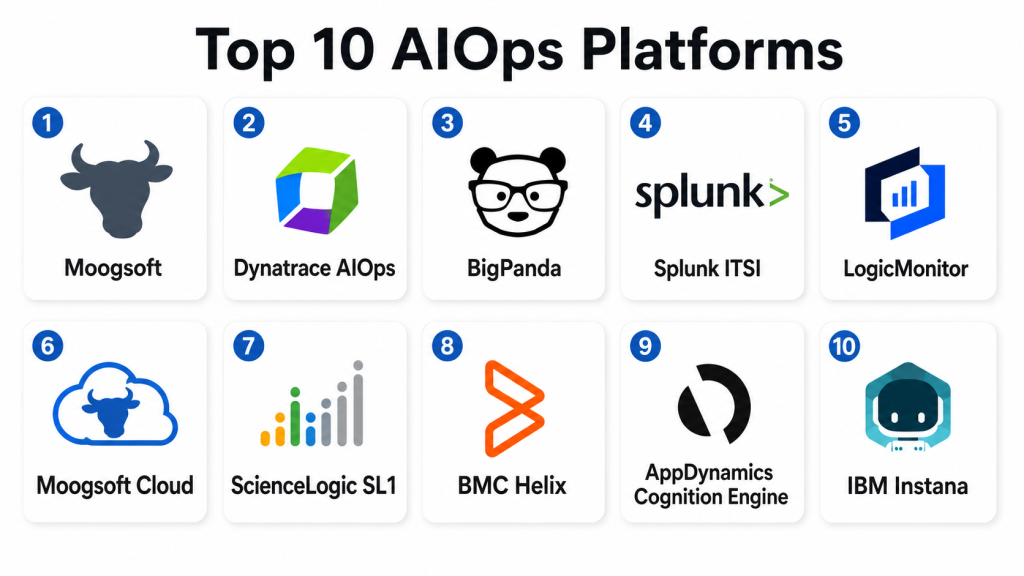
Top 10 AIOps Platforms
#1 — Moogsoft
Short description: Moogsoft delivers AI-driven monitoring, anomaly detection, and automated incident response for enterprises managing complex IT environments.
Key Features
- Real-time anomaly detection and correlation.
- Automated alert deduplication and prioritization.
- Predictive insights for potential outages.
- Integration with monitoring and ITSM tools.
- Incident timeline and analytics dashboards.
- Multi-cloud and hybrid environment support.
- API access for workflow automation.
Pros
- Reduces alert noise and improves response efficiency.
- AI-driven root cause analysis.
- Scales to enterprise environments.
Cons
- Premium pricing for full features.
- Requires onboarding and configuration.
- Complexity for small IT teams.
Platforms / Deployment
Web / Linux / Windows
Cloud / Hybrid
Security & Compliance
Supports encryption, RBAC, MFA, and audit logging.
Integrations & Ecosystem
- Slack, Teams
- ServiceNow, Jira
- AWS, Azure, GCP
- CI/CD pipelines
- Prometheus, Nagios
Support & Community
Enterprise support available with documentation and training resources.
#2 — Dynatrace AIOps
Short description: Dynatrace combines AIOps with full-stack observability to provide automated insights and anomaly detection across applications and infrastructure.
Key Features
- AI-assisted root cause analysis.
- Automatic anomaly detection across services.
- Full-stack monitoring including cloud-native apps.
- Integration with monitoring, CI/CD, and ITSM tools.
- Predictive incident alerts.
- Multi-cloud support.
- Visualization dashboards and analytics.
Pros
- Fully automated AI-driven insights.
- Strong cloud-native capabilities.
- Reduces MTTR with predictive analytics.
Cons
- Enterprise pricing may be prohibitive for SMBs.
- Advanced setup required for full functionality.
- Learning curve for dashboard customization.
Platforms / Deployment
Web / Linux / Windows / macOS
Cloud / Hybrid
Security & Compliance
Supports encryption, RBAC, audit logs; SOC 2 and ISO certifications available.
Integrations & Ecosystem
- AWS, Azure, GCP
- Kubernetes, Docker
- ServiceNow, Jira
- CI/CD pipelines
- Slack, Teams
Support & Community
Enterprise support and training; active Dynatrace community.
#3 — BigPanda
Short description: BigPanda consolidates alerts from multiple sources, applies AI correlation, and automates incident response across IT environments.
Key Features
- AI-driven event correlation.
- Automated incident creation.
- Predictive insights for potential issues.
- Integration with monitoring and ITSM tools.
- Analytics dashboards.
- Multi-cloud and hybrid environment support.
- API for workflow automation.
Pros
- Reduces alert fatigue.
- Scalable for large IT environments.
- AI-assisted insights improve operational efficiency.
Cons
- Enterprise pricing.
- Setup requires configuration.
- Best suited for complex environments.
Platforms / Deployment
Web / Linux / Windows
Cloud / Hybrid
Security & Compliance
RBAC, encrypted communication, audit logging; certifications vary.
Integrations & Ecosystem
- PagerDuty, Opsgenie
- Slack, Teams
- AWS, Azure, GCP
- CI/CD pipelines
- ServiceNow, Jira
Support & Community
Vendor support with documentation; professional community.
#4 — Splunk ITSI
Short description: Splunk IT Service Intelligence combines machine learning and analytics for proactive IT operations and incident management.
Key Features
- Predictive analytics and anomaly detection.
- Event correlation and root cause analysis.
- Integration with monitoring and logging sources.
- Multi-cloud and hybrid support.
- Automated remediation workflows.
- Dashboards and KPIs.
- CI/CD integration support.
Pros
- Strong analytics and reporting.
- Scales to enterprise environments.
- Reduces MTTR with predictive insights.
Cons
- High complexity and learning curve.
- Expensive for SMBs.
- Requires Splunk expertise for advanced use.
Platforms / Deployment
Web / Linux / Windows
Cloud / On-premise
Security & Compliance
Supports encryption, RBAC, audit logging; SOC 2, ISO certifications.
Integrations & Ecosystem
- AWS, Azure, GCP
- Slack, Teams
- ServiceNow, Jira
- Kubernetes, Docker
- CI/CD pipelines
Support & Community
Enterprise support with documentation and training; active Splunk community.
#5 — LogicMonitor
Short description: LogicMonitor provides predictive monitoring and AIOps for hybrid and cloud-native IT environments.
Key Features
- Real-time monitoring and alerting.
- Predictive anomaly detection.
- Event correlation and root cause analysis.
- Multi-cloud support.
- Dashboards and reporting.
- Integration with ITSM and CI/CD tools.
- Automated workflows.
Pros
- Easy to deploy for hybrid environments.
- Predictive insights improve reliability.
- Scalable monitoring for large IT estates.
Cons
- Enterprise pricing.
- Setup required for complex analytics.
- Advanced features require professional services.
Platforms / Deployment
Web / Linux / Windows
Cloud / Hybrid
Security & Compliance
Supports RBAC, encryption, and audit logs. Certifications vary.
Integrations & Ecosystem
- Slack, Teams
- ServiceNow, Jira
- AWS, Azure, GCP
- CI/CD pipelines
- Kubernetes, Docker
Support & Community
Vendor support with documentation; community active for enterprise users.
#6 — Moogsoft Cloud
Short description: Moogsoft Cloud leverages AI and machine learning for incident correlation, predictive alerts, and automated remediation in complex IT environments.
Key Features
- Event and incident correlation.
- Predictive alerting using ML.
- Automated workflows.
- Multi-cloud and hybrid support.
- Integration with monitoring tools.
- Dashboards and analytics.
- API for automation.
Pros
- Reduces alert noise and duplication.
- AI-driven insights enhance operational efficiency.
- Cloud-native optimized.
Cons
- Enterprise pricing.
- Requires configuration and onboarding.
- Complexity for small teams.
Platforms / Deployment
Web / Linux / Windows
Cloud
Security & Compliance
Supports encryption, RBAC, MFA, and audit logs.
Integrations & Ecosystem
- Slack, Teams
- PagerDuty, Opsgenie
- AWS, Azure, GCP
- CI/CD pipelines
- ServiceNow, Jira
Support & Community
Enterprise support with training and documentation.
#7 — ScienceLogic SL1
Short description: SL1 combines AIOps and monitoring with predictive analytics and automation for hybrid IT environments.
Key Features
- Event correlation and root cause analysis.
- Predictive insights for potential outages.
- Integration with monitoring, ITSM, and CI/CD tools.
- Multi-cloud and hybrid support.
- Dashboards and KPIs.
- Automated remediation workflows.
- API access for integration.
Pros
- Strong enterprise analytics.
- Reduces MTTR.
- Scalable for hybrid IT.
Cons
- Enterprise pricing.
- Requires configuration.
- Advanced features need expertise.
Platforms / Deployment
Web / Linux / Windows
Cloud / On-premise
Security & Compliance
Supports RBAC, encryption, audit logging; enterprise certifications available.
Integrations & Ecosystem
- Slack, Teams
- AWS, Azure, GCP
- ServiceNow, Jira
- Kubernetes, Docker
- CI/CD pipelines
Support & Community
Vendor support and documentation available; active community.
#8 — BMC Helix
Short description: BMC Helix provides AIOps-driven IT operations management with predictive insights and automation.
Key Features
- Event correlation and predictive analytics.
- Automated incident response.
- Integration with monitoring and ITSM.
- Multi-cloud and hybrid support.
- Dashboards and reporting.
- Workflow automation.
- API access.
Pros
- Enterprise-grade automation.
- Reduces operational overhead.
- Multi-cloud visibility.
Cons
- Premium pricing.
- Complex setup.
- Requires training for advanced features.
Platforms / Deployment
Web / Linux / Windows
Cloud / Hybrid
Security & Compliance
RBAC, encryption, audit logging; enterprise certifications supported.
Integrations & Ecosystem
- Slack, Teams
- ServiceNow, Jira
- AWS, Azure, GCP
- CI/CD pipelines
- Monitoring tools
Support & Community
Enterprise support with documentation and training.
#9 — AppDynamics Cognition Engine
Short description: AppDynamics combines AIOps with application performance monitoring for predictive insights and automated operations.
Key Features
- AI-driven anomaly detection.
- Root cause analysis and event correlation.
- Multi-cloud and hybrid support.
- Predictive alerts.
- Integration with ITSM and DevOps tools.
- Dashboards and analytics.
- Automated workflows.
Pros
- Strong predictive analytics.
- Deep integration with applications and infrastructure.
- Reduces downtime and MTTR.
Cons
- Enterprise pricing.
- Complex setup.
- Requires expertise for advanced analytics.
Platforms / Deployment
Web / Linux / Windows
Cloud / Hybrid
Security & Compliance
Supports encryption, RBAC, and audit logging; certifications vary.
Integrations & Ecosystem
- Slack, Teams
- ServiceNow, Jira
- AWS, Azure, GCP
- CI/CD pipelines
- Kubernetes, Docker
Support & Community
Vendor support with documentation; active AppDynamics community.
#10 — IBM Instana
Short description: Instana delivers AIOps and automated monitoring for distributed applications with AI-assisted root cause analysis.
Key Features
- Automated tracing and monitoring.
- AI-driven anomaly detection.
- Root cause analysis.
- Multi-cloud support.
- Integration with monitoring and ITSM tools.
- Dashboards and analytics.
- API for automation.
Pros
- Fully automated AIOps solution.
- Reduces MTTR and operational complexity.
- Scales for enterprise environments.
Cons
- Enterprise pricing.
- Learning curve for dashboards and workflows.
- Requires configuration for complex setups.
Platforms / Deployment
Web / Linux / Windows / macOS
Cloud / Hybrid
Security & Compliance
Supports encryption, RBAC, MFA, and audit logs; enterprise certifications available.
Integrations & Ecosystem
- Slack, Teams
- ServiceNow, Jira
- AWS, Azure, GCP
- CI/CD pipelines
- Kubernetes, Docker
Support & Community
Enterprise support with documentation and training resources.
Comparison Table
| Tool Name | Best For | Platform(s) Supported | Deployment | Standout Feature | Public Rating |
|---|---|---|---|---|---|
| Moogsoft | Enterprise IT | Web, Linux, Windows | Cloud / Hybrid | AI-driven correlation | N/A |
| Dynatrace AIOps | Cloud-native teams | Web, Linux, Windows, macOS | Cloud / Hybrid | Full-stack AI observability | N/A |
| BigPanda | Large IT environments | Web, Linux, Windows | Cloud / Hybrid | Event correlation | N/A |
| Splunk ITSI | Enterprise | Web, Linux, Windows | Cloud / On-prem | Predictive analytics | N/A |
| LogicMonitor | Hybrid IT teams | Web, Linux, Windows | Cloud / Hybrid | Predictive insights | N/A |
| Moogsoft Cloud | Cloud-native teams | Web, Linux, Windows | Cloud | Automated AI insights | N/A |
| ScienceLogic SL1 | Enterprise IT | Web, Linux, Windows | Cloud / On-prem | Hybrid IT monitoring | N/A |
| BMC Helix | Large enterprises | Web, Linux, Windows | Cloud / Hybrid | AI automation | N/A |
| AppDynamics Cognition | Enterprise apps | Web, Linux, Windows | Cloud / Hybrid | Predictive analytics | N/A |
| IBM Instana | Distributed apps | Web, Linux, Windows, macOS | Cloud / Hybrid | Automated tracing & AI | N/A |
Evaluation & Scoring of AIOps Platforms
| Tool Name | Core (25%) | Ease (15%) | Integrations (15%) | Security (10%) | Performance (10%) | Support (10%) | Value (15%) | Weighted Total |
|---|---|---|---|---|---|---|---|---|
| Moogsoft | 10 | 8 | 9 | 9 | 9 | 8 | 8 | 8.80 |
| Dynatrace AIOps | 10 | 7 | 9 | 9 | 9 | 8 | 7 | 8.40 |
| BigPanda | 9 | 7 | 8 | 8 | 8 | 8 | 7 | 7.95 |
| Splunk ITSI | 9 | 7 | 9 | 9 | 9 | 8 | 7 | 8.15 |
| LogicMonitor | 8 | 8 | 8 | 8 | 8 | 8 | 8 | 8.00 |
| Moogsoft Cloud | 9 | 7 | 9 | 9 | 9 | 8 | 7 | 8.15 |
| ScienceLogic SL1 | 9 | 7 | 8 | 8 | 8 | 7 | 7 | 7.75 |
| BMC Helix | 9 | 7 | 8 | 8 | 8 | 7 | 7 | 7.75 |
| AppDynamics Cognition | 9 | 7 | 9 | 9 | 9 | 8 | 7 | 8.15 |
| IBM Instana | 10 | 7 | 9 | 9 | 9 | 8 | 7 | 8.40 |
These scores allow comparison of core capabilities, ease of use, integrations, and overall value for different IT environments.
Which AIOps Platform Is Right for You?
Solo / Freelancer
Small teams may start with Moogsoft Cloud or LogicMonitor for predictive monitoring and AI-assisted insights.
SMB
BigPanda, LogicMonitor, and Moogsoft Cloud provide scalable AI-driven monitoring and incident management.
Mid-Market
Splunk ITSI, AppDynamics Cognition, and Dynatrace AIOps deliver advanced analytics, predictive insights, and multi-cloud support.
Enterprise
Moogsoft, Dynatrace AIOps, IBM Instana, and BMC Helix provide enterprise-grade AI-driven insights, automated remediation, and full-stack observability.
Budget vs Premium
Open-source or SMB-focused tools reduce cost but may require configuration. Enterprise solutions provide automation, analytics, and SLA tracking at a premium.
Feature Depth vs Ease of Use
Enterprise tools offer deeper insights and predictive analytics but require setup and expertise. SMB-friendly tools prioritize usability and quick deployment.
Integrations & Scalability
Ensure the platform integrates with monitoring, CI/CD, ITSM, cloud, and containerized environments. Evaluate scalability for large datasets.
Security & Compliance Needs
Check for RBAC, encrypted data, audit logs, and enterprise compliance certifications like SOC 2 and ISO 27001.
Frequently Asked Questions
What is AIOps?
AIOps applies AI and machine learning to IT operations to detect anomalies, predict issues, and automate remediation.
Why do organizations need AIOps platforms?
They reduce downtime, improve performance, automate incident response, and provide predictive insights for complex IT environments.
Can AIOps handle multi-cloud and hybrid IT?
Yes, enterprise-grade AIOps platforms support hybrid and multi-cloud infrastructures.
Do these tools integrate with CI/CD pipelines?
Yes, most AIOps platforms can integrate with DevOps pipelines to detect issues during deployment.
How does predictive alerting work?
AI models analyze historical and real-time data to anticipate potential incidents before they occur.
Are open-source AIOps platforms reliable?
Open-source solutions exist but enterprise platforms provide scalability, automation, and support for large IT environments.
Can AIOps automate remediation?
Yes, platforms like Moogsoft, Dynatrace, and Instana can trigger automated workflows for certain incidents.
Are dashboards customizable?
Yes. All major platforms provide configurable dashboards for insights, metrics, and analytics.
Do AIOps platforms support mobile alerts?
Most enterprise tools provide mobile notifications to alert IT teams of incidents.
How to choose the right AIOps platform?
Consider team size, IT complexity, cloud environments, integrations, budget, and required AI/automation capabilities.
Conclusion
AIOps platforms are vital for modern IT operations, DevOps, and SRE teams managing complex environments. SMBs may start with LogicMonitor, Moogsoft Cloud, or BigPanda for AI-assisted monitoring and predictive alerts. Mid-market organizations benefit from Splunk ITSI, AppDynamics Cognition, and Dynatrace AIOps for advanced analytics and multi-cloud visibility. Enterprises require Moogsoft, Dynatrace, IBM Instana, or BMC Helix for enterprise-grade automation, root cause analysis, and predictive insights. Teams should shortlist two to three platforms, validate integration with existing IT systems and CI/CD pipelines, and ensure security and compliance before full-scale deployment to optimize reliability, performance, and operational efficiency.
