Upgrade & Secure Your Future with DevOps, SRE, DevSecOps, MLOps!
We spend hours scrolling social media and waste money on things we forget, but won’t spend 30 minutes a day earning certifications that can change our lives.
Master in DevOps, SRE, DevSecOps & MLOps by DevOps School!
Learn from Guru Rajesh Kumar and double your salary in just one year.
Type / to choose a blockIntroduction
Deep learning frameworks help developers and data scientists build, train, test, deploy, and optimize neural network models. In simple English, they provide the tools needed to create AI systems that can work with images, text, speech, video, recommendations, robotics, forecasting, and complex pattern recognition.
Deep learning matters because modern AI systems are now used in customer support, healthcare, finance, security, manufacturing, marketing, search, automation, and software products. Teams need frameworks that support faster model development, GPU acceleration, distributed training, deployment flexibility, and reliable production workflows.
Common use cases include:
- Computer vision and image recognition
- Natural language processing and generative AI
- Speech recognition and audio processing
- Recommendation systems
- Fraud detection and predictive modeling
Buyers and teams should evaluate:
- Model development flexibility
- GPU and accelerator support
- Training performance
- Deployment options
- Ecosystem and libraries
- Community strength
- Production readiness
- Mobile and edge support
- Debugging and monitoring support
- Long-term maintainability
Best for: AI engineers, ML engineers, data scientists, research teams, product engineering teams, robotics teams, healthcare AI teams, fintech teams, and enterprises building production AI systems.
Not ideal for: Teams that only need simple analytics, basic dashboards, spreadsheet reporting, or traditional machine learning models that do not require neural networks.
Key Trends in Deep Learning Frameworks
- Generative AI adoption is increasing demand for frameworks that support large language models, diffusion models, and transformer-based architectures.
- GPU and accelerator optimization is now a major requirement because deep learning workloads are compute-heavy.
- Edge AI deployment is growing as companies want models to run on mobile, IoT, robotics, and embedded devices.
- Model compression and optimization are becoming important to reduce inference cost and latency.
- MLOps integration is now expected so models can move from experiments to production safely.
- Distributed training is becoming more common for large datasets and large models.
- Interoperability through formats like ONNX is important because teams often train in one framework and deploy in another.
- Responsible AI and governance are becoming important for regulated and customer-facing AI systems.
- Python-first workflows remain dominant, but production teams also need C++, Java, mobile, and cloud deployment support.
- Cloud-native AI platforms are making framework selection more dependent on the broader infrastructure stack.
How We Selected These Tools
The tools were selected based on:
- Strong adoption in AI, ML, and research communities
- Feature completeness for neural network development
- Support for GPU acceleration and distributed training
- Production deployment readiness
- Ecosystem strength, including models, libraries, and tooling
- Documentation and community maturity
- Fit for research, startups, mid-market, and enterprise teams
- Support for modern AI workloads such as transformers and generative AI
- Integration with cloud, edge, mobile, and MLOps workflows
- Long-term relevance and practical usability
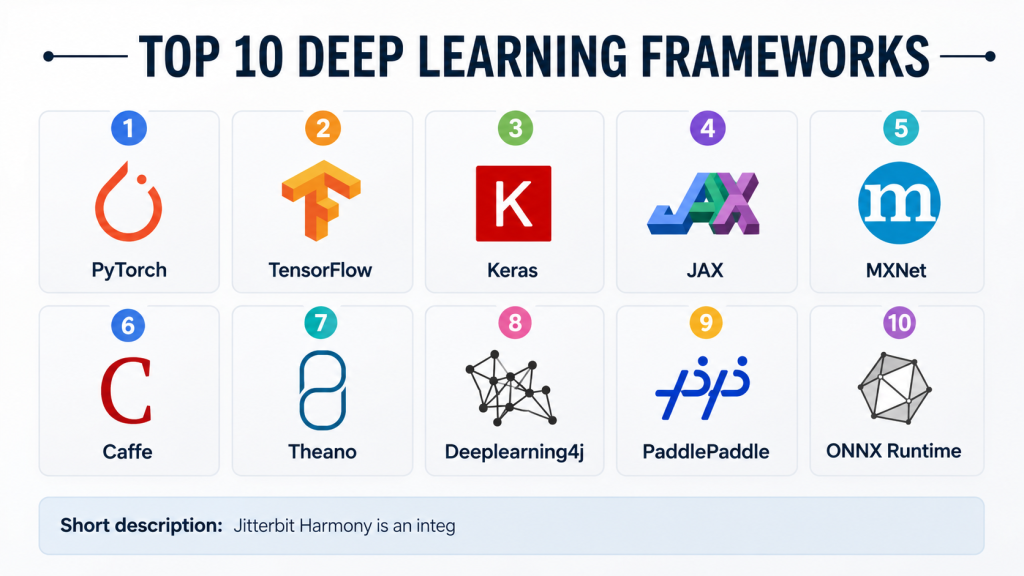
Top 10 Deep Learning Frameworks
#1 — PyTorch
Short description:PyTorch is one of the most widely used deep learning frameworks for research, experimentation, and production AI development. It is popular because of its flexible design, Python-friendly experience, and strong support for dynamic computation graphs. Researchers often prefer PyTorch because it makes experimentation easier and code easier to debug. ML engineers use it for computer vision, NLP, generative AI, recommendation systems, and large-scale training. PyTorch has a strong ecosystem around model libraries, deployment tools, and distributed training. It is also widely used in academic and enterprise AI teams. The framework is suitable for both early experiments and serious production workloads. It is best for teams that want flexibility, modern AI support, and a large community.
Key Features
- Python-first deep learning development
- Dynamic computation graph
- GPU acceleration support
- Distributed training support
- Strong ecosystem for NLP and computer vision
- Model deployment tools and integrations
- Large research and production community
Pros
- Very flexible for research and experimentation
- Strong support for modern AI models
- Large ecosystem and active community
Cons
- Production deployment may require extra planning
- Performance tuning can need expert knowledge
- Large projects require good engineering discipline
Platforms / Deployment
Windows / macOS / Linux / Web through hosted environments
Cloud / Self-hosted / Hybrid
Security & Compliance
Security depends on deployment environment, model hosting setup, data controls, and infrastructure configuration. Specific certifications are not publicly stated for the open-source framework itself.
Integrations & Ecosystem
PyTorch integrates strongly with AI libraries, cloud platforms, MLOps tools, and model repositories.
- Hugging Face ecosystem
- CUDA and GPU tooling
- MLflow
- ONNX
- TorchServe
- Cloud AI platforms
Support & Community
PyTorch has strong documentation, a large open-source community, academic adoption, tutorials, and enterprise ecosystem support.
#2 — TensorFlow
Short description:TensorFlow is a mature deep learning framework used for building, training, deploying, and scaling machine learning models. It supports many AI workloads, including image recognition, NLP, time-series modeling, recommendation systems, and mobile AI. TensorFlow is known for its production tooling and deployment ecosystem. It works well with TensorFlow Serving, TensorFlow Lite, TensorFlow.js, and cloud AI platforms. This makes it useful for teams that need models across servers, mobile devices, browsers, and edge environments. TensorFlow has a large ecosystem and long-standing enterprise adoption. It can be powerful, but some users find it less flexible than PyTorch for fast experimentation. It is best for teams that value production deployment and broad platform support.
Key Features
- Deep learning model development
- GPU and TPU support
- TensorFlow Serving for deployment
- TensorFlow Lite for mobile and edge
- TensorFlow.js for browser-based ML
- Distributed training support
- Large ecosystem of tools and libraries
Pros
- Strong production deployment ecosystem
- Good for mobile, edge, and browser AI
- Mature enterprise and cloud support
Cons
- Can feel complex for beginners
- Research workflow may feel less flexible than PyTorch
- Debugging can require framework experience
Platforms / Deployment
Windows / macOS / Linux / Web / Mobile / Edge
Cloud / Self-hosted / Hybrid
Security & Compliance
Security depends on deployment, model serving layer, cloud environment, access controls, and data handling. Specific certifications are not publicly stated for the open-source framework itself.
Integrations & Ecosystem
TensorFlow integrates with cloud platforms, mobile runtimes, browser environments, and MLOps tools.
- TensorFlow Serving
- TensorFlow Lite
- TensorFlow.js
- Keras
- Google Cloud AI tools
- ONNX workflows
Support & Community
TensorFlow has extensive documentation, tutorials, community examples, enterprise use cases, and broad ecosystem support.
#3 — Keras
Short description:Keras is a high-level deep learning API designed to make neural network development easier and faster. It is widely used by beginners, educators, data scientists, and developers who want a simple way to build deep learning models. Keras provides a clean and readable interface for defining models, training them, and evaluating performance. It is often used with TensorFlow as the backend. Keras is useful for rapid prototyping, learning deep learning concepts, and building standard neural network architectures. It is not always the best choice for highly customized research models, but it is excellent for productivity. Teams can use it for image classification, text modeling, forecasting, and tabular deep learning. It is best when simplicity and speed matter.
Key Features
- Simple high-level API
- Fast model prototyping
- TensorFlow ecosystem support
- Prebuilt layers and model components
- Support for common neural network architectures
- Easy training and evaluation workflows
- Good learning curve for beginners
Pros
- Easy to learn and use
- Great for fast experimentation
- Strong fit for standard deep learning workflows
Cons
- Less flexible for highly custom research
- Advanced optimization may require lower-level tools
- Mostly tied to backend ecosystem choices
Platforms / Deployment
Windows / macOS / Linux / Web through hosted environments
Cloud / Self-hosted / Hybrid
Security & Compliance
Security depends on the backend framework, deployment environment, and infrastructure. Specific certifications are not publicly stated for Keras itself.
Integrations & Ecosystem
Keras works closely with TensorFlow and common Python data science tools.
- TensorFlow
- NumPy
- pandas
- Jupyter notebooks
- TensorFlow Serving
- TensorFlow Lite
Support & Community
Keras has strong documentation, many tutorials, beginner-friendly examples, and broad adoption in education and applied ML.
#4 — JAX
Short description:JAX is a high-performance numerical computing and machine learning framework popular among researchers and advanced AI teams. It is known for automatic differentiation, just-in-time compilation, vectorization, and strong accelerator support. JAX is often used in cutting-edge research, large-scale model training, scientific computing, and custom deep learning systems. It gives users strong control over mathematical operations and performance. JAX is powerful but requires more technical skill than beginner-friendly frameworks. It is commonly used with libraries such as Flax and Haiku for neural network development. Teams choose JAX when performance, research flexibility, and advanced transformations matter. It is best for expert teams building custom AI systems.
Key Features
- Automatic differentiation
- Just-in-time compilation
- GPU and TPU acceleration
- Vectorized computation
- Functional programming style
- Strong research flexibility
- Ecosystem support through Flax and Haiku
Pros
- Excellent for advanced research
- Strong performance optimization capabilities
- Powerful for custom model development
Cons
- Steeper learning curve
- Smaller applied business user base than PyTorch or TensorFlow
- Requires strong technical expertise
Platforms / Deployment
Linux / macOS / Cloud notebook environments
Cloud / Self-hosted / Hybrid
Security & Compliance
Security depends on deployment infrastructure, cloud environment, and data controls. Specific certifications are not publicly stated for the open-source framework itself.
Integrations & Ecosystem
JAX integrates with scientific computing tools, accelerator platforms, and neural network libraries.
- NumPy-style workflows
- Flax
- Haiku
- Optax
- TPU and GPU environments
- Research tooling
Support & Community
JAX has strong research community support, technical documentation, and growing adoption among advanced AI teams.
#5 — MXNet
Short description:Apache MXNet is a deep learning framework designed for scalable training and flexible model development. It has been used for computer vision, NLP, and large-scale deep learning workloads. MXNet supports multiple programming languages and can run on CPUs and GPUs. It was historically known for scalability and performance in distributed training scenarios. While its mindshare is lower than PyTorch and TensorFlow today, it can still be relevant in existing environments or legacy workloads. Teams already using MXNet may continue to maintain production systems built on it. For new projects, many teams compare it carefully against more widely adopted frameworks. It is best for teams with existing MXNet expertise or specific compatibility needs.
Key Features
- Deep learning model training
- GPU support
- Distributed training support
- Multi-language support
- Gluon API for model development
- Support for computer vision and NLP models
- Open-source framework flexibility
Pros
- Flexible and scalable architecture
- Useful for existing MXNet environments
- Supports multiple languages
Cons
- Smaller community momentum than leading frameworks
- Fewer modern examples compared with PyTorch
- New teams may prefer more active ecosystems
Platforms / Deployment
Windows / macOS / Linux
Cloud / Self-hosted / Hybrid
Security & Compliance
Security depends on deployment environment and infrastructure. Specific certifications are not publicly stated for the open-source framework itself.
Integrations & Ecosystem
MXNet integrates with Python workflows, cloud services, and deep learning libraries.
- Python
- Gluon API
- CUDA
- Cloud platforms
- Data pipelines
- Model deployment workflows
Support & Community
MXNet has open-source documentation and community resources, though overall community momentum is smaller than PyTorch and TensorFlow.
#6 — Caffe
Short description:Caffe is a deep learning framework historically known for computer vision and image-based model development. It became popular for convolutional neural networks and fast experimentation with vision models. Caffe uses model definitions that make certain workflows structured and repeatable. It has been used in research, image classification, object detection, and academic projects. However, its modern adoption is lower compared with PyTorch, TensorFlow, and newer frameworks. Caffe is most relevant for legacy systems, existing research code, or teams maintaining older computer vision pipelines. It is not usually the first choice for new generative AI or large-scale transformer projects. It is best for teams with specific legacy or vision-based requirements.
Key Features
- Computer vision model support
- Convolutional neural network workflows
- GPU acceleration support
- Structured model configuration
- Fast inference in certain use cases
- Academic and research history
- Open-source framework availability
Pros
- Strong historical use in computer vision
- Useful for legacy model support
- Lightweight for certain vision workflows
Cons
- Lower modern ecosystem momentum
- Not ideal for newer AI architectures
- Limited flexibility compared with PyTorch
Platforms / Deployment
Linux / macOS / Windows support may vary
Self-hosted / Hybrid
Security & Compliance
Security depends on deployment, infrastructure, and model serving setup. Specific certifications are not publicly stated.
Integrations & Ecosystem
Caffe integrates mainly with computer vision and legacy deep learning workflows.
- CUDA
- OpenCV
- Python interfaces
- C++ workflows
- Image datasets
- Legacy research code
Support & Community
Caffe has historical documentation and community resources, but modern support and ecosystem activity are more limited than newer frameworks.
#7 — Theano
Short description:Theano is an older deep learning and numerical computation framework that influenced many modern AI tools. It supported symbolic computation, automatic differentiation, and GPU acceleration. Theano was widely used in early deep learning research and helped shape the ecosystem that followed. Today, it is mostly relevant for legacy research code, educational history, and older projects that still depend on it. It is not commonly selected for new production AI projects. Teams starting fresh usually choose PyTorch, TensorFlow, JAX, or other modern frameworks. However, understanding Theano can still be useful for historical context in deep learning. It is best for legacy maintenance or academic reference.
Key Features
- Symbolic mathematical computation
- Automatic differentiation
- GPU acceleration support
- Numerical optimization
- Python-based workflows
- Foundation for earlier deep learning projects
- Research-oriented computation model
Pros
- Important historical framework
- Useful for legacy research code
- Strong mathematical foundation
Cons
- Not recommended for most new projects
- Limited modern ecosystem momentum
- Production support is not ideal
Platforms / Deployment
Linux / macOS / Windows support may vary
Self-hosted
Security & Compliance
Security depends on local or hosted environment configuration. Specific certifications are not publicly stated.
Integrations & Ecosystem
Theano is mainly associated with older Python-based research workflows.
- Python
- NumPy
- Scientific computing libraries
- Legacy ML projects
- Academic codebases
- Earlier deep learning tools
Support & Community
Theano has historical documentation and academic references, but modern community support is limited compared with active frameworks.
#8 — Deeplearning4j
Short description:Deeplearning4j is a deep learning framework for the Java and JVM ecosystem. It is useful for organizations that build enterprise applications in Java and want machine learning capabilities closer to existing application infrastructure. Deeplearning4j can support neural network development, distributed training, and integration with big data tools. It is especially relevant for teams working in Java-heavy environments. While Python dominates much of deep learning, some enterprises prefer JVM-based tools for production integration. Deeplearning4j may not have the same research popularity as PyTorch or TensorFlow. However, it can be practical for enterprise Java teams. It is best for organizations that need deep learning inside JVM-based systems.
Key Features
- Java and JVM-based deep learning
- Neural network model development
- Distributed training support
- Integration with enterprise Java systems
- Support for big data workflows
- GPU acceleration support may be available
- Production-oriented application integration
Pros
- Good fit for Java enterprise teams
- Useful for JVM-based production systems
- Supports integration with existing enterprise apps
Cons
- Smaller AI research ecosystem than Python frameworks
- Fewer modern examples than PyTorch or TensorFlow
- Best fit is narrower than general-purpose frameworks
Platforms / Deployment
Windows / macOS / Linux
Cloud / Self-hosted / Hybrid
Security & Compliance
Security depends on application architecture, deployment infrastructure, and enterprise controls. Specific certifications are not publicly stated for the framework itself.
Integrations & Ecosystem
Deeplearning4j integrates with Java tools and enterprise data platforms.
- Java applications
- JVM ecosystem
- Apache Spark
- Hadoop
- Enterprise systems
- Production APIs
Support & Community
Community and documentation exist, but the ecosystem is smaller than Python-first deep learning frameworks.
#9 — PaddlePaddle
Short description:PaddlePaddle is an open-source deep learning framework developed for industrial AI applications. It supports model development, training, deployment, and use cases across computer vision, NLP, recommendation systems, and speech processing. PaddlePaddle is known for strong adoption in certain regions and enterprise AI scenarios. It provides tools for model training, inference, and production deployment. The framework can be useful for teams working with its ecosystem and prebuilt model libraries. It may not have the same global mindshare as PyTorch or TensorFlow, but it remains a credible deep learning option. Teams should evaluate documentation, community, and regional ecosystem fit. It is best for users who benefit from its industrial AI tooling.
Key Features
- Deep learning model training
- Computer vision and NLP support
- Inference and deployment tools
- Industrial AI model libraries
- GPU acceleration support
- Distributed training support
- Open-source framework availability
Pros
- Strong industrial AI focus
- Useful model ecosystem
- Supports training and deployment workflows
Cons
- Lower global adoption than PyTorch and TensorFlow
- Ecosystem fit may vary by region
- Enterprise teams should validate support needs
Platforms / Deployment
Windows / macOS / Linux
Cloud / Self-hosted / Hybrid
Security & Compliance
Security depends on deployment environment and infrastructure controls. Specific certifications are not publicly stated for the open-source framework itself.
Integrations & Ecosystem
PaddlePaddle integrates with AI development workflows and deployment tooling.
- Python workflows
- GPU tooling
- Model libraries
- Inference tools
- Data pipelines
- Cloud environments
Support & Community
PaddlePaddle has documentation and community support, with stronger visibility in certain developer ecosystems.
#10 — ONNX Runtime
Short description:ONNX Runtime is not a traditional model training framework, but it is highly important for deep learning inference and deployment. It helps teams run models trained in different frameworks using the ONNX model format. ONNX Runtime is useful when organizations train models in PyTorch, TensorFlow, or other frameworks and want efficient deployment across platforms. It supports optimized inference on CPUs, GPUs, edge devices, and cloud environments. It is especially valuable for production teams that care about performance, portability, and deployment flexibility. ONNX Runtime helps reduce framework lock-in during serving. It is not a full replacement for training frameworks. It is best for teams focused on fast, portable model inference.
Key Features
- Cross-framework model inference
- ONNX model format support
- CPU and GPU optimization
- Edge and cloud deployment support
- Performance-focused runtime
- Support for multiple languages and platforms
- Useful for production model serving
Pros
- Strong for portable inference
- Helps reduce framework lock-in
- Good performance optimization options
Cons
- Not a full training framework
- Model conversion may require testing
- Best used alongside other frameworks
Platforms / Deployment
Windows / macOS / Linux / Mobile / Edge
Cloud / Self-hosted / Hybrid
Security & Compliance
Security depends on deployment environment, serving layer, and infrastructure controls. Specific certifications are not publicly stated for the runtime itself.
Integrations & Ecosystem
ONNX Runtime integrates with training frameworks, deployment platforms, and production systems.
- PyTorch
- TensorFlow
- scikit-learn workflows
- Cloud platforms
- Edge devices
- C++, Python, and other APIs
Support & Community
ONNX Runtime has strong documentation, active technical usage, and support across many deployment-focused AI teams.
Comparison Table
| Tool Name | Best For | Platform(s) Supported | Deployment | Standout Feature | Public Rating |
|---|---|---|---|---|---|
| PyTorch | Research and production AI | Windows / macOS / Linux | Cloud / Self-hosted / Hybrid | Flexible dynamic model development | N/A |
| TensorFlow | Production and cross-platform AI | Windows / macOS / Linux / Mobile / Web | Cloud / Self-hosted / Hybrid | Broad deployment ecosystem | N/A |
| Keras | Beginner-friendly deep learning | Windows / macOS / Linux | Cloud / Self-hosted / Hybrid | Simple high-level model API | N/A |
| JAX | Advanced AI research | Linux / macOS / Cloud environments | Cloud / Self-hosted / Hybrid | High-performance automatic differentiation | N/A |
| MXNet | Existing scalable DL workloads | Windows / macOS / Linux | Cloud / Self-hosted / Hybrid | Multi-language scalable training | N/A |
| Caffe | Legacy computer vision workflows | Linux / macOS / Varies | Self-hosted / Hybrid | Classic CNN-focused framework | N/A |
| Theano | Legacy research code | Linux / macOS / Varies | Self-hosted | Symbolic computation foundation | N/A |
| Deeplearning4j | Java enterprise AI | Windows / macOS / Linux | Cloud / Self-hosted / Hybrid | JVM-based deep learning | N/A |
| PaddlePaddle | Industrial AI use cases | Windows / macOS / Linux | Cloud / Self-hosted / Hybrid | Industrial model ecosystem | N/A |
| ONNX Runtime | Model inference and portability | Windows / macOS / Linux / Mobile / Edge | Cloud / Self-hosted / Hybrid | Cross-framework optimized inference | N/A |
Evaluation & Scoring of Deep Learning Frameworks
| Tool Name | Core (25%) | Ease (15%) | Integrations (15%) | Security (10%) | Performance (10%) | Support (10%) | Value (15%) | Weighted Total |
|---|---|---|---|---|---|---|---|---|
| PyTorch | 10 | 8 | 10 | 7 | 9 | 10 | 10 | 9.25 |
| TensorFlow | 9 | 7 | 10 | 7 | 9 | 10 | 10 | 8.95 |
| Keras | 8 | 10 | 8 | 7 | 7 | 9 | 10 | 8.45 |
| JAX | 9 | 6 | 8 | 6 | 10 | 8 | 9 | 8.05 |
| MXNet | 7 | 6 | 7 | 6 | 8 | 6 | 8 | 6.95 |
| Caffe | 6 | 5 | 6 | 5 | 7 | 5 | 7 | 5.95 |
| Theano | 5 | 4 | 5 | 5 | 6 | 4 | 6 | 5.00 |
| Deeplearning4j | 7 | 6 | 7 | 6 | 7 | 6 | 8 | 6.75 |
| PaddlePaddle | 8 | 7 | 7 | 6 | 8 | 7 | 8 | 7.35 |
| ONNX Runtime | 8 | 7 | 9 | 7 | 9 | 8 | 10 | 8.30 |
These scores are comparative and should be used for shortlisting only. Training frameworks score higher when they support flexible model development, strong ecosystems, and production readiness. Inference-focused tools like ONNX Runtime score well for deployment but do not replace full training frameworks. The best choice depends on your model type, team skills, deployment target, and production needs.
Which Deep Learning Framework Is Right for You?
Solo / Freelancer
Solo learners, researchers, and freelancers should usually start with PyTorch or Keras. PyTorch gives flexibility and strong modern AI support. Keras is easier for beginners who want to build standard models quickly. Google Colab or local Jupyter notebooks can be enough for early practice.
SMB
Small businesses should choose frameworks based on team skill and deployment needs. PyTorch is a strong general choice. TensorFlow is useful when mobile, browser, or edge deployment matters. ONNX Runtime can help when the team wants portable and efficient inference.
Mid-Market
Mid-market teams often need a balance of experimentation, production deployment, and maintainability. PyTorch, TensorFlow, JAX, and ONNX Runtime are strong options. Teams should also consider cloud AI services, MLOps tools, and model monitoring around the framework.
Enterprise
Enterprises should prioritize governance, scalability, security, deployment flexibility, support ecosystem, and long-term maintainability. PyTorch and TensorFlow are the strongest general-purpose options. ONNX Runtime is valuable for production inference. Deeplearning4j may fit Java-heavy enterprise environments.
Budget vs Premium
Most deep learning frameworks are open-source, but the real cost comes from compute, GPUs, cloud usage, engineering time, deployment, monitoring, and maintenance. A free framework can still become expensive if training is inefficient or production operations are weak.
Feature Depth vs Ease of Use
Keras is easiest for beginners and standard workflows. PyTorch gives strong flexibility and modern model development. TensorFlow offers broad deployment tooling. JAX is powerful for advanced research but has a steeper learning curve. ONNX Runtime is best for optimized inference, not training.
Integrations & Scalability
PyTorch and TensorFlow have the strongest broad ecosystems. JAX is strong for research and accelerator-heavy workloads. ONNX Runtime helps bridge frameworks in production. Teams should validate integration with GPUs, cloud platforms, model registries, monitoring tools, and serving infrastructure.
Security & Compliance Needs
Security depends more on deployment architecture than the framework itself. Teams should evaluate data access, model serving security, dependency scanning, container security, secrets management, audit logs, access controls, and compliance needs in the surrounding platform.
Frequently Asked Questions
1. What is a deep learning framework?
A deep learning framework is a software toolkit used to build, train, evaluate, and deploy neural network models. It helps developers work with layers, tensors, gradients, GPUs, optimization, and model serving.
2. Which deep learning framework is best for beginners?
Keras is usually easiest for beginners because it has a simple high-level API. PyTorch is also beginner-friendly for many users because it feels natural in Python and is easier to debug than some older frameworks.
3. Is PyTorch better than TensorFlow?
PyTorch is often preferred for research and flexible experimentation, while TensorFlow is strong for production deployment, mobile, browser, and enterprise workflows. The better option depends on your team and use case.
4. How much do deep learning frameworks cost?
Most major deep learning frameworks are open-source. However, real costs come from GPUs, cloud compute, storage, data preparation, engineering time, deployment, monitoring, and production maintenance.
5. What are common mistakes when choosing a deep learning framework?
Common mistakes include choosing based only on popularity, ignoring deployment needs, underestimating GPU cost, skipping model monitoring, and using a complex framework when a simpler machine learning tool would be enough.
6. Can deep learning frameworks run on CPUs?
Yes, most deep learning frameworks can run on CPUs. However, training large models on CPUs can be slow, so GPUs or specialized accelerators are often used for serious deep learning workloads.
7. What is the role of ONNX Runtime?
ONNX Runtime helps run trained models efficiently across different platforms. It is useful when models are trained in one framework but need to be deployed in another environment with better performance or portability.
8. Are older frameworks like Caffe and Theano still useful?
They are mostly useful for legacy projects, older research code, or historical learning. For most new projects, PyTorch, TensorFlow, Keras, JAX, or modern deployment runtimes are better choices.
9. What integrations should teams check?
Teams should check GPU support, cloud platform support, model registry integration, experiment tracking, data pipeline compatibility, deployment tools, monitoring systems, and container or Kubernetes workflows.
10. When should a team switch deep learning frameworks?
A team should consider switching when the current framework limits model development, lacks deployment support, has weak community activity, does not meet performance needs, or creates maintenance problems in production.
Conclusion
Deep learning frameworks are the foundation of modern AI development. The best framework depends on your team’s skill level, model type, deployment needs, performance requirements, and production maturity. PyTorch is a strong all-around choice for research and modern AI development. TensorFlow is powerful for production and cross-platform deployment. Keras is excellent for beginners and fast prototyping. JAX is valuable for advanced research and high-performance computing. ONNX Runtime is important for portable and optimized inference. Older frameworks like MXNet, Caffe, and Theano may still matter for legacy workloads, while Deeplearning4j and PaddlePaddle fit specific ecosystem needs.
