Upgrade & Secure Your Future with DevOps, SRE, DevSecOps, MLOps!
We spend hours scrolling social media and waste money on things we forget, but won’t spend 30 minutes a day earning certifications that can change our lives.
Master in DevOps, SRE, DevSecOps & MLOps by DevOps School!
Learn from Guru Rajesh Kumar and double your salary in just one year.
Introduction
Synthetic data generation tools create artificial data that looks and behaves like real data without directly exposing original sensitive records. In simple words, these tools help teams build realistic datasets for software testing, machine learning, analytics, privacy-safe sharing, and product development. Instead of using raw customer, patient, financial, or operational data, teams can create synthetic versions that preserve useful patterns while reducing privacy and compliance risk.
Synthetic data matters in and beyond because AI teams need more high-quality data, but real data is often limited, sensitive, biased, incomplete, or difficult to access. These tools are useful for model training, test data management, privacy-preserving analytics, fraud simulation, healthcare research, autonomous systems, and software QA.
Buyers should evaluate:
- Data realism and statistical quality
- Privacy protection strength
- Supported data types
- Ease of generation
- Integration with data pipelines
- Governance and auditability
- Deployment flexibility
- Scalability
- Security controls
- Pricing and support
Best for: data science teams, QA teams, ML engineers, DevOps teams, security teams, healthcare organizations, banks, insurance firms, SaaS companies, and enterprises handling sensitive data.
Not ideal for: teams that only need small dummy datasets, organizations without privacy or data availability challenges, or use cases where exact real-world records are legally required.
Key Trends in Synthetic Data Generation Tools
- Synthetic data is becoming a practical privacy layer for AI and analytics teams.
- More tools now support tabular, text, image, time-series, and multimodal data generation.
- Enterprises are using synthetic data to reduce dependency on production data for testing.
- AI governance teams are paying closer attention to privacy leakage and re-identification risk.
- Synthetic data is being used to improve rare-case coverage in fraud, healthcare, insurance, and safety testing.
- Cloud, self-hosted, and hybrid deployment models are becoming important for regulated industries.
- Tools are increasingly integrating with data warehouses, ML platforms, CI/CD systems, and MLOps workflows.
- Evaluation metrics are becoming more important, including utility, privacy, bias, and similarity scores.
- Synthetic data for generative AI and LLM evaluation is growing as teams need safe test scenarios.
- Pricing models vary widely, with some tools focused on enterprise licensing and others offering open-source flexibility.
How We Selected These Tools
The tools in this list were selected using practical buyer-focused criteria:
- Recognition in synthetic data, data privacy, AI testing, or data generation
- Support for realistic data generation workflows
- Ability to serve business, testing, analytics, or ML use cases
- Strength of privacy, quality, and evaluation features
- Deployment flexibility across cloud, self-hosted, or hybrid environments
- Fit for startups, SMBs, mid-market teams, and enterprises
- Integration with data platforms, APIs, and ML pipelines
- Documentation quality and ecosystem maturity
- Usefulness across structured, unstructured, or domain-specific data needs
- Practical value for privacy-safe innovation and production workflows
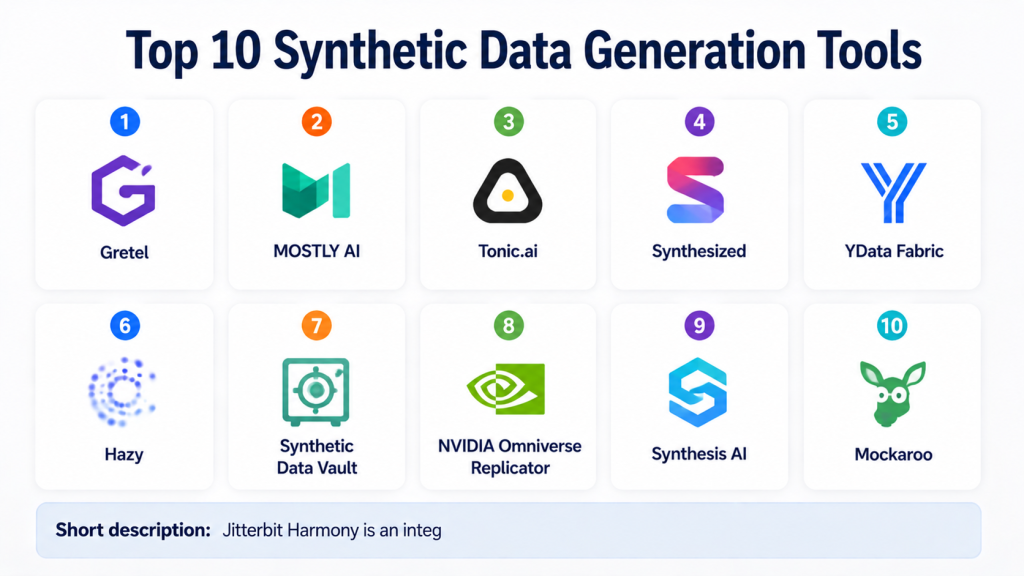
Top 10 Synthetic Data Generation Tools
#1 — Gretel
Short description: Gretel is a synthetic data platform designed to help teams generate, transform, and work with privacy-safe data. It is useful for data scientists, developers, security teams, and enterprises that need realistic data without exposing sensitive information. Gretel supports synthetic data generation, data transformation, privacy testing, and developer-friendly workflows. It is commonly used for test data, analytics, machine learning, and secure data collaboration. The platform offers APIs and tooling that fit well into modern engineering workflows. It is suitable for organizations that want controlled synthetic data pipelines. Gretel is especially useful when teams need a balance of privacy, usability, and automation.
Key Features
- Synthetic data generation for structured data
- Privacy-focused data transformation
- APIs and developer workflows
- Data quality and privacy evaluation
- Support for test data and ML use cases
- Cloud and deployment flexibility
- Automation-friendly pipeline support
Pros
- Strong developer-friendly synthetic data workflow
- Useful for privacy-safe data sharing and testing
- Good fit for technical data and engineering teams
Cons
- Advanced use cases may require data science knowledge
- Enterprise setup may need governance planning
- Pricing details may vary by use case
Platforms / Deployment
Cloud / Self-hosted / Hybrid
Security & Compliance
Security features may include access controls and enterprise deployment options. Specific certifications should be verified directly with the vendor.
Integrations & Ecosystem
Gretel fits into modern data and engineering environments.
- APIs
- Python workflows
- Data warehouses
- Cloud storage
- CI/CD pipelines
- ML pipelines
Support & Community
Gretel provides documentation, technical guides, support resources, and developer-focused learning material.
#2 — MOSTLY AI
Short description: MOSTLY AI is a synthetic data platform focused on privacy-preserving synthetic data for analytics, AI, testing, and data sharing. It is useful for enterprises that need realistic data while reducing exposure of sensitive customer or operational records. The platform is often considered by banks, insurers, telecom companies, and regulated industries. MOSTLY AI helps generate synthetic versions of structured datasets while preserving useful statistical relationships. It is suitable for business teams, data teams, and privacy-focused organizations. The tool supports privacy-safe collaboration and data access. It is a strong option where compliance, privacy, and analytical utility matter together.
Key Features
- Synthetic tabular data generation
- Privacy-preserving analytics support
- Data quality and similarity evaluation
- Enterprise data sharing workflows
- Support for regulated industries
- User-friendly interface
- Deployment flexibility
Pros
- Strong focus on privacy-preserving synthetic data
- Useful for analytics and data sharing
- Good fit for regulated enterprises
Cons
- Best suited for structured data use cases
- Advanced governance needs may require setup planning
- Pricing may be enterprise-oriented
Platforms / Deployment
Cloud / Self-hosted / Hybrid
Security & Compliance
Enterprise security capabilities may include role-based access and controlled deployment options. Specific certifications should be verified with the vendor.
Integrations & Ecosystem
MOSTLY AI can support enterprise data and analytics workflows.
- Data warehouses
- Databases
- Cloud platforms
- APIs
- Analytics workflows
- Data science tools
Support & Community
Provides documentation, onboarding resources, and enterprise support options. Community strength is stronger in privacy and data analytics use cases.
#3 — Tonic.ai
Short description: Tonic.ai is a synthetic data and test data generation platform built mainly for software development, QA, and data privacy workflows. It helps teams create realistic, safe, and usable test data from production-like datasets. The platform is useful for developers, QA engineers, DevOps teams, and data teams that need reliable non-production environments. Tonic.ai focuses strongly on replacing sensitive production data with de-identified or synthetic data for testing. It supports databases and development workflows where realistic test data is important. It is practical for SaaS companies and enterprises with complex application data. Tonic.ai is a strong option for test data management and privacy-safe development.
Key Features
- Synthetic and de-identified test data generation
- Database support for development workflows
- Data masking and transformation
- Realistic non-production datasets
- Developer and QA team workflows
- Privacy-focused test environments
- Automation support
Pros
- Strong fit for software testing and QA teams
- Helps reduce use of sensitive production data
- Practical for developer workflows
Cons
- More focused on test data than broad AI data generation
- Setup may require database and schema understanding
- Advanced needs may require technical configuration
Platforms / Deployment
Cloud / Self-hosted / Hybrid
Security & Compliance
Enterprise security features may include access controls and controlled deployment options. Specific compliance details should be verified with the vendor.
Integrations & Ecosystem
Tonic.ai works well with application development and database workflows.
- Relational databases
- Development environments
- CI/CD workflows
- Cloud databases
- QA pipelines
- DevOps tools
Support & Community
Provides documentation, onboarding, customer support, and resources for development and QA teams.
#4 — Synthesized
Short description: Synthesized is a data generation and data provisioning platform focused on creating high-quality synthetic and masked data for testing, analytics, and AI workflows. It helps teams generate realistic datasets while protecting sensitive information. The platform is useful for QA teams, data engineers, ML teams, and enterprises that need controlled access to safe data. Synthesized focuses on data quality, privacy, and automation for modern engineering teams. It can be used to support software testing, data science experiments, and privacy-safe data access. It is suitable for organizations that want synthetic data integrated into repeatable workflows. Synthesized is a strong fit for teams modernizing test data management.
Key Features
- Synthetic data generation
- Test data provisioning
- Data masking and privacy workflows
- Data quality validation
- Automation-friendly workflows
- Database and pipeline support
- Enterprise deployment options
Pros
- Strong fit for testing and data engineering teams
- Useful for privacy-safe data provisioning
- Supports repeatable workflows
Cons
- May require setup for complex data environments
- Best value depends on data pipeline maturity
- Pricing and deployment details may vary
Platforms / Deployment
Cloud / Self-hosted / Hybrid
Security & Compliance
Security features may vary by deployment and customer configuration. Specific certifications are not publicly stated here.
Integrations & Ecosystem
Synthesized fits into software testing, data engineering, and ML workflows.
- Databases
- Data warehouses
- CI/CD pipelines
- APIs
- Cloud platforms
- Testing environments
Support & Community
Offers documentation, onboarding resources, and support options. Public community strength is more limited than open-source projects.
#5 — YData Fabric
Short description: YData Fabric is a synthetic data and data-centric AI platform that helps teams improve data quality, generate synthetic datasets, and prepare data for machine learning. It is useful for data scientists, ML engineers, analytics teams, and enterprises working with structured data. The platform focuses on data profiling, synthetic generation, and quality improvement. It can help teams create privacy-aware datasets for AI development, testing, and analytics. YData Fabric is practical when teams need to understand data problems before model training. It also supports workflows where data quality and synthetic data are connected. It is a strong option for data-centric ML teams.
Key Features
- Synthetic data generation
- Data profiling and quality analysis
- Data preparation for ML workflows
- Privacy-aware dataset creation
- Support for tabular data
- AI and analytics use cases
- Data-centric workflow support
Pros
- Strong focus on data quality and synthetic data
- Useful for ML preparation workflows
- Practical for data science teams
Cons
- May be less focused on software test data than some competitors
- Advanced workflows may require data science skills
- Deployment and pricing details may vary
Platforms / Deployment
Cloud / Self-hosted / Hybrid / Varies
Security & Compliance
Security and compliance details vary by deployment and plan. Specific certifications are not publicly stated here.
Integrations & Ecosystem
YData Fabric fits into analytics and ML workflows.
- Python workflows
- Data science notebooks
- Data pipelines
- ML platforms
- Cloud storage
- Data quality processes
Support & Community
Provides documentation and support resources. Community strength is strongest among data science and synthetic data users.
#6 — Hazy
Short description: Hazy is a synthetic data platform focused on privacy-safe synthetic data for enterprise analytics and data sharing. It helps organizations create artificial datasets that preserve useful patterns while reducing privacy risk. Hazy is often considered by enterprises that need to unlock sensitive data for innovation, testing, and analytics. It is especially relevant for industries with strict data governance needs. The platform is useful for data teams, privacy teams, and business analytics groups. Hazy focuses on structured data and enterprise use cases. It is a strong option for organizations that want synthetic data as part of a privacy and governance strategy.
Key Features
- Synthetic structured data generation
- Privacy-focused data sharing
- Enterprise analytics support
- Data utility evaluation
- Governance-oriented workflows
- Sensitive data protection support
- Deployment flexibility
Pros
- Strong privacy and enterprise focus
- Useful for regulated data environments
- Helps improve safe data access
Cons
- May be more enterprise-focused than SMB-friendly
- Public technical details may be limited
- Pricing and deployment may require vendor discussion
Platforms / Deployment
Cloud / Self-hosted / Hybrid / Varies
Security & Compliance
Enterprise security capabilities may be available. Specific compliance certifications should be verified with the vendor.
Integrations & Ecosystem
Hazy can support enterprise data and analytics workflows.
- Databases
- Data warehouses
- Analytics platforms
- APIs
- Data governance workflows
- Enterprise data pipelines
Support & Community
Support is typically enterprise-oriented. Public community resources may be more limited than open-source tools.
#7 — Synthetic Data Vault
Short description: Synthetic Data Vault, often known as SDV, is an open-source ecosystem for generating synthetic tabular, relational, and time-series data. It is widely used by data scientists, researchers, developers, and ML teams that want a flexible Python-based synthetic data framework. SDV is useful for experimentation, academic work, data science workflows, and custom synthetic data pipelines. It helps users model real datasets and generate artificial data with similar structure and patterns. It is not a full enterprise platform by itself, but it is a strong open-source foundation. Teams can use it for prototyping, testing, and ML experiments. It is a good choice for technical users who want transparency and control.
Key Features
- Open-source synthetic data generation
- Support for tabular and relational data
- Time-series data generation support
- Python-based workflows
- Custom modeling options
- Useful for research and prototyping
- Flexible integration with data science stacks
Pros
- Open-source and flexible
- Good for technical experimentation
- Strong fit for Python data science users
Cons
- Requires technical skills
- Enterprise governance depends on implementation
- Not a full managed platform alone
Platforms / Deployment
Windows / macOS / Linux / Self-hosted
Security & Compliance
Not publicly stated. Security depends on how and where the tool is deployed.
Integrations & Ecosystem
Synthetic Data Vault works well with Python data science workflows.
- Python
- Pandas
- Jupyter
- Data science pipelines
- Custom ML workflows
- Local and cloud environments
Support & Community
Open-source documentation and community support are available. Commercial support may vary through related offerings.
#8 — NVIDIA Omniverse Replicator
Short description: NVIDIA Omniverse Replicator is a synthetic data generation toolset focused on generating physically realistic data for computer vision and simulation use cases. It is useful for robotics, autonomous systems, industrial AI, perception models, and visual inspection workflows. The platform helps teams create labeled synthetic images and simulation data for training and testing AI models. It is different from tabular synthetic data tools because it focuses heavily on 3D simulation and visual data. NVIDIA Omniverse Replicator is suitable for teams that need rare scenarios, controlled environments, and visual model testing. It is useful when collecting real-world image data is costly or risky. It is a strong option for simulation-driven AI development.
Key Features
- Synthetic visual data generation
- 3D simulation-based workflows
- Labeled data generation
- Computer vision support
- Scenario variation and domain randomization
- Integration with NVIDIA ecosystem
- Support for robotics and autonomous systems
Pros
- Strong for computer vision and simulation data
- Useful for rare and risky scenario generation
- Good fit for robotics and industrial AI teams
Cons
- Not designed for general tabular data
- Requires technical and simulation expertise
- Hardware and workflow needs may be more advanced
Platforms / Deployment
Windows / Linux / Cloud / Self-hosted / Varies
Security & Compliance
Not publicly stated for general synthetic data governance. Security depends on deployment environment and NVIDIA platform configuration.
Integrations & Ecosystem
NVIDIA Omniverse Replicator fits into simulation and AI development workflows.
- NVIDIA Omniverse
- 3D assets
- Robotics workflows
- Computer vision pipelines
- GPU-based environments
- AI model training workflows
Support & Community
Strong NVIDIA documentation, developer resources, tutorials, and ecosystem support for simulation and AI teams.
#9 — Synthesis AI
Short description: Synthesis AI focuses on synthetic data generation for computer vision and AI model training. It helps teams create labeled visual datasets for use cases where collecting real-world image data is expensive, slow, sensitive, or incomplete. The platform is useful for facial analysis, human-centric AI, perception systems, and visual model development. Synthesis AI is mainly relevant for computer vision teams rather than general database teams. It can help generate diverse visual scenarios and reduce dependence on manually labeled real-world image datasets. The tool is suitable for AI teams working on vision models. It is a strong option when privacy, labeling, and visual diversity are major concerns.
Key Features
- Synthetic image data generation
- Labeled visual datasets
- Computer vision model support
- Human-centric data generation
- Scenario and variation control
- Privacy-aware visual data creation
- AI training dataset support
Pros
- Strong fit for computer vision teams
- Helps reduce manual labeling effort
- Useful for privacy-sensitive visual AI use cases
Cons
- Not intended for general tabular data
- Best suited for specialized vision workflows
- Pricing and deployment may be enterprise-oriented
Platforms / Deployment
Cloud / Varies
Security & Compliance
Not publicly stated here. Security and compliance details should be verified directly with the vendor.
Integrations & Ecosystem
Synthesis AI fits into visual AI and model training workflows.
- Computer vision pipelines
- ML training environments
- Dataset workflows
- Cloud storage
- Annotation workflows
- AI model evaluation processes
Support & Community
Support is generally vendor-led with documentation and onboarding resources. Public community strength is more limited than open-source projects.
#10 — Mockaroo
Short description: Mockaroo is a practical fake data generation tool used by developers, testers, educators, and small teams. It helps users quickly create sample datasets for testing, demos, prototypes, and application development. Mockaroo is not a deep synthetic data privacy platform, but it is useful for structured dummy data generation. It supports common fields such as names, emails, addresses, dates, numbers, IDs, and custom formats. It is especially useful when teams need quick test data without complex setup. Mockaroo fits software developers and QA teams that need simple generated datasets. It is a good lightweight option for non-sensitive development and demo scenarios.
Key Features
- Fake structured data generation
- Custom field schemas
- Multiple export formats
- Quick dataset creation
- API support
- Useful for demos and testing
- Simple browser-based workflow
Pros
- Very easy to use
- Good for quick test datasets
- Useful for developers and QA teams
Cons
- Not a full privacy-preserving synthetic data platform
- Limited for advanced ML data generation
- Not suitable for complex statistical data simulation
Platforms / Deployment
Web / Cloud
Security & Compliance
Not publicly stated for enterprise synthetic data governance. It should not be treated as a replacement for privacy-focused synthetic data platforms.
Integrations & Ecosystem
Mockaroo works well for simple development and testing workflows.
- APIs
- CSV exports
- JSON exports
- SQL exports
- Application testing
- Prototype workflows
Support & Community
Documentation and user support resources are available. Community strength is strongest among developers and testers needing quick generated data.
Comparison Table
| Tool Name | Best For | Platform(s) Supported | Deployment | Standout Feature | Public Rating |
|---|---|---|---|---|---|
| Gretel | Developer-friendly synthetic data workflows | Web / API-based workflows | Cloud / Self-hosted / Hybrid | Privacy-focused synthetic data pipelines | N/A |
| MOSTLY AI | Enterprise privacy-preserving analytics | Web / API-based workflows | Cloud / Self-hosted / Hybrid | Structured synthetic data for analytics | N/A |
| Tonic.ai | Test data generation for development teams | Web / API-based workflows | Cloud / Self-hosted / Hybrid | Realistic non-production test data | N/A |
| Synthesized | Test data and privacy-safe data provisioning | Web / API-based workflows | Cloud / Self-hosted / Hybrid | Automated data provisioning workflows | N/A |
| YData Fabric | Data-centric AI and synthetic data | Web / Python workflows | Cloud / Self-hosted / Hybrid / Varies | Data quality plus synthetic data | N/A |
| Hazy | Enterprise synthetic data privacy | Web / API-based workflows | Cloud / Self-hosted / Hybrid / Varies | Privacy-safe enterprise data sharing | N/A |
| Synthetic Data Vault | Open-source synthetic data generation | Windows / macOS / Linux | Self-hosted | Python-based synthetic data ecosystem | N/A |
| NVIDIA Omniverse Replicator | Simulation and computer vision data | Windows / Linux | Cloud / Self-hosted / Varies | Synthetic 3D visual data generation | N/A |
| Synthesis AI | Computer vision training data | Web / API-based workflows | Cloud / Varies | Labeled synthetic image datasets | N/A |
| Mockaroo | Simple fake test data generation | Web | Cloud | Fast structured dummy data creation | N/A |
Evaluation & Scoring of Synthetic Data Generation Tools
| Tool Name | Core (25%) | Ease (15%) | Integrations (15%) | Security (10%) | Performance (10%) | Support (10%) | Value (15%) | Weighted Total (0–10) |
|---|---|---|---|---|---|---|---|---|
| Gretel | 9 | 8 | 8 | 8 | 8 | 8 | 8 | 8.25 |
| MOSTLY AI | 9 | 8 | 8 | 8 | 8 | 8 | 7 | 8.10 |
| Tonic.ai | 8 | 8 | 8 | 8 | 8 | 8 | 8 | 8.00 |
| Synthesized | 8 | 8 | 8 | 7 | 8 | 7 | 8 | 7.75 |
| YData Fabric | 8 | 7 | 7 | 7 | 8 | 7 | 8 | 7.50 |
| Hazy | 8 | 7 | 7 | 8 | 8 | 7 | 7 | 7.45 |
| Synthetic Data Vault | 8 | 7 | 7 | 5 | 7 | 7 | 9 | 7.30 |
| NVIDIA Omniverse Replicator | 8 | 6 | 8 | 6 | 9 | 8 | 7 | 7.45 |
| Synthesis AI | 8 | 7 | 7 | 6 | 8 | 7 | 7 | 7.25 |
| Mockaroo | 6 | 9 | 7 | 5 | 7 | 6 | 9 | 6.95 |
These scores are comparative and should not be treated as universal rankings. Enterprise privacy platforms score higher for governance, support, and structured workflows. Open-source tools score well for flexibility and value but need more technical ownership. Computer vision tools are scored for their specialized use cases, not general tabular data needs. The best choice depends on data type, privacy goals, team skills, and deployment requirements.
Which Synthetic Data Generation Tool Is Right for You?
Solo / Freelancer
Solo users and freelancers should choose tools based on simplicity and cost. Mockaroo is useful for quick dummy datasets, demos, and simple testing. Synthetic Data Vault is better for Python users who want more realistic synthetic data generation and are comfortable with code.
If you work on AI or ML projects, Synthetic Data Vault or YData Fabric may be more useful than basic fake data generators. If your work involves computer vision, NVIDIA Omniverse Replicator or Synthesis AI may be better, but they require more technical effort.
SMB
SMBs usually need practical tools that reduce risk without creating heavy implementation overhead. Tonic.ai, Gretel, Synthesized, and Mockaroo can be useful depending on whether the goal is software testing, safe data sharing, or simple development data.
For SMBs building AI models, Gretel, YData Fabric, and Synthetic Data Vault can help create usable synthetic datasets. Teams should start with one clear use case, such as test data generation or privacy-safe analytics, before expanding.
Mid-Market
Mid-market companies often need stronger integration, repeatability, and governance. Gretel, MOSTLY AI, Tonic.ai, Synthesized, and YData Fabric are strong candidates. These tools can support data teams, QA teams, and ML teams at the same time.
At this stage, companies should evaluate data quality metrics, privacy evaluation, pipeline integration, access control, and how synthetic data will be approved for use. The tool should fit into existing data operations rather than remain a standalone experiment.
Enterprise
Enterprises should prioritize privacy, governance, scalability, auditability, and support. MOSTLY AI, Gretel, Tonic.ai, Synthesized, Hazy, and YData Fabric are practical options for structured enterprise data needs. NVIDIA Omniverse Replicator and Synthesis AI are better for enterprise computer vision and simulation use cases.
Large organizations should involve privacy, legal, security, compliance, data governance, and business teams. Synthetic data should be evaluated not only for usefulness but also for privacy risk, bias, lineage, and controlled access.
Budget vs Premium
For budget-sensitive teams, Mockaroo and Synthetic Data Vault provide good value. Mockaroo is simple and fast for test data. Synthetic Data Vault provides more advanced open-source synthetic data generation for technical users.
Premium tools such as Gretel, MOSTLY AI, Tonic.ai, Synthesized, Hazy, and Synthesis AI may provide stronger support, governance, automation, and enterprise deployment options. The premium choice makes sense when sensitive data, regulated workflows, or repeatable production use cases are involved.
Feature Depth vs Ease of Use
Mockaroo is easy but not deep. Synthetic Data Vault is flexible but technical. Gretel, MOSTLY AI, Tonic.ai, and Synthesized provide more complete workflows for business and enterprise needs.
Computer vision teams should not choose a tabular synthetic data tool unless it supports their data type. NVIDIA Omniverse Replicator and Synthesis AI are more specialized for visual AI scenarios.
Integrations & Scalability
Integration matters because synthetic data usually fits into larger workflows. Buyers should check support for databases, warehouses, APIs, cloud storage, CI/CD tools, ML platforms, and governance systems.
For large-scale use, teams should evaluate generation speed, automation, repeatability, role-based access, and whether synthetic data can be refreshed regularly as real data changes.
Security & Compliance Needs
Security-sensitive teams should check access controls, SSO, MFA, RBAC, audit logs, encryption, private deployment, and data retention policies. They should also verify privacy evaluation methods and whether synthetic data can leak sensitive records.
Compliance teams should review how the tool measures privacy, similarity, and data utility. Synthetic data can reduce privacy risk, but it should still be governed carefully.
Frequently Asked Questions
1. What is synthetic data generation?
Synthetic data generation is the process of creating artificial data that looks similar to real data. It is used for testing, analytics, AI training, privacy-safe sharing, and software development.
2. Is synthetic data the same as fake data?
Not always. Simple fake data may only use random names or numbers, while advanced synthetic data preserves statistical patterns from real datasets. The right choice depends on whether you need realism, privacy, or only basic dummy records.
3. How are synthetic data tools priced?
Pricing varies by tool. Some open-source tools are free but require technical setup. Commercial tools may charge by users, data volume, deployment type, enterprise features, or custom contracts.
4. How long does implementation take?
Simple fake data generation can be done quickly. Enterprise synthetic data implementation may take longer because teams need data mapping, privacy review, integration, validation, governance, and approval workflows.
5. What are common mistakes when using synthetic data?
Common mistakes include assuming synthetic data is automatically private, ignoring data quality checks, using unrealistic generated data, failing to validate utility, and not involving privacy or security teams.
6. Can synthetic data replace real data completely?
Synthetic data can replace real data in many testing, training, and analytics workflows, but not always. Some regulatory, scientific, or business decisions may still require validation against real data.
7. Is synthetic data safe for privacy?
Synthetic data can reduce privacy risk, but safety depends on how it is generated and tested. Teams should check privacy leakage, similarity to original records, re-identification risk, and governance controls.
8. What data types can synthetic data tools generate?
Different tools support different data types. Some focus on tabular data, while others support text, images, time-series, relational data, or 3D simulation data. Buyers should match the tool to the data type.
9. Do synthetic data tools integrate with ML pipelines?
Many synthetic data tools support APIs, Python workflows, data warehouses, cloud storage, and ML pipelines. Integration quality varies, so teams should test the tool with their real workflow before buying.
10. When should a company switch synthetic data tools?
A company should consider switching if the current tool cannot support required data types, lacks privacy evaluation, does not scale, has weak integrations, or cannot meet governance and security requirements.
Conclusion
Synthetic data generation tools help organizations create useful data while reducing privacy risk, improving test coverage, and supporting AI development. The best tool depends on the data type, use case, team skill level, budget, privacy requirements, and deployment model. Gretel, MOSTLY AI, Tonic.ai, Synthesized, YData Fabric, and Hazy are strong options for structured enterprise data workflows. Synthetic Data Vault is a strong open-source choice for technical users. NVIDIA Omniverse Replicator and Synthesis AI are better suited for computer vision and simulation data. Mockaroo is useful for quick and simple test data needs.
