Upgrade & Secure Your Future with DevOps, SRE, DevSecOps, MLOps!
We spend hours scrolling social media and waste money on things we forget, but won’t spend 30 minutes a day earning certifications that can change our lives.
Master in DevOps, SRE, DevSecOps & MLOps by DevOps School!
Learn from Guru Rajesh Kumar and double your salary in just one year.
Introduction
Feature store platforms help data science, machine learning, and engineering teams manage, reuse, monitor, and serve machine learning features in a reliable way. In simple words, a feature store is a central system where approved ML features are stored so teams do not recreate the same logic again and again.
Feature stores matter because modern AI and ML systems need consistent data across training and production. Without a feature store, teams often face training-serving skew, duplicate pipelines, poor governance, slow deployment, and weak model monitoring.
Common use cases include fraud detection, recommendation systems, credit scoring, customer personalization, demand forecasting, and real-time risk analysis.
Buyers should evaluate:
- Offline and online feature serving
- Real-time and batch processing
- Data quality and validation
- Governance and lineage
- Integration with ML platforms
- Scalability and latency
- Security and access control
- Monitoring and observability
- Ease of developer experience
- Total cost of ownership
Best for: ML engineers, data scientists, data platform teams, MLOps teams, banks, fintech companies, e-commerce firms, SaaS companies, healthcare analytics teams, and enterprises building repeatable ML pipelines.
Not ideal for: small teams running only a few simple models, companies without production ML workloads, or teams that can manage features directly inside notebooks, warehouses, or lightweight pipelines.
Key Trends in Feature Store Platforms
- Feature stores are becoming part of larger MLOps and AI platform stacks instead of being used as standalone tools.
- Real-time feature serving is becoming more important for fraud detection, personalization, pricing, and recommendation use cases.
- Governance, lineage, and auditability are now key buying factors, especially for regulated industries.
- Cloud-native feature stores are growing because teams want managed scaling, security, and lower operational overhead.
- Open-source feature stores continue to attract developer-first teams that want flexibility and control.
- Integration with data warehouses, lakehouses, streaming platforms, and vector databases is becoming more common.
- Feature monitoring is becoming essential for detecting data drift, freshness issues, and model performance problems.
- Teams increasingly want reusable feature definitions that work across training, batch inference, and online serving.
- Cost control is becoming important as online serving and real-time pipelines can become expensive at scale.
- AI platform teams now prefer tools that support collaboration between data scientists, engineers, and governance teams.
How We Selected These Tools
The following tools were selected using a practical SaaS and MLOps evaluation approach:
- Market adoption and recognition among ML engineering and data platform teams
- Support for offline and online feature serving
- Ability to support both batch and real-time ML use cases
- Integration with popular data warehouses, lakehouses, streaming systems, and ML platforms
- Fit for different team sizes, from developer-first teams to large enterprises
- Strength of documentation, community, and ecosystem support
- Security and governance capabilities where publicly known
- Flexibility for cloud, self-hosted, and hybrid deployment models
- Performance and reliability signals for production machine learning
- Practical value for teams building repeatable ML workflows
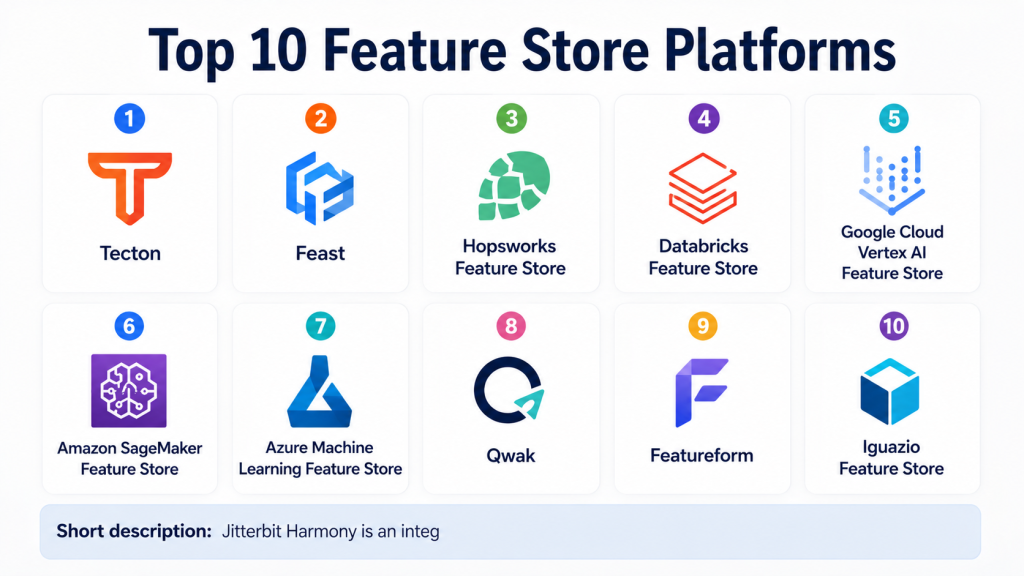
Top 10 Feature Store Platforms
#1 — Tecton
Short description:Tecton is a managed feature platform designed for teams building production-grade machine learning systems.
It focuses strongly on real-time feature pipelines, low-latency serving, feature reuse, and governance.
The platform is useful for teams that want to move beyond experimental ML and operate features as trusted production assets.
Tecton is often considered by companies that need both batch and streaming feature workflows.
It helps reduce training-serving skew by keeping feature definitions consistent across environments.
The platform is suitable for fraud detection, recommendation systems, ranking, personalization, and risk scoring.
It is more enterprise-oriented than many lightweight open-source options.
Teams with dedicated ML platform or MLOps functions may benefit most from Tecton.
Key Features
- Offline and online feature serving
- Real-time feature pipelines
- Feature registry and reusable feature definitions
- Support for batch and streaming data sources
- Low-latency feature serving for production models
- Monitoring and governance capabilities
- Integration with major data and ML ecosystem tools
Pros
- Strong fit for production ML and real-time use cases
- Helps reduce duplicate feature engineering work
- Enterprise-ready approach for governance and scale
Cons
- May be too advanced for small ML teams
- Pricing and implementation effort can be higher than lightweight options
- Requires mature data and ML engineering practices
Platforms / Deployment
Cloud / Hybrid
Security & Compliance
SSO/SAML, RBAC, encryption, and enterprise security controls may be available depending on plan and deployment. Specific compliance details are Not publicly stated.
Integrations & Ecosystem
Tecton is designed to connect with modern data platforms, streaming systems, and ML workflows. It works best when teams already have structured data infrastructure and production ML pipelines.
- Data warehouses and lakehouses
- Streaming systems
- Model serving platforms
- ML orchestration workflows
- Cloud data infrastructure
- APIs for production integration
Support & Community
Tecton provides enterprise-oriented documentation and support. Community presence is smaller than broad open-source projects, but its product focus is strong for production ML teams.
#2 — Feast
Short description:
Feast is one of the most widely known open-source feature store platforms.
It is popular with teams that want flexibility, transparency, and control over their feature infrastructure.
Feast supports feature definitions, offline stores, online stores, and model-serving integrations.
It is often used by ML platform teams that want to build custom feature store architecture.
The platform is developer-friendly and works well for teams comfortable with engineering ownership.
Feast can support both batch and online feature serving patterns.
It is a strong choice for teams that want to avoid vendor lock-in.
However, operating Feast at scale may require internal platform expertise.
Key Features
- Open-source feature store framework
- Offline and online feature store support
- Feature registry and feature definitions
- Flexible backend integrations
- Python-based developer workflow
- Support for batch and online serving
- Extensible architecture for custom infrastructure
Pros
- Strong open-source ecosystem
- Flexible and customizable
- Good choice for engineering-led ML teams
Cons
- Requires operational ownership
- Enterprise support depends on implementation path
- Advanced governance may need additional tools
Platforms / Deployment
Self-hosted / Hybrid / Cloud-managed through third-party implementations
Security & Compliance
Security depends heavily on the deployment environment and connected infrastructure. Compliance details are Not publicly stated.
Integrations & Ecosystem
Feast has a strong developer ecosystem and is built to integrate with common ML and data infrastructure.
- Python workflows
- Offline stores
- Online stores
- Kubernetes-based infrastructure
- Data warehouses
- Model serving systems
Support & Community
Feast has strong open-source community support and documentation. Enterprise-grade onboarding and support may depend on vendors or internal platform teams.
#3 — Hopsworks Feature Store
Short description:
Hopsworks Feature Store is a feature store platform focused on collaborative ML, governance, and end-to-end machine learning workflows.
It supports feature engineering, feature discovery, transformation logic, and serving for production ML.
The platform is useful for teams that want feature store capabilities with broader ML platform functionality.
Hopsworks is often considered by organizations that need reproducibility and governance around ML features.
It supports both offline and online feature usage.
The platform can help teams centralize feature development across multiple projects and departments.
It is suitable for enterprises, research-driven teams, and ML-heavy organizations.
Teams looking for a mature feature store with broader ML lifecycle support may find it useful.
Key Features
- Feature registry and feature discovery
- Offline and online feature serving
- Data validation and feature monitoring capabilities
- Feature transformation pipelines
- Governance and access control features
- Support for collaborative ML workflows
- Integration with model training and serving workflows
Pros
- Strong focus on full ML lifecycle workflows
- Useful for governance and collaboration
- Supports both research and production environments
Cons
- Can feel broad for teams needing only a simple feature store
- May require onboarding for non-platform teams
- Deployment and management complexity may vary
Platforms / Deployment
Cloud / Self-hosted / Hybrid
Security & Compliance
RBAC and access control capabilities are available. Specific compliance certifications are Not publicly stated unless confirmed by the vendor for a specific plan.
Integrations & Ecosystem
Hopsworks integrates with data, ML, and infrastructure tools used in production ML workflows.
- Python and ML libraries
- Data warehouses and storage systems
- Model training environments
- Online serving systems
- Workflow orchestration tools
- Cloud infrastructure
Support & Community
Hopsworks provides documentation, commercial support options, and community resources. Support depth may vary by plan and deployment model.
#4 — Databricks Feature Store
Short description:
Databricks Feature Store is designed for teams already using the Databricks Lakehouse ecosystem.
It helps manage, discover, and reuse features across ML projects.
The platform is suitable for data teams that use notebooks, Spark, Delta Lake, and ML workflows inside Databricks.
It supports feature tables and integration with model training and serving workflows.
For organizations already invested in Databricks, it can reduce friction because feature engineering happens close to the data.
It is especially useful for teams working on batch-heavy and lakehouse-based ML use cases.
Databricks Feature Store fits well in enterprise data platforms.
Teams outside the Databricks ecosystem may find it less flexible than independent feature store tools.
Key Features
- Feature tables inside the Databricks ecosystem
- Integration with Delta Lake and Spark workflows
- Feature discovery and reuse
- Support for ML training workflows
- Model serving integration within Databricks workflows
- Governance through Databricks platform capabilities
- Strong fit for lakehouse-based ML
Pros
- Excellent fit for existing Databricks users
- Keeps feature engineering close to enterprise data
- Strong support for large-scale batch workflows
Cons
- Less suitable for teams not using Databricks
- Ecosystem alignment may limit flexibility
- Real-time use cases may need additional design
Platforms / Deployment
Cloud / Hybrid depending on Databricks environment
Security & Compliance
Security depends on Databricks workspace configuration. RBAC, audit logs, encryption, and identity integrations may be available through Databricks. Compliance details vary by plan and region.
Integrations & Ecosystem
Databricks Feature Store works best inside the Databricks ecosystem and connects naturally with lakehouse workflows.
- Delta Lake
- Apache Spark
- MLflow
- Databricks notebooks
- Databricks model serving
- Cloud storage and data platforms
Support & Community
Databricks offers enterprise documentation, training, and support. The wider Spark and MLflow ecosystem also strengthens adoption.
#5 — Google Cloud Vertex AI Feature Store
Short description:
Vertex AI Feature Store is part of Google Cloud’s managed AI and machine learning ecosystem.
It helps teams serve and manage ML features for training and prediction workflows.
The platform is useful for teams already using Google Cloud services and Vertex AI.
It supports centralized feature management within a managed cloud environment.
Organizations can use it to reduce feature duplication and improve consistency across ML models.
It is suitable for teams that prefer cloud-managed infrastructure over self-hosted systems.
The platform fits companies building ML workflows around Google Cloud data and AI services.
Teams outside Google Cloud may need to evaluate ecosystem fit carefully.
Key Features
- Managed feature store capability in Google Cloud
- Integration with Vertex AI workflows
- Feature serving for ML use cases
- Support for centralized feature management
- Cloud-native scaling
- Identity and access controls through Google Cloud
- Integration with Google Cloud data services
Pros
- Strong fit for Google Cloud users
- Managed infrastructure reduces operational burden
- Works with broader Vertex AI workflows
Cons
- Best value comes inside Google Cloud ecosystem
- May not suit multi-cloud-first teams
- Advanced customization may be limited compared with self-hosted options
Platforms / Deployment
Cloud
Security & Compliance
Security is managed through Google Cloud IAM, encryption, and platform controls. Specific compliance applicability depends on service configuration and organization requirements.
Integrations & Ecosystem
Vertex AI Feature Store fits naturally with Google Cloud AI, analytics, and data services.
- Vertex AI
- BigQuery
- Cloud Storage
- Dataflow
- Google Cloud IAM
- Model training and prediction workflows
Support & Community
Google Cloud provides documentation, support plans, and ecosystem resources. Community knowledge is strong for Google Cloud ML workflows.
#6 — Amazon SageMaker Feature Store
Short description:
Amazon SageMaker Feature Store is a managed feature store service within the AWS machine learning ecosystem.
It helps teams store, retrieve, and share ML features for training and inference.
The platform is useful for organizations already using AWS for data engineering, analytics, and ML.
It supports offline and online feature storage patterns.
Teams can use it to improve consistency between model training and production inference.
It is suitable for fraud detection, personalization, forecasting, and customer intelligence use cases.
The service works best when connected with other SageMaker and AWS data services.
Teams with strong AWS skills can benefit from its managed infrastructure model.
Key Features
- Managed feature store inside SageMaker
- Offline and online feature storage
- Integration with SageMaker training and inference
- Feature groups for organizing features
- Cloud-native scalability
- Access control through AWS identity services
- Integration with AWS data and analytics tools
Pros
- Strong fit for AWS-based ML teams
- Reduces infrastructure management burden
- Good integration with SageMaker ecosystem
Cons
- Best suited for AWS-first organizations
- Multi-cloud flexibility may be limited
- Cost structure needs careful monitoring at scale
Platforms / Deployment
Cloud
Security & Compliance
Security is managed through AWS IAM, encryption, and AWS service controls. Compliance applicability depends on configuration, region, and organization requirements.
Integrations & Ecosystem
SageMaker Feature Store integrates closely with AWS ML, storage, and analytics services.
- Amazon SageMaker
- Amazon S3
- AWS Glue
- Amazon Athena
- AWS Lambda
- AWS IAM
Support & Community
AWS provides extensive documentation, support plans, and training resources. The AWS ML ecosystem has broad adoption and community knowledge.
#7 — Azure Machine Learning Feature Store
Short description:
Azure Machine Learning Feature Store supports feature management within the Microsoft Azure ML ecosystem.
It is designed for teams that want reusable, governed features for training and inference workflows.
The platform fits organizations that already use Azure Machine Learning, Azure data services, and Microsoft identity tools.
It helps reduce duplicated feature work and supports better collaboration across ML teams.
The platform is useful for enterprise teams with strong compliance and identity requirements.
It can support structured feature engineering workflows around Azure data infrastructure.
Azure-first teams may find it easier to adopt than independent feature store platforms.
Teams using many non-Azure tools should check integration needs carefully.
Key Features
- Feature store capability within Azure Machine Learning
- Centralized feature reuse
- Integration with Azure ML pipelines
- Support for enterprise identity and access control
- Connection with Azure data services
- Managed cloud infrastructure
- Governance support through Azure platform controls
Pros
- Strong fit for Microsoft Azure customers
- Enterprise-friendly identity and governance alignment
- Useful for teams standardizing ML workflows on Azure
Cons
- Less ideal for non-Azure-first teams
- May require Azure ML familiarity
- Advanced use cases may require additional platform design
Platforms / Deployment
Cloud
Security & Compliance
Security is managed through Azure identity, access control, encryption, and cloud governance features. Compliance applicability depends on configuration and service usage.
Integrations & Ecosystem
Azure Machine Learning Feature Store works best with Azure ML and related cloud services.
- Azure Machine Learning
- Azure Data Lake
- Azure Synapse
- Microsoft Entra ID
- Azure Databricks
- Azure pipelines and storage services
Support & Community
Microsoft provides documentation, enterprise support, and learning resources. Community support is strong across Azure ML and Microsoft data services.
#8 — Qwak
Short description:
Qwak is an end-to-end machine learning platform that includes feature store capabilities as part of a broader ML production workflow.
It is designed for teams that want to build, deploy, monitor, and manage ML systems from one platform.
The feature store component helps teams manage reusable features and serve them for production models.
Qwak is useful for companies that want a managed platform instead of stitching many tools together.
It can support teams moving from experimentation to production ML operations.
The platform may appeal to mid-market and enterprise teams that need practical MLOps acceleration.
Its value is strongest when teams want more than just a standalone feature store.
Teams looking only for an open-source feature store may prefer other options.
Key Features
- Feature store capabilities within an ML platform
- Model deployment and monitoring features
- Support for production ML workflows
- Feature reuse and serving
- Managed platform experience
- Integration with data and ML tools
- Collaboration support for ML teams
Pros
- Useful for teams wanting an integrated ML platform
- Reduces toolchain fragmentation
- Supports production-focused ML workflows
Cons
- May be more platform than some teams need
- Less flexible than building a custom open-source stack
- Pricing details may vary by plan
Platforms / Deployment
Cloud / Hybrid depending on plan
Security & Compliance
Enterprise security controls may be available. Specific compliance details are Not publicly stated.
Integrations & Ecosystem
Qwak is designed to connect data sources, model workflows, and production ML systems.
- Data warehouses
- Cloud storage
- ML frameworks
- Model serving workflows
- Monitoring tools
- APIs and SDKs
Support & Community
Qwak provides vendor documentation and commercial support. Community strength is more vendor-led than open-source-led.
#9 — Featureform
Short description:
Featureform is an open-source feature store focused on virtual feature stores and infrastructure flexibility.
It lets teams define, manage, and serve features while using their existing data infrastructure.
The platform is useful for organizations that do not want to duplicate data unnecessarily.
Featureform supports teams that prefer a declarative and developer-friendly approach.
It can work well for teams that want open-source control with modern feature store practices.
The tool is helpful when companies already have data warehouses, object stores, or compute systems in place.
It is suited for engineering teams comfortable managing their own ML infrastructure.
Teams needing full managed enterprise support should evaluate support options carefully.
Key Features
- Open-source feature store
- Virtual feature store approach
- Reusable feature definitions
- Integration with existing data infrastructure
- Offline and online serving patterns
- Developer-friendly workflows
- Support for modular MLOps architecture
Pros
- Avoids unnecessary data duplication
- Flexible for custom infrastructure
- Good for open-source-focused teams
Cons
- Requires engineering ownership
- Enterprise support may vary
- Smaller ecosystem than some larger platforms
Platforms / Deployment
Self-hosted / Hybrid
Security & Compliance
Security depends on deployment environment and connected systems. Compliance details are Not publicly stated.
Integrations & Ecosystem
Featureform is designed to work with existing data and ML infrastructure rather than forcing teams into one stack.
- Data warehouses
- Object storage
- Online stores
- Python workflows
- ML pipelines
- Infrastructure tooling
Support & Community
Featureform has open-source documentation and community resources. Support depth depends on deployment model and vendor engagement.
#10 — Iguazio Feature Store
Short description:
Iguazio provides feature store capabilities as part of a broader data science and MLOps platform.
It is designed for teams building real-time AI applications and production ML pipelines.
The platform supports feature engineering, data processing, model deployment, and operational workflows.
It is often considered by enterprises that need low-latency, real-time, and scalable AI infrastructure.
Iguazio can help teams manage features across experimentation and production environments.
The platform is suitable for financial services, telecommunications, industrial AI, and real-time analytics use cases.
It may be more suitable for mature ML teams than early-stage data science groups.
Organizations should evaluate its fit based on infrastructure, scale, and real-time needs.
Key Features
- Feature store capabilities within an MLOps platform
- Real-time data and feature processing
- Support for production ML pipelines
- Model serving and operational workflows
- Scalable infrastructure for AI applications
- Integration with data science tools
- Enterprise-oriented deployment options
Pros
- Strong fit for real-time AI use cases
- Combines feature store with broader MLOps capabilities
- Useful for enterprise-scale ML workloads
Cons
- May be complex for smaller teams
- Best value comes with broader platform adoption
- Pricing and deployment details may require vendor consultation
Platforms / Deployment
Cloud / Self-hosted / Hybrid
Security & Compliance
Enterprise security controls may be available. Specific compliance certifications are Not publicly stated unless confirmed for a specific deployment.
Integrations & Ecosystem
Iguazio connects with data science, streaming, storage, and model deployment workflows.
- Python and data science tools
- Streaming data systems
- Cloud and on-prem infrastructure
- Model serving tools
- Data pipelines
- Enterprise systems
Support & Community
Iguazio provides enterprise support and documentation. Community visibility is more specialized compared with larger open-source ecosystems.
Comparison Table
| Tool Name | Best For | Platform(s) Supported | Deployment | Standout Feature | Public Rating |
|---|---|---|---|---|---|
| Tecton | Enterprise real-time ML teams | Web / APIs / Cloud ecosystem | Cloud / Hybrid | Real-time production feature pipelines | N/A |
| Feast | Open-source ML platform teams | Linux / Cloud / Kubernetes environments | Self-hosted / Hybrid | Flexible open-source feature store | N/A |
| Hopsworks Feature Store | Collaborative ML and governance | Web / Cloud / Self-hosted environments | Cloud / Self-hosted / Hybrid | Feature store with broader ML lifecycle support | N/A |
| Databricks Feature Store | Databricks lakehouse users | Web / Databricks ecosystem | Cloud / Hybrid | Deep lakehouse integration | N/A |
| Vertex AI Feature Store | Google Cloud ML teams | Web / Google Cloud | Cloud | Managed feature store inside Vertex AI | N/A |
| SageMaker Feature Store | AWS ML teams | Web / AWS ecosystem | Cloud | Offline and online feature groups in AWS | N/A |
| Azure ML Feature Store | Microsoft Azure ML teams | Web / Azure ecosystem | Cloud | Azure-native feature governance | N/A |
| Qwak | Teams wanting integrated MLOps | Web / Cloud ecosystem | Cloud / Hybrid | Feature store inside end-to-end ML platform | N/A |
| Featureform | Open-source and flexible infrastructure teams | Linux / Cloud / Kubernetes environments | Self-hosted / Hybrid | Virtual feature store approach | N/A |
| Iguazio Feature Store | Real-time enterprise AI teams | Web / Cloud / On-prem environments | Cloud / Self-hosted / Hybrid | Real-time AI and MLOps platform integration | N/A |
Evaluation & Scoring of Feature Store Platforms
| Tool Name | Core (25%) | Ease (15%) | Integrations (15%) | Security (10%) | Performance (10%) | Support (10%) | Value (15%) | Weighted Total (0–10) |
|---|---|---|---|---|---|---|---|---|
| Tecton | 9 | 8 | 8 | 8 | 9 | 8 | 7 | 8.25 |
| Feast | 8 | 7 | 9 | 6 | 8 | 8 | 9 | 7.95 |
| Hopsworks Feature Store | 8 | 8 | 8 | 8 | 8 | 8 | 8 | 8.00 |
| Databricks Feature Store | 8 | 8 | 9 | 8 | 8 | 9 | 7 | 8.10 |
| Vertex AI Feature Store | 8 | 8 | 8 | 8 | 8 | 8 | 7 | 7.85 |
| SageMaker Feature Store | 8 | 8 | 8 | 8 | 8 | 8 | 7 | 7.85 |
| Azure ML Feature Store | 8 | 8 | 8 | 8 | 8 | 8 | 7 | 7.85 |
| Qwak | 8 | 8 | 7 | 7 | 8 | 8 | 7 | 7.60 |
| Featureform | 7 | 7 | 8 | 6 | 7 | 7 | 9 | 7.35 |
| Iguazio Feature Store | 8 | 7 | 7 | 8 | 9 | 8 | 7 | 7.75 |
These scores are comparative, not absolute.
A higher score does not mean the tool is best for every company.
For example, Feast may score higher for open-source flexibility, while Tecton may be stronger for managed real-time production use cases.
Cloud-native teams should give more weight to ecosystem fit.
Regulated teams should review security, auditability, access control, and compliance requirements before making a final decision.
Which Feature Store Platform Is Right for You?
Solo / Freelancer
Solo users usually do not need a complex feature store unless they are building serious ML products. For learning, experimentation, and portfolio projects, Feast or Featureform can be practical because they are flexible and developer-friendly. If you already work inside a cloud ecosystem, SageMaker Feature Store, Vertex AI Feature Store, or Azure ML Feature Store may also be useful.
SMB
Small and mid-sized businesses should avoid overbuilding. If the team has a few production models, a managed cloud-native feature store may be easier than self-hosting. AWS users can consider SageMaker Feature Store, Google Cloud users can consider Vertex AI Feature Store, and Azure users can consider Azure ML Feature Store. If the team has strong engineers, Feast or Featureform can reduce vendor lock-in.
Mid-Market
Mid-market companies usually need reusable features, better governance, real-time pipelines, and shared ML workflows. Tecton, Hopsworks, Databricks Feature Store, and Qwak are strong options depending on ecosystem fit. Teams should prioritize integration with existing data platforms, model deployment workflows, and security tools.
Enterprise
Enterprises need governance, scale, security, access control, monitoring, and platform consistency. Tecton, Databricks Feature Store, Hopsworks, Iguazio, and cloud-native options from AWS, Google Cloud, and Azure can be strong choices. The best choice depends heavily on existing infrastructure, compliance needs, and internal MLOps maturity.
Budget vs Premium
Open-source tools like Feast and Featureform can reduce license costs but require internal engineering ownership. Premium managed platforms like Tecton, Qwak, and enterprise cloud feature stores reduce operational burden but may cost more. The right choice depends on whether your team wants to pay with engineering time or platform subscription cost.
Feature Depth vs Ease of Use
If feature depth is most important, Tecton, Hopsworks, Databricks, and Iguazio are strong candidates. If ease of use inside an existing cloud stack matters more, AWS, Google Cloud, and Azure-native feature stores may be easier. For developer-first flexibility, Feast and Featureform are practical options.
Integrations & Scalability
Integration should be one of the first evaluation criteria. A feature store must connect with your data warehouse, lakehouse, streaming system, orchestration tool, model registry, and serving layer. If your team already uses Databricks, AWS, Google Cloud, or Azure, native options may reduce integration effort.
Security & Compliance Needs
Regulated teams should evaluate identity management, RBAC, encryption, audit logs, lineage, data access policies, and governance workflows. Do not select a feature store only based on feature count. Security, compliance, and operational visibility are often more important in production ML environments.
Frequently Asked Questions
1. What is a feature store platform?
A feature store platform is a central system for storing, managing, sharing, and serving machine learning features. It helps teams reuse trusted feature logic across training and production.
2. Why do ML teams need a feature store?
ML teams need a feature store to reduce duplicate work, improve consistency, and avoid training-serving skew. It also helps with governance, collaboration, monitoring, and faster model deployment.
3. What is the difference between offline and online feature stores?
An offline feature store is mainly used for training, batch analysis, and historical features. An online feature store is used for low-latency feature serving during real-time prediction.
4. Are feature stores only useful for large enterprises?
No, but large enterprises usually benefit the most. Smaller teams may also benefit if they run multiple models, need real-time predictions, or repeatedly reuse the same features.
5. What are common pricing models for feature store platforms?
Pricing can be open-source, subscription-based, usage-based, cloud-service-based, or enterprise-contract-based. If pricing is unclear, buyers should request details based on storage, compute, serving volume, and support needs.
6. How long does feature store implementation take?
Implementation depends on data maturity, number of models, integration needs, and governance requirements. A simple setup may be quick, while enterprise rollout can require planning, data modeling, access policies, and pipeline migration.
7. What are common mistakes when choosing a feature store?
Common mistakes include choosing a tool before defining ML use cases, ignoring online serving needs, underestimating governance, and not checking integration with existing data systems. Teams should also avoid overbuilding too early.
8. How important is security in a feature store?
Security is very important because feature stores often handle sensitive business, customer, behavioral, or financial data. Teams should review access control, encryption, audit logs, identity integration, and compliance requirements.
9. Can feature stores support real-time ML?
Yes, many feature stores support real-time ML, but capabilities vary. Teams should check latency, streaming support, freshness guarantees, online store design, and production serving architecture.
10. What integrations should a feature store support?
A feature store should ideally integrate with data warehouses, lakehouses, object storage, streaming platforms, orchestration tools, model registries, ML frameworks, and model serving systems.
Conclusion
Feature store platforms are becoming a core part of modern machine learning infrastructure because they help teams manage features with consistency, governance, speed, and reliability. The best platform depends on your current stack, team size, ML maturity, real-time requirements, budget, and security expectations. Tecton is strong for production-grade real-time ML, Feast and Featureform are good for open-source flexibility, Databricks fits lakehouse users, and cloud-native options from AWS, Google Cloud, and Azure are practical for teams already committed to those ecosystems.
