Upgrade & Secure Your Future with DevOps, SRE, DevSecOps, MLOps!
We spend hours scrolling social media and waste money on things we forget, but won’t spend 30 minutes a day earning certifications that can change our lives.
Master in DevOps, SRE, DevSecOps & MLOps by DevOps School!
Learn from Guru Rajesh Kumar and double your salary in just one year.
Introduction
Batch Processing Frameworks help organizations process large volumes of stored data in scheduled or grouped jobs. In simple English, batch processing means collecting data over time and processing it together, instead of handling every record instantly. It is commonly used for reporting, billing, ETL pipelines, machine learning preparation, financial reconciliation, log processing, and large-scale data transformation.
Batch processing still matters because many business workloads do not need real-time processing. Instead, they need reliable, cost-efficient, repeatable, and auditable processing at scale. Modern batch frameworks also support cloud platforms, AI pipelines, lakehouse architectures, orchestration, and hybrid data environments.
Buyers should evaluate:
- Scalability
- Performance
- Fault tolerance
- Workflow scheduling
- Cloud compatibility
- Security controls
- Data source integrations
- Developer experience
- Monitoring and observability
- Cost efficiency
Best for: data engineers, platform teams, analytics engineers, DevOps teams, AI/ML teams, finance teams, enterprise architects, and organizations handling large scheduled data workloads.
Not ideal for: systems needing instant event response, ultra-low-latency streaming, or small teams that only need simple spreadsheet reporting.
Key Trends in Batch Processing Frameworks
- Cloud-native batch processing: More teams are moving from self-managed clusters to managed cloud compute and serverless batch platforms.
- AI and ML data preparation: Batch frameworks are heavily used for feature engineering, model training datasets, and data quality checks.
- Lakehouse integration: Batch processing is increasingly connected with Delta Lake, Iceberg, Hudi, Snowflake, BigQuery, and Databricks.
- Hybrid batch and streaming models: Tools like Spark, Flink, and Beam are supporting both batch and streaming workloads.
- Workflow orchestration maturity: Batch jobs are now managed through tools like Airflow, Dagster, and Prefect for scheduling and observability.
- Cost-aware processing: Teams are optimizing compute usage, storage layout, job duration, and cloud billing.
- Data governance pressure: Batch pipelines need lineage, access control, encryption, audit logs, and policy enforcement.
- Containerized execution: Kubernetes-based batch processing is becoming common for portability and scalable job execution.
- Data contracts and testing: Teams are adding validation, schema checks, and automated quality gates before downstream reporting.
- Open-source plus managed services: Many organizations combine open-source frameworks with managed cloud services to reduce operations.
How We Selected These Tools
The tools were selected using practical evaluation logic:
- Market adoption and ecosystem maturity
- Ability to process large-scale batch workloads
- Fit for enterprise, cloud, and open-source environments
- Support for data engineering, analytics, AI, and ETL use cases
- Performance, scalability, and fault-tolerance capabilities
- Integration with modern data lakes, warehouses, and orchestration tools
- Security and governance readiness
- Developer experience and operational complexity
- Community strength, documentation, and support ecosystem
- Suitability across SMB, mid-market, and enterprise teams
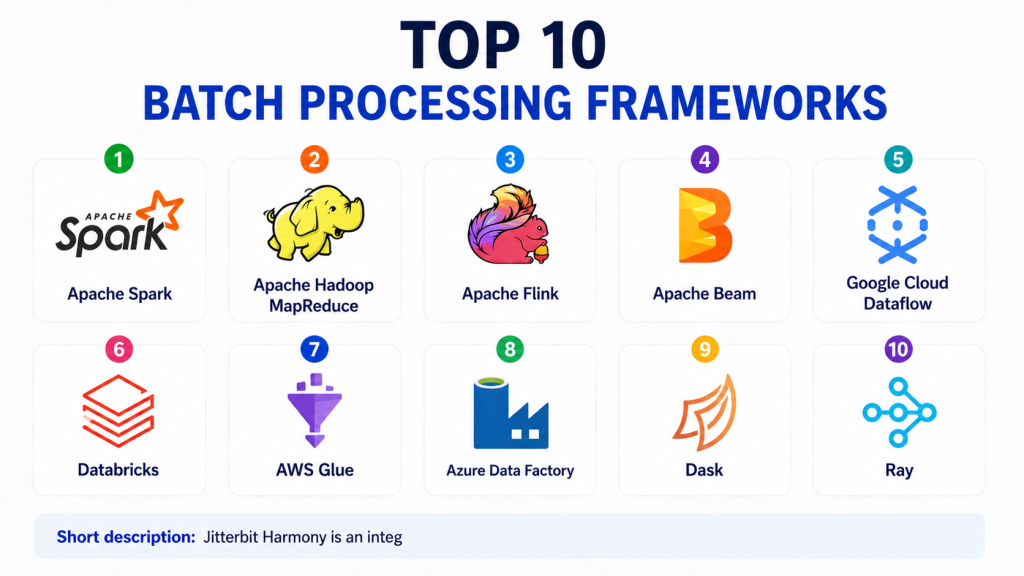
Top 10 Batch Processing Frameworks
#1 — Apache Spark
Short description:Apache Spark is one of the most widely used batch processing frameworks for large-scale data engineering and analytics workloads.
It supports batch processing, SQL analytics, machine learning, graph processing, and streaming through a unified engine.
Spark is commonly used for ETL jobs, data lake processing, log analysis, AI data preparation, and large-scale transformations.
It works with many storage systems, including data lakes, cloud storage, Hadoop, and lakehouse formats.
Spark is popular because it can process large datasets faster than older disk-heavy batch systems when configured properly.
It is used by data engineers, platform teams, analytics engineers, and ML teams.
However, Spark requires tuning, cluster planning, and skilled engineering for production workloads.
It is best for teams that need powerful, scalable, general-purpose batch processing.
Key Features
- Distributed batch processing
- Spark SQL and DataFrame APIs
- Machine learning library support
- Integration with lakehouse formats
- Fault-tolerant execution
- Support for batch and streaming
- Large ecosystem and community
Pros
- Very strong ecosystem and adoption
- Handles large-scale data processing well
- Flexible for ETL, analytics, and ML pipelines
Cons
- Requires tuning for performance
- Cluster operations can be complex
- Poor job design can increase cost and runtime
Platforms / Deployment
Linux / Kubernetes / Cloud infrastructure
Cloud / Self-hosted / Hybrid
Security & Compliance
Supports authentication, authorization, encryption, and access controls depending on deployment. Compliance depends on infrastructure and platform configuration.
Integrations & Ecosystem
Spark integrates broadly with modern data platforms and engineering tools.
- Hadoop and HDFS
- Data lakes
- Delta Lake, Iceberg, and Hudi
- Cloud object storage
- Databricks
- Orchestration tools
Support & Community
Apache Spark has strong open-source documentation, large community support, vendor-backed platforms, and extensive learning resources.
#2 — Apache Hadoop MapReduce
Short description:Apache Hadoop MapReduce is one of the original large-scale batch processing frameworks for distributed data processing.
It processes data by splitting work into map and reduce stages across a cluster.
Hadoop MapReduce is commonly associated with older big data platforms and large on-premises data environments.
It is reliable for batch workloads but usually slower and less flexible than modern frameworks like Spark.
Many enterprises still have Hadoop-based systems for legacy processing, archival analytics, or long-running ETL workloads.
It is useful when organizations need stability and compatibility with existing Hadoop infrastructure.
However, it is not usually the first choice for new modern data projects.
It is best for legacy big data environments and teams maintaining existing Hadoop workloads.
Key Features
- Distributed batch processing
- Map and reduce programming model
- HDFS integration
- Fault-tolerant execution
- Large-scale data handling
- Mature big data ecosystem
- Suitable for long-running batch jobs
Pros
- Mature and stable for legacy workloads
- Good for very large batch data processing
- Strong compatibility with Hadoop ecosystem
Cons
- Slower than newer engines for many workloads
- More complex programming model
- Less attractive for modern cloud-native teams
Platforms / Deployment
Linux / Hadoop clusters
Self-hosted / Hybrid
Security & Compliance
Security depends on Hadoop distribution and configuration. Kerberos, access controls, encryption, and audit features may be available depending on deployment.
Integrations & Ecosystem
Hadoop MapReduce works with traditional big data infrastructure.
- HDFS
- Hive
- Pig
- HBase
- YARN
- Enterprise Hadoop distributions
Support & Community
Open-source resources are available, but active innovation is lower than newer frameworks. Support depends on vendors, distributions, or internal teams.
#3 — Apache Flink
Short description:Apache Flink is a distributed processing framework that supports both batch and stream processing.
Although it is widely known for real-time streaming, it can also process bounded datasets as batch workloads.
Flink is useful for teams that want one engine for real-time and batch processing patterns.
It supports stateful computation, event-time processing, fault tolerance, and high-performance data processing.
Batch workloads in Flink can be valuable for analytics, ETL, data transformation, and hybrid data pipelines.
It is especially useful where batch and streaming logic need to stay consistent.
However, Flink can be more complex to operate than simpler batch-only tools.
It is best for technical teams building unified batch and streaming architectures.
Key Features
- Batch and stream processing
- Stateful computation
- Fault-tolerant execution
- SQL and DataStream APIs
- Event-time processing
- Distributed execution
- Strong performance for complex workloads
Pros
- Unified batch and streaming engine
- Strong for stateful and complex processing
- Good fit for real-time plus batch architectures
Cons
- Operational learning curve can be high
- Requires skilled engineering teams
- Smaller batch ecosystem than Spark
Platforms / Deployment
Linux / Kubernetes / Cloud infrastructure
Cloud / Self-hosted / Hybrid
Security & Compliance
Supports authentication, encryption, and access controls depending on deployment. Compliance depends on infrastructure and configuration.
Integrations & Ecosystem
Flink integrates with streaming, storage, and data processing systems.
- Kafka
- Data lakes
- Cloud storage
- Hive catalog
- Iceberg
- Stream processing ecosystems
Support & Community
Apache Flink has strong open-source community support and commercial support through vendors and managed services.
#4 — Apache Beam
Short description:Apache Beam is a unified programming model for batch and streaming data processing.
It allows developers to write pipelines once and run them on different execution engines, called runners.
Beam can run on platforms such as Google Cloud Dataflow, Apache Flink, Apache Spark, and other supported runners.
It is useful for organizations that want portability across batch and streaming engines.
Beam is often used for ETL, data transformation, event processing, and cloud data pipelines.
Its biggest strength is pipeline portability and a unified model.
However, it can feel more abstract and verbose than using a native framework directly.
It is best for teams that want flexible pipeline logic across multiple execution environments.
Key Features
- Unified batch and streaming model
- Portable pipeline execution
- Multiple runner support
- Windowing and triggers
- Data transformation APIs
- Cloud and open-source compatibility
- Strong fit for pipeline portability
Pros
- Avoids lock-in to one execution engine
- Good for hybrid batch and streaming logic
- Strong fit with Google Cloud Dataflow
Cons
- Learning curve can be high
- Debugging depends on runner behavior
- Some features vary by runner
Platforms / Deployment
Linux / Cloud infrastructure / Runner-dependent
Cloud / Self-hosted / Hybrid
Security & Compliance
Security depends on the execution runner and infrastructure. Compliance should be verified based on the platform used to run Beam pipelines.
Integrations & Ecosystem
Beam integrates through runners and connectors.
- Google Cloud Dataflow
- Apache Spark
- Apache Flink
- Kafka
- Cloud storage
- Data warehouses
Support & Community
Apache Beam has open-source documentation and community support. Commercial support depends on the runner or cloud provider selected.
#5 — Google Cloud Dataflow
Short description:Google Cloud Dataflow is a managed data processing service based on Apache Beam.
It supports both batch and streaming pipelines without requiring teams to manage clusters directly.
Dataflow is commonly used for ETL, log processing, real-time analytics, data enrichment, and cloud data pipelines.
It is especially useful for organizations using Google Cloud services such as BigQuery, Pub/Sub, and Cloud Storage.
The service handles scaling, resource management, and execution infrastructure for Beam pipelines.
It reduces operations compared with self-managed Spark or Flink clusters.
However, it is best suited for teams already invested in Google Cloud.
It is best for cloud-native teams that want managed batch and streaming pipeline execution.
Key Features
- Managed batch and streaming processing
- Apache Beam support
- Autoscaling
- Google Cloud integration
- Serverless execution model
- Fault-tolerant pipeline processing
- Data transformation workflows
Pros
- Reduces infrastructure management
- Strong Google Cloud integration
- Good for batch and streaming pipelines
Cons
- Best value inside Google Cloud
- Beam learning curve still applies
- Pricing should be monitored for large workloads
Platforms / Deployment
Web / Google Cloud ecosystem
Cloud / Managed service
Security & Compliance
Supports Google Cloud IAM, encryption, audit logging, and access controls. Specific compliance depends on Google Cloud configuration.
Integrations & Ecosystem
Dataflow integrates naturally with Google Cloud data services.
- BigQuery
- Cloud Storage
- Pub/Sub
- Dataplex
- Cloud Logging
- Data lakes and warehouses
Support & Community
Google Cloud provides documentation, support plans, training resources, and partner services.
#6 — Databricks
Short description:Databricks is a lakehouse platform built around Apache Spark and related modern data engineering capabilities.
It supports batch processing, data engineering pipelines, machine learning, SQL analytics, and lakehouse workloads.
Databricks is commonly used for large-scale ETL, data transformation, feature engineering, and AI-ready data preparation.
It simplifies Spark operations by providing managed clusters, notebooks, workflows, governance features, and collaboration tools.
The platform is useful for enterprises that want Spark power without managing everything manually.
It works well with Delta Lake and modern cloud storage architectures.
However, costs can grow if workloads are not optimized.
It is best for teams building large-scale data lakehouse and AI data pipelines.
Key Features
- Managed Spark-based processing
- Lakehouse architecture
- Batch ETL workflows
- Notebooks and collaboration
- Delta Lake support
- ML and AI data pipelines
- Workflow scheduling and job management
Pros
- Strong managed Spark experience
- Good for data engineering and AI workloads
- Excellent lakehouse alignment
Cons
- Cost optimization is important
- Requires Spark and lakehouse skills
- Best suited for cloud data teams
Platforms / Deployment
Web / Cloud platforms
Cloud / Managed platform
Security & Compliance
Supports workspace permissions, identity integrations, encryption, access controls, audit logs, and governance features. Specific certifications should be verified with the vendor.
Integrations & Ecosystem
Databricks integrates with cloud storage, warehouses, BI tools, and ML systems.
- Cloud object storage
- Delta Lake
- BI tools
- ML frameworks
- Orchestration tools
- Data governance platforms
Support & Community
Databricks provides enterprise support, documentation, training, partner services, and a large Spark-focused ecosystem.
#7 — AWS Glue
Short description:AWS Glue is a managed data integration and ETL service used for batch processing on AWS.
It helps teams discover, prepare, transform, and move data across data lakes, warehouses, and applications.
Glue is commonly used for scheduled ETL jobs, cataloging, data lake preparation, and analytics pipelines.
It is especially useful for AWS-centric organizations using S3, Redshift, Athena, and other AWS services.
Glue reduces the need to manage ETL infrastructure manually.
It supports serverless execution and integrates with AWS data catalog capabilities.
However, complex pipelines still need good design and monitoring.
It is best for AWS teams needing managed batch ETL and data preparation.
Key Features
- Managed ETL processing
- Serverless job execution
- Data catalog support
- Integration with AWS analytics services
- Scheduled batch jobs
- Data transformation workflows
- Support for Spark-based processing
Pros
- Strong AWS integration
- Reduces infrastructure management
- Good for data lake ETL workloads
Cons
- Best value inside AWS ecosystem
- Debugging complex jobs can take effort
- Pricing should be monitored carefully
Platforms / Deployment
Web / AWS ecosystem
Cloud / Managed service
Security & Compliance
Supports AWS IAM, encryption, access policies, logging, and security controls. Compliance depends on AWS account and service configuration.
Integrations & Ecosystem
AWS Glue integrates with AWS data and analytics services.
- Amazon S3
- Amazon Redshift
- Amazon Athena
- AWS Lake Formation
- AWS Lambda
- Databases and JDBC sources
Support & Community
AWS provides documentation, support plans, training, partner resources, and a large cloud community.
#8 — Azure Data Factory
Short description:Azure Data Factory is a managed cloud data integration service for building batch ETL and ELT pipelines.
It helps teams move and transform data across cloud, on-premises, SaaS, and enterprise systems.
ADF is commonly used for scheduled batch pipelines, data warehouse loading, data lake ingestion, and hybrid data integration.
It is especially useful for organizations using Microsoft Azure, SQL Server, Synapse, Fabric, and Power BI.
ADF provides a visual pipeline interface, connectors, triggers, monitoring, and orchestration capabilities.
It reduces custom scripting for many common data movement tasks.
However, complex transformations may require additional compute engines or careful design.
It is best for Microsoft Azure teams building managed batch data pipelines.
Key Features
- Managed ETL and ELT pipelines
- Visual pipeline design
- Scheduling and triggers
- Large connector library
- Hybrid data movement
- Monitoring and logging
- Integration with Microsoft data services
Pros
- Strong Microsoft ecosystem fit
- Good for hybrid and cloud data movement
- Visual interface helps pipeline development
Cons
- Complex logic can become hard to manage visually
- Best value inside Azure ecosystem
- Performance depends on pipeline design and compute choices
Platforms / Deployment
Web / Azure ecosystem
Cloud / Hybrid
Security & Compliance
Supports Microsoft identity, RBAC, managed identities, encryption, private networking options, and audit capabilities depending on configuration.
Integrations & Ecosystem
Azure Data Factory connects with Microsoft and third-party systems.
- Azure Synapse
- Azure Data Lake
- Microsoft Fabric
- SQL Server
- Power BI ecosystem
- SaaS and database connectors
Support & Community
Microsoft provides documentation, enterprise support, training resources, partner services, and strong Azure community support.
#9 — Dask
Short description:Dask is an open-source parallel computing framework for Python that supports batch processing and distributed computation.
It is popular with data scientists and Python teams that need to scale pandas, NumPy, and machine learning workloads.
Dask helps process datasets larger than memory by distributing work across cores or clusters.
It is commonly used for data preparation, scientific computing, feature engineering, and analytics workloads.
Dask is useful when teams want Python-native distributed processing without moving fully into Spark.
Its biggest strength is familiarity for Python users and flexibility for analytical workloads.
However, it may require careful cluster management and performance tuning for production scale.
It is best for Python-heavy teams needing scalable batch and analytical processing.
Key Features
- Python-native parallel computing
- Distributed DataFrame support
- Scales pandas-like workflows
- Integration with NumPy and scikit-learn workflows
- Cluster execution support
- Good for analytical batch workloads
- Flexible task scheduling
Pros
- Familiar for Python data teams
- Good for scientific and analytical workloads
- Flexible and lightweight compared with heavy big data stacks
Cons
- Not as universal as Spark for enterprise ETL
- Production operations require skill
- Performance depends on workload design
Platforms / Deployment
Linux / Windows / macOS / Cloud infrastructure
Self-hosted / Cloud / Hybrid
Security & Compliance
Security depends on deployment and infrastructure. Enterprise compliance should be handled through surrounding platform controls.
Integrations & Ecosystem
Dask integrates well with Python data and ML ecosystems.
- pandas
- NumPy
- scikit-learn
- Jupyter
- Cloud storage
- Kubernetes and distributed clusters
Support & Community
Dask has open-source documentation, community support, and commercial support options through service providers.
#10 — Ray
Short description:Ray is an open-source distributed computing framework used for scalable Python workloads, AI, machine learning, and data processing.
It supports distributed tasks, actors, datasets, model training, tuning, and serving workflows.
Ray is increasingly used where batch processing connects with AI pipelines and large-scale Python workloads.
It can help teams scale data preparation, ML feature generation, simulation, and distributed compute jobs.
Ray is especially attractive for AI/ML teams that need flexible compute beyond traditional ETL frameworks.
Its ecosystem includes tools for training, tuning, serving, and distributed data processing.
However, it may require engineering maturity for production platform design.
It is best for AI-focused teams needing scalable Python-native batch and distributed processing.
Key Features
- Distributed Python execution
- Task and actor model
- Scalable data processing
- ML training and tuning support
- AI workload orchestration
- Cluster execution
- Flexible distributed compute APIs
Pros
- Strong fit for AI and ML workloads
- Flexible Python-native distributed computing
- Useful beyond traditional ETL pipelines
Cons
- Requires engineering knowledge for production use
- Less traditional for classic warehouse ETL
- Ecosystem maturity varies by use case
Platforms / Deployment
Linux / macOS / Cloud infrastructure / Kubernetes
Self-hosted / Cloud / Hybrid
Security & Compliance
Security depends on deployment, cluster configuration, and surrounding infrastructure. Specific compliance should be verified based on platform setup.
Integrations & Ecosystem
Ray integrates with modern AI, ML, and Python ecosystems.
- Python ML libraries
- Kubernetes
- Cloud storage
- Data processing workloads
- Model training tools
- Distributed compute pipelines
Support & Community
Ray has active open-source documentation, growing community support, and commercial support options through vendors and service providers.
Comparison Table
| Tool Name | Best For | Platform(s) Supported | Deployment | Standout Feature | Public Rating |
|---|---|---|---|---|---|
| Apache Spark | Large-scale batch ETL | Linux / Kubernetes / Cloud | Cloud / Self-hosted / Hybrid | General-purpose distributed batch engine | N/A |
| Apache Hadoop MapReduce | Legacy big data batch workloads | Linux / Hadoop clusters | Self-hosted / Hybrid | Mature distributed batch processing | N/A |
| Apache Flink | Unified batch and streaming | Linux / Kubernetes / Cloud | Cloud / Self-hosted / Hybrid | Stateful batch and stream processing | N/A |
| Apache Beam | Portable batch and streaming pipelines | Runner-dependent | Cloud / Self-hosted / Hybrid | Write once, run on multiple runners | N/A |
| Google Cloud Dataflow | Managed Beam pipelines | Web / Google Cloud | Cloud | Serverless batch and streaming execution | N/A |
| Databricks | Lakehouse batch processing | Web / Cloud platforms | Cloud | Managed Spark and lakehouse workflows | N/A |
| AWS Glue | AWS batch ETL | Web / AWS ecosystem | Cloud | Serverless ETL and data catalog integration | N/A |
| Azure Data Factory | Azure data integration | Web / Azure ecosystem | Cloud / Hybrid | Visual ETL and hybrid data movement | N/A |
| Dask | Python-native batch analytics | Linux / Windows / macOS / Cloud | Cloud / Self-hosted / Hybrid | Scalable pandas-style workflows | N/A |
| Ray | AI-focused distributed batch compute | Linux / macOS / Kubernetes / Cloud | Cloud / Self-hosted / Hybrid | Scalable Python and AI workloads | N/A |
Evaluation & Scoring of Batch Processing Frameworks
| Tool Name | Core (25%) | Ease (15%) | Integrations (15%) | Security (10%) | Performance (10%) | Support (10%) | Value (15%) | Weighted Total |
|---|---|---|---|---|---|---|---|---|
| Apache Spark | 9 | 7 | 9 | 8 | 9 | 9 | 9 | 8.55 |
| Apache Hadoop MapReduce | 7 | 5 | 7 | 7 | 6 | 7 | 8 | 6.75 |
| Apache Flink | 8 | 6 | 8 | 8 | 9 | 8 | 8 | 7.75 |
| Apache Beam | 8 | 6 | 8 | 7 | 8 | 7 | 8 | 7.40 |
| Google Cloud Dataflow | 8 | 8 | 8 | 9 | 8 | 8 | 7 | 8.00 |
| Databricks | 9 | 8 | 9 | 9 | 9 | 9 | 7 | 8.60 |
| AWS Glue | 8 | 8 | 8 | 9 | 8 | 9 | 8 | 8.25 |
| Azure Data Factory | 8 | 8 | 9 | 9 | 8 | 9 | 8 | 8.40 |
| Dask | 7 | 8 | 7 | 6 | 7 | 7 | 9 | 7.35 |
| Ray | 8 | 7 | 7 | 6 | 8 | 7 | 8 | 7.45 |
These scores are comparative and should be used as a practical starting point, not as absolute rankings. A lower-scoring tool may still be the right fit if it matches your language, cloud provider, workload type, and team skills. Always test real data volume, runtime, cost, monitoring, and security needs before choosing a framework.
Which Batch Processing Framework Is Right for You?
Solo / Freelancer
Solo developers usually do not need heavy enterprise batch platforms. Dask, Ray, or local Spark can be useful for learning and small projects. If you mainly work with Python data analysis, Dask is often easier to start with than a full Spark cluster.
SMB
SMBs should prioritize low operational effort and predictable cost. AWS Glue, Azure Data Factory, Google Cloud Dataflow, and managed Databricks can reduce infrastructure management. If the team is technical and wants open source, Spark or Dask can also be considered.
Mid-Market
Mid-market teams often need repeatable ETL pipelines, cloud storage integration, monitoring, and scalable workloads. Apache Spark, Databricks, AWS Glue, Azure Data Factory, Google Cloud Dataflow, and Apache Beam are strong candidates. The right choice depends on cloud provider and team skill level.
Enterprise
Enterprises should focus on scale, governance, security, observability, support, and integration with existing platforms. Databricks, Spark, Azure Data Factory, AWS Glue, Google Cloud Dataflow, and Flink are strong enterprise options. Hadoop MapReduce may remain relevant only for legacy systems.
Budget vs Premium
Open-source tools like Spark, Flink, Beam, Dask, Ray, and Hadoop reduce licensing costs but require more engineering effort. Managed platforms like Databricks, AWS Glue, Azure Data Factory, and Google Cloud Dataflow reduce operations but may increase recurring cloud costs.
Feature Depth vs Ease of Use
Spark and Flink offer strong technical depth, but they require skill. AWS Glue, Azure Data Factory, and Google Cloud Dataflow are easier for cloud-native teams. Dask and Ray are attractive for Python and AI-focused workloads. Hadoop MapReduce is mostly suitable for legacy environments.
Integrations & Scalability
If you use AWS, Glue is a natural fit. If you use Azure, Data Factory is practical. If you use Google Cloud, Dataflow is strong. If you use a lakehouse architecture, Databricks and Spark are strong choices. If portability matters, Apache Beam is worth evaluating.
Security & Compliance Needs
Security-focused teams should validate IAM, RBAC, encryption, private networking, audit logs, data access policies, job isolation, and compliance requirements. Batch jobs often process sensitive data, so governance and monitoring should be designed from the beginning.
Frequently Asked Questions
1. What is a batch processing framework?
A batch processing framework processes large groups of stored data at scheduled times or in defined jobs. It is commonly used for ETL, reporting, billing, data preparation, and analytics pipelines.
2. How is batch processing different from stream processing?
Batch processing works on collected data in groups, while stream processing handles data continuously as it arrives. Batch is better for scheduled and large-volume jobs, while streaming is better for real-time reactions.
3. Is Apache Spark still relevant for batch processing?
Yes, Apache Spark remains highly relevant because it supports large-scale ETL, analytics, ML preparation, and lakehouse workloads. It is widely used across cloud and enterprise data environments.
4. Is Hadoop MapReduce outdated?
Hadoop MapReduce is less common for new projects because newer frameworks are faster and easier to use. However, it still exists in legacy big data environments and long-running enterprise systems.
5. Which tool is best for cloud batch processing?
The best tool depends on cloud provider. AWS Glue is strong for AWS, Azure Data Factory fits Azure, Google Cloud Dataflow fits Google Cloud, and Databricks is strong across lakehouse-oriented cloud environments.
6. Which framework is best for Python teams?
Dask and Ray are strong options for Python-heavy teams. Dask is useful for scaling pandas-style workloads, while Ray is strong for distributed Python, AI, ML, and flexible compute workloads.
7. How much do batch processing platforms cost?
Costs vary by compute usage, storage, job frequency, data volume, managed service pricing, and support needs. Open-source frameworks may reduce license cost but require more operational effort.
8. What are common batch processing mistakes?
Common mistakes include poor partitioning, no monitoring, weak retry logic, bad data quality checks, unnecessary full reloads, and ignoring cloud compute costs. Good pipeline design is essential.
9. Can batch processing support AI and machine learning?
Yes, batch processing is commonly used to prepare training datasets, generate features, clean data, run large transformations, and build repeatable ML pipelines.
10. Should companies use managed or self-hosted batch tools?
Managed tools reduce infrastructure work and are easier for many teams. Self-hosted tools provide more control but require engineering effort for scaling, security, upgrades, and monitoring.
Conclusion
Batch Processing Frameworks remain essential for modern data engineering, analytics, AI preparation, compliance reporting, and large-scale business operations. The best framework depends on your workload size, cloud provider, team skills, governance needs, and operational model. Apache Spark and Databricks are strong for large-scale lakehouse and ETL workloads, AWS Glue fits AWS batch pipelines, Azure Data Factory suits Microsoft environments, and Google Cloud Dataflow is powerful for managed Beam pipelines. Dask and Ray are practical for Python and AI-focused teams, while Hadoop MapReduce is mostly relevant for legacy systems.
