Upgrade & Secure Your Future with DevOps, SRE, DevSecOps, MLOps!
We spend hours scrolling social media and waste money on things we forget, but won’t spend 30 minutes a day earning certifications that can change our lives.
Master in DevOps, SRE, DevSecOps & MLOps by DevOps School!
Learn from Guru Rajesh Kumar and double your salary in just one year.
Introduction
Data observability tools help teams monitor the health, quality, freshness, accuracy, and reliability of data across pipelines, warehouses, lakes, dashboards, and business applications. In simple English, these tools tell you when data is late, broken, incomplete, duplicated, changed unexpectedly, or no longer trustworthy.
This matters now because modern companies depend on data for analytics, AI, reporting, compliance, customer experience, and business decisions. When bad data reaches a dashboard or AI model, the impact can be expensive and difficult to detect manually.
Common use cases include:
- Detecting broken pipelines before business users notice
- Monitoring data freshness and volume changes
- Finding schema changes and failed transformations
- Alerting data teams about anomalies
- Improving trust in dashboards, reports, and AI datasets
Buyers should evaluate:
- Anomaly detection
- Freshness monitoring
- Volume monitoring
- Schema change detection
- Data quality checks
- Lineage and root cause analysis
- Alerting and incident workflow
- Integrations with warehouses and BI tools
- Security and access controls
- Pricing flexibility
Best for: Data engineers, analytics engineers, BI teams, platform teams, data governance teams, AI teams, and enterprises that rely heavily on trusted data.
Not ideal for: Very small teams with simple reporting workflows, where manual checks or basic warehouse alerts may be enough.
Key Trends in Data Observability Tools
- AI-driven anomaly detection is becoming a core feature for identifying unusual data behavior faster.
- Data observability and data quality are merging into one broader reliability workflow.
- Column-level monitoring is becoming more useful for sensitive and business-critical datasets.
- Root cause analysis is now a key buyer requirement, not just alerting.
- Integration with modern data stacks like Snowflake, BigQuery, Databricks, dbt, Airflow, and BI tools is essential.
- Cost observability is becoming important as cloud data platforms become more expensive.
- Data reliability SLAs are being adopted by mature data teams.
- AI and ML data monitoring is growing because poor-quality data can damage model performance.
- Open-source observability frameworks are gaining attention among engineering-led teams.
- Governance and compliance visibility are becoming stronger buying drivers.
How We Selected These Tools
The tools were selected based on:
- Market recognition and usage among modern data teams
- Strength of monitoring features such as freshness, volume, schema, and anomaly detection
- Data quality and validation capabilities
- Root cause analysis and lineage support
- Integration coverage with warehouses, orchestration tools, BI tools, and transformation tools
- Fit for SMB, mid-market, and enterprise teams
- Security and governance readiness
- Support for cloud-native and hybrid data environments
- Ease of setup and daily usability
- Practical value for reducing data incidents
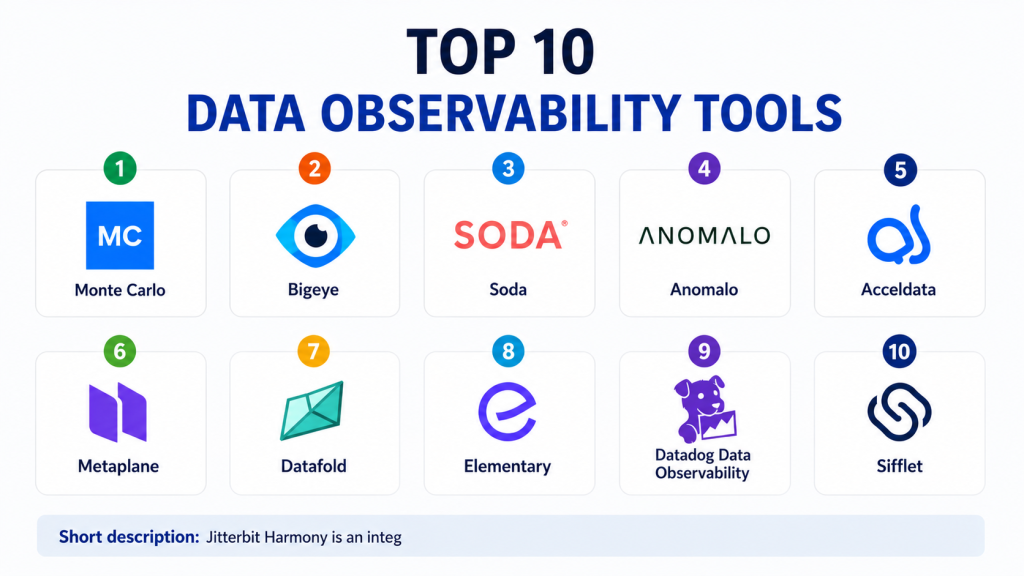
Top 10 Data Observability Tools
#1 — Monte Carlo
Short description:Monte Carlo is one of the most recognized data observability platforms for modern data teams. It helps organizations monitor data freshness, volume, schema changes, lineage, and anomalies across data pipelines and warehouses. The platform is designed for teams that want to prevent bad data from reaching dashboards, reports, and machine learning workflows. Monte Carlo is especially useful for mid-market and enterprise teams with complex data environments. It focuses on automated monitoring and incident response rather than manual rule creation only. Data engineers, analytics engineers, and data leaders can use it to improve trust in business-critical data. It is a strong fit for companies that treat data reliability like software reliability. Smaller teams may find it more advanced than they need.
Key Features
- Automated anomaly detection
- Freshness, volume, and schema monitoring
- Data lineage and root cause analysis
- Alerting and incident workflows
- Warehouse and BI tool integrations
- Data reliability dashboards
- Support for data quality monitoring
Pros
- Strong end-to-end data observability coverage
- Good fit for mature data teams
- Helps reduce manual monitoring effort
Cons
- May be expensive for smaller teams
- Requires proper setup for best results
- Advanced features may need data team maturity
Platforms / Deployment
Cloud
Security & Compliance
SSO/SAML, RBAC, encryption, and audit-related controls are commonly supported. Specific certifications should be validated directly before purchase.
Integrations & Ecosystem
Monte Carlo integrates with major data warehouses, BI platforms, transformation tools, and workflow systems.
- Snowflake
- BigQuery
- Databricks
- dbt
- Looker
- Tableau
Support & Community
Monte Carlo provides enterprise onboarding, documentation, and customer support. Community strength is higher among modern data reliability teams.
#2 — Bigeye
Short description:Bigeye is a data observability platform focused on helping teams detect data quality issues, pipeline failures, and unusual behavior across data systems. It is designed for organizations that want automated monitoring with flexibility to create custom checks. Bigeye is useful for teams managing business-critical datasets in warehouses and analytics platforms. It provides visibility into metrics like freshness, volume, distribution, and schema changes. The platform supports both technical and business-facing data reliability use cases. It is suitable for mid-market and enterprise teams that need strong monitoring depth. Bigeye can help reduce dashboard trust issues and prevent poor data from spreading. It works best when teams already have clear data ownership.
Key Features
- Automated data quality monitoring
- Anomaly detection across datasets
- Freshness and volume monitoring
- Schema change alerts
- Custom validation rules
- Incident alerting workflows
- Root cause investigation support
Pros
- Strong monitoring and anomaly detection
- Flexible checks for different data needs
- Useful for enterprise data quality programs
Cons
- Setup may require planning
- Some advanced use cases need technical users
- Pricing may vary by scale and usage
Platforms / Deployment
Cloud
Security & Compliance
SSO, RBAC, encryption, and enterprise security controls may be available. Specific certifications are not publicly stated for every plan.
Integrations & Ecosystem
Bigeye connects with common warehouse, transformation, and notification tools used by data teams.
- Snowflake
- BigQuery
- Databricks
- dbt
- Slack
- PagerDuty
Support & Community
Bigeye offers documentation, onboarding, and customer support. Community presence is more product-led than open-source driven.
#3 — Soda
Short description:Soda is a data quality and observability platform that helps teams test, monitor, and validate data across pipelines and warehouses. It is known for giving teams a practical way to define data quality checks and monitor them continuously. Soda works well for engineering teams that want both code-based and platform-based data quality workflows. It can support use cases like freshness checks, missing values, schema validation, and business rule monitoring. Soda is useful for teams that want to shift data quality checks earlier in the pipeline. It is suitable for modern data teams using cloud warehouses and transformation tools. It offers flexibility for technical users while still supporting broader observability needs. Teams that prefer open and programmable workflows may find it attractive.
Key Features
- Data quality checks and monitoring
- Freshness and schema validation
- Custom rule creation
- Code-friendly quality workflows
- Integration with pipelines and warehouses
- Alerts for failed checks
- Support for automated testing practices
Pros
- Good balance of quality and observability
- Developer-friendly approach
- Useful for proactive data testing
Cons
- Requires teams to define useful checks
- May need engineering involvement
- Full value depends on integration depth
Platforms / Deployment
Cloud / Self-hosted / Hybrid
Security & Compliance
Security features vary by offering. Enterprise controls may include SSO and RBAC. Specific certifications should be validated directly.
Integrations & Ecosystem
Soda integrates with modern data warehouses, workflow tools, and data engineering pipelines.
- Snowflake
- BigQuery
- Redshift
- Databricks
- dbt
- Airflow
Support & Community
Soda has documentation, support options, and an active technical user base. Community strength is good among data quality-focused teams.
#4 — Anomalo
Short description:Anomalo is a data quality and observability platform focused on detecting data issues automatically. It helps teams identify anomalies, missing data, duplicate data, schema changes, and unexpected data behavior. Anomalo is useful for organizations that want machine learning-assisted monitoring without manually writing every rule. It is often used by data teams that manage large datasets and need early warnings before issues affect business users. The platform is especially valuable for analytics, operations, and AI use cases where data trust is critical. It supports both technical and governance-oriented workflows. Anomalo is a good fit for teams that want automated detection with explainability. Smaller teams may need to evaluate whether the platform depth matches their needs.
Key Features
- Automated anomaly detection
- Data quality monitoring
- Missing and duplicate data detection
- Schema and distribution monitoring
- Root cause analysis support
- Business-critical dataset monitoring
- Alerting and workflow integrations
Pros
- Strong automated issue detection
- Good for large and complex datasets
- Helps reduce manual rule-writing effort
Cons
- May require tuning for best results
- Pricing details may not be simple
- Not ideal for very small data environments
Platforms / Deployment
Cloud / Hybrid
Security & Compliance
Enterprise security features may include SSO, RBAC, and encryption. Specific compliance certifications are not publicly stated for all cases.
Integrations & Ecosystem
Anomalo integrates with major warehouses, lakes, and communication tools used by data teams.
- Snowflake
- BigQuery
- Databricks
- Redshift
- Slack
- Workflow systems
Support & Community
Anomalo provides customer support, documentation, and onboarding. Community visibility is strongest among enterprise data quality teams.
#5 — Acceldata
Short description:Acceldata is an enterprise data observability platform designed to monitor data pipelines, infrastructure, cost, performance, and reliability. It is useful for large organizations with complex data platforms, including cloud, hybrid, and big data environments. Acceldata goes beyond basic dataset monitoring by adding operational visibility into data systems and platform performance. It helps teams detect issues in data quality, pipeline execution, resource usage, and system behavior. The platform is suitable for enterprises running large-scale data operations. Data platform teams, data engineering teams, and operations teams can use it to improve reliability. It is especially useful where performance and cost monitoring matter alongside data quality. Smaller teams may find it too broad.
Key Features
- Data quality and pipeline monitoring
- Infrastructure and platform observability
- Performance and cost visibility
- Anomaly detection
- Operational dashboards
- Support for enterprise data environments
- Root cause analysis capabilities
Pros
- Strong enterprise-scale observability
- Covers data, pipelines, and platform performance
- Good for complex hybrid environments
Cons
- May be more than small teams need
- Implementation can require planning
- Best suited for mature data operations
Platforms / Deployment
Cloud / Hybrid
Security & Compliance
Enterprise security controls are commonly available. Specific certifications and compliance details should be confirmed directly.
Integrations & Ecosystem
Acceldata supports large-scale data platforms, cloud services, and enterprise systems.
- Databricks
- Snowflake
- Hadoop ecosystem
- Kafka
- Cloud data platforms
- BI and pipeline systems
Support & Community
Acceldata provides enterprise support, onboarding, and documentation. Community strength is enterprise and platform-team focused.
#6 — Metaplane
Short description:Metaplane is a data observability platform designed for analytics and data engineering teams that want fast setup and automated monitoring. It helps detect freshness problems, volume anomalies, schema changes, and unexpected data behavior in warehouses and pipelines. Metaplane is often suitable for small to mid-sized modern data teams because it emphasizes usability and quick time to value. It helps teams catch broken data before stakeholders lose trust in dashboards. The platform is useful for teams using cloud warehouses and BI tools. It provides alerts and context so data teams can respond quickly. Metaplane is a practical option for teams starting their data observability journey. Larger enterprises may need to compare its governance depth with broader platforms.
Key Features
- Freshness and volume monitoring
- Schema change detection
- Automated anomaly detection
- Alerting for data issues
- Warehouse and BI integrations
- Simple setup experience
- Incident context for data teams
Pros
- Easy to adopt for modern data teams
- Good fit for cloud warehouse monitoring
- Helpful for analytics reliability
Cons
- May not cover every enterprise governance need
- Advanced customization may vary
- Best fit depends on supported integrations
Platforms / Deployment
Cloud
Security & Compliance
Security features may include access controls and encryption. Specific compliance details are not publicly stated for every case.
Integrations & Ecosystem
Metaplane integrates with common modern data stack tools.
- Snowflake
- BigQuery
- Redshift
- dbt
- Looker
- Slack
Support & Community
Metaplane provides documentation and customer support. Community strength is growing among analytics engineering teams.
#7 — Datafold
Short description:Datafold focuses on data quality, regression testing, lineage, and impact analysis for analytics engineering workflows. It is especially useful for teams that use dbt and want to prevent data changes from breaking downstream reports. Datafold helps compare datasets, detect differences, and understand the impact of changes before they reach production. It supports a proactive approach to data reliability by catching issues during development. This makes it valuable for teams practicing analytics engineering, CI/CD for data, and controlled data changes. Datafold is not only about monitoring live data; it also helps prevent bad changes before deployment. It is a strong choice for teams that care about data testing and change management. It may not replace a broader observability platform in every enterprise.
Key Features
- Data diff and regression testing
- Lineage and impact analysis
- dbt workflow support
- CI/CD-friendly data validation
- Schema and data change detection
- Pull request-based quality checks
- Support for analytics engineering teams
Pros
- Strong for preventing data issues before release
- Excellent fit for dbt-heavy teams
- Helps improve analytics engineering discipline
Cons
- Less focused on broad enterprise monitoring
- Best value depends on development workflow maturity
- May need another tool for full observability coverage
Platforms / Deployment
Cloud
Security & Compliance
Enterprise controls may be available. Specific certifications should be validated directly before purchase.
Integrations & Ecosystem
Datafold works well with modern analytics engineering and warehouse workflows.
- dbt
- Snowflake
- BigQuery
- Redshift
- Git workflows
- CI/CD tools
Support & Community
Datafold provides documentation, support, and resources for analytics engineering teams. Community strength is strongest around dbt and data testing use cases.
#8 — Elementary
Short description:Elementary is an open-source data observability tool built for dbt projects. It helps teams monitor dbt runs, tests, freshness, anomalies, and model performance. Elementary is especially useful for analytics engineering teams that want visibility into dbt-based transformation workflows. It provides reports and alerts that help teams understand failures and quality issues. The tool is attractive for teams that prefer open-source-first workflows and want observability close to their transformation layer. It is lightweight compared with large enterprise platforms. Elementary works best when dbt is a central part of the data stack. It may not be enough for organizations that need broad enterprise governance across many systems.
Key Features
- dbt-focused observability
- Test and run monitoring
- Freshness and anomaly checks
- Data quality reporting
- Alerts for failed jobs and tests
- Open-source workflow support
- Useful for analytics engineering teams
Pros
- Strong fit for dbt users
- Open-source friendly
- Easy starting point for data observability
Cons
- Limited outside dbt-heavy workflows
- Enterprise support may vary
- Not a full data governance platform
Platforms / Deployment
Self-hosted / Cloud options may vary
Security & Compliance
Security depends on deployment and configuration. Specific certifications are not publicly stated.
Integrations & Ecosystem
Elementary is closely connected to dbt and modern warehouse workflows.
- dbt
- Snowflake
- BigQuery
- Redshift
- Slack
- Git workflows
Support & Community
Elementary has open-source community support and documentation. Commercial support options may vary.
#9 — Datadog Data Observability
Short description:Datadog is widely known for infrastructure, application, and cloud observability, and it also offers data observability capabilities for monitoring data pipelines and reliability signals. It is useful for organizations that already use Datadog for engineering operations and want to bring data reliability into the same observability workflow. Datadog can help teams connect data issues with broader system behavior, infrastructure events, and application performance. This is valuable for platform teams and engineering-led organizations. It may be less focused on traditional data governance than dedicated data catalog platforms. However, it is strong for operational monitoring and alerting. Teams that want one observability layer across apps, systems, and data may find it useful.
Key Features
- Data pipeline monitoring
- Operational alerting
- Infrastructure and application observability
- Dashboarding and incident workflows
- Log and metric correlation
- Cloud platform monitoring
- Data reliability visibility
Pros
- Strong operational observability ecosystem
- Good for engineering-led teams
- Helpful when data issues connect to infrastructure issues
Cons
- May not replace dedicated data governance tools
- Data observability depth depends on use case
- Cost can grow with usage
Platforms / Deployment
Cloud / Agent-based monitoring / Hybrid
Security & Compliance
Datadog commonly supports enterprise security controls such as SSO, RBAC, audit logs, and encryption. Specific certifications should be confirmed based on plan and region.
Integrations & Ecosystem
Datadog has a broad integration ecosystem across infrastructure, cloud, application, and data systems.
- AWS
- Azure
- Google Cloud
- Kubernetes
- Databases
- Pipeline tools
Support & Community
Datadog offers documentation, enterprise support, training resources, and a large technical community.
#10 — Sifflet
Short description:Sifflet is a data observability platform focused on monitoring data quality, lineage, pipeline health, and business trust. It helps teams detect anomalies, investigate root causes, and understand how data issues affect downstream assets. Sifflet is suitable for data teams that want both technical visibility and business impact context. It supports modern data environments and helps reduce the time spent manually debugging pipeline problems. The platform is useful for analytics, governance, and data engineering teams. It can help organizations build more reliable data products. Sifflet is a strong choice for teams that want observability combined with lineage and collaboration. Smaller teams should evaluate whether its platform depth matches their needs.
Key Features
- Data quality monitoring
- Anomaly detection
- Lineage and impact analysis
- Pipeline health visibility
- Root cause investigation
- Alerting and collaboration workflows
- Modern data stack integrations
Pros
- Strong combination of lineage and observability
- Useful for business impact analysis
- Good fit for modern data teams
Cons
- May require setup effort
- Pricing details may vary
- Best value depends on data stack complexity
Platforms / Deployment
Cloud
Security & Compliance
Enterprise security features may include SSO, RBAC, and encryption. Specific certifications are not publicly stated for every case.
Integrations & Ecosystem
Sifflet integrates with common warehouses, BI platforms, transformation tools, and workflow systems.
- Snowflake
- BigQuery
- Databricks
- dbt
- Tableau
- Slack
Support & Community
Sifflet provides documentation, onboarding, and customer support. Community presence is growing among data reliability teams.
Comparison Table
| Tool Name | Best For | Platform(s) Supported | Deployment | Standout Feature | Public Rating |
|---|---|---|---|---|---|
| Monte Carlo | Enterprise data reliability | Web | Cloud | End-to-end observability | N/A |
| Bigeye | Automated data quality monitoring | Web | Cloud | Flexible anomaly detection | N/A |
| Soda | Data quality checks and testing | Web / API | Cloud / Self-hosted / Hybrid | Code-friendly data quality | N/A |
| Anomalo | ML-assisted issue detection | Web | Cloud / Hybrid | Automated anomaly detection | N/A |
| Acceldata | Enterprise data operations | Web | Cloud / Hybrid | Data, pipeline, and platform observability | N/A |
| Metaplane | Modern analytics teams | Web | Cloud | Fast warehouse monitoring | N/A |
| Datafold | Analytics engineering workflows | Web | Cloud | Data diff and regression testing | N/A |
| Elementary | dbt-focused teams | Web / CLI | Self-hosted / Varies | Open-source dbt observability | N/A |
| Datadog Data Observability | Engineering-led operations | Web / Agent | Cloud / Hybrid | Unified operational observability | N/A |
| Sifflet | Lineage-aware observability | Web | Cloud | Business impact visibility | N/A |
Evaluation & Scoring of Data Observability Tools
| Tool Name | Core (25%) | Ease (15%) | Integrations (15%) | Security (10%) | Performance (10%) | Support (10%) | Value (15%) | Weighted Total |
|---|---|---|---|---|---|---|---|---|
| Monte Carlo | 9 | 8 | 9 | 8 | 9 | 9 | 7 | 8.45 |
| Bigeye | 8 | 8 | 8 | 8 | 8 | 8 | 7 | 7.85 |
| Soda | 8 | 7 | 8 | 7 | 8 | 7 | 8 | 7.65 |
| Anomalo | 8 | 8 | 8 | 8 | 8 | 8 | 7 | 7.85 |
| Acceldata | 9 | 7 | 8 | 8 | 9 | 8 | 7 | 8.05 |
| Metaplane | 8 | 9 | 8 | 7 | 8 | 8 | 8 | 8.05 |
| Datafold | 8 | 8 | 8 | 7 | 8 | 8 | 8 | 7.90 |
| Elementary | 7 | 8 | 7 | 6 | 7 | 7 | 9 | 7.30 |
| Datadog Data Observability | 8 | 7 | 9 | 9 | 9 | 9 | 7 | 8.20 |
| Sifflet | 8 | 8 | 8 | 8 | 8 | 8 | 7 | 7.85 |
These scores are comparative and should be used as a shortlist guide, not as a final buying decision. Enterprise platforms often score higher in support, security, and scale. Open-source and developer-friendly tools may score higher in value and flexibility. The best tool depends on your stack, team size, budget, and data reliability goals.
Which Data Observability Tool Is Right for You?
Solo / Freelancer
Solo users usually do not need a heavy enterprise data observability platform. If you work mostly with small datasets, spreadsheets, or simple dashboards, basic warehouse alerts and manual checks may be enough. If you use dbt, Elementary can be a practical starting point.
SMB
Small and growing businesses should focus on fast setup, simple alerts, and strong warehouse integrations. Metaplane, Soda, and Datafold can be practical choices. These tools help teams catch problems early without building a large governance program.
Mid-Market
Mid-market teams usually need stronger monitoring, alerting, and impact analysis. Monte Carlo, Bigeye, Anomalo, Sifflet, and Metaplane are worth evaluating. The best choice depends on whether your main pain is broken dashboards, data quality rules, pipeline failures, or schema changes.
Enterprise
Enterprises should prioritize scale, security, support, integration depth, and governance alignment. Monte Carlo, Acceldata, Datadog, Bigeye, and Anomalo are strong candidates. If platform operations and infrastructure visibility matter, Acceldata or Datadog may be especially useful.
Budget vs Premium
Budget-conscious teams can start with Elementary or Soda depending on their stack. Premium platforms are better when data incidents affect revenue, compliance, executive reporting, or customer-facing analytics. The cost should be compared with the business cost of bad data.
Feature Depth vs Ease of Use
Metaplane and Soda are easier starting points for many teams. Monte Carlo, Acceldata, and Datadog provide broader capabilities for larger environments. Datafold is best when preventing data changes before production is more important than only monitoring after deployment.
Integrations & Scalability
Always validate integrations with your actual stack. Key systems may include Snowflake, BigQuery, Redshift, Databricks, dbt, Airflow, Tableau, Looker, Power BI, Slack, PagerDuty, and CI/CD tools. A tool with fewer but deeper integrations may be better than one with many shallow integrations.
Security & Compliance Needs
Security-focused teams should evaluate SSO, RBAC, audit logs, encryption, data access model, deployment architecture, and compliance documentation. For regulated industries, do not rely only on marketing claims. Validate security controls during vendor evaluation.
Frequently Asked Questions
1. What is a data observability tool?
A data observability tool monitors the health and reliability of data across pipelines, warehouses, dashboards, and applications. It helps detect issues like missing data, late data, schema changes, and unexpected volume changes.
2. How is data observability different from data quality?
Data quality focuses on whether data is accurate, complete, valid, and usable. Data observability is broader because it monitors data behavior, pipeline health, freshness, anomalies, lineage, and incidents across the full data environment.
3. How much do data observability tools cost?
Pricing varies widely by vendor, data volume, number of tables, monitored assets, users, and support level. Many enterprise tools use custom pricing, so buyers should request pricing based on their real environment.
4. How long does implementation take?
Simple setups can start quickly when using a supported cloud warehouse and standard integrations. Larger enterprise implementations may take longer because of access controls, security reviews, source mapping, alert design, and ownership setup.
5. What are common mistakes when choosing a data observability tool?
Common mistakes include monitoring too many low-value tables, ignoring alert fatigue, skipping ownership mapping, not testing integrations, and buying a tool without defining what a data incident means for the business.
6. Can data observability tools prevent bad data?
They can help reduce bad data incidents by detecting issues early and alerting the right teams. However, they do not replace good pipeline design, proper testing, ownership, documentation, and strong data engineering practices.
7. Do these tools support AI and machine learning data?
Many tools can monitor datasets used for AI and machine learning workflows. Teams should check whether the tool can monitor training data, feature tables, model input data, freshness, drift signals, and downstream usage.
8. Are open-source data observability tools enough?
Open-source tools can be enough for technical teams with strong engineering skills and limited budgets. However, commercial platforms usually provide stronger support, easier onboarding, broader integrations, and enterprise security controls.
9. What integrations matter most?
The most important integrations are usually cloud warehouses, transformation tools, orchestration tools, BI tools, alerting tools, and incident management systems. Common examples include Snowflake, BigQuery, Databricks, dbt, Airflow, Tableau, Looker, Slack, and PagerDuty.
10. When should a company switch data observability tools?
A company should consider switching when the current tool creates too many false alerts, lacks key integrations, cannot scale, misses important incidents, has weak root cause analysis, or does not support the team’s security and governance needs.
Conclusion
Data observability tools are now essential for organizations that depend on trusted analytics, reliable data pipelines, AI readiness, and accurate business reporting. The right tool depends on the size of your team, the complexity of your data stack, your security needs, and how much business risk comes from bad data. Monte Carlo, Bigeye, Anomalo, Acceldata, and Sifflet are strong choices for mature data reliability programs. Metaplane, Soda, Datafold, and Elementary are useful for modern analytics and engineering teams that want practical adoption paths. Datadog is valuable for organizations that want data reliability connected with broader operational observability.
