Upgrade & Secure Your Future with DevOps, SRE, DevSecOps, MLOps!
We spend hours scrolling social media and waste money on things we forget, but won’t spend 30 minutes a day earning certifications that can change our lives.
Master in DevOps, SRE, DevSecOps & MLOps by DevOps School!
Learn from Guru Rajesh Kumar and double your salary in just one year.
Introduction
Data Catalog & Metadata Management Tools are software solutions that help organizations organize, manage, and govern their data assets effectively. In plain English, they act like an intelligent library for your enterprise data, ensuring every dataset is easily discoverable, understandable, and usable by authorized teams. These platforms capture metadata — information about your data — and often include features like data lineage, governance policies, search, and collaboration, allowing data teams to work smarter and faster.
In 2026 and beyond, organizations are producing exponential volumes of data across cloud and hybrid environments. Proper metadata management is critical for compliance, security, and enabling data-driven decision-making. Enterprises leveraging these tools can accelerate analytics, streamline machine learning initiatives, and maintain regulatory compliance.
Real-world use cases:
- Cataloging datasets across multiple cloud providers for easy access.
- Tracking data lineage for compliance with regulations such as GDPR or HIPAA.
- Empowering data scientists with curated, trusted data for analytics and ML projects.
- Enforcing data governance policies automatically.
- Enabling self-service data discovery for business analysts.
Buyer evaluation criteria:
- Ease of data discovery and search capabilities.
- Metadata capture and data lineage features.
- Governance, security, and compliance support.
- Integration with existing BI, ETL, and data platforms.
- Collaboration and user management features.
- AI-powered recommendations and automation.
- Deployment flexibility (cloud, on-premise, hybrid).
- Performance and scalability.
Best for: Data engineers, data scientists, analytics teams, and enterprise IT departments managing large, complex data ecosystems. Medium to large enterprises in finance, healthcare, retail, or SaaS sectors benefit most.
Not ideal for: Small organizations with minimal datasets or teams, or those whose data management needs are met by simpler spreadsheet or cloud-native solutions.
Key Trends in Data Catalog & Metadata Management Tools
- AI-driven metadata enrichment: Automatic tagging, classification, and recommendations for datasets.
- Data lineage visualization: Graphical views showing how data flows across pipelines, essential for audits and debugging.
- Hybrid and multi-cloud support: Tools increasingly support cross-cloud environments and on-premises sources.
- Integrated governance and compliance: Automated policy enforcement to meet GDPR, HIPAA, and SOC 2 requirements.
- Collaboration features: Commenting, sharing, and workflow approvals embedded within the catalog.
- Self-service discovery: Business users and analysts can find and access relevant datasets without IT intervention.
- Data quality integration: Native or third-party connectors to monitor, profile, and validate datasets.
- Pricing and deployment flexibility: Subscription-based SaaS or on-premise licenses to accommodate various enterprise models.
- API-first architecture: Enables easy integration with modern ETL pipelines, BI tools, and ML platforms.
- Focus on trust and compliance metrics: Data trust scores and metadata analytics to drive enterprise adoption.
How We Selected These Tools (Methodology)
- Evaluated market adoption and mindshare across enterprise clients and industries.
- Assessed feature completeness, including cataloging, lineage, governance, and AI features.
- Analyzed reliability and performance signals, such as latency in search and metadata updates.
- Verified security posture, including encryption, SSO/MFA support, and compliance capabilities.
- Reviewed integration and ecosystem maturity, including connectors to BI, ETL, and cloud platforms.
- Considered customer fit across segments, from SMBs to large enterprises.
- Checked user interface and usability, ensuring non-technical users can leverage the catalog effectively.
- Evaluated community and vendor support, including documentation, forums, and onboarding.
- Scored scalability and flexibility, especially for multi-cloud and hybrid deployments.
- Weighted AI automation and intelligence as a differentiator for modern data teams.
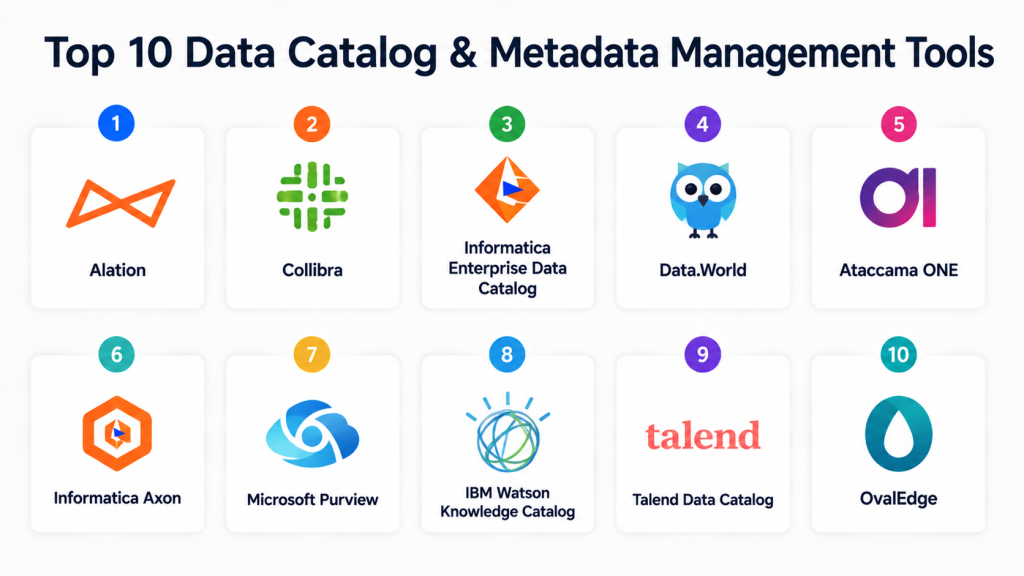
Top 10 Data Catalog & Metadata Management Tools
#1 — Alation
Short description: Alation provides a powerful enterprise data catalog with robust governance and collaboration features. It helps data teams discover, understand, and trust their data assets while improving analytics efficiency.
Key Features
- AI-powered data discovery and recommendations.
- Data lineage visualization across pipelines.
- Built-in governance and stewardship workflows.
- Search-driven data analytics interface.
- Integration with BI and ETL tools.
- Collaboration features for data teams.
- Automated metadata capture.
Pros
- Strong governance and compliance capabilities.
- Highly intuitive user interface.
Cons
- Can be expensive for smaller teams.
- Learning curve for advanced features.
Platforms / Deployment
- Web / Windows / macOS / Linux
- Cloud / Hybrid
Security & Compliance
- SSO/SAML, MFA, RBAC
- Not publicly stated for SOC 2/ISO 27001
Integrations & Ecosystem
Alation integrates broadly with modern BI and ETL tools:
- Tableau, Power BI, Looker
- Snowflake, Redshift, BigQuery
- APIs for custom integrations
- Supports popular ML platforms
Support & Community
- Strong documentation and tutorials.
- Active customer community and webinars.
#2 — Collibra
Short description: Collibra is an enterprise-grade data governance and catalog platform focused on compliance, stewardship, and enabling self-service analytics.
Key Features
- Comprehensive data governance framework.
- Data quality and lineage tracking.
- Role-based access control and stewardship workflows.
- Integration with enterprise data sources.
- Collaboration tools for business and IT users.
- AI recommendations for cataloging.
- Custom metadata model support.
Pros
- Excellent for regulated industries.
- Strong support for complex data governance.
Cons
- Costly for small-scale deployment.
- Requires dedicated administration.
Platforms / Deployment
- Web / Windows / macOS / Linux
- Cloud / On-premises / Hybrid
Security & Compliance
- SSO/SAML, RBAC, MFA
- Not publicly stated for ISO/GDPR specifics
Integrations & Ecosystem
- Supports Snowflake, Oracle, SAP, AWS
- REST APIs and SDKs for extensions
- Connectors for ETL and BI tools
Support & Community
- Extensive documentation and training.
- Enterprise support tiers available.
#3 — Informatica Enterprise Data Catalog
Short description: Informatica’s cataloging solution emphasizes metadata management, lineage, and AI-powered discovery for enterprise-scale environments.
Key Features
- Automated metadata scanning across databases and applications.
- AI-driven recommendations and lineage analysis.
- Prebuilt connectors for cloud and on-premise systems.
- Data stewardship and policy enforcement.
- Collaboration dashboards and reporting.
- Data quality integration.
- Custom metadata tagging.
Pros
- Highly scalable for large data environments.
- Mature ecosystem with robust connectors.
Cons
- Complex setup and administration.
- May be overwhelming for smaller teams.
Platforms / Deployment
- Web / Windows / Linux
- Cloud / On-premises / Hybrid
Security & Compliance
- SSO/SAML, RBAC, audit logging
- Not publicly stated for SOC 2/GDPR
Integrations & Ecosystem
- Connectors for AWS, Azure, GCP, Snowflake
- BI tools: Tableau, Power BI, Looker
- ETL platforms: Informatica PowerCenter, Talend
Support & Community
- Vendor documentation and training programs.
- Active enterprise user forums.
#4 — Data.World
Short description: Data.World provides a cloud-native collaborative data catalog and metadata management platform aimed at analysts and data teams seeking accessible governance.
Key Features
- Cloud-based collaborative catalog.
- Data lineage and audit tracking.
- Query-based search for datasets.
- Integration with analytics and ML tools.
- Collaboration and sharing features.
- AI-assisted metadata tagging.
- API-first design for extensibility.
Pros
- Easy onboarding and intuitive interface.
- Strong collaborative features.
Cons
- Limited advanced governance for large enterprises.
- Some integrations require custom configuration.
Platforms / Deployment
- Web / Windows / macOS / Linux
- Cloud
Security & Compliance
- SSO/SAML, RBAC
- Not publicly stated
Integrations & Ecosystem
- Connectors for Tableau, Power BI, Python, R
- APIs for ETL and ML pipelines
Support & Community
- Active online support and tutorials
- Growing community of data professionals
#5 — Ataccama ONE
Short description: Ataccama ONE is a unified platform for data governance, quality, and cataloging, enabling enterprises to manage metadata and enforce policies across multiple sources.
Key Features
- Centralized data catalog with lineage.
- Data quality monitoring.
- AI-assisted metadata management.
- Policy and workflow automation.
- Integration with BI and ETL systems.
- Collaboration tools for data stewardship.
- Self-service discovery.
Pros
- Strong AI and automation features.
- Comprehensive governance capabilities.
Cons
- Interface can be complex.
- Higher learning curve for small teams.
Platforms / Deployment
- Web / Windows / Linux
- Cloud / On-premises / Hybrid
Security & Compliance
- SSO/SAML, RBAC
- Not publicly stated for SOC 2/ISO
Integrations & Ecosystem
- Supports Snowflake, Oracle, SAP, AWS
- Connectors for Tableau, Power BI
Support & Community
- Vendor support and documentation
- Online community for guidance
#6 — Informatica Axon
Short description: Axon complements Informatica’s data management suite by providing enterprise governance, stewardship, and collaborative cataloging.
Key Features
- Centralized data governance dashboard.
- Data lineage and quality monitoring.
- Collaboration for business users.
- Policy enforcement and compliance tracking.
- AI-assisted metadata management.
- Workflow automation.
- Integration with ETL and BI tools.
Pros
- Integrated with Informatica ecosystem.
- Strong governance capabilities.
Cons
- Best suited for existing Informatica customers.
- Less flexible for small-scale deployments.
Platforms / Deployment
- Web / Cloud
- Cloud / On-premises / Hybrid
Security & Compliance
- SSO/SAML, RBAC
- Not publicly stated
Integrations & Ecosystem
- Works with PowerCenter, Talend, Tableau, Snowflake
Support & Community
- Enterprise support tiers
- Online documentation
#7 — Microsoft Purview
Short description: Microsoft Purview is a data governance and catalog solution integrated within the Microsoft ecosystem, enabling metadata management across cloud and on-premises sources.
Key Features
- Unified data catalog for Azure and hybrid environments.
- Data lineage and classification.
- Compliance and risk management tools.
- AI-based metadata enrichment.
- Integration with Power BI, Synapse, and SQL servers.
- Role-based access and governance policies.
- Collaboration workflows.
Pros
- Seamless integration with Microsoft ecosystem.
- Scales well for enterprise needs.
Cons
- Limited outside Microsoft environments.
- Requires Azure familiarity.
Platforms / Deployment
- Web / Windows / Cloud
- Cloud / Hybrid
Security & Compliance
- SSO/SAML, MFA, RBAC
- Not publicly stated for SOC 2
Integrations & Ecosystem
- Power BI, Azure Synapse, SQL Server
- APIs for custom integrations
Support & Community
- Microsoft documentation
- Active community forums
#8 — IBM Watson Knowledge Catalog
Short description: IBM Watson Knowledge Catalog offers enterprise-level metadata management and governance, powered by AI for discovery and lineage tracking.
Key Features
- AI-driven data discovery and tagging.
- End-to-end data lineage.
- Governance and compliance automation.
- Integration with IBM Cloud Pak for Data.
- Collaboration and self-service analytics.
- Policy enforcement workflows.
- Cloud and on-premises support.
Pros
- Strong AI and compliance features.
- Enterprise-grade scalability.
Cons
- Complex implementation.
- Costly for smaller organizations.
Platforms / Deployment
- Web / Linux / Windows
- Cloud / On-premises / Hybrid
Security & Compliance
- SSO/SAML, RBAC
- Not publicly stated
Integrations & Ecosystem
- IBM Cloud Pak, Tableau, Power BI, Python APIs
Support & Community
- Vendor support and extensive docs
- IBM community for guidance
#9 — Talend Data Catalog
Short description: Talend Data Catalog helps organizations manage metadata, data lineage, and governance with cloud-native deployment for rapid adoption.
Key Features
- Metadata management and tagging.
- Lineage visualization and audit trails.
- Governance workflow automation.
- Integration with Talend ETL tools.
- AI-assisted recommendations.
- Collaboration features.
- Self-service search.
Pros
- Integrates well with Talend ecosystem.
- Supports cloud-native deployments.
Cons
- Best suited for existing Talend users.
- Limited advanced AI features compared to peers.
Platforms / Deployment
- Web / Cloud / Windows
- Cloud / Hybrid
Security & Compliance
- SSO/SAML, RBAC
- Not publicly stated
Integrations & Ecosystem
- Talend ETL, Snowflake, Tableau, Power BI
Support & Community
- Talend documentation and community forums
#10 — OvalEdge
Short description: OvalEdge is a flexible data catalog and governance tool focused on self-service analytics and collaboration for data-driven organizations.
Key Features
- Cloud-based data catalog.
- Data lineage and stewardship dashboards.
- AI-assisted metadata management.
- Collaboration tools for analysts and data teams.
- Integration with BI and data platforms.
- Workflow automation.
- Governance and policy enforcement.
Pros
- Affordable for SMBs and mid-market.
- Easy to onboard non-technical users.
Cons
- Limited enterprise-scale advanced features.
- Smaller ecosystem than top competitors.
Platforms / Deployment
- Web / Cloud / Windows
- Cloud / Hybrid
Security & Compliance
- SSO/SAML, RBAC
- Not publicly stated
Integrations & Ecosystem
- Tableau, Power BI, Snowflake, Redshift, APIs
Support & Community
- Documentation available
- Customer support and onboarding
Comparison Table (Top 10)
| Tool Name | Best For | Platform(s) Supported | Deployment | Standout Feature | Public Rating |
|---|---|---|---|---|---|
| Alation | Enterprise governance | Web / Windows / macOS / Linux | Cloud / Hybrid | AI-powered discovery | N/A |
| Collibra | Compliance-focused orgs | Web / Windows / macOS / Linux | Cloud / On-prem / Hybrid | Governance workflows | N/A |
| Informatica Enterprise Data Catalog | Large-scale enterprises | Web / Windows / Linux | Cloud / On-prem / Hybrid | Automated metadata scanning | N/A |
| Data.World | Analysts and small teams | Web / Windows / macOS / Linux | Cloud | Cloud-native collaboration | N/A |
| Ataccama ONE | Data governance & quality | Web / Windows / Linux | Cloud / On-prem / Hybrid | AI-assisted metadata | N/A |
| Informatica Axon | Governance within Informatica | Web / Cloud | Cloud / On-prem / Hybrid | Collaborative governance | N/A |
| Microsoft Purview | Azure ecosystem | Web / Windows | Cloud / Hybrid | Azure-integrated catalog | N/A |
| IBM Watson Knowledge Catalog | Enterprise AI catalog | Web / Linux / Windows | Cloud / On-prem / Hybrid | AI discovery | N/A |
| Talend Data Catalog | Talend ecosystem | Web / Cloud / Windows | Cloud / Hybrid | Lineage visualization | N/A |
| OvalEdge | SMB/mid-market | Web / Cloud / Windows | Cloud / Hybrid | Affordable, self-service | N/A |
Evaluation & Scoring of Tools
| Tool Name | Core (25%) | Ease (15%) | Integrations (15%) | Security (10%) | Performance (10%) | Support (10%) | Value (15%) | Weighted Total |
|---|---|---|---|---|---|---|---|---|
| Alation | 9 | 8 | 8 | 8 | 9 | 8 | 7 | 8.45 |
| Collibra | 9 | 7 | 8 | 9 | 8 | 8 | 6 | 8.15 |
| Informatica EDC | 9 | 6 | 9 | 8 | 9 | 7 | 6 | 8.05 |
| Data.World | 7 | 9 | 7 | 7 | 7 | 8 | 8 | 7.65 |
| Ataccama ONE | 8 | 7 | 8 | 8 | 8 | 7 | 7 | 7.85 |
| Informatica Axon | 8 | 7 | 7 | 8 | 8 | 7 | 6 | 7.55 |
| Microsoft Purview | 8 | 7 | 8 | 8 | 8 | 7 | 7 | 7.75 |
| IBM Watson KC | 8 | 6 | 7 | 8 | 8 | 7 | 6 | 7.25 |
| Talend Data Catalog | 7 | 8 | 7 | 7 | 7 | 7 | 8 | 7.35 |
| OvalEdge | 6 | 9 | 6 | 7 | 7 | 7 | 8 | 7.15 |
Interpretation: Scores are comparative across the top 10 tools. Weighted totals reflect overall suitability considering feature depth, usability, integration, security, performance, support, and value.
Which Data Catalog Tool Is Right for You?
Solo / Freelancer
- Recommendation: Data.World or OvalEdge.
- Light-weight, easy onboarding, cost-effective, quick to deploy.
SMB
- Recommendation: Talend Data Catalog or OvalEdge.
- Balanced governance and affordability, good integration with existing BI tools.
Mid-Market
- Recommendation: Ataccama ONE or Microsoft Purview.
- Strong AI features, multi-cloud support, moderate scale.
Enterprise
- Recommendation: Alation, Collibra, Informatica EDC, IBM Watson KC.
- Comprehensive governance, lineage, compliance, and scalability.
Budget vs Premium
- Budget: Data.World, OvalEdge — ideal for smaller teams.
- Premium: Alation, Collibra — best for enterprise-scale governance.
Feature Depth vs Ease of Use
- Ease of Use: Data.World, OvalEdge, Microsoft Purview
- Depth: Alation, Collibra, Informatica EDC
Integrations & Scalability
- Tools with broader connectors: Informatica EDC, Alation, Collibra.
- Cloud-native and API-first tools scale better for future expansions.
Security & Compliance Needs
- Enterprises with regulatory obligations: Collibra, Alation, Informatica Axon, IBM Watson KC.
- SMBs may leverage built-in SSO/RBAC features from Data.World or OvalEdge.
Frequently Asked Questions (FAQs)
1. What is a Data Catalog & Metadata Management Tool?
A data catalog centralizes metadata, enabling teams to discover, understand, and trust datasets. It captures lineage, enforces governance, and improves analytics efficiency across the organization.
2. How does it help in compliance?
By tracking data lineage, enforcing access policies, and documenting metadata, these tools help organizations meet GDPR, HIPAA, and SOC 2 requirements.
3. Can small businesses benefit from these tools?
Yes, cloud-native and affordable platforms like Data.World and OvalEdge allow SMBs to implement governance and data discovery without heavy infrastructure.
4. How is AI used in metadata management?
AI automatically tags datasets, recommends data relationships, identifies anomalies, and enriches metadata for better discovery and usability.
5. What integration capabilities should I check?
Look for connectors to cloud storage, ETL pipelines, BI platforms, ML frameworks, and APIs for extensibility.
6. How complex is implementation?
Enterprise-grade tools like Alation, Collibra, or IBM Watson KC require dedicated administration and planning, while smaller platforms are often plug-and-play.
7. Are these tools only for data teams?
No, business analysts and decision-makers benefit too through self-service discovery and analytics capabilities.
8. Can these tools scale with growing data?
Yes, most enterprise solutions support multi-cloud, hybrid deployments, and large dataset indexing to handle growth.
9. How do pricing models differ?
Some platforms offer subscription-based SaaS, others have on-prem licenses. SMB-friendly tools are typically cloud-only with pay-per-user pricing.
10. How do I choose the right tool?
Evaluate based on team size, data complexity, compliance needs, integrations, ease of use, and budget. Pilot a few tools to determine fit before enterprise adoption.
Conclusion
Data Catalog & Metadata Management Tools are essential for modern enterprises navigating complex, multi-cloud data landscapes. The “best” tool depends on organizational size, compliance requirements, team skill, and deployment needs. Smaller teams may favor lightweight, intuitive tools like Data.World or OvalEdge, while enterprises often require robust platforms like Alation, Collibra, or Informatica EDC for governance, AI-powered recommendations, and lineage tracking.
