Upgrade & Secure Your Future with DevOps, SRE, DevSecOps, MLOps!
We spend hours scrolling social media and waste money on things we forget, but won’t spend 30 minutes a day earning certifications that can change our lives.
Master in DevOps, SRE, DevSecOps & MLOps by DevOps School!
Learn from Guru Rajesh Kumar and double your salary in just one year.
Introduction
Data lineage tools help teams understand where data comes from, how it moves, how it changes, and where it is used across systems. In simple words, data lineage is like a map of your data journey. It shows the full path from source systems to dashboards, reports, data warehouses, AI models, and business applications.
This matters strongly now because companies are using more cloud platforms, AI systems, data lakes, data warehouses, and real-time pipelines. Without lineage, teams struggle to trust reports, fix broken pipelines, meet compliance needs, and understand the impact of data changes.
Common use cases include:
- Tracking data movement across warehouses and pipelines
- Understanding report and dashboard dependencies
- Supporting governance, privacy, and audit needs
- Finding root causes of data quality issues
- Managing AI and analytics data trust
Buyers should evaluate:
- Automated lineage discovery
- Column-level lineage
- Integration coverage
- Data catalog support
- Governance features
- Security controls
- Ease of use
- Scalability
- API support
- Pricing transparency
Best for: Data engineers, analytics engineers, data governance teams, BI teams, compliance teams, platform teams, and enterprises managing complex data environments.
Not ideal for: Very small teams with simple spreadsheets or single-database reporting, where a lightweight documentation process may be enough.
Key Trends in Data Lineage Tools
- AI-assisted lineage mapping is becoming more common, helping teams detect relationships faster.
- Column-level lineage is now more important than basic table-level lineage.
- Cloud-native lineage is growing due to Snowflake, BigQuery, Databricks, and modern data stacks.
- Governance and compliance are major buying drivers for regulated industries.
- Open metadata standards are becoming more useful for avoiding vendor lock-in.
- Real-time pipeline visibility is gaining importance for streaming and operational analytics.
- Data quality plus lineage is becoming a combined requirement.
- Business-friendly lineage views are improving adoption beyond engineering teams.
- AI model governance is increasing the need to trace training and inference data.
- API-first platforms are preferred by mature data teams building custom workflows.
How We Selected These Tools
The tools below were selected based on:
- Strong recognition in the data governance and metadata market
- Support for automated lineage discovery
- Ability to serve enterprise or modern data stack teams
- Integration with warehouses, BI tools, ETL tools, and catalogs
- Support for governance, compliance, and audit workflows
- Practical usability for data engineers and business users
- Ecosystem maturity and documentation quality
- Fit across SMB, mid-market, and enterprise use cases
- Availability of deployment flexibility where relevant
- Balance between commercial and open-source options
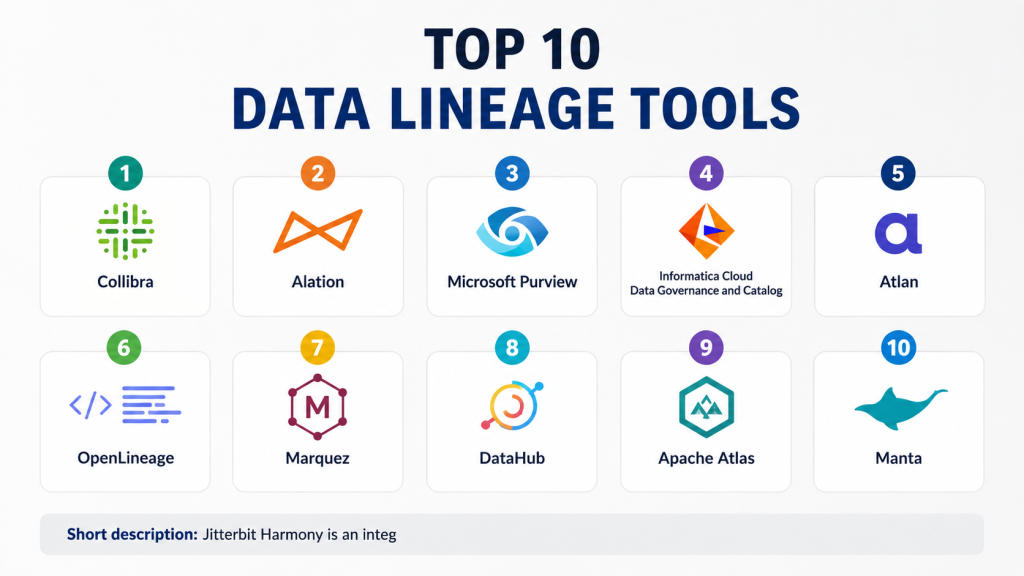
Top 10 Data Lineage Tools
#1 — Collibra
Short description:Collibra is an enterprise data intelligence and governance platform with strong capabilities for data cataloging, lineage, stewardship, and compliance workflows. It is best suited for large organizations that need a formal data governance operating model. Collibra helps teams understand data ownership, definitions, usage, and movement across systems. Its lineage features are useful for compliance, impact analysis, and business trust. It works well for banks, healthcare companies, insurance firms, and large enterprises with complex data estates. The platform is powerful but may require proper implementation planning. It is not usually the simplest choice for very small teams. Collibra is best when data governance is a strategic business priority.
Key Features
- Enterprise data catalog and governance workflows
- Automated data lineage and impact analysis
- Business glossary and policy management
- Stewardship and ownership assignment
- Metadata management across systems
- Data quality and privacy support
- Workflow-based governance operations
Pros
- Strong enterprise governance capabilities
- Good fit for regulated industries
- Useful for both technical and business users
Cons
- Implementation can be complex
- May require dedicated governance resources
- Pricing is not always simple for small teams
Platforms / Deployment
Cloud / Hybrid
Security & Compliance
SSO/SAML, RBAC, audit logs, encryption, and enterprise governance controls are commonly supported. Specific certifications may vary by product package and region.
Integrations & Ecosystem
Collibra integrates with many data warehouses, BI platforms, ETL tools, and enterprise systems. Its ecosystem is strong for large governance programs.
- Snowflake
- Databricks
- Tableau
- Power BI
- Informatica
- Cloud data platforms
Support & Community
Collibra offers enterprise support, onboarding services, documentation, and partner assistance. Community strength is good in governance-focused organizations.
#2 — Alation
Short description:Alation is a data intelligence platform known for data cataloging, search, governance, and collaborative metadata management. It helps users discover trusted data and understand how data assets are connected. Its lineage capabilities support impact analysis, governance, and analytics reliability. Alation is useful for organizations that want both technical metadata and business-friendly data discovery. It is often used by data teams, analysts, governance leaders, and enterprise analytics teams. The platform focuses heavily on usability and collaboration. It is suitable for mid-market and enterprise teams. Smaller teams may find it more than they need.
Key Features
- Data catalog with search and discovery
- Automated lineage and metadata extraction
- Data governance workflows
- Business glossary support
- Usage analytics and data popularity signals
- Collaboration features for analysts
- Policy and stewardship support
Pros
- Strong user experience for data discovery
- Good business and technical metadata balance
- Helpful for analytics governance
Cons
- Advanced implementation may require planning
- Some features may depend on integrations
- Pricing can vary by enterprise needs
Platforms / Deployment
Cloud / Hybrid
Security & Compliance
SSO/SAML, RBAC, audit logs, and encryption are commonly supported. Some compliance details are not publicly stated for every deployment model.
Integrations & Ecosystem
Alation connects with many warehouses, BI tools, databases, and data platforms. Its integrations help users discover and understand assets across the data stack.
- Snowflake
- BigQuery
- Databricks
- Tableau
- Power BI
- dbt
Support & Community
Alation provides documentation, onboarding, customer success, and enterprise support. It has a strong presence among data catalog and governance teams.
#3 — Microsoft Purview
Short description:Microsoft Purview is a data governance, catalog, compliance, and lineage platform built for organizations using Microsoft and multi-cloud data environments. It helps teams scan data sources, classify data, manage metadata, and understand data movement. Purview is especially useful for companies already using Azure, Microsoft Fabric, Power BI, and Microsoft security tools. It supports governance, privacy, and compliance workflows across structured and unstructured data. Its lineage capabilities work well in Microsoft-heavy environments. It can also connect with non-Microsoft systems. Enterprises may benefit most when Purview is part of a wider Microsoft data strategy.
Key Features
- Data catalog and metadata scanning
- Automated lineage for supported sources
- Data classification and sensitivity labels
- Governance and compliance workflows
- Integration with Microsoft data ecosystem
- Policy and access insights
- Support for hybrid and cloud environments
Pros
- Strong fit for Microsoft ecosystem users
- Useful for compliance and governance
- Good integration with Power BI and Azure services
Cons
- Best experience often comes within Microsoft stack
- Setup can require governance planning
- Some lineage depth depends on source support
Platforms / Deployment
Cloud / Hybrid
Security & Compliance
Microsoft enterprise security controls commonly include RBAC, encryption, audit logs, identity integration, and compliance features. Specific certifications depend on Microsoft cloud services and configuration.
Integrations & Ecosystem
Purview connects strongly with Microsoft data and analytics platforms and also supports selected external sources.
- Azure Data Factory
- Power BI
- Microsoft Fabric
- Azure Synapse
- SQL Server
- Snowflake
Support & Community
Microsoft offers documentation, enterprise support, partner support, and a large technical community.
#4 — Informatica Cloud Data Governance and Catalog
Short description:Informatica offers strong data governance, cataloging, metadata management, and lineage capabilities through its cloud data management platform. It is well suited for enterprises that need deep integration across data quality, governance, integration, and master data management. Informatica is often used in large organizations with complex data movement and strict compliance requirements. Its lineage features help teams trace data from source to target and understand transformation logic. It is powerful for hybrid environments where cloud and on-prem systems both exist. The platform may be more suitable for mature data teams than very small companies. Its strength lies in broad enterprise data management coverage.
Key Features
- Enterprise metadata management
- Automated data lineage
- Data governance workflows
- Data quality integration
- Cloud and hybrid data management
- Business glossary and stewardship
- Impact analysis and compliance support
Pros
- Strong enterprise data management ecosystem
- Good for hybrid and complex environments
- Works well with governance and data quality needs
Cons
- Can be complex for new teams
- May require expert implementation
- Pricing and packaging can vary
Platforms / Deployment
Cloud / Hybrid
Security & Compliance
Enterprise security features commonly include SSO, RBAC, encryption, and audit capabilities. Some specific certification details may vary by service and region.
Integrations & Ecosystem
Informatica has a broad integration ecosystem across databases, warehouses, cloud platforms, and enterprise applications.
- Snowflake
- Databricks
- Oracle
- SAP
- AWS
- Azure
Support & Community
Informatica provides enterprise support, documentation, professional services, and a mature partner network.
#5 — Atlan
Short description:Atlan is a modern data collaboration and governance platform built for data teams working with cloud-native data stacks. It combines data cataloging, lineage, ownership, documentation, and collaboration. Atlan is popular among teams that want a modern, user-friendly experience for discovering and managing data assets. Its lineage capabilities help engineers, analysts, and governance teams understand dependencies across tools. It is especially useful for teams using modern warehouses, dbt, BI tools, and cloud data platforms. Atlan is often seen as easier to adopt than some traditional enterprise platforms. It works well for fast-growing data teams and larger organizations.
Key Features
- Modern data catalog and discovery
- Automated lineage and metadata collection
- Column-level lineage support
- Ownership and documentation workflows
- Collaboration features for data teams
- Integration with modern data stack tools
- Governance and access context
Pros
- Strong modern data stack fit
- User-friendly interface
- Good collaboration features
Cons
- Enterprise governance depth may vary by use case
- Advanced setup still needs planning
- Pricing details may not be fully public
Platforms / Deployment
Cloud
Security & Compliance
SSO/SAML, RBAC, audit logs, and encryption are commonly supported. Some compliance details are not publicly stated for all cases.
Integrations & Ecosystem
Atlan integrates well with popular cloud warehouses, transformation tools, BI tools, and workflow systems.
- Snowflake
- BigQuery
- Databricks
- dbt
- Looker
- Tableau
Support & Community
Atlan provides documentation, onboarding support, and customer success. It has a growing community among modern data teams.
#6 — OpenLineage
Short description:OpenLineage is an open standard for collecting lineage metadata from data pipelines. It is not a traditional commercial data catalog by itself, but it is highly important for teams that want open, interoperable lineage tracking. OpenLineage helps capture metadata about jobs, datasets, runs, and dependencies. It is especially useful for data engineering teams using orchestration and pipeline tools. It can be used with platforms such as Marquez and other metadata systems. OpenLineage is best for technical teams that want flexibility and open standards. It may require engineering work to implement properly. It is a strong option for teams avoiding vendor lock-in.
Key Features
- Open standard for lineage metadata
- Job, run, and dataset tracking
- Useful for pipeline observability
- Works with compatible tools
- Helps avoid vendor lock-in
- Developer-friendly architecture
- Suitable for custom data platforms
Pros
- Open and flexible
- Strong for engineering-led teams
- Useful for interoperable metadata collection
Cons
- Requires technical implementation
- Not a complete catalog by itself
- Business-user features depend on connected tools
Platforms / Deployment
Open-source / Self-hosted / Hybrid
Security & Compliance
Not publicly stated as a standalone standard. Security depends on the implementation and connected systems.
Integrations & Ecosystem
OpenLineage works with pipeline and orchestration tools that support the standard.
- Apache Airflow
- Spark
- dbt
- Marquez
- Data orchestration tools
- Custom APIs
Support & Community
Community support is strong among open metadata and data engineering users. Enterprise support depends on vendors using OpenLineage.
#7 — Marquez
Short description:Marquez is an open-source metadata and lineage service often used with OpenLineage. It helps teams collect, store, and visualize metadata about data jobs and datasets. Marquez is useful for data engineering teams that want to understand pipeline dependencies without buying a full enterprise governance platform. It provides visibility into job runs, datasets, and lineage relationships. It is best for technical users and platform teams. Marquez may not provide the same business glossary, stewardship, or policy management depth as commercial platforms. However, it is valuable for teams building open and customizable metadata systems.
Key Features
- Open-source metadata management
- Lineage visualization
- OpenLineage compatibility
- Dataset and job tracking
- Pipeline dependency visibility
- API-based architecture
- Useful for custom data platforms
Pros
- Good open-source option
- Strong for engineering teams
- Helps build flexible lineage workflows
Cons
- Requires setup and maintenance
- Limited enterprise governance features
- Not ideal for non-technical users alone
Platforms / Deployment
Self-hosted / Hybrid
Security & Compliance
Not publicly stated. Security depends on deployment, configuration, and infrastructure controls.
Integrations & Ecosystem
Marquez works well with OpenLineage-supported systems and engineering workflows.
- OpenLineage
- Apache Airflow
- Spark
- dbt
- Custom APIs
- Pipeline systems
Support & Community
Community support is available through open-source channels. Enterprise support may depend on third-party vendors or internal teams.
#8 — DataHub
Short description:DataHub is an open-source metadata platform used for data discovery, governance, observability, and lineage. It is designed for modern data ecosystems and supports metadata ingestion from many tools. DataHub helps teams understand data ownership, schema changes, usage, and relationships between assets. Its lineage capabilities are useful for engineering and governance teams that need flexible metadata management. It can be self-hosted and customized, making it attractive for platform teams. DataHub is powerful but requires technical skill to operate at scale. It is a strong option for organizations that want open-source flexibility with enterprise-style metadata capabilities.
Key Features
- Open-source metadata platform
- Data discovery and cataloging
- Lineage and impact analysis
- Ownership and documentation support
- Metadata ingestion framework
- Schema and usage metadata
- Extensible API-driven architecture
Pros
- Strong open-source ecosystem
- Flexible and customizable
- Good fit for modern data platforms
Cons
- Requires technical setup
- Operational maintenance is needed
- Business workflows may need customization
Platforms / Deployment
Self-hosted / Cloud through managed options / Hybrid
Security & Compliance
RBAC and authentication options are available depending on deployment. Specific compliance certifications are not publicly stated for all deployment models.
Integrations & Ecosystem
DataHub supports a wide set of integrations across data warehouses, BI tools, orchestration tools, and transformation systems.
- Snowflake
- BigQuery
- Kafka
- dbt
- Airflow
- Looker
Support & Community
DataHub has a strong open-source community. Managed and enterprise support may be available through commercial providers.
#9 — Apache Atlas
Short description:Apache Atlas is an open-source metadata and governance framework commonly associated with big data and Hadoop-based ecosystems. It supports metadata management, classification, governance, and lineage. Atlas is useful for organizations running data lakes and big data platforms that need open-source governance capabilities. It can track relationships between data assets and provide lineage visibility. Apache Atlas is more technical and may not feel as modern as newer catalog tools. It is best suited for engineering teams with open-source infrastructure experience. It remains relevant where Hadoop, Hive, and related ecosystems are still part of the data estate.
Key Features
- Open-source metadata governance
- Data classification and tagging
- Lineage tracking
- Metadata repository
- Integration with big data systems
- Policy and governance support
- Extensible type system
Pros
- Open-source and flexible
- Strong fit for big data ecosystems
- Useful for technical governance teams
Cons
- Can be complex to configure
- Interface may feel less modern
- Best suited for technical users
Platforms / Deployment
Self-hosted / Hybrid
Security & Compliance
Security depends on deployment and integration with enterprise identity and access systems. Specific certifications are not publicly stated.
Integrations & Ecosystem
Apache Atlas is commonly used with big data and open-source data platforms.
- Apache Hive
- Hadoop ecosystem
- Apache Ranger
- Kafka
- Spark
- Custom metadata systems
Support & Community
Community support is available through the Apache ecosystem. Enterprise support depends on vendors and internal platform teams.
#10 — Manta
Short description:Manta is a data lineage platform focused on automated lineage scanning, impact analysis, and metadata visibility. It is often used by enterprises that need deep technical lineage across databases, ETL tools, BI systems, and code-based transformations. Manta helps teams understand complex dependencies and reduce risk when making changes to data systems. It is useful for compliance, migration, modernization, and data governance projects. The platform is especially valuable where data flows across many legacy and modern tools. Manta is more specialized in lineage than general collaboration-focused catalogs. It is best for organizations that need detailed technical lineage.
Key Features
- Automated data lineage scanning
- Technical lineage and impact analysis
- Support for complex enterprise environments
- Metadata extraction from multiple systems
- Change impact visibility
- Governance and compliance support
- Useful for migration projects
Pros
- Strong technical lineage depth
- Good for complex enterprise systems
- Useful for impact analysis
Cons
- May be too specialized for simple teams
- Implementation can require technical support
- Broader catalog experience may depend on ecosystem
Platforms / Deployment
Cloud / Self-hosted / Hybrid
Security & Compliance
Enterprise security controls may be available, but specific certifications should be validated directly. Use “Not publicly stated” where unsure.
Integrations & Ecosystem
Manta supports many enterprise data tools, including databases, BI tools, ETL systems, and data warehouses.
- Oracle
- SQL Server
- Snowflake
- Tableau
- Informatica
- ETL platforms
Support & Community
Manta provides enterprise support and documentation. Community strength is more enterprise-customer focused than open-source community driven.
Comparison Table
| Tool Name | Best For | Platform(s) Supported | Deployment | Standout Feature | Public Rating |
|---|---|---|---|---|---|
| Collibra | Enterprise governance teams | Web | Cloud / Hybrid | Governance-led lineage | N/A |
| Alation | Data discovery and analytics teams | Web | Cloud / Hybrid | Business-friendly catalog | N/A |
| Microsoft Purview | Microsoft ecosystem users | Web | Cloud / Hybrid | Microsoft-native governance | N/A |
| Informatica Cloud Data Governance and Catalog | Large enterprise data teams | Web | Cloud / Hybrid | Broad enterprise data management | N/A |
| Atlan | Modern data stack teams | Web | Cloud | Collaborative data catalog | N/A |
| OpenLineage | Engineering-led teams | Varies / N/A | Self-hosted / Hybrid | Open lineage standard | N/A |
| Marquez | Open-source pipeline lineage | Web / API | Self-hosted / Hybrid | OpenLineage-based metadata service | N/A |
| DataHub | Open-source metadata platforms | Web / API | Self-hosted / Hybrid | Flexible metadata platform | N/A |
| Apache Atlas | Big data governance teams | Web / API | Self-hosted / Hybrid | Open-source metadata governance | N/A |
| Manta | Technical enterprise lineage | Web | Cloud / Self-hosted / Hybrid | Deep automated lineage scanning | N/A |
Evaluation & Scoring of Data Lineage Tools
| Tool Name | Core (25%) | Ease (15%) | Integrations (15%) | Security (10%) | Performance (10%) | Support (10%) | Value (15%) | Weighted Total |
|---|---|---|---|---|---|---|---|---|
| Collibra | 9 | 7 | 9 | 9 | 8 | 9 | 7 | 8.35 |
| Alation | 8 | 8 | 8 | 8 | 8 | 8 | 7 | 7.85 |
| Microsoft Purview | 8 | 7 | 8 | 9 | 8 | 8 | 8 | 7.95 |
| Informatica Cloud Data Governance and Catalog | 9 | 7 | 9 | 9 | 8 | 9 | 7 | 8.35 |
| Atlan | 8 | 9 | 8 | 8 | 8 | 8 | 8 | 8.15 |
| OpenLineage | 7 | 6 | 7 | 6 | 8 | 7 | 9 | 7.15 |
| Marquez | 7 | 6 | 7 | 6 | 7 | 6 | 9 | 6.95 |
| DataHub | 8 | 7 | 8 | 7 | 8 | 8 | 9 | 7.95 |
| Apache Atlas | 7 | 5 | 7 | 7 | 7 | 6 | 8 | 6.75 |
| Manta | 9 | 7 | 8 | 8 | 8 | 8 | 7 | 7.95 |
These scores are comparative, not absolute. A higher score does not mean the tool is always the best choice. Enterprise tools usually score higher in governance and support, while open-source tools often score better in flexibility and value. The right choice depends on your stack, budget, data maturity, and compliance needs.
Which Data Lineage Tool Is Right for You?
Solo / Freelancer
Solo users usually do not need a heavy enterprise lineage platform. If you work with simple analytics projects, basic documentation, dbt docs, or warehouse-native metadata may be enough. If you want open-source learning, DataHub, OpenLineage, or Marquez can be useful.
SMB
Small and growing businesses should focus on ease of use and fast setup. Atlan, Alation, or Microsoft Purview can be good options depending on your data stack. If your team is technical and budget-sensitive, DataHub may also be practical.
Mid-Market
Mid-market companies need better governance, ownership, and integration coverage. Atlan, Alation, Microsoft Purview, and Informatica are strong options. The best choice depends on whether your stack is modern cloud-first, Microsoft-heavy, or enterprise hybrid.
Enterprise
Large enterprises should prioritize governance workflows, compliance, scalability, and support. Collibra, Informatica, Microsoft Purview, and Manta are strong choices. Enterprises with open-source platform teams may also evaluate DataHub alongside commercial tools.
Budget vs Premium
If budget is limited, open-source options such as DataHub, OpenLineage, Marquez, and Apache Atlas can help. However, they require engineering time. Premium tools cost more but usually provide better onboarding, support, governance features, and business-user experience.
Feature Depth vs Ease of Use
For deep governance, Collibra and Informatica are strong. For user-friendly discovery and collaboration, Atlan and Alation are attractive. For deep technical lineage, Manta is strong. For flexible engineering control, DataHub and OpenLineage are better.
Integrations & Scalability
Choose a tool that supports your actual data stack. Snowflake, BigQuery, Databricks, dbt, Airflow, Tableau, Power BI, Kafka, and cloud platforms are common integration needs. Do not choose a tool only by feature list; validate real integration depth.
Security & Compliance Needs
Regulated companies should prioritize RBAC, SSO, audit logs, encryption, policy workflows, and data classification. Collibra, Informatica, Microsoft Purview, and Alation are often stronger for governance-heavy requirements. Always validate compliance claims directly before purchase.
Frequently Asked Questions
1. What is a data lineage tool?
A data lineage tool shows how data moves from source systems to reports, dashboards, warehouses, pipelines, and applications. It helps teams understand data flow, transformations, ownership, and dependencies.
2. Why is data lineage important?
Data lineage is important because it improves trust in data. When a report breaks or a metric changes, lineage helps teams find the source of the problem faster and understand business impact.
3. How much do data lineage tools cost?
Pricing varies widely. Enterprise platforms usually use custom pricing based on users, data sources, modules, and support needs. Open-source tools may reduce license cost but require engineering and maintenance effort.
4. How long does implementation take?
Implementation can take a few days for simple modern stacks and several months for large enterprise environments. The timeline depends on source systems, metadata quality, governance goals, and integration complexity.
5. What is column-level lineage?
Column-level lineage tracks how individual fields or columns move and transform across systems. It is more detailed than table-level lineage and is very useful for audits, debugging, and impact analysis.
6. What are common mistakes when buying a lineage tool?
Common mistakes include choosing based only on screenshots, ignoring integration depth, underestimating setup effort, skipping business-user needs, and not validating security and compliance requirements before purchase.
7. Are open-source data lineage tools good enough?
Open-source tools can be excellent for technical teams with strong engineering skills. However, they may need more setup, maintenance, customization, and internal support compared with commercial platforms.
8. Can data lineage tools improve data quality?
Yes, but lineage alone does not fix data quality. It helps identify where issues start, how they spread, and which reports or systems are affected. Many teams combine lineage with data quality monitoring.
9. Do data lineage tools support cloud data warehouses?
Many modern lineage tools support cloud warehouses such as Snowflake, BigQuery, Databricks, and other platforms. However, integration depth varies, so buyers should test their exact sources before committing.
10. What are alternatives to data lineage tools?
Alternatives include manual documentation, dbt documentation, warehouse-native metadata, BI dependency views, and custom metadata pipelines. These may work for smaller teams but become harder to manage at scale.
Conclusion
Data lineage tools are becoming essential for teams that want trusted analytics, stronger governance, smoother compliance, and better control over complex data environments. There is no single best tool for every company. Collibra and Informatica are strong for enterprise governance. Atlan and Alation are useful for modern data collaboration. Microsoft Purview fits well in Microsoft-focused environments. DataHub, OpenLineage, Marquez, and Apache Atlas are good for technical teams that want open and flexible metadata control. Manta is strong for deep technical lineage and impact analysis.
