Upgrade & Secure Your Future with DevOps, SRE, DevSecOps, MLOps!
We spend hours scrolling social media and waste money on things we forget, but won’t spend 30 minutes a day earning certifications that can change our lives.
Master in DevOps, SRE, DevSecOps & MLOps by DevOps School!
Learn from Guru Rajesh Kumar and double your salary in just one year.
Introduction
Data Governance Platforms help organizations manage, protect, understand, and control their data across departments, systems, cloud platforms, analytics tools, and AI workflows. In simple words, these platforms help businesses answer important questions: Where is our data? Who owns it? Is it trusted? Who can access it? Is it compliant? Can teams safely use it for reporting, automation, and AI?
In and beyond, data governance is becoming more important because companies are using AI, machine learning, self-service analytics, cloud data warehouses, and real-time business applications. Without governance, data becomes risky, duplicated, insecure, and difficult to trust.
Common use cases include:
- Data cataloging and discovery
- Data ownership and stewardship
- Compliance and privacy management
- Data quality monitoring
- Business glossary management
- Data lineage and impact analysis
Buyers should evaluate:
- Data catalog features
- Lineage and metadata tracking
- Policy management
- Access governance
- Privacy and compliance support
- Integration ecosystem
- AI-assisted automation
- Ease of use
- Workflow and stewardship features
- Deployment flexibility
Best for: data leaders, governance teams, compliance teams, analytics teams, enterprise architects, data engineers, security teams, and organizations in finance, healthcare, retail, insurance, telecom, manufacturing, and technology.
Not ideal for: very small teams with limited data sources, businesses needing only basic spreadsheet tracking, or companies that only need simple database documentation without governance workflows.
Key Trends in Data Governance Platforms
- AI governance is becoming central: Organizations now need governance for AI training data, model inputs, sensitive data usage, and automated decision-making.
- Active metadata is replacing passive catalogs: Modern platforms do not only store metadata; they trigger alerts, workflows, access actions, and quality checks.
- Privacy-first governance is growing: Teams need better control over personal data, consent, retention, masking, and regulatory reporting.
- Data lineage is becoming business-critical: Companies want to understand how data moves from source systems to dashboards, reports, AI models, and business decisions.
- Self-service data discovery is expanding: Business users need simple ways to find trusted data without depending on data engineering teams every time.
- Cloud and hybrid governance are now standard: Governance platforms must work across cloud warehouses, SaaS tools, data lakes, legacy systems, and on-premises environments.
- Policy automation is increasing: Manual governance is slow, so platforms are adding automated classification, ownership assignment, and policy enforcement.
- Data quality and governance are merging: Buyers prefer platforms that connect governance rules with real data quality monitoring.
- Integration with security tools is more important: Access controls, identity systems, audit logs, and security monitoring are now part of governance evaluation.
- Business glossary adoption is improving: Organizations want shared business definitions so teams use the same meaning for terms like customer, revenue, churn, and active user.
How We Selected These Tools
The top tools were selected using practical evaluation logic:
- Strong recognition in the data governance and metadata management market
- Breadth of features across catalog, lineage, glossary, ownership, and policy management
- Fit for enterprise, mid-market, and modern data teams
- Support for cloud, hybrid, and complex data environments
- Integration with common data warehouses, BI tools, SaaS apps, and data platforms
- Security and governance controls such as RBAC, audit logs, and access workflows
- Practical usability for both technical and business users
- Ability to support compliance and privacy programs
- Scalability for growing data ecosystems
- Balance between platform depth, ease of adoption, and long-term value
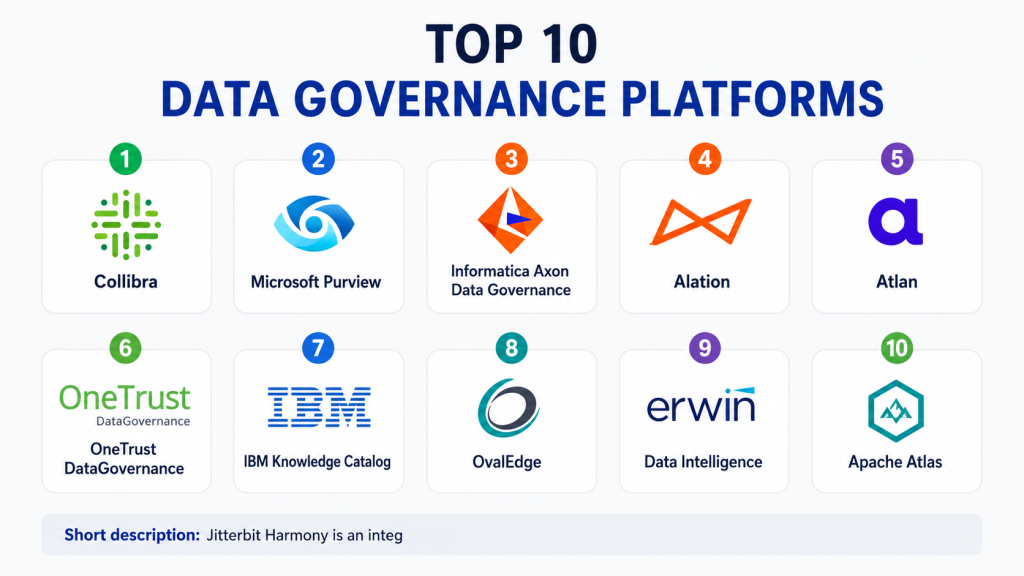
Top 10 Data Governance Platforms
#1 — Collibra
Short description:Collibra is a widely recognized enterprise data governance platform built for organizations that need strong control over data ownership, business definitions, policies, lineage, and compliance.
It is commonly used by large enterprises that want a central governance operating model across business and technical teams.
The platform helps users find trusted data, understand data meaning, manage stewardship, and align data with business rules.
Collibra is useful for regulated industries where compliance, accountability, and audit readiness are important.
It supports business glossaries, data cataloging, privacy workflows, policy management, and data intelligence use cases.
The platform is especially strong when governance needs to involve many departments and stakeholders.
It may require careful setup because successful governance depends on clear ownership and business adoption.
Collibra is best for enterprises that want a mature, business-friendly governance foundation.
Key Features
- Enterprise data catalog
- Business glossary management
- Data lineage and impact analysis
- Data ownership and stewardship workflows
- Policy and privacy management
- Data marketplace capabilities
- Governance workflow automation
Pros
- Strong enterprise governance features
- Good for regulated and complex organizations
- Business-friendly glossary and stewardship capabilities
Cons
- Can require significant implementation planning
- May be expensive for smaller teams
- Success depends heavily on user adoption and governance process maturity
Platforms / Deployment
Cloud / SaaS / Hybrid options vary by configuration.
Security & Compliance
Supports enterprise-grade access controls, auditability, role-based governance workflows, and security integrations. Specific certifications should be verified with the vendor.
Integrations & Ecosystem
Collibra integrates with many enterprise data systems and analytics platforms, making it suitable for large data ecosystems.
- Cloud data warehouses
- BI and analytics tools
- Data lakes
- ETL and ELT tools
- Privacy and security tools
- APIs and metadata connectors
Support & Community
Collibra offers enterprise support, documentation, onboarding services, training resources, and a strong partner ecosystem. Community strength is high among governance professionals.
#2 — Microsoft Purview
Short description:Microsoft Purview is a data governance, compliance, cataloging, and risk management platform designed for organizations using Microsoft and hybrid data environments.
It helps teams discover, classify, govern, and protect data across cloud, on-premises, and SaaS systems.
Purview is especially useful for businesses already using Microsoft Azure, Microsoft Fabric, Power BI, Microsoft 365, and related services.
The platform supports data cataloging, sensitivity classification, lineage, access insights, compliance workflows, and data estate management.
It helps technical and compliance teams understand where sensitive data exists and how it is being used.
Purview is a strong option for organizations that want governance and compliance aligned with Microsoft security and productivity tools.
It may be less ideal for companies with very little Microsoft footprint.
It is best for enterprises and mid-market teams building governance around the Microsoft ecosystem.
Key Features
- Data catalog and discovery
- Automated data classification
- Data lineage tracking
- Sensitive data management
- Microsoft ecosystem integration
- Compliance and risk controls
- Data estate mapping
Pros
- Strong fit for Microsoft environments
- Combines governance, compliance, and security controls
- Useful for cloud and hybrid data landscapes
Cons
- Best value is within Microsoft ecosystem
- Some advanced scenarios can require technical expertise
- Non-Microsoft integrations may need careful validation
Platforms / Deployment
Cloud / Hybrid.
Security & Compliance
Supports Microsoft identity, access controls, sensitivity labels, audit features, and compliance management capabilities. Specific certifications depend on Microsoft cloud services and tenant configuration.
Integrations & Ecosystem
Microsoft Purview integrates naturally with Microsoft cloud, analytics, productivity, and security tools.
- Microsoft Azure
- Microsoft Fabric
- Power BI
- Microsoft 365
- SQL Server
- Data lakes and cloud storage
Support & Community
Microsoft provides documentation, enterprise support, partner resources, training materials, and strong community coverage across Azure and Microsoft data products.
#3 — Informatica Axon Data Governance
Short description:Informatica Axon Data Governance is designed to help organizations build structured data governance programs around ownership, policies, business terms, and enterprise data usage.
It works well with Informatica’s broader ecosystem, including data quality, data cataloging, data integration, and MDM products.
Axon helps business and technical users define ownership, document business meaning, track governance rules, and manage data accountability.
It is useful for enterprises that need governance connected with actual data operations.
The platform can support compliance, stewardship, glossary management, and governance workflows.
It is especially strong for organizations already using Informatica tools for data integration and data quality.
Implementation should be planned carefully because governance requires strong operating models.
It is best for large organizations that want governance connected to enterprise data management.
Key Features
- Business glossary management
- Data ownership and stewardship
- Governance workflow support
- Policy and rule management
- Integration with Informatica ecosystem
- Data quality alignment
- Enterprise governance operating model support
Pros
- Strong connection with data quality and integration
- Good fit for mature enterprise data programs
- Useful for business and technical governance alignment
Cons
- Best value comes with broader Informatica ecosystem
- May require governance maturity to use effectively
- Implementation effort can be high
Platforms / Deployment
Cloud / Hybrid / Enterprise deployment options vary.
Security & Compliance
Enterprise access controls and governance workflows are available. Specific certifications and compliance details should be verified with the vendor.
Integrations & Ecosystem
Informatica Axon works closely with Informatica’s data management suite and other enterprise systems.
- Informatica Data Quality
- Informatica Data Catalog
- Informatica MDM
- Cloud data warehouses
- BI tools
- Enterprise applications
Support & Community
Informatica provides enterprise support, documentation, professional services, training, and a broad partner ecosystem.
#4 — Alation
Short description:Alation is a data intelligence and governance platform known for data cataloging, search, collaboration, stewardship, and business-friendly data discovery.
It helps organizations create a trusted data culture by making data easier to find, understand, and use responsibly.
Alation is often used by analytics teams, data stewards, data engineers, and business users who need access to reliable data.
The platform supports data cataloging, lineage, governance workflows, policy management, and active metadata use cases.
It is strong for organizations that want self-service analytics without losing control over governance.
Alation also supports collaboration through user ratings, documentation, conversations, and stewardship features.
It may need clear governance design to avoid becoming only a searchable catalog.
It is best for companies that want governance and data discovery together.
Key Features
- Enterprise data catalog
- Business glossary
- Data discovery and search
- Data lineage
- Stewardship workflows
- Active metadata support
- Collaboration and data usage insights
Pros
- Strong user experience for data discovery
- Good for analytics-driven organizations
- Encourages collaboration between data and business teams
Cons
- Governance depth depends on implementation approach
- Advanced workflows may need configuration
- Pricing may be less suitable for small teams
Platforms / Deployment
Cloud / SaaS / Hybrid options vary.
Security & Compliance
Supports enterprise security controls such as role-based permissions and auditability. Specific certifications should be verified with the vendor.
Integrations & Ecosystem
Alation integrates with many modern data and analytics platforms.
- Cloud data warehouses
- BI tools
- Data lakes
- Databases
- ETL and ELT tools
- APIs and connectors
Support & Community
Alation offers documentation, support, customer success programs, training, and a strong community among data catalog and governance teams.
#5 — Atlan
Short description:Atlan is a modern data governance and active metadata platform built for data teams that want collaboration, discovery, lineage, and automation in one place.
It is often used by modern analytics, data engineering, and data platform teams working with cloud data stacks.
Atlan focuses on active metadata, meaning metadata can trigger workflows, alerts, ownership updates, and governance actions.
It helps teams understand data context, ownership, lineage, quality signals, and usage patterns.
The platform is popular with organizations that want a more modern and collaborative governance experience.
It supports both technical and business users through search, documentation, glossary, and metadata automation.
It may not be the first choice for highly traditional governance programs that need very rigid operating models.
It is best for cloud-first data teams that value speed, collaboration, and automation.
Key Features
- Active metadata management
- Data catalog and discovery
- Data lineage
- Business glossary
- Ownership and stewardship
- Collaboration workflows
- Data quality and observability integrations
Pros
- Modern and user-friendly experience
- Strong for cloud data teams
- Good collaboration and metadata automation features
Cons
- Enterprise governance depth should be validated for complex needs
- May require process design for large organizations
- Best suited to modern data stack environments
Platforms / Deployment
Cloud / SaaS.
Security & Compliance
Supports enterprise access controls and governance features. Specific certifications should be verified with the vendor.
Integrations & Ecosystem
Atlan integrates with common modern data stack tools and governance workflows.
- Cloud warehouses
- BI tools
- Data transformation tools
- Data quality tools
- Data observability platforms
- APIs and metadata connectors
Support & Community
Atlan provides documentation, customer support, onboarding help, and growing community resources for modern data teams.
#6 — OneTrust DataGovernance
Short description:OneTrust DataGovernance focuses on data discovery, privacy, compliance, risk, and governance across business systems.
It is especially useful for organizations that need to understand sensitive data, privacy obligations, consent, and regulatory risk.
The platform helps teams discover data, classify it, map data flows, manage policies, and support privacy operations.
It is commonly considered by privacy, legal, compliance, security, and data governance teams.
OneTrust is strong where governance and privacy management need to work together.
It helps organizations move beyond documentation toward operational privacy and risk controls.
The platform may be broader than needed if the team only wants a simple data catalog.
It is best for businesses with strong privacy, compliance, and risk management requirements.
Key Features
- Data discovery and classification
- Privacy and compliance workflows
- Data mapping
- Risk and policy management
- Sensitive data identification
- Governance reporting
- Consent and privacy program alignment
Pros
- Strong privacy and compliance focus
- Good fit for legal, risk, and security teams
- Useful for sensitive data governance
Cons
- May be too broad for simple catalog needs
- Data engineering teams may need additional technical integrations
- Implementation depends on privacy program maturity
Platforms / Deployment
Cloud / SaaS.
Security & Compliance
Supports privacy, compliance, risk, and governance workflows. Specific certifications should be verified with the vendor.
Integrations & Ecosystem
OneTrust connects governance with privacy, security, and business systems.
- SaaS applications
- Data stores
- Privacy tools
- Security platforms
- Workflow systems
- APIs
Support & Community
OneTrust provides documentation, onboarding, enterprise support, privacy program resources, and implementation assistance.
#7 — IBM Knowledge Catalog
Short description:IBM Knowledge Catalog is a data catalog and governance platform used to organize, classify, manage, and govern enterprise data.
It is often used with IBM Cloud Pak for Data and broader IBM data and AI environments.
The platform helps users discover trusted data, apply governance policies, manage metadata, and support responsible data usage.
It is suitable for organizations working on AI, analytics, compliance, and data science projects.
IBM Knowledge Catalog can support business glossary, data quality, lineage, access control, and policy enforcement use cases.
It is a strong fit for enterprises that already use IBM’s data and AI ecosystem.
It may be less attractive for teams outside IBM environments unless integrations are validated carefully.
It is best for enterprise governance programs connected to data science and AI initiatives.
Key Features
- Data cataloging
- Metadata management
- Data governance policies
- Business glossary
- Data quality support
- AI and analytics governance alignment
- Access and policy controls
Pros
- Strong fit for IBM data and AI environments
- Useful for enterprise analytics governance
- Good governance and catalog foundation
Cons
- Best value comes within IBM ecosystem
- May require specialist knowledge
- Smaller teams may find it heavy
Platforms / Deployment
Cloud / Hybrid options vary.
Security & Compliance
Supports enterprise security, access controls, and governance policies. Specific compliance certifications should be verified by deployment model.
Integrations & Ecosystem
IBM Knowledge Catalog integrates with IBM data, AI, and analytics tools.
- IBM Cloud Pak for Data
- Data warehouses
- Data lakes
- AI and ML workflows
- Databases
- APIs
Support & Community
IBM provides enterprise support, documentation, training resources, and professional services. Community strength is high in IBM enterprise environments.
#8 — OvalEdge
Short description:OvalEdge is a data governance and data catalog platform designed to help organizations discover, classify, govern, and manage enterprise data.
It is often considered by mid-market and enterprise teams looking for practical governance capabilities without excessive complexity.
The platform includes data cataloging, lineage, business glossary, data quality, access workflows, and stewardship features.
OvalEdge helps users understand where data lives, who owns it, how it moves, and whether it is trusted.
It can support data democratization by allowing business users to find and request access to data.
The platform is useful for teams that want a balanced mix of governance, cataloging, and operational workflows.
It may not have the same large-vendor ecosystem as some enterprise leaders.
It is best for organizations seeking practical governance with approachable implementation.
Key Features
- Data catalog
- Data lineage
- Business glossary
- Data quality rules
- Access request workflows
- Data stewardship
- Metadata management
Pros
- Practical governance and cataloging features
- Good fit for mid-market teams
- Useful access workflow capabilities
Cons
- Ecosystem may be smaller than major vendors
- Advanced enterprise needs should be validated
- Implementation quality depends on metadata coverage
Platforms / Deployment
Cloud / On-premises / Hybrid options vary.
Security & Compliance
Role-based access and governance controls are available. Specific certifications should be verified with the vendor.
Integrations & Ecosystem
OvalEdge integrates with common enterprise data and analytics systems.
- Databases
- Cloud data warehouses
- BI tools
- Data lakes
- ETL tools
- APIs
Support & Community
OvalEdge provides documentation, onboarding, customer support, and implementation help. Community visibility is moderate compared with larger platforms.
#9 — erwin Data Intelligence
Short description:erwin Data Intelligence is a metadata management, data catalog, and data governance platform used by organizations that need visibility into data assets, lineage, definitions, and governance rules.
It is often used in environments where data modeling, metadata management, and governance need to connect closely.
The platform helps teams document data, understand relationships, manage business terms, and trace data movement.
It is useful for compliance, analytics, enterprise architecture, and data modernization projects.
erwin is a strong choice for organizations with legacy systems, complex metadata, and formal data management practices.
It supports business glossary, lineage, impact analysis, and governance workflows.
It may feel more traditional compared with newer active metadata platforms.
It is best for enterprises that value metadata depth, modeling alignment, and structured governance.
Key Features
- Metadata management
- Data catalog
- Business glossary
- Data lineage
- Impact analysis
- Governance workflows
- Data model integration
Pros
- Strong metadata and modeling heritage
- Good for complex enterprise environments
- Useful for lineage and impact analysis
Cons
- User experience may feel traditional for some teams
- Requires proper metadata onboarding
- May need expert setup for complex environments
Platforms / Deployment
Cloud / On-premises / Hybrid options vary.
Security & Compliance
Enterprise governance controls and access management are available. Specific certifications should be verified with the vendor.
Integrations & Ecosystem
erwin integrates with modeling tools, databases, data platforms, and governance workflows.
- Databases
- Data modeling tools
- BI platforms
- ETL tools
- Data warehouses
- APIs
Support & Community
Support, documentation, and implementation resources are available. Community strength is stronger among enterprise architecture and data modeling teams.
#10 — Apache Atlas
Short description:Apache Atlas is an open-source metadata and governance framework often used in big data and data lake environments.
It helps organizations manage metadata, classification, lineage, and data governance across supported data platforms.
Atlas is commonly associated with Hadoop-based and open-source data ecosystems, but it can also be adapted for broader governance use cases.
It is useful for technical teams that want control, extensibility, and open-source flexibility.
Apache Atlas supports metadata types, classifications, lineage tracking, and governance integration patterns.
It is not as business-user-friendly as many commercial platforms.
It requires technical expertise to deploy, maintain, and customize effectively.
It is best for engineering-led teams that want an open-source governance foundation.
Key Features
- Open-source metadata management
- Data classification
- Lineage tracking
- Governance framework
- Extensible metadata models
- API support
- Integration with big data ecosystems
Pros
- Open-source and extensible
- Good for technical governance use cases
- Useful for data lake and big data environments
Cons
- Requires technical setup and maintenance
- Less polished for business users
- Support depends on internal skills or external service providers
Platforms / Deployment
Self-hosted / Linux / Cloud infrastructure depending on deployment.
Security & Compliance
Security and compliance depend on deployment, configuration, and surrounding infrastructure. Not publicly stated as a commercial certification model.
Integrations & Ecosystem
Apache Atlas works best with open-source and big data ecosystems.
- Hadoop ecosystem
- Hive
- Spark environments
- Data lake platforms
- APIs
- Custom metadata integrations
Support & Community
Community support is available through open-source channels. Enterprise-grade support depends on vendors, consultants, or internal engineering teams.
Comparison Table
| Tool Name | Best For | Platform(s) Supported | Deployment | Standout Feature | Public Rating |
|---|---|---|---|---|---|
| Collibra | Enterprise data governance | Web / Enterprise systems | Cloud / SaaS / Hybrid | Strong business glossary and governance workflows | N/A |
| Microsoft Purview | Microsoft ecosystem governance | Web / Microsoft cloud | Cloud / Hybrid | Data governance plus compliance alignment | N/A |
| Informatica Axon Data Governance | Enterprise governance with data quality | Web / Enterprise systems | Cloud / Hybrid | Strong Informatica ecosystem connection | N/A |
| Alation | Data catalog and self-service analytics governance | Web / Enterprise systems | Cloud / SaaS / Hybrid | Collaborative data discovery | N/A |
| Atlan | Modern active metadata governance | Web / Cloud data stack | Cloud / SaaS | Active metadata automation | N/A |
| OneTrust DataGovernance | Privacy and compliance governance | Web / SaaS systems | Cloud / SaaS | Sensitive data and privacy governance | N/A |
| IBM Knowledge Catalog | IBM data and AI governance | Web / IBM ecosystem | Cloud / Hybrid | Governance for data and AI workflows | N/A |
| OvalEdge | Practical mid-market governance | Web / Enterprise systems | Cloud / On-premises / Hybrid | Catalog, lineage, and access workflows | N/A |
| erwin Data Intelligence | Metadata and lineage-heavy governance | Web / Enterprise systems | Cloud / On-premises / Hybrid | Metadata depth and data modeling alignment | N/A |
| Apache Atlas | Open-source technical governance | Linux / APIs / Data platforms | Self-hosted | Open-source metadata governance framework | N/A |
Evaluation & Scoring of Data Governance Platforms
| Tool Name | Core (25%) | Ease (15%) | Integrations (15%) | Security (10%) | Performance (10%) | Support (10%) | Value (15%) | Weighted Total |
|---|---|---|---|---|---|---|---|---|
| Collibra | 9 | 7 | 9 | 8 | 8 | 9 | 7 | 8.25 |
| Microsoft Purview | 8 | 8 | 9 | 9 | 8 | 9 | 8 | 8.40 |
| Informatica Axon Data Governance | 9 | 7 | 9 | 8 | 8 | 9 | 7 | 8.25 |
| Alation | 8 | 8 | 9 | 8 | 8 | 8 | 8 | 8.20 |
| Atlan | 8 | 9 | 9 | 8 | 8 | 8 | 8 | 8.35 |
| OneTrust DataGovernance | 8 | 8 | 8 | 9 | 8 | 8 | 7 | 8.05 |
| IBM Knowledge Catalog | 8 | 7 | 8 | 8 | 8 | 8 | 7 | 7.75 |
| OvalEdge | 8 | 8 | 8 | 7 | 8 | 7 | 8 | 7.85 |
| erwin Data Intelligence | 8 | 7 | 8 | 7 | 8 | 8 | 7 | 7.65 |
| Apache Atlas | 7 | 5 | 7 | 6 | 7 | 6 | 9 | 6.85 |
The scores are comparative and based on practical product fit, not fixed universal rankings. A tool with a lower score may still be the best choice for a specific environment, especially if it matches your budget, ecosystem, or technical model. Always validate integrations, security controls, deployment fit, and user adoption before final selection.
Which Data Governance Platform Is Right for You?
Solo / Freelancer
Solo users usually do not need a full enterprise data governance platform. If you manage small datasets, simple documentation tools, spreadsheets, or lightweight data catalogs may be enough. Apache Atlas may be useful only if you are technical and want to experiment with open-source metadata governance.
SMB
SMBs should look for platforms that are easy to deploy, simple to manage, and not too heavy. OvalEdge, Atlan, Alation, and Microsoft Purview can be practical options depending on the data stack. The focus should be on data discovery, ownership, access requests, and basic policy workflows.
Mid-Market
Mid-market organizations often need better governance because data is spread across cloud warehouses, BI tools, CRM systems, and SaaS applications. Atlan, Alation, Microsoft Purview, OvalEdge, and OneTrust can be strong choices. If governance must connect with privacy and compliance, OneTrust should be considered.
Enterprise
Large enterprises should evaluate Collibra, Informatica Axon, Microsoft Purview, IBM Knowledge Catalog, Alation, and erwin Data Intelligence. These platforms are better suited for complex governance programs, multiple business units, regulatory needs, and large-scale metadata management.
Budget vs Premium
Budget-sensitive teams should start with a clear scope instead of buying the most advanced platform immediately. Open-source tools like Apache Atlas may reduce license cost but increase engineering effort. Premium tools may be worth the investment when compliance, trust, and scale are business-critical.
Feature Depth vs Ease of Use
Collibra, Informatica, IBM, and erwin are strong for deep enterprise governance. Atlan and Alation are often easier for modern data teams and business users. Microsoft Purview is practical when the organization is already using Microsoft cloud and productivity tools.
Integrations & Scalability
If your data stack is built around Microsoft, Microsoft Purview is a strong candidate. If you need broad enterprise governance, Collibra and Informatica are strong. If you use modern cloud warehouses and transformation tools, Atlan and Alation may provide faster adoption.
Security & Compliance Needs
For privacy-heavy use cases, OneTrust is highly relevant. For enterprise-wide governance, validate SSO, RBAC, audit logs, encryption, data residency, policy workflows, sensitive data classification, and regulatory reporting before choosing any platform.
Frequently Asked Questions
1. What is a data governance platform?
A data governance platform helps organizations manage data ownership, quality, access, privacy, lineage, and business definitions. It gives teams a structured way to keep data trusted, secure, and usable.
2. Why is data governance important?
Data governance is important because poor data creates bad reports, compliance risks, duplicate work, and poor business decisions. A governance platform helps teams understand and control data across the organization.
3. Is data governance only for large enterprises?
No, but large enterprises usually need it more because they have many systems, teams, and regulations. SMBs can also benefit when data is growing across sales, finance, marketing, product, and analytics systems.
4. How much do data governance platforms cost?
Pricing varies based on users, data sources, connectors, features, deployment model, and support level. Many enterprise vendors do not publish full pricing, so buyers should request a custom quote.
5. How long does implementation take?
Implementation depends on data complexity, number of systems, metadata quality, and governance maturity. A focused rollout can start with one domain, while enterprise-wide governance may require phased implementation.
6. What are common mistakes in data governance?
Common mistakes include buying a tool without clear ownership, ignoring business users, trying to govern everything at once, and not defining business terms. Governance works best when people, process, and technology are aligned.
7. What is data lineage?
Data lineage shows where data comes from, how it moves, how it changes, and where it is used. It helps teams understand the impact of data changes on dashboards, reports, systems, and AI workflows.
8. What is a business glossary?
A business glossary defines common business terms such as customer, revenue, profit, churn, order, and active account. It helps teams use the same meaning across departments and reports.
9. How does data governance support compliance?
Data governance supports compliance by helping teams identify sensitive data, manage policies, track ownership, control access, and produce audit-ready documentation. It also helps reduce privacy and security risks.
10. Can data governance platforms integrate with BI tools?
Yes, many platforms integrate with BI tools, cloud warehouses, databases, ETL tools, and data lakes. Buyers should validate specific connectors before purchase because integration depth varies by vendor.
Conclusion
Data Governance Platforms are now essential for organizations that want trusted data, safer AI adoption, better compliance, and stronger business decision-making. The right platform depends on your company size, data ecosystem, regulatory needs, technical skills, and governance maturity. Collibra and Informatica are strong for enterprise governance, Microsoft Purview is a practical choice for Microsoft-driven environments, Atlan and Alation are strong for modern data teams, and OneTrust is valuable for privacy-heavy governance. Smaller or technical teams may consider OvalEdge or Apache Atlas depending on budget and skill level.
