Upgrade & Secure Your Future with DevOps, SRE, DevSecOps, MLOps!
We spend hours scrolling social media and waste money on things we forget, but won’t spend 30 minutes a day earning certifications that can change our lives.
Master in DevOps, SRE, DevSecOps & MLOps by DevOps School!
Learn from Guru Rajesh Kumar and double your salary in just one year.
Introduction
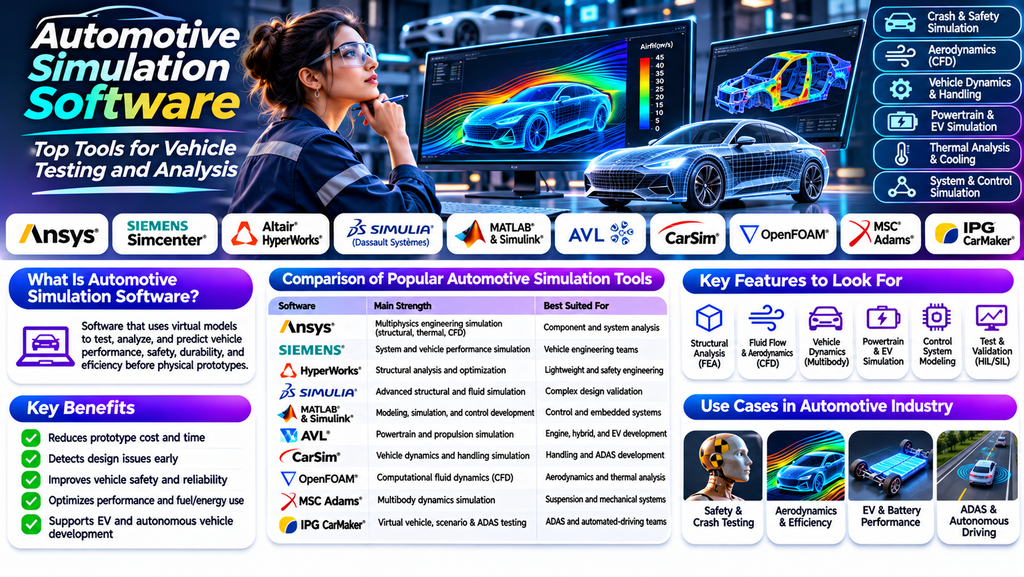
Automotive Simulation Software helps engineers evaluate vehicle performance, safety, durability, and efficiency in a virtual environment before building physical prototypes. These tools use mathematical models and computer-based simulations to study how vehicles and their components behave under different operating conditions.
From crash testing and aerodynamics to engine performance, electric vehicle systems, and autonomous driving, simulation technology plays an important role in modern automotive engineering. It can help manufacturers identify design problems earlier, reduce physical testing costs, and accelerate product development.
What Is Automotive Simulation Software?
Automotive Simulation Software uses computational models to predict the behavior of vehicles, components, and control systems. Depending on the application, it may include finite element analysis (FEA), computational fluid dynamics (CFD), multibody dynamics, powertrain simulation, and hardware-in-the-loop testing.
Engineers use these tools to investigate vehicle handling, structural strength, thermal behavior, fuel consumption, battery performance, and other engineering characteristics.
Top Automotive Simulation Software Tools
1. ANSYS
ANSYS offers engineering simulation tools used to analyze structural performance, fluid flow, thermal behavior, and electromagnetic systems. Automotive engineers can use its solutions to study vehicle components and systems under virtual operating conditions.
Key features:
- Structural and crash-related analysis workflows
- Computational fluid dynamics
- Thermal simulation
- Electric vehicle and battery system analysis
Best for: Automotive engineers conducting multiphysics simulation and component validation.
2. Siemens Simcenter
Siemens Simcenter provides simulation and testing solutions for product engineering. It supports vehicle performance studies, system simulation, durability analysis, and correlation between physical tests and virtual models.
Key features:
- Multibody dynamics
- System simulation
- Durability and fatigue analysis
- Integration with engineering design workflows
Best for: Automotive engineering teams analyzing vehicle dynamics and system performance.
3. Altair HyperWorks
Altair HyperWorks is a computer-aided engineering environment that supports structural analysis, optimization, and lightweight design. It is used to investigate how vehicle components respond to loads and other engineering constraints.
Key features:
- Finite element modeling and analysis
- Structural optimization
- Lightweight engineering workflows
- Multiphysics simulation capabilities
Best for: Engineers focused on structural performance, crashworthiness, and vehicle weight reduction.
4. Dassault Systèmes SIMULIA
SIMULIA provides simulation technologies for evaluating complex engineering behavior, including structural mechanics and fluid dynamics. Its tools can support automotive development from component design to system validation.
Key features:
- Nonlinear structural analysis
- Impact and crash simulation workflows
- Fluid dynamics capabilities
- Design validation and optimization
Best for: Automotive teams analyzing complex material behavior and structural performance.
5. MATLAB and Simulink
MATLAB and Simulink are widely used for modeling, simulation, and control-system development. They are particularly valuable for powertrain control, vehicle dynamics, embedded systems, and model-based development.
Key features:
- Mathematical modeling and data analysis
- Block-diagram system simulation
- Control-system design
- Model-based testing and verification
Best for: Engineers developing vehicle control systems, electric powertrains, and embedded software.
6. AVL Simulation Tools
AVL provides engineering solutions for powertrain development, vehicle simulation, and testing. Its tools support the analysis of conventional engines, hybrid systems, electric powertrains, and energy management.
Key features:
- Powertrain and vehicle modeling
- Engine and hybrid-system simulation
- Electric vehicle system analysis
- Integration with engineering test workflows
Best for: Automotive manufacturers and suppliers working on propulsion systems and vehicle efficiency.
7. CarSim
CarSim is a vehicle dynamics simulation tool used to study how vehicles respond to steering, braking, road surfaces, and other driving conditions. It can be integrated with compatible control-system simulation environments.
Key features:
- Vehicle dynamics modeling
- Handling and ride simulation
- Virtual driving scenarios
- Integration with control-system development tools
Best for: Vehicle dynamics engineers and teams developing advanced driver assistance systems.
8. OpenFOAM
OpenFOAM is an open-source computational fluid dynamics framework that can be used to simulate airflow around vehicles and through vehicle systems. It offers extensive flexibility for users comfortable with technical configuration and computational workflows.
Key features:
- Fluid flow simulation
- Turbulence modeling
- Aerodynamic analysis
- Customizable computational workflows
Best for: Researchers and engineers requiring flexible CFD simulations.
9. MSC Adams
MSC Adams is a multibody dynamics simulation solution used to study the motion and interaction of mechanical systems. Automotive engineers can model suspensions, linkages, and complete vehicle systems.
Key features:
- Multibody dynamics
- Suspension and steering analysis
- Motion and load prediction
- Mechanical system performance studies
Best for: Engineers investigating vehicle motion, ride, handling, and mechanical behavior.
10. IPG CarMaker
IPG CarMaker is a simulation platform for virtual vehicle development, testing, and validation. It supports driving scenarios and can be used in workflows involving advanced driver assistance systems and automated driving functions.
Key features:
- Virtual vehicle and road simulation
- Scenario-based testing
- ADAS and automated-driving workflows
- Integration with software- and hardware-in-the-loop environments
Best for: Automotive teams developing and validating vehicle functions and driver assistance systems.
Comparison of Popular Automotive Simulation Software
| Software | Main strength | Best suited for |
|---|---|---|
| ANSYS | Multiphysics engineering simulation | Component and system analysis |
| Siemens Simcenter | System and vehicle performance simulation | Vehicle engineering teams |
| Altair HyperWorks | Structural analysis and optimization | Lightweight and safety engineering |
| SIMULIA | Advanced structural and fluid simulation | Complex design validation |
| MATLAB and Simulink | System modeling and control development | Control and embedded systems engineers |
| AVL Simulation Tools | Powertrain and propulsion simulation | Engine and EV development teams |
| CarSim | Vehicle dynamics simulation | Handling and ADAS development |
| OpenFOAM | Flexible CFD simulation | Researchers and aerodynamic engineers |
| MSC Adams | Multibody dynamics | Suspension and mechanical system engineers |
| IPG CarMaker | Virtual driving and scenario testing | ADAS and automated-driving teams |
Key Features to Look for in Automotive Simulation Software
Accurate Engineering Models
Choose software that supports the physics, material models, and operating conditions relevant to your engineering problem.
Vehicle Dynamics Simulation
Handling, braking, steering, and ride studies require suitable vehicle and road models.
Structural and Crash Analysis
For safety-related work, evaluate capabilities for nonlinear materials, impact conditions, deformation, and energy absorption.
Aerodynamic and Thermal Analysis
CFD and thermal simulation can help engineers investigate drag, cooling performance, airflow, and heat management.
Powertrain and Battery Modeling
Electric and hybrid vehicles require tools for evaluating batteries, motors, energy consumption, thermal behavior, and control strategies.
Integration with Testing Workflows
Software that connects simulation with physical testing and software- or hardware-in-the-loop environments can support more complete validation.
Benefits of Automotive Simulation Software
- Reduced prototype costs: Evaluate design alternatives virtually before physical testing.
- Earlier problem detection: Identify performance issues during the design stage.
- Improved safety development: Study loads, deformation, and system responses under defined conditions.
- Faster product development: Run repeatable virtual experiments across different configurations.
- Better energy efficiency: Analyze aerodynamic drag, powertrain performance, and energy use.
- Improved system integration: Test interactions between mechanical components and electronic controls.
How to Choose the Right Automotive Simulation Software
- Define your objective: Determine whether you need crash analysis, CFD, vehicle dynamics, powertrain simulation, or control-system development.
- Assess your engineering expertise: Some platforms offer visual workflows, while others require advanced numerical modeling and scripting.
- Check model compatibility: Ensure that CAD geometry, material data, and system models can be imported or exchanged.
- Evaluate computing requirements: Large finite element or CFD models may need significant memory and processing resources.
- Review validation capabilities: Check whether the software supports correlation with experimental measurements.
- Compare licensing and training: Consider the total cost, available support, and learning requirements.
- Run a pilot simulation: Test a representative engineering problem before adopting the platform.
Common Mistakes to Avoid
- Using simulation results without checking model assumptions
- Ignoring mesh quality and numerical convergence
- Applying inaccurate material properties or boundary conditions
- Treating virtual testing as a complete substitute for required physical validation
- Selecting software without considering integration with existing tools
- Overlooking computing resources and staff training
Conclusion
Automotive Simulation Software helps engineers study vehicle performance, safety, aerodynamics, powertrains, and control systems before committing to expensive physical prototypes. Tools such as ANSYS, Siemens Simcenter, Altair HyperWorks, MATLAB and Simulink, CarSim, and IPG CarMaker address different simulation requirements across the automotive development process.
The best solution depends on your engineering objective, model complexity, validation requirements, budget, and existing software environment. Choosing an appropriate simulation platform can help automotive teams make better design decisions and develop safer, more efficient vehicles.
