Upgrade & Secure Your Future with DevOps, SRE, DevSecOps, MLOps!
We spend hours scrolling social media and waste money on things we forget, but won’t spend 30 minutes a day earning certifications that can change our lives.
Master in DevOps, SRE, DevSecOps & MLOps by DevOps School!
Learn from Guru Rajesh Kumar and double your salary in just one year.
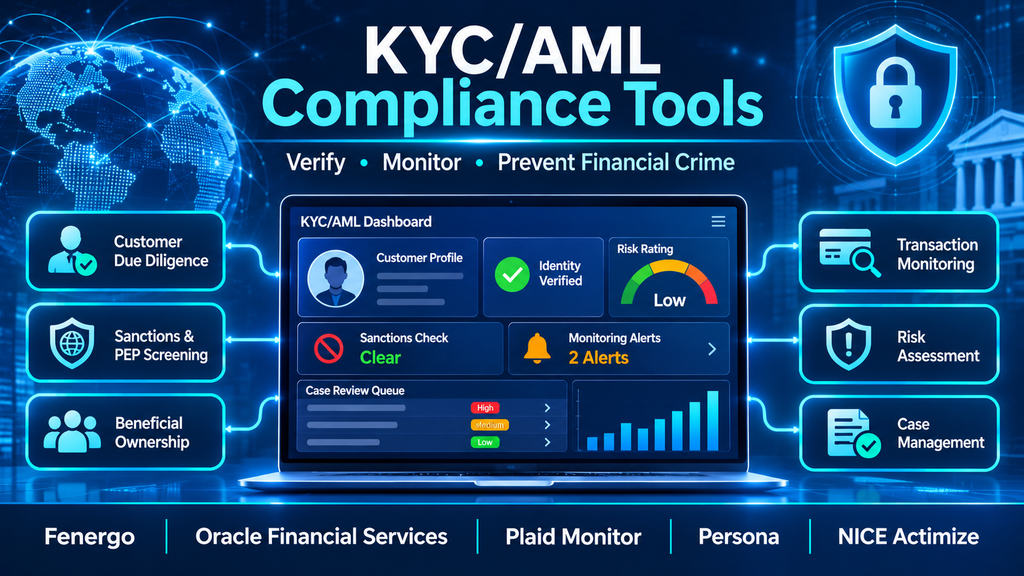
KYC/AML Compliance Tools: Strengthening Customer Due Diligence and Financial Crime Prevention
Introduction
Financial institutions and regulated businesses must understand who their customers are, assess the risks associated with business relationships, and identify activity that may indicate money laundering, terrorist financing, sanctions violations, or other financial crime.
These responsibilities have become increasingly complex as organizations expand into digital onboarding, cross-border payments, online financial services, and global customer markets. Customer identities may involve multiple documents, corporate structures can span jurisdictions, and suspicious activity may emerge long after an account has been opened.
Manual compliance processes often struggle to keep pace with these demands. Fragmented customer records, repetitive document collection, disconnected screening systems, and large alert volumes can increase operational costs and make consistent oversight difficult.
KYC/AML compliance tools help organizations manage these challenges through identity verification, customer due diligence, sanctions screening, risk assessment, transaction monitoring, and investigation workflows. They connect onboarding controls with ongoing financial crime oversight and help preserve evidence of compliance decisions.
The objective is not simply to automate identity checks. It is to establish a reliable process for understanding customer risk throughout the relationship.
What Are KYC/AML Compliance Tools?
KYC/AML compliance tools are software platforms that support customer identification, due diligence, financial crime screening, monitoring, investigation, and regulatory reporting.
KYC, or Know Your Customer, focuses on establishing customer identity, understanding the nature and purpose of a business relationship, and assessing associated risks.
AML, or Anti-Money Laundering, refers to a broader set of controls designed to detect, prevent, and report potential money laundering and related financial crime.
These processes are closely connected but serve different purposes. Identity verification can establish that a person matches an identity document, while AML screening and monitoring assess whether the customer or their activity presents financial crime concerns.
A typical platform may provide:
- Identity and document verification.
- Customer due diligence (CDD).
- Enhanced due diligence (EDD).
- Business verification and beneficial ownership identification.
- Sanctions and politically exposed person (PEP) screening.
- Adverse media screening.
- Customer risk assessment.
- Ongoing customer monitoring.
- Transaction monitoring.
- Alert management and investigations.
- Suspicious activity reporting support.
- Audit trails and compliance reporting.
Some providers offer a broad financial crime platform, while others specialize in identity verification, screening, or specific parts of the compliance lifecycle.
Why Organizations Need KYC/AML Compliance Tools
1. Managing digital customer onboarding
Digital businesses can onboard customers across multiple channels and jurisdictions. Automated identity verification and document processing help reduce manual work while maintaining consistent onboarding controls.
2. Understanding customer and business ownership
Corporate customers may involve subsidiaries, holding companies, trusts, nominees, and multiple beneficial owners.
Compliance teams need to understand ownership and control structures rather than relying only on the name of the immediate business applicant.
3. Screening sanctions and politically exposed persons
Organizations may need to screen customers, beneficial owners, directors, and other relevant parties against applicable sanctions lists and PEP databases.
Screening systems help identify potential matches, but analysts must review the available information to distinguish genuine matches from similar names.
4. Monitoring changing customer risk
A customer’s risk profile can change after onboarding because of new ownership information, changes in geographic exposure, adverse media, sanctions updates, or unusual activity.
Ongoing monitoring helps organizations identify relevant changes instead of relying entirely on periodic reviews.
5. Managing transaction monitoring alerts
Financial institutions may process large numbers of transactions every day. Monitoring systems help identify patterns that may warrant investigation, such as unusual transaction frequency, unexpected geographic activity, or behavior inconsistent with a customer’s profile.
6. Maintaining audit-ready evidence
Compliance teams need to demonstrate what checks were performed, which data sources were used, how risk was assessed, and who approved important decisions.
A centralized platform can make these records easier to retrieve and review.
Core Features of KYC/AML Compliance Software
Identity and document verification
Identity verification establishes whether a customer is who they claim to be.
Depending on the solution, this may involve:
- Government-issued identity document verification.
- Optical character recognition (OCR).
- Document authenticity and tampering checks.
- Facial comparison.
- Liveness detection.
- Database and electronic identity checks.
- Manual review of uncertain cases.
Organizations should evaluate supported document types, countries, verification methods, accessibility, and fallback procedures.
Identity verification is an important KYC component, but it does not independently establish that a customer presents an acceptable financial crime risk.
Customer due diligence
Customer due diligence involves collecting and evaluating information about a customer and the proposed business relationship.
Information may include identity details, occupation, business activity, expected account use, geographic exposure, source of funds, and source of wealth where appropriate.
The objective is to establish a customer risk profile and determine which controls are proportionate to that risk.
Enhanced due diligence
Higher-risk relationships may require additional investigation and approval.
Enhanced due diligence can involve more detailed information about ownership, source of wealth, source of funds, business activities, and relationships with higher-risk jurisdictions or parties.
The platform should support escalation workflows, additional evidence collection, approval requirements, and documented review decisions.
Sanctions and PEP screening
Screening tools compare customer and related-party information against relevant sanctions lists, PEP databases, and other watchlists.
Useful capabilities include:
- Configurable matching thresholds.
- Alias and transliteration matching.
- Date-of-birth and nationality comparison.
- Related-party screening.
- Adverse media screening.
- Ongoing rescreening.
- Alert review and disposition.
- False-positive management.
Screening quality depends on the coverage, freshness, and accuracy of the underlying data sources as well as the matching configuration.
Beneficial ownership and business verification
Know Your Business (KYB) processes help organizations verify companies and understand their ownership and control structures.
Capabilities may include corporate registry checks, director verification, shareholder identification, ownership-chain analysis, and ultimate beneficial owner identification.
These functions are particularly important when onboarding complex corporate entities or cross-border business relationships.
Customer risk assessment
Risk assessment tools evaluate customer information against configurable risk factors.
Common factors include:
- Customer type and business activity.
- Geographic exposure.
- Products and services used.
- Ownership complexity.
- PEP or sanctions-related information.
- Source-of-funds considerations.
- Expected transaction behavior.
The platform should allow organizations to configure risk models according to their policies and applicable obligations. Automated risk ratings should be explainable and subject to appropriate review.
Transaction monitoring
Transaction monitoring evaluates financial activity for patterns that may indicate suspicious behavior.
Detection scenarios may examine transaction amounts, frequency, velocity, counterparties, geographic exposure, and relationships between accounts.
A monitoring platform should support configurable rules, alert generation, prioritization, investigation, and feedback from confirmed outcomes.
Case management and investigation
When a potential concern is identified, analysts need a structured way to review it.
Useful capabilities include:
- Centralized alert queues.
- Customer and transaction context.
- Related-party and entity information.
- Investigation notes and evidence.
- Case assignment and escalation.
- Approval and disposition records.
- Regulatory reporting workflows.
Good case management reduces fragmented investigations and makes decisions easier to reconstruct.
Ongoing monitoring and periodic reviews
Customer risk does not remain constant.
Platforms should support scheduled reviews, event-driven reassessments, ongoing sanctions screening, and notifications when relevant customer information changes.
Review frequency should reflect the organization’s risk assessment and applicable regulatory requirements.
Audit trails and regulatory reporting
Compliance software should preserve records of checks, alerts, decisions, approvals, and changes to customer risk profiles.
Depending on jurisdiction and product configuration, platforms may also support suspicious activity report or suspicious transaction report preparation and related regulatory workflows.
Organizations remain responsible for determining whether reporting is required and ensuring submissions comply with applicable rules.
Leading KYC/AML Compliance Tools
The following platforms represent different approaches to customer due diligence and financial crime compliance. Their suitability depends on organizational size, customer types, jurisdictions, integration requirements, and compliance operating model.
1. Fenergo Client Lifecycle Management and KYC
<text color=”default” weight=”medium”>Key focus: Client lifecycle management, risk-based KYC, and continuous due diligence</text>
Fenergo provides client lifecycle management and KYC capabilities designed for financial institutions.
Its platform supports onboarding, risk-based due diligence, customer data management, beneficial ownership analysis, screening integrations, and ongoing monitoring.
Fenergo’s KYC capabilities include configurable policies and workflows for different customer types and jurisdictions. Its broader client lifecycle approach helps organizations manage customer information beyond initial onboarding, including periodic reviews and changes to customer risk profiles.
The platform is particularly relevant to institutions managing complex corporate relationships, multiple products, and cross-border compliance requirements.
Best suited for: Banks, financial institutions, and organizations with complex client structures and lifecycle management requirements.
2. Oracle Financial Services Crime and Compliance Management
<text color=”default” weight=”medium”>Key focus: Enterprise financial crime compliance, customer due diligence, and investigations</text>
Oracle Financial Services provides financial crime and compliance capabilities for banking and financial institutions.
Its customer due diligence capabilities support customer risk assessment, enhanced due diligence, sanctions and PEP screening, identity-related checks, ongoing monitoring, and investigations.
Oracle’s wider financial crime portfolio also includes transaction monitoring and investigation capabilities. This can help organizations connect customer information with suspicious activity and compliance operations.
Buyers should evaluate the specific Oracle Financial Services modules, data architecture, deployment model, and integration requirements needed for their environment.
Best suited for: Large banks and financial groups seeking enterprise-scale financial crime and compliance capabilities.
3. NICE Actimize
<text color=”default” weight=”medium”>Key focus: Financial crime management, AML monitoring, and investigation workflows</text>
NICE Actimize offers financial crime and compliance solutions that support AML transaction monitoring, customer risk management, sanctions screening, fraud detection, and investigations.
Its broader financial crime portfolio can help organizations connect monitoring alerts with investigation processes and operational controls.
Organizations should examine the relevant modules and how they integrate with customer onboarding, transaction processing, screening data providers, and existing case management systems.
Best suited for: Financial institutions seeking enterprise financial crime management and connected investigation capabilities.
4. Plaid Monitor
<text color=”default” weight=”medium”>Key focus: Watchlist screening and ongoing AML monitoring</text>
Plaid Monitor provides AML compliance capabilities focused on customer screening and ongoing monitoring.
Its published capabilities include screening against sanctions and PEP lists, automatic watchlist updates, ongoing customer rescreening, and case management. Plaid also connects Monitor with its identity verification ecosystem.
This approach can help eligible businesses connect customer identity information with AML screening workflows without managing every watchlist process independently.
Organizations should assess geographic coverage, available data sources, integration requirements, and suitability for their specific regulatory obligations.
Best suited for: Fintechs and digital financial services businesses seeking API-oriented identity and AML screening workflows.
5. Persona
<text color=”default” weight=”medium”>Key focus: Identity verification and configurable compliance workflows</text>
Persona provides identity verification and compliance capabilities through configurable workflows.
Its offerings include document verification, database checks, risk scoring, business verification, watchlist screening, ongoing monitoring, and transaction monitoring capabilities.
The platform’s modular approach can help organizations build customer onboarding and compliance journeys around their specific requirements.
Buyers should confirm which features are generally available, which are in early access or require additional configuration, and which integrations are necessary for their intended use case.
Best suited for: Digital businesses and financial services organizations seeking configurable identity verification and compliance workflows.
KYC/AML Compliance Platform Comparison
| Platform | Primary focus | Potential fit |
|---|---|---|
| Fenergo | Client lifecycle, KYC, risk assessment, transaction compliance | Complex financial institutions |
| Oracle Financial Services | Customer due diligence, screening, AML investigations | Large banks and financial groups |
| NICE Actimize | Financial crime management and transaction monitoring | Enterprise financial crime teams |
| Plaid Monitor | Watchlist screening and ongoing monitoring | API-driven fintech workflows |
| Persona | Identity verification and configurable compliance workflows | Digital onboarding and identity programs |
This comparison reflects broad product positioning, not a universal ranking. Available capabilities, regional coverage, licensing, and integrations should be validated directly with vendors.
Understanding the KYC and AML Compliance Lifecycle
A mature compliance process connects customer onboarding with ongoing risk monitoring.
Step 1: Customer identification
The organization collects relevant customer information, such as name, date of birth, address, identity documents, or company details.
The information required depends on the customer type, product, jurisdiction, and applicable rules.
Step 2: Identity and business verification
The organization verifies the identity of individuals and, where relevant, the legitimacy of business entities.
For corporate customers, this may include company registration, directors, shareholders, ownership structures, and ultimate beneficial owners.
Step 3: Sanctions, PEP, and adverse media screening
Customer and related-party information is screened against relevant lists and information sources.
Potential matches are reviewed using additional identifiers and evidence. A name match alone should not automatically be treated as a confirmed match.
Step 4: Customer risk assessment
The organization evaluates customer characteristics, geographic exposure, business activity, ownership structure, products, and expected relationship behavior.
The resulting risk classification helps determine the level of due diligence and ongoing monitoring required.
Step 5: Enhanced due diligence where necessary
Higher-risk relationships may require additional information, supporting evidence, and senior approval.
The platform should record why enhanced checks were required and how the resulting concerns were resolved.
Step 6: Ongoing monitoring
After onboarding, the organization monitors relevant customer changes, sanctions updates, and transaction activity.
The objective is to identify new risks that were not present or known when the relationship began.
Step 7: Investigation and reporting
Potentially suspicious activity is routed to appropriate compliance personnel.
Analysts document evidence, review related activity, make decisions, and escalate or report matters where required by applicable rules.
Common Implementation Challenges
Fragmented customer data
KYC information may be distributed across onboarding applications, CRM systems, document repositories, transaction platforms, and external data providers.
Incomplete or inconsistent records can lead to repeated customer requests and weak risk assessments.
A unified customer record and well-designed integration strategy can help address this issue.
Complex ownership structures
Corporate relationships can involve multiple layers of entities and individuals across jurisdictions.
Organizations need tools that can identify beneficial owners, visualize relationships, and preserve supporting evidence.
Sanctions screening false positives
Common names, transliteration differences, incomplete dates of birth, and limited customer information can create potential matches that are not genuine.
Matching thresholds should be configured carefully and supported by analyst review procedures.
Inconsistent risk scoring
Different teams may apply different interpretations of customer risk.
A configurable and documented risk methodology helps improve consistency, provided the underlying assumptions and scoring factors are regularly reviewed.
Excessive transaction monitoring alerts
Poorly calibrated rules can produce large numbers of low-value alerts.
This increases analyst workload and can delay the investigation of more significant cases.
Monitoring scenarios should be tested against historical data and refined using documented performance measures.
Changing regulatory requirements
KYC and AML obligations vary by jurisdiction, industry, product, and customer type.
Organizations need a process for tracking regulatory changes and updating internal policies, workflows, and risk models accordingly.
Limited audit visibility
If checks, approvals, and investigation decisions are stored in different systems, reconstructing a customer history can become difficult.
Centralized audit records and consistent case documentation improve traceability.
How to Select the Right KYC/AML Platform
1. Map customer types and jurisdictions
Identify the individuals, companies, beneficial owners, counterparties, and other entities the organization needs to assess.
Document the jurisdictions and products involved before evaluating vendor coverage.
2. Define verification requirements
Determine whether the business needs document verification, biometric checks, database verification, corporate registry data, or combinations of these capabilities.
3. Evaluate screening coverage
Ask vendors which sanctions lists, PEP sources, adverse media sources, and geographic databases are included.
Check how frequently data is updated and how matching results can be reviewed.
4. Examine beneficial ownership capabilities
For corporate onboarding, assess how the platform identifies ownership chains, directors, shareholders, and ultimate beneficial owners.
Test complex structures rather than relying only on simple company examples.
5. Review risk assessment and due diligence workflows
Confirm that the system supports customer risk models, enhanced due diligence, periodic reviews, and event-driven reassessment.
6. Assess transaction monitoring
Evaluate supported monitoring scenarios, rule configuration, alert prioritization, explainability, and feedback mechanisms.
Test using representative transaction data wherever possible.
7. Validate case management and reporting
Review how analysts investigate alerts, attach evidence, record decisions, escalate cases, and prepare regulatory reporting documentation.
8. Check integrations and security
Assess APIs, identity systems, core banking platforms, payment systems, data providers, access controls, encryption, data residency, and retention.
9. Calculate total cost of ownership
Consider implementation, data-source subscriptions, verification volumes, monitoring modules, integrations, maintenance, analyst training, and ongoing administration.
A Practical Implementation Roadmap
Phase 1: Risk and obligation mapping
Identify relevant customer segments, products, jurisdictions, financial crime risks, and compliance responsibilities.
Phase 2: Process design
Define customer onboarding, verification, screening, risk rating, enhanced due diligence, periodic reviews, escalation, and reporting workflows.
Phase 3: Data and integration planning
Map customer, identity, corporate, transaction, and screening data sources. Define integration methods and data quality requirements.
Phase 4: Platform configuration
Configure risk models, screening thresholds, monitoring rules, workflow assignments, approval requirements, and audit logging.
Phase 5: Historical testing
Test screening and transaction monitoring against representative historical records. Review match quality, false positives, missed scenarios, and alert volumes.
Phase 6: Controlled pilot
Deploy the solution for a limited customer segment, product, or jurisdiction. Measure onboarding efficiency, review quality, analyst workload, and system performance.
Phase 7: Continuous governance
Monitor platform performance, update risk scenarios, review data-provider coverage, validate model changes, and maintain audit evidence.
The Role of AI in KYC/AML Compliance
AI can help compliance teams process information, identify patterns, and prioritize investigations.
Potential applications include:
- Extracting information from identity and corporate documents.
- Identifying inconsistencies in customer records.
- Resolving entities across different data sources.
- Prioritizing sanctions and adverse media alerts.
- Detecting unusual transaction patterns.
- Summarizing customer relationships and investigation histories.
- Supporting suspicious activity report preparation.
However, AI introduces important governance requirements.
Organizations should validate model performance, monitor false positives and false negatives, document decision logic, protect sensitive customer information, and ensure that automated outputs receive appropriate human oversight.
A generated summary should not replace the underlying evidence. A model-generated risk score should not become an unexplained substitute for a documented customer risk assessment.
The compliance function must retain accountability for decisions and regulatory obligations.
Conclusion
KYC/AML compliance tools help organizations connect identity verification, customer due diligence, sanctions screening, risk assessment, transaction monitoring, and investigation into a controlled customer lifecycle.
Fenergo, Oracle Financial Services, NICE Actimize, Plaid Monitor, and Persona represent different approaches to these requirements. The right choice depends on customer complexity, geographic coverage, transaction channels, data quality, integration needs, and the organization’s compliance operating model.
A strong platform does more than automate checks. It helps an organization understand who it is doing business with, identify when risk changes, investigate concerns consistently, and demonstrate how compliance decisions were made.
