Upgrade & Secure Your Future with DevOps, SRE, DevSecOps, MLOps!
We spend hours scrolling social media and waste money on things we forget, but won’t spend 30 minutes a day earning certifications that can change our lives.
Master in DevOps, SRE, DevSecOps & MLOps by DevOps School!
Learn from Guru Rajesh Kumar and double your salary in just one year.
Introduction
Data is the engine behind every modern product. It powers dashboards, recommendations, fraud detection, customer insights, and business decisions. However, data is only useful when it is clean, secure, and available on time. Many teams struggle with the same problems: pipelines fail silently, costs grow without warning, access becomes messy, and data quality becomes unreliable. This is where a strong data engineering skillset matters. AWS Certified Data Engineer – Associate is designed for professionals who build and operate data systems on AWS. It validates your ability to design pipelines, choose the right storage and processing approach, apply governance and security, and keep the platform stable and cost-aware. You don’t just learn tools—you learn how to think like a production-ready data engineer.
Who this guide is for
Engineers
- Data Engineers and Analytics Engineers building pipelines and models
- Cloud Engineers moving into data platforms
- Platform Engineers and SREs supporting data infrastructure
- Developers who own ingestion, processing, or reporting flows
Managers
- Engineering Managers and Tech Leads who review designs
- Managers who want to understand trade-offs, risks, and cost controls
- Leaders planning data platform roadmaps
Why this certification matters for engineers and managers
For engineers
- You learn clear patterns for batch and streaming ingestion.
- You strengthen your skills in data storage, transformation, and serving.
- You understand reliability topics like retries, backfills, and late-arriving data.
- You improve security, governance, and access control thinking.
- You learn how to optimize performance and keep costs under control.
For managers
- You get a common language to evaluate data platform decisions.
- You can review architectures with confidence.
- You can ask better questions about governance, risks, and reliability.
- You can set standards for your team and reduce platform surprises.
Where AWS Certified Data Engineer – Associate fits in the AWS certification landscape
AWS certifications broadly follow this learning flow:
- Foundational: for basic cloud understanding
- Associate: for hands-on practitioners
- Professional: for complex architecture and operations leadership
- Specialty: for deep domain expertise (security, networking, ML, etc.)
This certification sits at the Associate level but focuses on data engineering outcomes: pipelines, lake/warehouse patterns, governance, security, monitoring, and cost control.
Certification table (Track, Level, Audience, Prereqs, Skills, Order, Link)
| Track | Level | Certification | Who it’s for | Prerequisites (practical) | Skills covered | Recommended order |
|---|---|---|---|---|---|---|
| Core Cloud | Foundational | AWS Certified Cloud Practitioner | New to cloud, managers, early-career engineers | Basic cloud concepts | Cloud basics, security basics, billing basics | Optional first step |
| Architecture | Associate | AWS Certified Solutions Architect – Associate | Cloud engineers, architects | AWS basics + design thinking | Secure, resilient architectures | Good before or alongside |
| Operations | Associate | AWS Certified CloudOps Engineer – Associate | Ops, SRE, platform engineers | Monitoring + ops basics | Operations, reliability, automation | Good before ops-heavy roles |
| Development | Associate | AWS Certified Developer – Associate | App developers | AWS deployment basics | Build/deploy/debug apps | Optional based on role |
| Data | Associate | AWS Certified Data Engineer – Associate | Data engineers, analytics engineers, cloud data specialists | ETL/ELT basics + AWS data services exposure | Pipelines, lake/warehouse, governance, security, monitoring, cost | After fundamentals or architecture |
| DevOps | Professional | AWS Certified DevOps Engineer – Professional | DevOps/platform leads | Strong CI/CD + ops | Advanced delivery and ops design | After associate level |
| Architecture | Professional | AWS Certified Solutions Architect – Professional | Senior architects | Strong architecture experience | Large-scale complex systems | After SAA |
| Security | Specialty | AWS Certified Security – Specialty | Security engineers | AWS security fundamentals | Security controls, monitoring, governance | After associate basics |
| Networking | Specialty | AWS Certified Advanced Networking – Specialty | Network specialists | VPC + hybrid networking | Advanced network design | After SAA |
| Machine Learning | Specialty | AWS Certified Machine Learning – Specialty | ML specialists | Strong ML fundamentals | ML design, training, tuning | After ML foundation |
What is AWS Certified Data Engineer – Associate?
AWS Certified Data Engineer – Associate validates that you can build and run data systems on AWS in a production-ready way. That means you can:
- Ingest data reliably (batch and streaming)
- Store it properly (lake, curated layers, warehouse)
- Transform and model it safely (ETL/ELT)
- Secure and govern it (access control, encryption, audit readiness)
- Monitor it (metrics, logs, alerts)
- Optimize it (performance and cost)
It is designed for people who want to prove practical data engineering capability in cloud projects.
What you’ll learn at a practical level
1) Data ingestion patterns
You will learn how to choose the right ingestion approach:
- Batch ingestion for scheduled loads (daily, hourly, weekly)
- Streaming ingestion for near real-time events
- Change Data Capture patterns for database replication style needs
- Handling schema changes without breaking consumers
- Preventing duplicates and data loss
2) Storage and lakehouse thinking
You will learn how to design storage that scales:
- Raw, cleaned, and curated layers
- Partitioning strategies for performance
- File formats and compaction ideas
- Cataloging and discoverability so teams can find data fast
3) Processing and transformation
You will learn how to build transformations that are stable:
- ETL/ELT concepts and when each is better
- Job orchestration and dependency management
- Handling late data, backfills, retries, and partial failures
- Data quality checks built into the workflow
4) Serving and analytics
You will learn how data is delivered to users:
- Warehouse vs query-on-lake decisions
- Reducing query costs and improving performance
- Reporting refresh reliability
- Supporting both analysts and applications
5) Governance, security, and compliance
You will strengthen security habits:
- Least privilege access
- Encryption expectations
- Audit thinking and traceability
- Data access approval logic and role separation
6) Monitoring, reliability, and cost control
You will learn how to keep systems stable:
- Monitoring what matters (freshness, completeness, latency)
- Alerting with actionable signals
- Cost levers in storage, queries, and compute
- Performance bottlenecks and tuning mindset
Certification mini-sections (consistent format)
AWS Certified Data Engineer – Associate
What it is
It is an AWS certification that proves you can design and operate production-ready data pipelines and analytics systems. It focuses on ingestion, storage, transformation, governance, security, monitoring, performance, and cost awareness.
Who should take it
- Data Engineers who build and maintain pipelines and lakes
- Analytics Engineers who run ELT workflows and optimize warehouses
- Cloud Engineers moving into data platforms
- Platform Engineers who support data teams and shared data services
- SREs supporting reliability and observability of data workloads
- Engineering Managers who want deeper clarity for reviews and decisions
Skills you’ll gain (bullets)
- Build batch ingestion pipelines with clear scheduling and validation
- Build streaming ingestion pipelines with controlled schema evolution
- Design data lake layers (raw → cleaned → curated) that are easy to manage
- Apply cataloging and governance so teams can discover and access data safely
- Create ETL/ELT transformations with error handling and repeatability
- Use orchestration patterns for multi-step workflows and dependencies
- Add data quality checks that block bad data early
- Secure data with least privilege access and encryption expectations
- Monitor pipeline health using freshness, completeness, and latency metrics
- Tune performance and reduce cost using storage, partitioning, and query discipline
Real-world projects you should be able to do after it (bullets)
- Build a batch pipeline from a database extract into a lake, with validation and partitioning
- Build a streaming event pipeline, with duplicate handling and a stable schema plan
- Build a curated “gold layer” table set used by dashboards and product reporting
- Create an orchestration workflow that manages retries, reruns, and dependencies
- Implement data quality gates for nulls, duplicates, freshness, and schema checks
- Add monitoring and alerting so pipeline failures are detected quickly
- Optimize analytics cost by improving query patterns and storage layout
- Apply access control policies and encryption standards in a clean, repeatable way
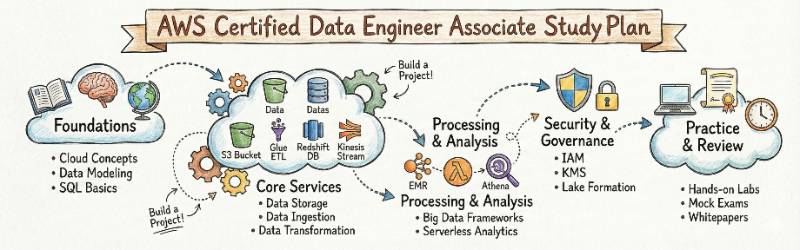
Preparation plan (7–14 days / 30 days / 60 days)
7–14 days plan (for experienced AWS data engineers)
- Day 1–2: List the major topics and map them to what you already do. Note weak areas.
- Day 3–5: Focus on weak zones first: governance, security, monitoring, cost controls.
- Day 6–8: Build one batch pipeline end-to-end and document each decision.
- Day 9–10: Build one streaming pipeline end-to-end and simulate duplicates and late events.
- Day 11–12: Add quality gates, retries, backfills, and operational checks.
- Day 13–14: Review with practice questions, revisit mistakes, and tighten notes.
30 days plan (most working professionals)
- Week 1: AWS data services overview + ingestion patterns (batch + streaming)
- Week 2: Storage and lakehouse patterns + partitioning + catalog and governance basics
- Week 3: ETL/ELT transformations + orchestration + failure handling and backfills
- Week 4: Security + monitoring + performance and cost optimization + revision and tests
60 days plan (for people new to AWS data engineering)
- Weeks 1–2: Cloud basics, IAM basics, storage basics, and common data engineering terms
- Weeks 3–4: Ingestion patterns and hands-on labs (batch + streaming)
- Weeks 5–6: Transformation patterns, orchestration, retries, and real-world failure handling
- Weeks 7–8: Governance, security, monitoring, cost control, mock tests, and revision
Common mistakes
- Learning only services, not patterns like retries, backfills, and idempotency
- Ignoring governance and security, then failing questions about access control
- Skipping monitoring and alerting, which are critical in production pipelines
- Forgetting cost thinking, especially for storage and query-heavy workloads
- Not practicing schema evolution and late-arriving data scenarios
- Over-focusing on one tool and missing the bigger end-to-end workflow
Best next certification after this
Choose based on your direction:
- Architecture growth: Solutions Architect – Associate (if you want stronger system design)
- Ops and reliability growth: CloudOps Engineer – Associate (if you run pipelines in production)
- Security growth: Security – Specialty (if your work includes sensitive data and compliance)
Choose your path (6 learning paths, expanded)
1) DevOps path
This path is best if your main goal is automation, delivery reliability, and platform enablement.
- Learn cloud fundamentals so you can design pipelines that work with CI/CD and ops tooling.
- Add Data Engineer – Associate to handle operational data, telemetry, analytics, and platform reporting.
- Next step is professional-level delivery and operations certifications if you lead CI/CD and platform improvements.
Best fit roles: DevOps Engineer, Platform Engineer, Automation Engineer
2) DevSecOps path
This path is best if you build pipelines that handle sensitive data or you design access controls.
- Focus on governance, encryption, and least privilege.
- Use Data Engineer – Associate as a base to understand data access and data movement.
- Move next into deeper security learning to handle audits, compliance questions, and security reviews.
Best fit roles: DevSecOps Engineer, Security Engineer, Cloud Security Specialist
3) SRE path
This path is best if you are responsible for uptime and reliability of data platforms.
- Treat pipelines like production services.
- Use monitoring, alerting, and incident thinking.
- Learn how to reduce failures through retries, safe reruns, and operational runbooks.
Best fit roles: SRE, Production Engineer, Reliability Lead for data systems
4) AIOps/MLOps path
This path is best if your career connects data engineering with ML systems and automation.
- Data Engineer – Associate strengthens data foundations for training and inference systems.
- Strong data pipelines reduce ML failure risk and model quality issues.
- Next move into ML engineering concepts to connect data pipelines with feature and model workflows.
Best fit roles: MLOps Engineer, ML Platform Engineer, Data + ML Engineer
5) DataOps path
This path is best if you want faster, safer, repeatable data delivery.
- Focus on versioning, testing, pipeline quality gates, and release discipline.
- Build quality and reliability into every step.
- Data Engineer – Associate becomes your core base and then you deepen operational maturity.
Best fit roles: DataOps Engineer, Analytics Platform Engineer, Data Platform Owner
6) FinOps path
This path is best if cost control is a major part of your job.
- Data platforms can become expensive quickly if you don’t manage usage and performance.
- Learn storage layouts, query discipline, and cost tracking.
- Use Data Engineer – Associate to make decisions that protect budgets while keeping performance strong.
Best fit roles: FinOps Practitioner, Cloud Cost Analyst, Engineering Manager owning cost outcomes
Role → Recommended certifications
| Role | What you should focus on | Recommended certification direction |
|---|---|---|
| DevOps Engineer | Automation, reliability, delivery pipelines, platform enablement | Cloud basics → architecture basics → ops maturity → professional-level delivery |
| SRE | Monitoring, incident response, reliability, capacity planning | Ops certification first → architecture reinforcement → professional-level reliability |
| Platform Engineer | Shared platforms, standardization, developer enablement | Architecture + ops → professional-level DevOps + optional data specialization |
| Cloud Engineer | Cloud design, migration, operational stability | Architecture as base → choose data or ops based on project needs |
| Security Engineer | IAM, governance, audit readiness, secure design | Architecture base → security specialization → add data certification if handling governed data |
| Data Engineer | Pipelines, modeling, governance, monitoring | Data Engineer – Associate as core → add architecture/ops/security based on role |
| FinOps Practitioner | Cost control, usage tracking, budget discipline | Cloud basics → architecture cost thinking → data analytics cost control |
| Engineering Manager | System decisions, risks, cost trade-offs, reliability expectations | Cloud fundamentals → architecture base → pick one domain (data/security/ops) to deepen |
Next certifications to take (3 options)
1) Same track (data-focused growth)
Choose this if you want to stay deep in data engineering:
- Strengthen architecture skills for better platform design decisions.
- Add more operational maturity for stable pipelines.
- Build advanced patterns like multi-account governance and shared lakehouse standards.
2) Cross-track (security or operations)
Choose this if your job includes production responsibility or sensitive data:
- Security track helps with access control, audit readiness, and governance.
- Operations track helps with monitoring, incident response, and reliability engineering.
3) Leadership direction (professional-level depth)
Choose this if you lead teams or design platforms across business units:
- Professional-level certifications help you handle larger architectures and complex systems.
- You learn trade-offs, standardization, and enterprise-level design patterns.
Top institutions that help with Training cum Certifications
DevOpsSchool
DevOpsSchool provides structured training that is aligned to the certification objectives and real job scenarios. The learning style suits working professionals because it focuses on practical workflows, not just theory. Many learners prefer the guided hands-on approach for building pipelines, applying governance, and practicing production-style troubleshooting. It also supports corporate training, which helps teams follow a common standard.
Cotocus
Cotocus is often chosen by learners who want practical coaching and structured mentoring. It suits professionals who want to connect certification learning to real project outcomes. The learning experience is generally focused on building confidence through scenario practice and clear step-by-step progress.
ScmGalaxy
ScmGalaxy supports learners who prefer a guided approach with a focus on fundamentals and steady progress. It is useful when you want a structured plan and practice-based revision. Many learners use it to strengthen both conceptual understanding and job readiness through consistent learning routines.
BestDevOps
BestDevOps typically appeals to learners who want a direct, outcome-focused approach. It is a good fit when you want hands-on practice and a practical preparation plan that fits into busy work schedules. Many learners value training that is built around real implementation patterns.
DevSecOpsSchool
DevSecOpsSchool is a strong choice if you want your data engineering knowledge to include security thinking from the start. It supports learners who deal with sensitive data, governance needs, and compliance questions. This can improve how you design access control and reduce security gaps in pipelines.
SRESchool
SRESchool is helpful if your role is tied to reliability and production stability. It builds habits around monitoring, incident response, and operational readiness. This is useful for data platforms where failures can cause business reporting issues and decision delays.
AIOpsSchool
AIOpsSchool is relevant for professionals who want to connect monitoring data with automation and intelligent operations. It helps you think about signals, alerts, and operational insights. This becomes useful when you run large-scale pipelines and need strong observability practices.
DataOpsSchool
DataOpsSchool is a good fit for teams aiming to deliver data faster and safer. It supports learning around testing, versioning, quality gates, and predictable releases for data pipelines. This complements AWS data engineering well because it reduces pipeline risk in real production setups.
FinOpsSchool
FinOpsSchool is useful when cost control is a serious requirement. Data platforms can become expensive without clear cost discipline and performance thinking. This training direction helps you understand cost drivers and build habits that keep analytics and storage spending stable.
FAQs — difficulty, time, prerequisites, sequence, value, career outcomes
- Is AWS Certified Data Engineer – Associate difficult?
It is manageable if you already build pipelines on AWS. It becomes harder if you are new to cloud data services and have not done hands-on projects. - How much time do I need to prepare?
Many working professionals do it in 30–60 days. If you already work daily in AWS data projects, a focused 7–14 day plan can work. - Do I need to complete another AWS certification first?
Not mandatory, but cloud fundamentals and architecture understanding make preparation much easier. - What practical knowledge helps the most?
ETL/ELT basics, data pipeline troubleshooting, storage layout thinking, and basic access control understanding. - Is hands-on practice required?
Strongly yes. Reading is not enough. The best learning comes from building, breaking, and fixing pipelines. - Which topics are most important?
Ingestion patterns, storage design, transformations, governance and security, monitoring, and cost control. - What is the best sequence if I am new to AWS?
Start with cloud basics, then basic architecture, then take this certification with a strong hands-on plan. - Does this certification help with job switching?
Yes, especially when you can show real projects. Hiring managers trust projects more than certificates alone. - What career outcomes can I expect?
You become credible for owning data pipelines, improving reliability, and supporting analytics platforms in cloud teams. - What are the most common reasons people fail?
They ignore governance and monitoring, do not practice failure scenarios, and rely only on memorization. - Is this useful for managers and leads?
Yes, because it improves decision-making around cost, risk, governance, and architecture reviews. - What should I do immediately after passing?
Choose your next step: deepen data track skills, cross into security or ops, or move toward leadership-level certifications.
FAQs — AWS Certified Data Engineer – Associate (Q&A)
- What does this certification validate in simple words?
It proves you can build and operate data pipelines and analytics systems on AWS with reliability, security, governance, and cost awareness. - Who should take it first: a Data Engineer or a Cloud Engineer?
Both can take it. Data Engineers benefit directly. Cloud Engineers benefit when they work on data platforms or want to move into data roles. - Do I need deep programming skills for this?
You should understand data transformations and workflow logic. You do not need to be an expert programmer, but you must be comfortable with how pipelines behave. - What should I practice the most during preparation?
End-to-end workflows, retries, backfills, late data handling, schema evolution, and access control decisions. - How do I know I am exam-ready?
You can explain design trade-offs, handle pipeline failures, and choose cost-aware storage and processing options with confidence. - What is the biggest hidden skill tested?
Production thinking: monitoring, reliability, governance, and cost control are often underestimated. - What is a good next move if I want stronger security?
Build a solid base in IAM and governance thinking, then move into security-focused certifications once your fundamentals are strong. - What is a good next move if I run pipelines in production?
Strengthen operations and reliability skills, then progress toward advanced delivery and operational maturity.
Conclusion
AWS Certified Data Engineer – Associate is a strong step for anyone who wants to build data systems that work reliably in the real world. It pushes you beyond “moving data” and into production thinking—how to design pipelines that are stable, secure, monitored, and cost-aware. If you follow a hands-on preparation plan, you will gain confidence in handling common pipeline failures like schema changes, late data, duplicates, and partial job failures. After passing, your best next step is to pick a clear direction: go deeper in data, cross into security or operations, or move toward leadership-level certifications. Most importantly, keep building real projects—because real practice is what turns certification knowledge into career growth.