Upgrade & Secure Your Future with DevOps, SRE, DevSecOps, MLOps!
We spend hours scrolling social media and waste money on things we forget, but won’t spend 30 minutes a day earning certifications that can change our lives.
Master in DevOps, SRE, DevSecOps & MLOps by DevOps School!
Learn from Guru Rajesh Kumar and double your salary in just one year.
Introduction
The modern software landscape has shifted from simply delivering features to ensuring those features are consistently available, scalable, and performant. This evolution has made the role of a Site Reliability Engineer (SRE) one of the most critical positions in the technology sector. This guide focuses on the Certified Site Reliability Professional, a comprehensive program designed to bridge the gap between traditional operations and modern software engineering.
Whether you are a software engineer looking to understand production environments or a systems administrator transitioning to a code-first mindset, this guide provides a roadmap for your journey. It is hosted and delivered by Sreschool, a platform dedicated to high-concurrency and high-availability engineering. As companies move toward cloud-native architectures and platform engineering, holding a recognized certification helps professionals validate their expertise in managing complex, distributed systems. This guide aims to help you make an informed decision about your career trajectory and how this specific certification fits into the broader DevOps and cloud ecosystem.
What is the Certified Site Reliability Professional?
The Certified Site Reliability Professional represents a paradigm shift in how technical professionals approach infrastructure. Unlike traditional certifications that focus on specific cloud provider tools or syntax, this program focuses on the core principles of reliability engineering. It exists to standardize the knowledge required to handle large-scale distributed systems, emphasizing the engineering aspect of the role.
The curriculum is built around real-world, production-focused learning. It covers the implementation of Service Level Objectives (SLOs), error budget management, and the reduction of toil through intelligent automation. In a modern enterprise, reliability is not an afterthought but a primary feature of the product. This certification aligns with current industry workflows where engineers are expected to write code to manage infrastructure, respond to incidents with post-mortem analysis, and build resilient systems that can survive failures.
Who Should Pursue Certified Site Reliability Professional?
This certification is designed for a broad spectrum of technical professionals who are involved in the lifecycle of software production. Software engineers who want to take ownership of their code in production will find the reliability patterns invaluable. Similarly, DevOps engineers and Cloud Architects can use this program to move beyond CI/CD pipelines and focus on the long-term stability and observability of their environments.
Beginners in the field can use this as a foundational pillar to understand how enterprise-grade systems operate. Experienced engineers and managers benefit by learning how to quantify reliability, which allows for better decision-making regarding feature velocity versus system stability. In the context of the global market, where digital transformation is accelerating, professionals who can prove they understand the nuances of high-scale system operations are in extremely high demand.
Why Certified Site Reliability Professional is Valuable and Beyond
The demand for reliability expertise is not tied to a single tool or a specific cloud vendor. As long as businesses rely on digital services, the need for engineers who can maintain those services will persist. This certification offers longevity because it teaches first-principles thinking. Tools like Kubernetes or Terraform may change, but the concepts of monitoring, alerting, and incident response remain constant across the industry.
By pursuing the Certified Site Reliability Professional, you are making a strategic investment in your career. Enterprise adoption of SRE practices is growing as organizations realize that downtime translates directly to lost revenue and damaged reputation. For a professional, this means better job security, higher salary potential, and the ability to work on the most challenging and impactful projects within an organization. It provides a significant return on time by focusing on the skills that actually matter in a high-stakes production environment.
Certified Site Reliability Professional Certification Overview
The Certified Site Reliability Professional program is delivered through a structured digital learning environment hosted on the official site. It is designed to be rigorous yet accessible, focusing on a mix of theoretical frameworks and practical application. The certification ownership lies with an organization dedicated to operational excellence, ensuring that the content is updated to reflect the latest industry shifts.
The assessment approach typically involves a combination of knowledge-based exams and hands-on scenarios. This ensures that a certified professional does not just know the definitions but can actually apply SRE principles to solve real-world problems. The structure is modular, allowing learners to progress through different stages of expertise while building a portfolio of reliability-focused projects.
Certified Site Reliability Professional Certification Tracks & Levels
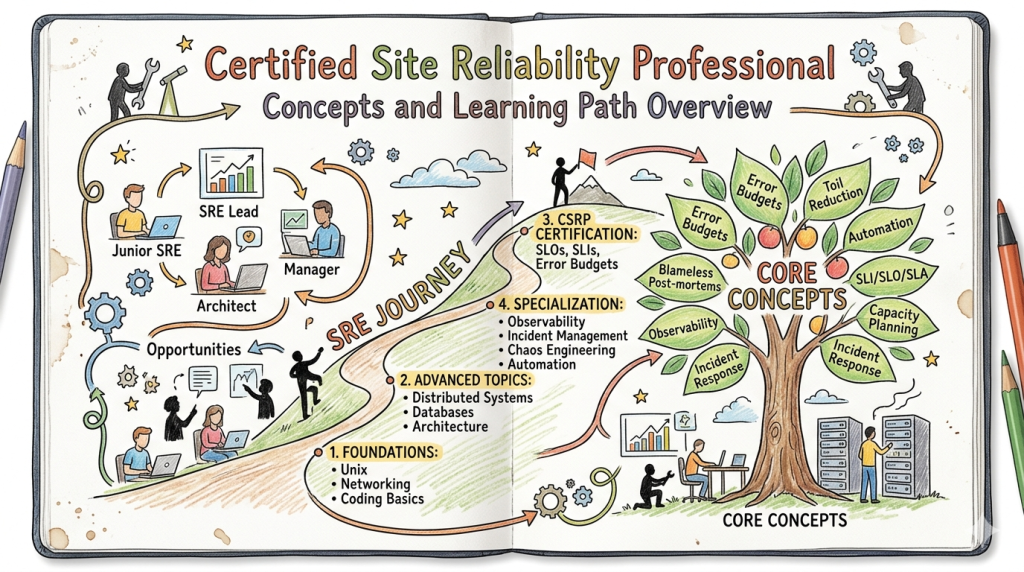
The certification is structured to support a professional at every stage of their career, from an entry-level associate to a high-level architect. The Foundation level introduces the core vocabulary and concepts of SRE, such as the pillars of observability and the importance of blameless culture. This is the entry point for most professionals entering the domain.
As one progresses to the Professional and Advanced levels, the focus shifts toward complex system design, chaos engineering, and fleet management. There are also specialization tracks that allow engineers to map their SRE knowledge to specific domains like FinOps (focusing on cost-effective reliability) or DevSecOps (focusing on secure reliability). This tiered approach ensures that your learning path aligns perfectly with your current job responsibilities and future career aspirations.
Complete Certified Site Reliability Professional Certification Table
| Track | Level | Who it’s for | Prerequisites | Skills Covered | Recommended Order |
| Core SRE | Foundation | Junior Engineers | Basic Linux & Networking | SLOs, SLIs, Toil, Monitoring | First |
| Core SRE | Professional | DevOps/SRE with 2+ years | Foundation Level | Incident Mgmt, Automation, IaC | Second |
| Core SRE | Advanced | Senior SREs/Architects | Professional Level | Chaos Engineering, System Design | Third |
| Specialized | FinOps SRE | Cloud Financial Analysts | Basic Cloud Knowledge | Cost-based SLIs, Cloud Economics | Optional |
| Specialized | Security SRE | Security Engineers | Security Fundamentals | Zero Trust, Vulnerability Management | Optional |
Detailed Guide for Each Certified Site Reliability Professional Certification
Certified Site Reliability Professional – Foundation
What it is
This certification validates a candidate’s understanding of the fundamental principles of Site Reliability Engineering. It covers the core philosophy of SRE and how it differs from traditional IT operations and DevOps.
Who should take it
This is ideal for fresh graduates, junior software engineers, and systems administrators who are new to the SRE world. It is also suitable for project managers who need to understand the technical language used by their engineering teams.
Skills you’ll gain
- Understanding of SLIs, SLOs, and SLAs.
- Ability to identify and categorize technical toil.
- Knowledge of the SRE engagement model.
- Basics of monitoring and alerting strategies.
- Familiarity with the concepts of error budgets.
Real-world projects you should be able to do
- Define and document Service Level Objectives for a simple web application.
- Create a basic monitoring dashboard using standard industry tools.
- Draft a blameless post-mortem report for a hypothetical service outage.
Preparation plan
- 7-14 days: Review the core SRE handbook and familiarize yourself with the basic terminology.
- 30 days: Engage with online modules, take practice quizzes, and set up a basic monitoring stack on a local machine.
- 60 days: Thoroughly document a mock system’s reliability metrics and participate in community study groups.
Common mistakes
- Focusing too much on specific tools rather than the underlying SRE principles.
- Underestimating the importance of cultural aspects like blamelessness.
- Ignoring the mathematical logic behind error budget calculations.
Best next certification after this
- Same-track option: Certified Site Reliability Professional – Professional.
- Cross-track option: Certified DevOps Associate.
- Leadership option: Technical Team Lead Foundation.
Choose Your Learning Path
DevOps Path
The DevOps path focuses on the synergy between development and operations through the lens of SRE. It emphasizes building pipelines that are not just fast, but inherently reliable. Professionals in this path learn how to integrate testing and deployment with reliability gates, ensuring that only stable code reaches the production environment. It is the ideal path for those who want to remain deeply involved in the software delivery lifecycle while ensuring operational excellence.
DevSecOps Path
In the DevSecOps path, reliability and security are treated as two sides of the same coin. This path focuses on building resilient systems that are also secure by design. Learners explore how to automate security checks within the SRE framework and how to respond to security incidents using SRE principles like post-mortems and automated remediation. This is perfect for engineers who want to specialize in the intersection of infrastructure stability and cybersecurity.
SRE Path
The pure SRE path is for those who want to dedicate their careers to the science of reliability. It follows the traditional Google-pioneered model, focusing heavily on reducing toil, managing error budgets, and building internal tools to manage production systems. This path is deeply technical and requires a strong software engineering mindset applied to infrastructure problems. It is best for professionals who enjoy solving complex architectural challenges.
AIOps Path
The AIOps path is designed for engineers looking to leverage artificial intelligence to improve system reliability. This path covers how to use AI models to predict outages, automate root cause analysis, and manage the vast amounts of data generated by modern monitoring systems. As environments become too complex for human intervention alone, the AIOps path provides the skills needed to manage infrastructure at an algorithmic scale.
MLOps Path
The MLOps path focuses on the specific reliability challenges of machine learning production systems. Unlike traditional software, ML models require continuous monitoring for data drift and model decay. This path teaches SREs how to apply reliability principles to the ML lifecycle, ensuring that data pipelines and model serving infrastructures are robust, scalable, and reproducible. It is essential for organizations that rely on AI for their core business logic.
DataOps Path
The DataOps path applies SRE principles to data engineering and data pipelines. Reliability in this context means ensuring data quality, availability, and low latency for data consumers. Learners will understand how to set SLOs for data pipelines and how to build automated systems to detect and fix data failures. This path is crucial for data engineers who want to move away from manual firefighting to a more automated, reliable data infrastructure.
FinOps Path
The FinOps path focuses on the intersection of cloud reliability and cost management. In modern cloud environments, an unreliable system is often one that scales uncontrollably and incurs massive costs. This path teaches SREs how to build cost-aware architectures and how to balance system performance with financial efficiency. It is a highly valued skill set for senior engineers who need to justify infrastructure spend to the business.
Role → Recommended Certified Site Reliability Professional Certifications
| Role | Recommended Certifications |
| DevOps Engineer | CSRP Foundation, CSRP Professional |
| SRE | CSRP Foundation, Professional, and Advanced |
| Platform Engineer | CSRP Professional, CSRP Advanced |
| Cloud Engineer | CSRP Foundation, CSRP Professional |
| Security Engineer | CSRP Foundation, Security SRE Track |
| Data Engineer | CSRP Foundation, DataOps Specialization |
| FinOps Practitioner | CSRP Foundation, FinOps SRE Track |
| Engineering Manager | CSRP Foundation, Leadership Track |
Training & Certification Support Providers for Certified Site Reliability Professional
DevOpsSchool
DevOpsSchool provides a robust framework for professionals looking to transition into high-scale reliability roles. Their training modules are built by industry experts who focus on the practical application of SRE concepts, moving beyond simple theory. Students gain access to a wide range of labs that simulate production-grade environments, allowing them to test their skills in real-time. The community support provided by this platform is exceptional, offering a space for peer learning and professional networking. By focusing on the entire lifecycle of software delivery, DevOpsSchool ensures that candidates are prepared for the multifaceted challenges of a modern SRE role.
Cotocus
Cotocus is recognized for its high-end consulting and technical training programs that cater to the enterprise market. They focus on delivering advanced technical skills required to manage complex, distributed systems at scale. Their approach is highly personalized, often involving mentorship from senior engineers who have handled major production outages in global corporations. This real-world perspective is invaluable for students aiming for the Professional and Advanced levels of the Certified Site Reliability Professional program. Cotocus prides itself on its ability to transform traditional IT professionals into forward-thinking reliability engineers through rigorous, hands-on training and expert guidance.
Scmgalaxy
Scmgalaxy serves as a comprehensive knowledge hub for the DevOps and SRE community, offering a vast array of resources for self-paced learning. They provide detailed documentation, video tutorials, and technical blogs that cover every aspect of the reliability journey. Their training programs are designed to be accessible, making them a great starting point for those looking to build a strong foundation in site reliability. With a focus on the history and evolution of the field, Scmgalaxy helps students understand the “why” behind modern practices, which is essential for developing a first-principles engineering mindset. Their platform remains a cornerstone for technical professionals seeking continuous upskilling.
BestDevOps
BestDevOps offers a curated learning experience that prioritizes efficiency and practical skill acquisition. They understand that working professionals often have limited time, so their curriculum is streamlined to focus on the most impactful SRE skills. Their training for the Certified Site Reliability Professional involves interactive sessions and intensive workshops that prepare candidates for both the exam and the actual demands of the job. By focusing on automation and observability, BestDevOps ensures that its graduates can provide immediate value to their organizations. Their training is characterized by a high degree of technical clarity and a focus on industry-standard best practices.
devsecopsschool.com
This provider is dedicated to the integration of security into the SRE framework, offering specialized training for the DevSecOps path. They teach students how to treat security as a reliability metric, ensuring that systems are not just available, but also hardened against potential threats. Their programs cover automated vulnerability management and compliance as code, which are critical skills in today’s high-risk digital environment. By attending devsecopsschool.com, SRE professionals can broaden their scope to include cybersecurity, making them highly versatile assets for any engineering organization that prioritizes both stability and data protection.
sreschool.com is the primary delivery platform for the Certified Site Reliability Professional, providing an all-encompassing environment for reliability education. The platform is designed to host the entire certification journey, from the initial foundation stages to the most advanced specialization tracks. Students benefit from direct access to the source material and official assessments, ensuring that their learning is perfectly aligned with the certification standards. The platform also offers a dedicated space for SRE-focused projects and mentorship, making it the most direct and effective path for any professional seeking this specific certification.
aiopsschool.com
Focused on the future of operations, aiopsschool.com provides training on the use of artificial intelligence to enhance system reliability. Their courses are essential for engineers who want to stay ahead of the curve by learning how to apply machine learning to monitoring and incident response. They focus on algorithmic management of infrastructure, teaching students how to build self-healing systems that can predict and remediate failures before they impact users. This forward-looking approach makes aiopsschool.com a key provider for those aiming to master the intersection of data science and reliability engineering.
dataopsschool.com
dataopsschool.com addresses the unique reliability challenges found in modern data engineering. They provide specialized training that applies SRE principles to large-scale data pipelines and storage systems. Students learn how to manage data quality, latency, and availability using the same rigorous engineering standards applied to software services. This provider is instrumental for data engineers who want to transition into a more automated and reliable way of working. By focusing on the stability of data as a service, dataopsschool.com helps organizations maintain the integrity of their most important digital assets.
finopsschool.com
finopsschool.com provides essential training on the financial aspects of cloud reliability. They teach SREs how to manage the cost of uptime, helping them build architectures that are both reliable and financially sustainable. Their curriculum covers cloud economics, cost-aware automation, and financial guardrail implementation. For professionals who need to justify their technical decisions to the business, this training is invaluable. It bridges the gap between the engineering team and the finance department, ensuring that the organization can grow its infrastructure without incurring unexpected or uncontrolled costs.
Frequently Asked Questions (General)
- How difficult is the Certified Site Reliability Professional exam?
The difficulty level is moderate to high, depending on your experience. While the Foundation level focuses on core concepts, the Professional and Advanced levels require a deep understanding of production environments and the ability to solve practical engineering problems under pressure.
- How long does it take to get certified?
A professional dedicated to learning can complete the Foundation level in about four weeks. Progressing to the Professional and Advanced levels typically takes three to six months, as these stages require more hands-on project experience and a deeper dive into complex system architecture.
- Are there any prerequisites for the Foundation level?
There are no strict formal prerequisites for the starting level. However, having a basic understanding of Linux systems, networking fundamentals, and at least one programming language like Python or Go will make your learning process much smoother and more effective.
- What is the ROI of this certification?
The return on investment is significant, as it positions you for high-paying roles in the cloud and platform engineering space. Beyond the salary increase, it provides you with a structured framework to reduce operational stress through automation and better system design.
- Is this certification recognized globally?
Yes, the principles of Site Reliability Engineering are universal across the global technology industry. Whether you are working in India, Europe, or the United States, the skills validated by this certification are highly sought after by major tech enterprises and startups alike.
- Do I need to know how to code to become an SRE?
Coding is an essential requirement for any SRE role. You do not need to be a software developer, but you must be able to write scripts and tools to automate infrastructure tasks and manage the systems you are responsible for maintaining.
- How does SRE differ from DevOps?
DevOps is a cultural philosophy of collaboration, while SRE is a specific way of implementing that philosophy. SRE uses software engineering principles to solve operations problems, providing a concrete set of practices like SLOs and error budgets to achieve DevOps goals.
- Can I take the exam online?
Yes, the exams are hosted on a secure digital platform that allows you to take the test from anywhere. This provides flexibility for working professionals to manage their certification journey alongside their current job responsibilities.
- What happens if I fail the exam?
Most training providers offer a clear retake policy. If you do not pass on the first attempt, you will receive feedback on your performance, allowing you to focus your studies on specific areas before attempting the exam again.
- Is there a renewal process for the certification?
To ensure that your knowledge remains current with the rapidly changing tech landscape, the certification usually requires renewal every two to three years. This can be done by taking a refresher course or demonstrating continued professional development in the field.
- Which cloud provider is covered in the certification?
The certification is designed to be cloud-agnostic. While you may use specific tools like AWS or Google Cloud for your labs, the principles you learn are applicable to any cloud provider or on-premises environment, ensuring your skills are transferable.
- Is there a community for certified professionals?
Yes, becoming certified gives you access to a global network of SRE professionals. This community is a valuable resource for sharing best practices, finding job opportunities, and staying updated on the latest trends in reliability engineering.
FAQs on Certified Site Reliability Professional
- How does this certification address modern microservices?
The program is built with a microservices-first mindset. It teaches you how to manage the complexity of distributed systems, focusing on observability and service-to-service communication to ensure that individual failures do not lead to a total system outage.
- Is chaos engineering part of the curriculum?
Chaos engineering is a core part of the Professional and Advanced levels. You will learn how to design experiments that proactively test your system’s resilience, helping you find and fix hidden bugs before they cause actual downtime in production.
- How much emphasis is placed on toil reduction?
A major portion of the certification focuses on identifying and eliminating toil. You will learn how to move away from manual, repetitive tasks by building automated solutions that allow your engineering team to focus on long-term project work and system improvements.
- Does the certification cover incident management?
Yes, incident response is a critical skill covered in detail. You will learn how to lead a response team, manage stakeholder communication during an outage, and conduct blameless post-mortems that result in actual improvements to the system’s architecture.
- Are SLIs and SLOs the main focus?
Service Level Indicators and Objectives are the foundational metrics taught in this program. You will learn how to define what success looks like for your service and how to use error budgets to make informed decisions about feature releases versus stability work.
- Can a manager benefit from this certification?
Engineering managers benefit greatly by learning how to quantify reliability. It provides them with the language and metrics needed to justify investments in infrastructure and to balance the roadmap between new feature development and essential maintenance work.
- What is the focus on automation?
Automation is taught as an engineering discipline rather than just a collection of scripts. You will learn how to build sustainable, self-documenting automation that manages everything from infrastructure provisioning to automated rollback procedures during failed deployments.
- How does it handle legacy systems?
The certification acknowledges that not every system is a modern microservice. It provides strategies for introducing reliability and observability to older, monolithic applications, helping organizations modernize their operations without needing to rewrite every line of code immediately.
Conclusion
In my experience as a mentor, the most successful engineers are those who understand the bridge between writing code and running it at scale. The Certified Site Reliability Professional provides exactly that bridge. It offers a structured, professional path for anyone looking to master the art of keeping complex systems running smoothly under heavy load.
The value of this certification lies in its focus on engineering-led operations. It empowers you to stop reacting to failures and start designing systems that are resilient by default. If you are looking to build a career that is both technically challenging and highly rewarding, pursuing this certification is a logical and practical step. It is an investment in your future that aligns with where the entire technology industry is headed.