Upgrade & Secure Your Future with DevOps, SRE, DevSecOps, MLOps!
We spend hours scrolling social media and waste money on things we forget, but won’t spend 30 minutes a day earning certifications that can change our lives.
Master in DevOps, SRE, DevSecOps & MLOps by DevOps School!
Learn from Guru Rajesh Kumar and double your salary in just one year.
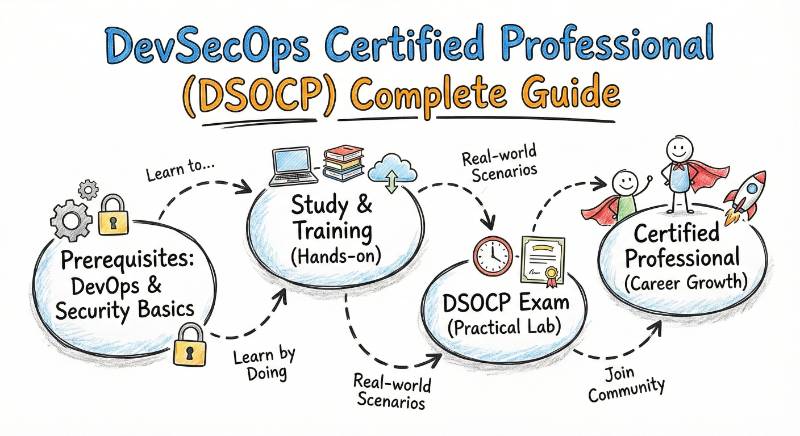
Introduction
The software industry is undergoing a massive transformation where “DevOps” is no longer enough. We are entering an era where speed must be balanced with absolute trust. Traditional security models—often called “Waterfall Security”—relied on a separate team to perform manual audits right before a product went live. This created a bottleneck that frustrated developers and left systems vulnerable to modern, rapid-fire cyberattacks.
DevSecOps solves this by introducing the “Shift Left” mindset. This approach ensures that security testing, compliance checks, and vulnerability scanning are automated and integrated into the earliest stages of development. As an expert in this domain, I have seen that teams who embrace the DevSecOps Certified Professional (DSOCP) framework don’t just find bugs faster—they build a culture where everyone is responsible for security, resulting in more stable and trustworthy software.
Master Certification Table
The following table summarizes the core professional certifications provided by DevOpsSchool and its affiliates. These are designed to take you from foundational knowledge to expert-level execution.
| Track | Level | Who it’s for | Prerequisites | Skills Covered | Recommended Order |
| DevSecOps | Professional | Engineers, SecOps | Basic DevOps Knowledge | SAST, DAST, SCA, Container Security | DSOCP → Architect → Manager |
| DevOps | Professional | Developers, Ops | Software Engineering basics | CI/CD, IaC, Automation, Culture | DCP → Architect → Manager |
| SRE | Professional | Reliability Engineers | Ops & Scripting knowledge | SLOs, SLIs, Error Budgets, Monitoring | SRECP → Architect → Manager |
| AIOps/MLOps | Professional | Data & ML Engineers | Python, Data basics | ML Pipelines, Model Ops, AI Automation | AIOCP/MLOCP → Architect |
| DataOps | Professional | Data Engineers | SQL, Data Pipeline basics | Data Quality, Pipeline Automation | DOCP → Architect → Manager |
| FinOps | Professional | Finance, Lead Eng | Cloud Billing access | Cost Optimization, Tagging, Governance | FinOps Engineer → Professional |
2. Deep Dive: DevSecOps Certified Professional (DSOCP)
What it is
The DSOCP is an intensive professional program focusing on “Security as Code.” It moves beyond theory to show you how to automate security audits, scanning, and compliance within your CI/CD pipelines. It is the gold standard for professionals who want to ensure their delivery process is both fast and secure.
Who should take it
This is built for Software Engineers who want to write secure code, DevOps Engineers looking to specialize in security automation, and Security Professionals moving into cloud-native environments. Engineering Managers also find it invaluable for setting high-security standards across their teams.
Skills you’ll gain
- Static Application Security Testing (SAST): Scanning source code for flaws before execution.
- Dynamic Application Security Testing (DAST): Identifying vulnerabilities in running applications.
- Software Composition Analysis (SCA): Managing risks in third-party libraries and open-source dependencies.
- Infrastructure as Code (IaC) Security: Hardening Terraform, Ansible, and CloudFormation scripts.
- Container Security: Securing Docker images and Kubernetes clusters against runtime threats.
Real-world projects you should be able to do
- The Secure Pipeline: Build a Jenkins or GitHub Actions pipeline that automatically blocks deployments with “Critical” vulnerabilities.
- Automated Image Hardening: Create a system that builds and patches “Gold Images” for cloud-native deployments.
- Vulnerability Dashboarding: Implement a centralized view of security risks across a microservices architecture.
Preparation plan
- 7–14 Days: Best for experienced DevOps pros. Focus on the core security scanners (SonarQube, Snyk) and the DSOCP exam pattern.
- 30 Days: The standard route. Two hours daily focusing on hands-on labs and real-world project scenarios.
- 60 Days: For those new to security. Includes a deep dive into Linux fundamentals and basic scripting before tackling the core security modules.
Common mistakes
- Tool Obsession: Thinking a tool like SonarQube makes you “DevSecOps.” The real skill is in the process of how you handle the findings.
- Alert Fatigue: Turning on every possible alert and overwhelming developers. Learning to tune tools for “Low False Positives” is critical.
- Ignoring Culture: Forgetting that DevSecOps requires collaboration between developers and security teams, not just new software.
Best next certification after this
Once you have mastered the professional level, the Certified DevSecOps Architect is the natural progression to learn how to design security at an enterprise scale.
3. Choose Your Path: 6 Specialized Learning Paths
Modern engineering is too broad for one-size-fits-all. Based on your career goals, choose a specific track:
- The DevOps Path: Best for those focused on general velocity, CI/CD, and breaking down silos between Dev and Ops teams.
- The DevSecOps Path: Essential for high-stakes environments like Fintech or Healthcare where security and compliance are paramount.
- The SRE Path: Focused on reliability, scalability, and “keeping the lights on” for massive, high-traffic systems using error budgets.
- The AIOps/MLOps Path: The frontier for those managing AI models and using machine learning to automate complex operations.
- The DataOps Path: Tailored for the modern data stack, ensuring data pipelines are as reliable and automated as software pipelines.
- The FinOps Path: A growing field focused on cloud cost transparency and ensuring the business gets the most value for every cloud dollar spent.
Role → Recommended Certifications Mapping
| Your Current Role | Recommended Certification Journey |
| DevOps Engineer | DCP → DSOCP → CKA/CKAD |
| SRE | SRECP → Master in Observability → SRE Architect |
| Platform Engineer | DCP → Terraform Associate → Kubernetes Admin |
| Cloud Engineer | Cloud Associate → DCP → Cloud Security |
| Security Engineer | DSOCP → Certified DevSecOps Architect |
| Data Engineer | DOCP → Cloud Data Engineer → DataOps Architect |
| FinOps Practitioner | FinOps Engineer → Professional → Architect |
| Engineering Manager | Certified DevOps Manager → Certified FinOps Manager |
4. Top Institutions for DSOCP Training
Choosing the right training partner is vital for a hands-on certification like DSOCP. Here are the top providers:
- DevOpsSchool: A global leader in DevOps education. They offer over 100 hours of live, instructor-led training with a heavy focus on real-world labs and industry-standard toolchains.
- Cotocus: Known for deep-dive technical workshops and corporate training. They specialize in tailoring the DevSecOps curriculum to specific cloud environments like AWS and Azure.
- Scmgalaxy: A veteran community platform that provides extensive documentation and tutorials. They offer a great blend of self-paced and instructor-led sessions for SCM and build automation.
- BestDevOps: Focuses on result-oriented training. Their program is built around practical projects that you can showcase in your professional portfolio immediately after completion.
- DevSecOpsSchool: A specialized institution dedicated exclusively to security-first DevOps. They cover advanced topics like threat modeling and “Compliance as Code” in great detail.
- SRESchool: The go-to destination for Site Reliability Engineering. They focus on the Google-born principles of reliability, SLIs, and SLOs.
- AIOpsSchool: Leads the way in teaching how to apply AI and ML to operations, helping you build “Self-Healing” infrastructures.
- DataOpsSchool: Provides specialized tracks for data engineers looking to apply DevOps speed and security to big data lifecycles.
- FinOpsSchool: Dedicated to cloud financial management. They teach you how to align engineering speed with financial accountability.
5. Next Certifications to Take
The DSOCP is a major milestone, but the journey doesn’t end there. Here are three powerful directions for your next step:
- Option 1: Same Track (Vertical Growth)Move to the Certified DevSecOps Architect. This focuses on high-level security design, global tool selection, and governance strategies for multi-cloud enterprises.
- Option 2: Cross-Track (Horizontal Growth)Consider the SRE Certified Professional (SRECP). Security and Reliability are two sides of the same coin; mastering both makes you an elite Platform Engineer capable of handling any production crisis.
- Option 3: Leadership (Career Growth)The Certified DevSecOps Manager or Certified DevOps Manager is perfect if you are moving into a role where you lead squads, manage budgets, and define the culture of your organization.
FAQs: DevSecOps Certified Professional (DSOCP)
1. How difficult is the DSOCP certification?
It is an intermediate to advanced level. It requires a solid grasp of basic DevOps before you can effectively layer security automation on top.
2. How much time do I need to commit?
Most learners find that 72-100 hours of instructor-led training plus 30 hours of self-labs is the “sweet spot” for mastery.
3. Are there prerequisites?
While not mandatory, having a basic understanding of Linux, Git, and CI/CD concepts will make your learning journey much faster.
4. What tools are most emphasized in DSOCP?
The “Big Five”: SonarQube (SAST), OWASP ZAP (DAST), Snyk (SCA), HashiCorp Vault (Secrets), and Trivy (Container Security).
5. What is the value of this certification in India?
India is a global hub for software services. Companies are desperate for engineers who can deliver secure code. This certification is a major differentiator in high-paying MNCs.
6. Does it cover “Compliance as Code”?
Yes, that is a key module. You learn how to automate the evidence collection for audits like ISO 27001 or GDPR.
7. Can a manager benefit from this?
Yes. Managers need to understand the “cost of security” and how to hire and guide teams through the DevSecOps transition effectively.
8. Is the training live or recorded?
Top providers like DevOpsSchool offer live interactive sessions, which are far more effective for complex security topics than static videos.
6. Conclusion
The transition from DevOps to DevSecOps is the most significant shift in our industry today. As we navigate the complexities of modern engineering, the demand for professionals who can “secure the pipeline” will only intensify. The DSOCP is more than just a certificate; it is the evidence of your ability to protect your organization’s most valuable asset: its trust.
Whether you are an engineer looking to level up or a manager aiming to build a more resilient team, this certification provides the structure and expertise needed to lead. Start your journey today, choose your path wisely, and build a more secure digital world.