Upgrade & Secure Your Future with DevOps, SRE, DevSecOps, MLOps!
We spend hours scrolling social media and waste money on things we forget, but won’t spend 30 minutes a day earning certifications that can change our lives.
Master in DevOps, SRE, DevSecOps & MLOps by DevOps School!
Learn from Guru Rajesh Kumar and double your salary in just one year.
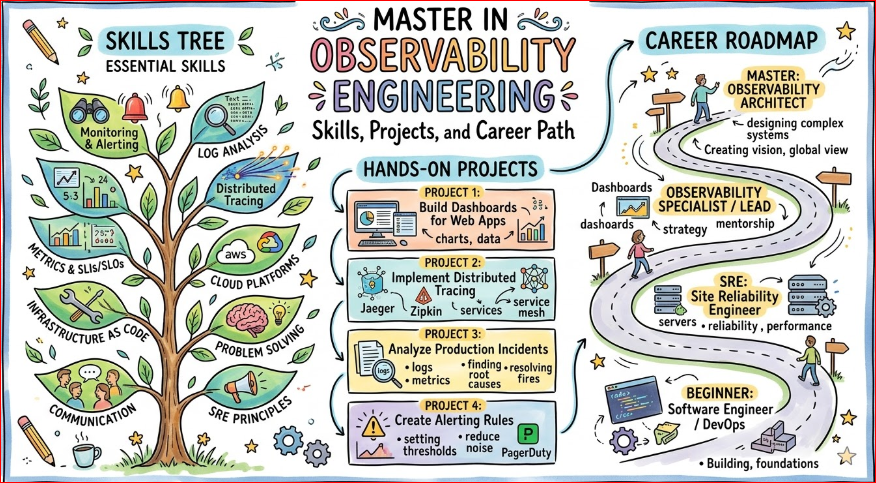
Observability Engineering has become a must-have skill for teams that want reliable, fast, and cost-efficient systems. The Master in Observability Engineering (MOE) certification from DevOpsSchool helps you build these skills in a structured and practical way. In this guide, you will learn what MOE is, who it is for, what skills you gain, and how to plan your learning path as a DevOps, SRE, DevSecOps, AIOps/MLOps, DataOps, or FinOps professional. You will also see role-based recommendations, FAQs, and how training institutes can support your journey.
What Is Observability Engineering?
Observability Engineering focuses on understanding what is happening inside your systems by using signals like logs, metrics, traces, and events. Instead of guessing the root cause of issues, you design your systems so that they explain themselves clearly through telemetry data.
In practice, an Observability Engineer defines what to measure, how to instrument services, how to store and visualize data, and how to turn insights into actions like alerts, automation, and incident response. This discipline sits at the intersection of DevOps, SRE, platform engineering, and cloud operations.
What Is Master in Observability Engineering (MOE)?
Master in Observability Engineering (MOE) is a specialized certification and training program offered by DevOpsSchool. It is designed to give you a 360-degree understanding of observability concepts, tools, patterns, and real-world implementation practices.
The program covers fundamentals like metrics, logs, traces, as well as advanced topics such as OpenTelemetry, cloud-native observability, SLO-based alerting, AI/ML in observability, and cost optimization. It is delivered with hands-on labs, real project scenarios, and practical assignments aligned with SRE and DevOps workflows.
Why MOE Matters for Your Career
- Companies are moving to microservices, Kubernetes, and multi-cloud, which makes debugging harder and outages more expensive.
- Reliability, performance, user experience, and cost control are now board-level topics, not just technical issues.
- Observability Engineering skills are in high demand across DevOps, SRE, platform, security, data, and cloud roles.
With MOE, you show that you can design, implement, and operate robust observability systems and help teams reduce downtime, speed up incident resolution, and optimize infrastructure. This makes you more valuable as an engineer, architect, or manager leading modern platforms.
MOE Certification Details
What It Is
Master in Observability Engineering (MOE) is a comprehensive certification that teaches you how to design, build, and manage observability for modern, distributed systems. It blends theory, tools, and real project work across metrics, logs, traces, dashboards, and alerting.
Who Should Take It
- DevOps, SRE, and platform engineers managing production systems
- Cloud and infrastructure engineers responsible for uptime and SLAs
- Security and DevSecOps practitioners who need deep visibility into events
- Data, AIOps/MLOps, and FinOps professionals who work with telemetry and cost data
- Engineering managers who lead reliability and operations teams
Skills You’ll Gain
- Observability fundamentals: metrics, logs, traces, events, and correlations
- Designing observability architectures for microservices, Kubernetes, and hybrid/multi-cloud
- Instrumenting applications and services using OpenTelemetry and related SDKs
- Building dashboards, alerts, and SLO-based monitoring strategies
- Troubleshooting performance, latency, and reliability issues using telemetry data
- Integrating observability into CI/CD and DevOps pipelines
- Using AI/ML and AIOps concepts for anomaly detection and intelligent alerting
- Managing costs through data retention, sampling, and cardinality control
Real-World Projects You Should Be Able to Do After It
- Design and implement an observability stack for a microservices-based application using common tools (e.g., Prometheus, Grafana, ELK, Jaeger, OpenTelemetry).
- Set up end-to-end tracing and metrics for a Kubernetes cluster and troubleshoot real issues like latency spikes and error rates.
- Build SLO dashboards and alert policies for critical user journeys, such as checkout flows or API endpoints.
- Implement logging strategies with structured logs, correlation IDs, and context-rich telemetry data.
- Integrate observability into CI/CD pipelines, enabling automated checks and health analysis during releases.
- Optimize observability costs by tuning retention, sampling, aggregation, and storage tiers.
Preparation Plan
You can adapt the plan based on your background and available time.
7–14 Days Fast-Track Plan
- Day 1–2: Learn core observability concepts and signals (metrics, logs, traces, events).
- Day 3–4: Study observability tooling basics (Prometheus, Grafana, ELK, Jaeger, OpenTelemetry) and set up a small lab.
- Day 5–7: Focus on Kubernetes and cloud-native observability, plus basic SLOs and alerting.
- Day 8–10: Work on one end-to-end project on a sample microservices application.
- Day 11–14: Revise concepts, review notes, and practice interview-style questions and scenarios.
30 Days Balanced Plan
- Week 1: Fundamentals of monitoring vs observability, architecture, and telemetry pipelines.
- Week 2: Deep dive into tools, dashboards, and queries, plus log management and tracing.
- Week 3: Kubernetes and cloud observability, SLO/SLI design, incident management workflows.
- Week 4: Execute 2–3 full projects, document your work, and build a small portfolio of observability case studies.
60 Days Deep Mastery Plan
- Month 1: Strong coverage of fundamentals, tooling, and basic projects.
- Month 2: Advanced topics such as OpenTelemetry integration, service mesh observability, AI/ML-based analysis, and cost optimization strategies.
Common Mistakes
- Treating observability as only dashboards and tools, ignoring proper instrumentation and data design.
- Copy-pasting dashboards without understanding the metrics and what they really mean.
- Over-collecting data without retention and sampling strategies, resulting in high costs.
- Ignoring traces and focusing only on logs, making root cause analysis harder.
- Not aligning observability with SLOs, business KPIs, and incident management processes.
Best Next Certification After This
- An SRE-focused certification to deepen your reliability engineering and SLO practices.
- A DevSecOps or security observability program to extend visibility into threats and compliance.
- A cloud provider–specific observability or monitoring track (e.g., AWS/Azure/GCP observability courses).
MOE Certification Table
Below is a consolidated view of the MOE certification as a core track in your observability journey.
| Track | Level | Who it’s for | Prerequisites | Skills covered | Recommended order |
|---|---|---|---|---|---|
| Observability Engineering | Intermediate to Advanced | DevOps, SRE, Cloud, Platform, Security, Data, and FinOps professionals | Basic Linux, networking, cloud concepts, scripting familiarity, exposure to production or test environments | Observability concepts, metrics/logs/traces, OpenTelemetry, Kubernetes and cloud observability, SLOs, dashboards, alerting, AI/ML in observability, cost optimization | Take after basic DevOps/Cloud fundamentals and monitoring experience |
Choose Your Path (6 Learning Paths)
You can align MOE with different career tracks. Here are six practical learning paths.
1. DevOps Path
- Start with core Linux, networking, Git, and CI/CD.
- Learn containerization and Kubernetes basics.
- Take MOE to build strong monitoring and observability into your DevOps pipelines.
- Then move into advanced DevOps toolchains and release engineering.
2. DevSecOps Path
- Start with DevOps and security fundamentals.
- Take MOE to understand observability for security events, anomalies, and audit trails.
- Extend into DevSecOps, security monitoring, SIEM, and compliance tooling.
3. SRE Path
- Learn SRE principles: SLOs, SLIs, error budgets, incident response.
- Use MOE to deepen practical skills in building telemetry for SRE use cases.
- Move into advanced SRE certifications and production engineering roles.
4. AIOps/MLOps Path
- Learn basics of data pipelines, ML workflows, and automation.
- Use MOE to understand how to gather high-quality telemetry data for AIOps use cases like anomaly detection and predictive alerts.
- Then explore AIOps and MLOps platforms and specialized certifications.
5. DataOps Path
- Start with data engineering and pipeline fundamentals.
- Take MOE to learn how to observe data pipelines, detect failures, and track data quality through telemetry.
- Move into DataOps and analytics-focused certifications.
6. FinOps Path
- Learn cloud cost fundamentals and financial governance.
- Use MOE to build telemetry that links usage data, performance, and cost signals.
- Proceed to specialized FinOps certifications and cloud economics training.
Role → Recommended Certifications Mapping
| Role | Primary focus with MOE | Recommended approach |
|---|---|---|
| DevOps Engineer | Embed observability into CI/CD, infra-as-code, and release pipelines | Take MOE after core DevOps and Kubernetes training to design reliable delivery workflows. |
| SRE | SLO-based monitoring, incident response, post-incident analysis | Use MOE to build deep telemetry and then add SRE certifications for operational excellence. |
| Platform Engineer | Design platform-wide observability for clusters, services, and shared tools | Combine MOE with Kubernetes and cloud platform courses to build robust internal platforms. |
| Cloud Engineer | Cloud-native observability for AWS, Azure, GCP | Take MOE, then provider-specific observability/monitoring certifications. |
| Security Engineer | Security observability, detecting and investigating threats | Align MOE with DevSecOps and SIEM training for full security visibility. |
| Data Engineer | Telemetry for data pipelines and ETL jobs | Use MOE plus DataOps certifications to manage pipeline health and data quality. |
| FinOps Practitioner | Observability of usage, performance, and cost | Combine MOE with FinOps certifications to drive cost-aware design and operations. |
| Engineering Manager | Leading teams on reliability, tooling, and observability strategy | Take MOE to understand the stack, then leadership or architecture-focused programs. |
Next Certifications to Take After MOE
Once you complete MOE, you can choose your next step based on your interests.
- Same track:
- Advanced SRE or Observability Architect–level training focused on SLOs, incident response, and resilience patterns.
- Cross-track:
- DevSecOps or security monitoring certification to extend observability into threat detection and compliance.
- Leadership:
- Engineering leadership, cloud architecture, or platform strategy programs to lead observability and reliability transformations at organization level.
Top Institutions for MOE Training and Certification Support
Several specialized institutions support training and certification for Master in Observability Engineering (MOE). They help you with structured learning, live guidance, and practical labs.
DevOpsSchool
DevOpsSchool is the official provider of the Master in Observability Engineering (MOE) certification and offers multiple training modes like live online, self-paced, and corporate workshops. Their programs include real-world labs, LMS access, interview preparation, and mentorship from experienced trainers who work on DevOps and SRE projects.
Cotocus
Cotocus focuses on DevOps, SRE, and observability engineering–related consulting and training. It helps professionals and corporate teams design role-based learning journeys, including MOE preparation, with a strong focus on hands-on practice and project-based learning aligned with real environments.
ScmGalaxy
ScmGalaxy has a long track record in DevOps training, CI/CD, cloud, and related technologies. For MOE, it supports learners with workshops, mock scenarios, and ecosystem knowledge so that participants can connect observability with version control, deployment pipelines, and release engineering workflows.
BestDevOps
BestDevOps is a community and learning platform that surfaces best practices, tools, and case studies in DevOps and observability. It supports MOE learners via curated content, knowledge-sharing, and learning paths that align observability skills with day-to-day operations and platform teams.
devsecopsschool.com
devsecopsschool.com emphasizes the security side of software delivery, DevSecOps, and secure operations. It helps observability learners understand how telemetry, logs, and traces can support threat detection, compliance, and audit-ready systems when used along with MOE concepts.
sreschool.com
sreschool.com focuses on Site Reliability Engineering skills such as SLOs, incident management, and reliability culture. Learners who combine its SRE programs with MOE training build a strong profile in designing reliable, observable services and running effective incident response practices.
aiopsschool.com
aiopsschool.com provides programs around AIOps, intelligent operations, and ML-powered automation. With MOE, it helps learners connect observability data with AIOps platforms for anomaly detection, predictive maintenance, and smart alerting strategies.
dataopsschool.com
dataopsschool.com focuses on DataOps, analytics pipelines, and data reliability. For MOE learners, it adds depth in observing data flows, data quality, and pipeline health using observability techniques and telemetry practices.
finopsschool.com
finopsschool.com specializes in FinOps and cloud cost optimization. Combining MOE and its FinOps curriculum, learners can design telemetry that reveals cost drivers, performance trade-offs, and efficiency opportunities across cloud environments.
FAQs on Observability Engineering and MOE (General)
- Is Observability Engineering only for large companies?
No. Even small and mid-size teams benefit from observability because it reduces debugging time and outages. The same principles apply at any scale. - Do I need a strong coding background to learn MOE?
Basic scripting and comfort with CLI tools are helpful, but you do not need to be a full-time developer. The focus is on instrumentation, analysis, and system understanding. - How is observability different from traditional monitoring?
Monitoring checks predefined metrics and alerts, while observability focuses on making systems explain themselves so that you can answer new, unknown questions during failures. - Can MOE help if I already work as a DevOps engineer?
Yes. MOE adds structured knowledge of telemetry, dashboards, alerting, and root cause analysis, making your DevOps work more reliable and data-driven. - Is MOE useful for SRE roles?
Absolutely. SRE relies heavily on observability for SLOs, incident troubleshooting, and post-incident reviews. MOE strengthens those core capabilities. - Can a security professional benefit from MOE?
Yes. Security teams can use observability data to detect anomalies, trace incidents, and build better security monitoring strategies. - Is MOE relevant in a multi-cloud environment?
Yes. The certification covers cloud-native observability patterns that apply across various clouds and hybrid setups. - Will MOE help in AIOps and automation?
AIOps systems rely on high-quality telemetry data. MOE helps you design that data layer, which is crucial for any AIOps or ML-based operations platform. - Is observability only about tools like Prometheus or Grafana?
Tools are important, but the real value comes from understanding what to measure, how to instrument, and how to interpret signals. MOE focuses strongly on this design mindset. - How does observability impact business outcomes?
Better observability reduces downtime, speeds up incident recovery, improves user experience, and helps control infrastructure costs. - Do managers and leaders need observability knowledge?
Yes. Leaders need to understand observability to prioritize investments, set SLOs, and guide teams toward more reliable systems. - Can MOE support my move into platform engineering?
MOE is highly relevant to platform roles because platforms must provide standardized, observable services and infrastructure to development teams.
FAQs Specific to Master in Observability Engineering (MOE)
- What is the Master in Observability Engineering (MOE) certification?
MOE is a professional certification by DevOpsSchool that focuses on building strong observability skills for modern, distributed systems. - How long does it take to complete MOE training?
The typical training duration is around 15–20 hours for online or self-paced formats, or 5 days for corporate batches. - What are the prerequisites for MOE?
You should be comfortable with Linux, basic networking, cloud fundamentals, and scripting. Prior exposure to monitoring or production environments is a plus. - Is MOE more theoretical or hands-on?
MOE combines both, but strongly emphasizes hands-on labs and real-world scenarios using popular observability tools and platforms. - Can I take MOE if I am new to observability?
Yes. If you have basic DevOps or cloud knowledge, MOE is a good starting point to build structured observability skills. - Does MOE include OpenTelemetry and cloud-native observability?
Yes. The syllabus covers OpenTelemetry, cloud-native patterns, and how to integrate observability into Kubernetes and microservices environments. - Will MOE help me in job interviews?
The program includes interview preparation support, real questions, and project exposure, which can significantly boost your interview performance. - Is MOE recognized by employers?
MOE is backed by DevOpsSchool and is valued in organizations that take observability, reliability, and DevOps seriously, especially where modern stacks are in use.
Conclusion
Master in Observability Engineering (MOE) is a powerful certification for engineers and managers who want to build reliable, observable, and cost-efficient systems in modern cloud-native environments. It brings together observability fundamentals, hands-on tooling, and real-world scenarios across DevOps, SRE, DevSecOps, AIOps/MLOps, DataOps, and FinOps paths.
If you are already working in software engineering, operations, or cloud, investing in MOE can significantly upgrade your skills, career opportunities, and impact on your organization’s reliability and performance.