Upgrade & Secure Your Future with DevOps, SRE, DevSecOps, MLOps!
We spend hours scrolling social media and waste money on things we forget, but won’t spend 30 minutes a day earning certifications that can change our lives.
Master in DevOps, SRE, DevSecOps & MLOps by DevOps School!
Learn from Guru Rajesh Kumar and double your salary in just one year.
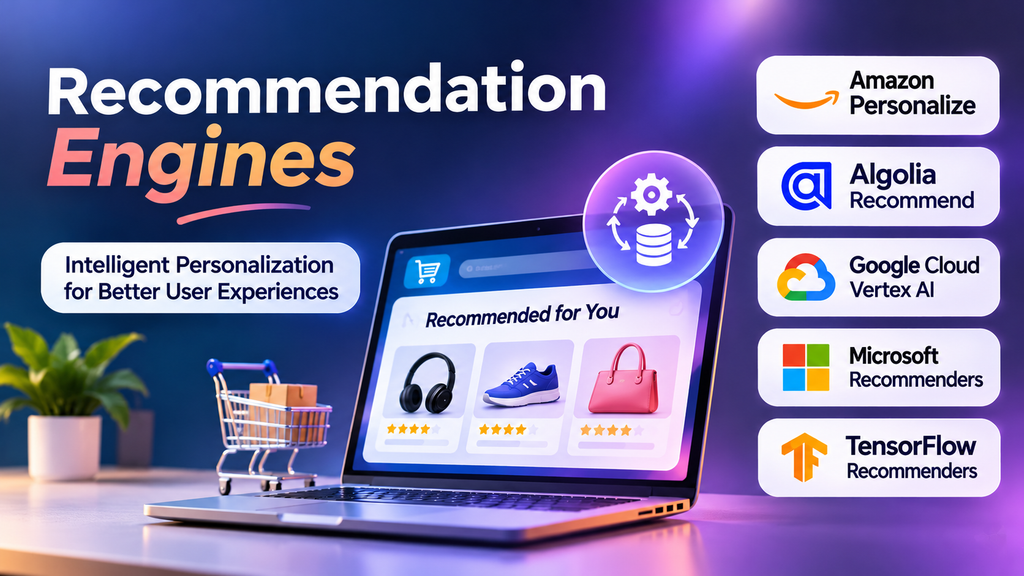
A customer browsing an online store may face thousands of products, while a streaming platform may offer more content than anyone could reasonably explore. Recommendation engines help solve this discovery problem by identifying products, services, or content that are likely to interest each user.
These systems analyze signals such as browsing activity, previous purchases, ratings, searches, and similarities between items. Depending on the application, they can recommend complementary products, suggest content, personalize a homepage, or rank search results according to individual preferences.
For businesses, the objective is not simply to display more suggestions. It is to make discovery more relevant while balancing customer satisfaction, commercial goals, privacy, and operational cost.
How Recommendation Engines Work
Most recommendation systems follow a process that converts user and item data into ranked suggestions.
1. Collect Relevant Data
The system receives information about user interactions, such as product views, clicks, purchases, ratings, watch history, and searches. Product attributes, categories, descriptions, and availability can provide additional context.
Data quality matters. Incorrect product identifiers, duplicate events, missing catalog information, and outdated inventory can reduce recommendation relevance.
2. Generate Candidate Items
The engine identifies a manageable set of potentially relevant items from a larger catalog. Candidates may come from popular products, similar items, user preferences, or patterns found across many customers.
3. Rank the Candidates
A ranking model estimates which candidates are most relevant to a particular user or situation. Some systems also consider business rules, product availability, freshness, diversity, and eligibility.
4. Deliver and Evaluate Recommendations
The ranked results appear in locations such as product pages, homepages, email campaigns, or mobile applications. Teams measure whether users click, purchase, engage, or return, then refine the system based on the results.
The Main Approaches to Recommendation
Different recommendation techniques solve different discovery problems. Selecting the right approach depends on the amount of available data, catalog characteristics, and the experience the business wants to create.
Collaborative Filtering
Collaborative filtering identifies patterns in interactions among users and items. For example, if customers who purchased a particular camera frequently bought a certain lens, the system may recommend that lens to similar shoppers.
This approach can uncover useful relationships without requiring every product attribute to be manually defined. However, it may struggle with newly introduced products or users who have little interaction history.
Content-Based Filtering
Content-based systems recommend items that resemble products or content a user has previously liked. They use attributes such as category, description, genre, brand, or other relevant features.
This approach can be useful when item descriptions are informative, although it may repeatedly suggest similar items instead of introducing users to unfamiliar options.
Hybrid Recommendation Systems
Hybrid systems combine multiple approaches to improve relevance. A platform might use item similarity, user behavior, popularity, and contextual signals together.
The additional flexibility can improve discovery, but it also introduces more complexity in data preparation, evaluation, and ongoing maintenance.
Context-Aware Recommendations
Context-aware systems consider circumstances such as the current session, device, location where appropriate, time, or the user’s immediate activity.
For example, a travel website could prioritize luggage recommendations for someone browsing travel accessories. Context must be used carefully, with appropriate privacy controls and clear business justification.
Recommendation Engine Platforms Worth Evaluating
The right implementation may involve a managed cloud service, a search and discovery platform, or an open-source framework. These options differ in how much infrastructure and machine-learning work the business must handle.
Amazon Personalize
Amazon Personalize is a managed machine-learning service for generating personalized recommendations through application integrations and APIs. It supports use cases such as personalized item suggestions, similar-item discovery, and personalized ranking.
It can suit teams that already use AWS or want managed recommendation infrastructure rather than building and operating an entire modeling pipeline themselves.
The main considerations are data preparation, AWS integration, request capacity, usage-based costs, and the engineering work needed to display and evaluate the returned recommendations.
Algolia Recommend
Algolia Recommend provides recommendation capabilities designed for product and content discovery. Its documented use cases include related items, complementary products, similar items, trending content, and personalized recommendations.
It is worth evaluating when recommendations need to work alongside a search and discovery experience. Teams should check catalog synchronization, event collection, filtering requirements, and the costs associated with their expected usage.
Google Cloud and Vertex AI
Google Cloud offers machine-learning infrastructure that can support recommendation solutions, including custom approaches built with Vertex AI and related data services.
This route can suit organizations that need greater control over their models, feature engineering, data pipelines, and deployment architecture. However, a custom implementation usually requires more technical ownership than adopting a narrowly scoped managed recommendation product.
Before selecting a solution, verify the availability and lifecycle of any specific Google Cloud recommendation product or feature rather than assuming that older product names remain current.
Microsoft Recommenders
Microsoft Recommenders is an open-source repository containing examples, implementations, and utilities for building and evaluating recommendation systems.
It is useful for developers and data scientists who want to explore algorithms, understand modeling techniques, or build a customized solution. It is not equivalent to purchasing a fully managed recommendation service: production deployment, monitoring, infrastructure, and integration remain the team’s responsibility.
TensorFlow Recommenders
TensorFlow Recommenders is an open-source library for building recommendation models using TensorFlow. It supports workflows involving retrieval, ranking, and model evaluation.
It can be appropriate for machine-learning teams that need flexibility and want to integrate recommendation models into their own applications. The trade-off is the expertise required to prepare data, train models, deploy serving infrastructure, and maintain model quality.
Comparing the Main Options
| Platform or approach | Main strength | Important consideration |
|---|---|---|
| Amazon Personalize | Managed recommendation services and APIs | AWS dependency and usage costs |
| Algolia Recommend | Recommendations for search and product discovery | Catalog and event integration requirements |
| Vertex AI-based solutions | Flexible custom machine-learning workflows | More implementation and operational work |
| Microsoft Recommenders | Open-source examples and algorithms | Production infrastructure must be managed |
| TensorFlow Recommenders | Custom recommendation modeling | Requires machine-learning engineering expertise |
These options are not interchangeable in every situation. A managed service, a discovery product, and an open-source modeling library solve overlapping but different parts of the problem.
Where Businesses Use Recommendation Engines
Recommendation systems are useful whenever people must navigate a large selection of products, content, or services.
- E-commerce: Suggest related products, complementary accessories, and personalized product selections.
- Streaming services: Recommend videos, music, or other content based on viewing and listening patterns.
- Online education: Suggest courses and learning resources based on interests and progress.
- Travel platforms: Surface relevant destinations, accommodation options, and travel accessories.
- Digital publishing: Recommend articles and other content based on reading activity.
- Financial services: Help users discover relevant services or educational resources, subject to appropriate governance and suitability requirements.
The recommendation should serve a real user need. A system that increases clicks but repeatedly promotes irrelevant or unavailable products may damage trust rather than improve the experience.
How to Measure Recommendation Quality
A recommendation engine should be evaluated against the outcome it is intended to improve.
Click-through rate measures the proportion of recommendation impressions that result in clicks. It can reveal whether suggestions attract attention, but clicks alone do not establish business value.
Conversion rate measures how frequently exposed users complete a desired action, such as purchasing a product or registering for a service. Carefully designed experiments can help determine whether recommendations contribute to the outcome.
Revenue per visitor or average order value can help e-commerce teams understand commercial impact. These metrics should be interpreted alongside returns, cancellations, discounts, and customer satisfaction.
Coverage and diversity indicate whether the system recommends a useful range of items or repeatedly promotes the same popular products.
Latency and availability matter when recommendations are generated during live browsing. Slow responses can undermine an otherwise relevant experience.
Where possible, compare the system against a meaningful baseline, such as popular items or existing recommendations. A controlled A/B test is generally more informative than assuming that model scores automatically translate into better business results.
Common Problems and How to Avoid Them
The Cold-Start Problem
New users may have little interaction history, and newly added items may not have enough engagement data. Initial recommendations can combine relevant item attributes, category preferences, editorial selections, and popularity signals until stronger behavioral evidence becomes available.
Popularity Bias
A system that repeatedly recommends already popular items may prevent users from discovering useful alternatives. Evaluate catalog coverage and consider diversity rules or controlled exploration where appropriate.
Poor Data Quality
Inaccurate event tracking or incomplete product information can lead to irrelevant suggestions. Validate event schemas, identifiers, inventory status, and the relationship between interactions and catalog items before deploying a model.
Privacy and Consent
Personalization may involve behavioral data that requires careful handling. Collect only what is necessary, establish appropriate access controls and retention policies, and comply with applicable privacy requirements. Avoid assuming that every available customer signal is appropriate to use.
Measuring the Wrong Outcome
Optimizing clicks alone may encourage sensational or repetitive recommendations. Define success using a combination of engagement, conversion, long-term customer value, and user experience measures.
A Practical Implementation Strategy
For a business introducing recommendations for the first time, a focused rollout is usually easier to evaluate than a broad personalization project.
- Choose one use case. Start with a clear objective, such as recommending related products on product pages.
- Audit the data. Confirm that user events, item identifiers, product attributes, and inventory information are accurate.
- Establish a baseline. Record the performance of the existing discovery experience before making changes.
- Select the appropriate technology. Compare managed services, discovery platforms, and custom libraries based on integration needs, technical skills, and total operating cost.
- Run a limited pilot. Test the recommendation experience with a defined audience and monitor relevance, latency, and business outcomes.
- Expand based on evidence. Improve the model and broaden its use only when the pilot demonstrates meaningful value.
Making the Right Recommendation Engine Decision
Recommendation engines are most useful when they help people discover something relevant without adding friction. A managed service such as Amazon Personalize can reduce the need to operate recommendation infrastructure, while platforms such as Algolia Recommend can fit naturally into search and discovery workflows. Open-source options such as TensorFlow Recommenders and Microsoft Recommenders offer greater flexibility for teams prepared to manage more of the technical work.
The practical next step is to identify the discovery problem, review the quality of the available data, and establish a measurable baseline. Start with one recommendation placement, test its effect on real user behavior, and expand only when the evidence supports the investment.
