Upgrade & Secure Your Future with DevOps, SRE, DevSecOps, MLOps!
We spend hours scrolling social media and waste money on things we forget, but won’t spend 30 minutes a day earning certifications that can change our lives.
Master in DevOps, SRE, DevSecOps & MLOps by DevOps School!
Learn from Guru Rajesh Kumar and double your salary in just one year.
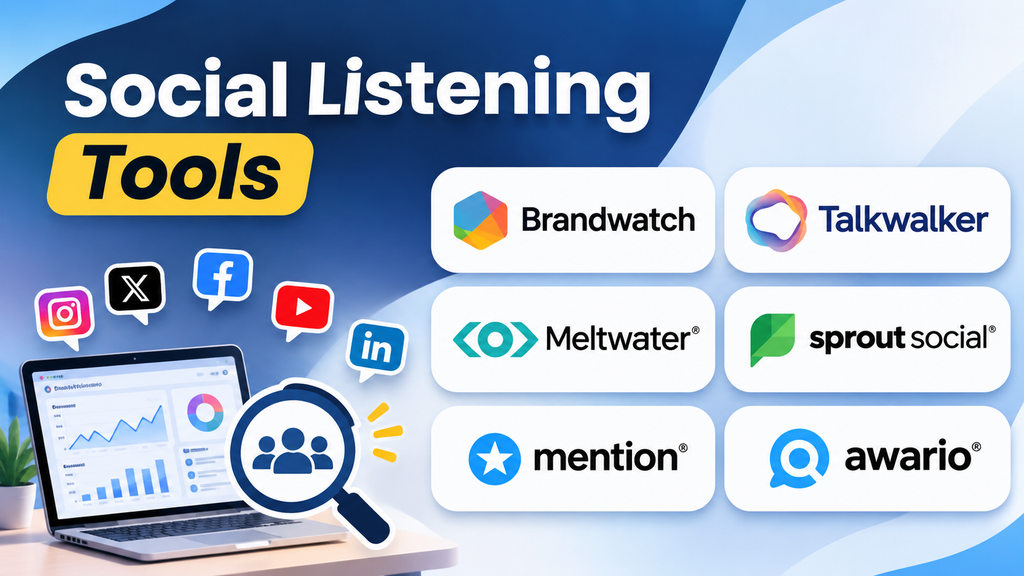
Customers share opinions, ask questions, discuss products, and recommend brands across social networks, forums, review sites, and online communities. These conversations can reveal what people value, what frustrates them, and how they perceive competing products.
Social listening tools help businesses collect and analyze these public conversations to identify patterns and opportunities. Instead of focusing only on likes, shares, or follower growth, teams can use listening insights to understand the discussions influencing their market.
What Are Social Listening Tools?
Social listening tools monitor relevant online conversations about brands, products, competitors, keywords, and industry topics. Depending on the platform, they can track brand mentions, analyze sentiment, identify emerging trends, compare share of voice, and generate reports for marketing or customer experience teams.
Social listening differs from basic social media monitoring. Monitoring generally focuses on specific mentions and interactions that require attention. Listening examines broader patterns across conversations to help businesses understand why people are talking and what those discussions may mean.
For example, a skincare brand might discover that customers frequently discuss irritation associated with a product category. That insight could inform customer education, product research, and future content planning.
Essential Features to Look For
Brand and Keyword Monitoring
Listening platforms can track brand names, product names, campaign phrases, competitors, and industry keywords across supported sources.
A good setup includes relevant variations, common misspellings, product names, and contextual exclusions. Without careful query design, a tool may collect irrelevant conversations or miss important mentions.
Sentiment Analysis
Sentiment analysis attempts to classify conversations as positive, negative, or neutral. Some platforms also provide emotion-related classifications or topic-level sentiment.
Automated sentiment is an estimate, not a definitive assessment. Sarcasm, regional language, slang, mixed opinions, and multilingual conversations can lead to incorrect classifications. Important findings should be reviewed in context.
Trend and Topic Discovery
Topic analysis helps teams identify recurring themes and changes in discussion volume. Businesses can use these insights to discover customer concerns, emerging product interests, and opportunities for relevant educational content.
A sudden increase in mentions does not automatically indicate a meaningful trend. Teams should examine the source, context, and quality of the conversations before responding.
Competitor Analysis and Share of Voice
Social listening can help compare how frequently brands are discussed and what themes appear around each competitor.
Share of voice estimates a brand’s portion of relevant conversations within a defined comparison set. Its usefulness depends on consistent search terms, comparable data coverage, and a clearly defined measurement period.
Alerts and Reporting
Alerts can notify teams when mention volume increases or when particular keywords appear. Reporting features can help summarize conversation themes, sentiment patterns, engagement, and competitor activity.
Useful alerts should prioritize meaningful events rather than notifying teams about every routine mention.
Popular Social Listening Tools
Different platforms offer different combinations of monitoring, analytics, research, and engagement features. The best fit depends on the sources you need to analyze and the depth of insight required.
Brandwatch
Brandwatch provides consumer intelligence and social media listening capabilities for researching online conversations, audience interests, and brand perceptions.
It may suit larger marketing teams that need broad research capabilities, sophisticated query building, and structured reporting. Buyers should evaluate source coverage, data access, analytical features, and implementation requirements.
Talkwalker
Talkwalker offers social listening and consumer intelligence capabilities, including conversation analysis and trend research across supported sources.
It can be relevant to brands that need to understand public discussion patterns and compare brand activity across markets. Evaluate language coverage, source availability, sentiment quality, and the reporting features included in the proposed offering.
Meltwater
Meltwater combines media intelligence with social listening and related monitoring capabilities. It can help communications and marketing teams track brand coverage, public discussions, and relevant industry developments.
Organizations should check which social sources are available, how traditional media monitoring fits their needs, and whether the platform’s reporting and alerting workflows justify the cost.
Sprout Social
Sprout Social offers social media management alongside listening and analytics capabilities, depending on the product and plan.
It may suit organizations that want to connect audience conversations with their publishing, engagement, and reporting workflows. Teams should confirm the depth of listening functionality and whether the required features are included in the selected subscription.
Mention
Mention provides online and social media monitoring capabilities for tracking brand names, keywords, and relevant discussions across supported sources.
It can be useful for businesses that want to establish a structured monitoring process without adopting a broad enterprise intelligence platform. Check the supported sources, alert limits, historical data access, and reporting options.
Awario
Awario focuses on web and social listening, helping businesses discover brand mentions, monitor keywords, and examine online discussions.
It may be worth evaluating for smaller businesses and agencies looking for brand monitoring and competitor research. Compare its source coverage, query controls, sentiment features, and reporting against your requirements.
YouScan
YouScan provides social media listening and consumer intelligence capabilities, including visual analysis features in supported contexts.
It may be relevant to brands that want to understand conversations involving products, logos, or visual content as well as text-based mentions. Confirm which platforms and image-analysis features are supported for your intended use case.
Comparing Social Listening Platforms
| Platform | Potential strength | Important consideration |
|---|---|---|
| Brandwatch | Consumer intelligence and conversation research | Data coverage and advanced research requirements |
| Talkwalker | Social listening and trend analysis | Source availability and language coverage |
| Meltwater | Media intelligence and monitoring | Scope of social and media coverage |
| Sprout Social | Listening alongside social management | Listening features included in the plan |
| Mention | Brand and keyword monitoring | Alert limits and source coverage |
| Awario | Web and social mention discovery | Query quality and reporting needs |
| YouScan | Listening with visual analysis capabilities | Image-analysis and platform support |
Capabilities, pricing, and source coverage can change. Confirm the current offering and test representative searches before making a purchasing decision.
How to Choose the Right Social Listening Tool
Define the Business Question
Begin with a specific question. Do you want to detect reputation issues, understand customer complaints, research competitors, identify industry trends, or evaluate a campaign?
A clear question makes it easier to choose relevant keywords, configure alerts, and determine which metrics matter.
Identify the Sources You Need
Not every platform covers every social network, forum, review site, or region equally. Some content may be unavailable because of privacy settings, platform restrictions, or limited data access.
List the sources that matter to your audience and verify that the platform can monitor them under the intended configuration.
Test Query Accuracy
Create sample searches for your brand, product names, competitor names, and relevant industry terms. Review the results manually to estimate how many are relevant and how many important conversations are missing.
Add exclusions and alternative terms to reduce noise. A tool that produces thousands of irrelevant mentions may be less useful than one that identifies a smaller, more accurate set of discussions.
Evaluate Language and Sentiment Support
For multilingual audiences, verify that the platform handles the languages, scripts, slang, and regional expressions your customers use.
Automated sentiment should be validated against real examples before it is used for business decisions or performance reporting.
Compare Cost and Team Requirements
Consider subscription fees, user seats, search limits, historical data access, reporting features, onboarding, and the time needed to maintain listening queries.
A small business may need only basic brand alerts, while an enterprise team may require broader consumer intelligence and formal reporting.
How Businesses Use Social Listening
Brand reputation management: Identify recurring complaints, incorrect information, and emerging reputation concerns so the appropriate team can investigate.
Customer research: Understand frequently discussed needs, frustrations, preferences, and questions.
Competitor analysis: Compare brand conversations and identify subjects that receive attention across competing products.
Content planning: Discover questions and themes that can inspire useful posts, videos, articles, and educational campaigns.
Campaign evaluation: Examine how people discuss a campaign and whether its key messages appear in relevant conversations.
Product development: Surface recurring feature requests, product complaints, and unmet needs that may deserve further investigation.
Influencer discovery: Identify people who regularly contribute relevant discussions or influence conversations in a particular niche.
Listening findings should be treated as evidence to investigate, not as a complete representation of every customer’s opinion.
Important Metrics for Social Listening
- Mention volume: The number of relevant conversations captured by a defined query.
- Sentiment distribution: The proportion of classified positive, negative, and neutral mentions.
- Share of voice: A brand’s share of mentions within a clearly defined competitor set.
- Conversation themes: The subjects and issues that appear repeatedly.
- Engagement: Interactions with the content being analyzed, where reliable data is available.
- Response time: How quickly teams respond to conversations that require action.
- Trend changes: Increases or decreases in relevant discussion over time.
Metrics should be interpreted alongside source coverage, query quality, and changes in platform access. A rise in mentions may reflect a successful campaign, a controversy, or simply a change in monitoring scope.
Common Social Listening Mistakes
Tracking too many generic keywords: Broad terms can generate large volumes of irrelevant results. Refine queries using brand context and appropriate exclusions.
Trusting sentiment scores blindly: Automated classification can misread sarcasm, humor, and regional language. Review important conversations manually.
Ignoring context: A mention count does not explain why people are discussing a brand. Read the original conversations before deciding how to respond.
Treating online discussion as representative of everyone: Social media users are not necessarily representative of the full customer base. Combine listening with surveys, customer interviews, support records, or other appropriate research.
Failing to assign ownership: Insights lose value when nobody is responsible for responding to complaints or sharing findings with relevant teams.
Overlooking privacy and access rules: Use data in accordance with platform terms, applicable law, and organizational policies. Avoid collecting or exposing unnecessary personal information.
A Practical Social Listening Workflow
- Define one business objective, such as understanding recurring customer complaints.
- Select relevant brand, product, competitor, and industry keywords.
- Verify that the platform covers the sources and languages you need.
- Review sample results and refine queries to improve accuracy.
- Configure alerts for meaningful changes or high-priority issues.
- Review conversation context and share findings with the appropriate teams.
- Track actions taken and evaluate whether those actions improve the intended outcome.
For example, a Hyderabad-based fashion retailer could monitor its brand name, product categories, and recurring customer concerns. The marketing team could use those discussions to improve product descriptions, plan educational content, and identify issues that need attention from customer support.
Turning Social Conversations Into Business Value
Social listening tools help businesses understand the discussions taking place around their brands and markets. Brandwatch, Talkwalker, Meltwater, Sprout Social, Mention, Awario, and YouScan offer different approaches to monitoring and analyzing those conversations.
The most effective listening program starts with a clear business question, reliable search queries, and an agreed process for turning insights into action. Choose a platform based on relevant source coverage, accuracy, usability, and cost, then review the findings regularly to improve customer understanding and marketing decisions.
