Upgrade & Secure Your Future with DevOps, SRE, DevSecOps, MLOps!
We spend hours scrolling social media and waste money on things we forget, but won’t spend 30 minutes a day earning certifications that can change our lives.
Master in DevOps, SRE, DevSecOps & MLOps by DevOps School!
Learn from Guru Rajesh Kumar and double your salary in just one year.
Introduction
Site Reliability Engineering (SRE) is a rapidly growing discipline within IT and software engineering that emphasizes maintaining high-performing, reliable, and scalable systems. As organizations scale their digital operations, ensuring system availability and reliability becomes increasingly crucial. The Site Reliability Engineering Certified Professional (SRECP) certification is designed for professionals who want to master the skills necessary for ensuring system uptime, managing incidents, and driving scalability in complex environments.The SRECP certification will equip you with the knowledge to create robust systems, automate processes, and troubleshoot system failures effectively. It’s not just for engineers who are already in operations roles but also for software engineers looking to expand their skills to include operational concerns such as monitoring, performance optimization, and reliability engineering. Whether you’re managing cloud infrastructure or working on production systems, SRECP provides you with the necessary tools and mindset to ensure your systems run smoothly and efficiently.
About the Certification
Certification Name: Site Reliability Engineering Certified Professional (SRECP)
Official URL: SRECP Certification
Provider: DevOpsSchool
What is SRECP?
The SRECP certification helps professionals develop expertise in Site Reliability Engineering practices, which focus on managing incidents, ensuring scalability, automating tasks, and maintaining system reliability. This certification validates your knowledge and practical skills in managing high-availability systems and handling real-time incidents.
Who Should Take This Certification?
The SRECP certification is ideal for a variety of IT professionals looking to deepen their understanding of system reliability and automation. This certification is suited for:
1. Site Reliability Engineers (SREs)
If you are already working as an SRE or aspiring to transition into this role, the SRECP will solidify your expertise in system reliability, incident management, and automation.
2. DevOps Engineers
DevOps professionals who want to specialize in the reliability and scalability of systems will benefit greatly from the SRECP. SRE focuses heavily on automation and system reliability, which align with core DevOps practices.
3. Cloud Engineers
For engineers working with cloud services and infrastructure, the SRECP helps you gain the skills to ensure that cloud-based systems are reliable and scalable.
4. Software Engineers
As a software engineer, the SRECP is ideal if you want to shift your focus to production systems and improve your understanding of system health, incident management, and operational concerns.
5. Engineering Managers
Engineering managers overseeing teams that are responsible for large-scale systems can benefit from SRECP to better guide their teams and improve the overall reliability of the systems they manage.
6. Platform Engineers
For platform engineers who are responsible for building scalable and reliable systems, the SRECP can enhance your knowledge of monitoring, observability, and scaling strategies.
Skills You’ll Gain
After completing the SRECP, you’ll acquire several critical skills needed to ensure the reliability, availability, and scalability of systems. These include:
1. Incident Management
Learn to handle and resolve incidents swiftly. This includes setting up incident response plans, managing real-time issues, and ensuring quick recovery from failures.
2. SRE Principles
Master the core principles of SRE, such as Service Level Objectives (SLOs), Service Level Indicators (SLIs), and error budgets, which are essential for measuring and maintaining system reliability.
3. Automation
You’ll learn how to automate repetitive operational tasks, reducing the need for manual intervention and making processes more efficient. This includes automating deployment pipelines, health checks, and monitoring.
4. Monitoring & Observability
Monitoring is a key part of SRE, and you’ll gain hands-on experience with setting up observability systems using tools like Prometheus, Grafana, and Nagios to ensure real-time visibility of system health.
5. Scalability
Ensure that systems can scale efficiently as demand grows. Learn strategies for horizontal and vertical scaling, and how to design systems that can handle large amounts of traffic.
6. Capacity Planning
Learn how to forecast system resource needs, plan for growth, and ensure that your systems can handle future workloads without performance issues.
7. Reliability Engineering
Study how to implement practices that prevent failures, increase uptime, and ensure that systems can recover quickly when issues occur. Learn the importance of post-incident reviews and implementing fixes to prevent future occurrences.
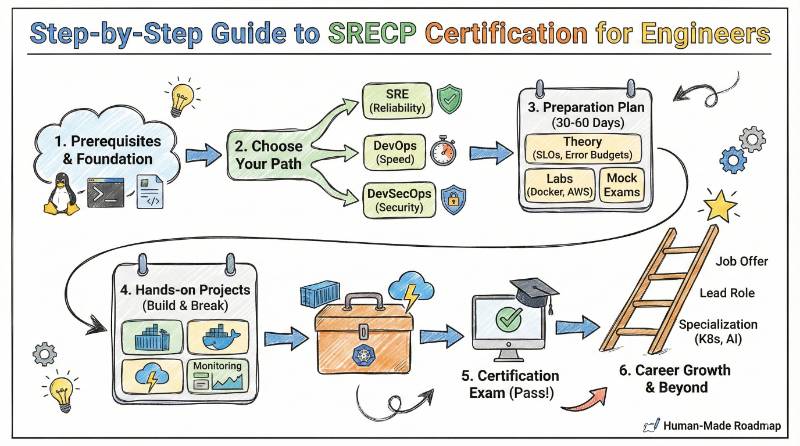
Preparation Plan
To pass the SRECP exam, you’ll need to follow a structured and comprehensive study plan. Below is an optimal preparation timeline:
7–14 Days:
- Core SRE Principles: Spend the first week learning about the foundational principles of SRE. Understand key concepts like Service Level Objectives (SLOs), Service Level Indicators (SLIs), and error budgets.
- Incident Management Basics: Learn about incident response processes and tools. Focus on real-time issue detection and resolution.
- Introduction to Monitoring Tools: Familiarize yourself with the monitoring and observability tools commonly used in SRE practices, such as Prometheus and Grafana.
30 Days:
- Deep Dive into SLOs and SLIs: Study in detail how to define and implement Service Level Objectives and Service Level Indicators to measure system performance.
- Hands-On Automation: Start automating basic tasks such as system health checks and deploying applications. This will help you understand how to increase operational efficiency through automation.
- Incident Response Simulation: Practice incident management using real-life scenarios to get a feel for how to manage high-pressure situations.
60 Days:
- Advanced Automation: Dive deeper into automation tools and scripts. Automate tasks like capacity management, monitoring, and reporting.
- Complete Mock Exams: Attempt multiple practice exams to gauge your readiness for the actual exam. Focus on applying theoretical knowledge to practical scenarios.
- Post-Incident Review: Study real-world post-incident reviews to learn how to analyze and improve incident response practices.
Common Mistakes to Avoid
While preparing for SRECP, it’s important to avoid common mistakes that can hinder your progress:
1. Neglecting Automation
Automation is at the core of SRE. Failing to automate repetitive tasks or operations will lead to inefficiencies and higher chances of human error. Always focus on automating processes like system health checks and deployment.
2. Skipping Post-Incident Reviews
One of the most valuable lessons from SRE is learning from failure. Skipping incident reviews or not thoroughly analyzing failures will prevent you from improving the reliability of your systems.
3. Not Defining Clear SLOs
Service Level Objectives (SLOs) help you define and measure the level of reliability your system is providing. Without clear SLOs and SLIs, it’s impossible to monitor and improve system performance effectively.
4. Overlooking Monitoring Tools
Relying on inadequate monitoring can lead to missing critical issues before they escalate. Ensure you use robust tools for monitoring and observability to keep track of system health in real time.
Best Next Certification After This
Once you complete SRECP, there are several paths to further advance your career in reliability engineering and beyond:
- Same Track: Site Reliability Engineering Certified Expert (SRECE) – This is an advanced certification for those who want to dive deeper into SRE practices.
- Cross-Track: DevOps Certified Professional (DCP) – If you want to expand your skills to broader DevOps practices.
- Leadership: Certified DevOps Manager (CDM) – Ideal for professionals aiming to take on management roles in operations and engineering teams.
Choose Your Path
After SRECP, you can pursue different learning paths based on your career goals. Below are six paths that align with the skills learned in SRECP:
- DevOps – For professionals looking to improve collaboration between development and operations teams.
- DevSecOps – Specialize in integrating security into the development and operations pipeline.
- SRE – Focus exclusively on ensuring the reliability, availability, and scalability of systems.
- AIOps/MLOps – Use artificial intelligence and machine learning to enhance IT operations and monitoring.
- DataOps – Learn how to automate and manage data pipelines efficiently and reliably.
- FinOps – Learn how to manage cloud costs and optimize financial performance in cloud-based systems.
Role → Recommended Certifications
| Role | Recommended Certifications |
|---|---|
| DevOps Engineer | DCP, SRECP, DCE |
| SRE | SRECP, SRECE |
| Platform Engineer | DCP, SRECP, AIOps |
| Cloud Engineer | DCP, SRECP, AWS Certified Solutions Architect |
| Security Engineer | DevSecOps, SRECP, Certified Ethical Hacker (CEH) |
| Data Engineer | DataOps, SRECP, GCP Professional Data Engineer |
| FinOps Practitioner | FinOps, SRECP, Certified Cloud Financial Professional |
| Engineering Manager | CDM, DCP, SRECP |
op Institutions Offering SRECP Training & Certifications
Several institutions offer excellent training for the SRECP certification:
1. DevOpsSchool
DevOpsSchool is the official provider for SRECP training and certification. They offer live sessions, hands-on labs, and detailed study material designed to help professionals develop in-depth knowledge of SRE practices. This platform provides real-world examples and tools commonly used in SRE operations.
2. Cotocus
Cotocus provides DevOps and SRE training that includes cloud services, scalability, automation, and more. Their training focuses on practical, hands-on experience, making it an ideal choice for those looking to gain real-world expertise in Site Reliability Engineering.
3. scmGalaxy
scmGalaxy offers community-driven training with a strong focus on DevOps and SRE principles. Their courses are designed to ensure participants not only learn theory but also develop practical skills in SRE, incident management, and automation.
4. BestDevOps
BestDevOps offers specialized training for DevOps and SRE professionals. Their courses emphasize operational reliability, service monitoring, and automation, all of which are crucial for ensuring the reliability of large-scale systems.
5. devsecopsschool
devsecopsschool integrates security practices into SRE training. Their courses focus on how to secure production environments while maintaining high availability and reliability, an essential skill for SRE professionals.
6. SRESchool
SRESchool specializes in SRE-focused training programs. They provide detailed coverage of incident management, automation, and system performance monitoring, which are key skills for anyone pursuing the SRECP certification.
7. aiopsschool
aiopsschool offers training in AIOps, which focuses on the use of AI to automate operations and improve system performance. This is an essential skill for modern SREs working with large-scale infrastructure.
8. dataopsschool
dataopsschool specializes in DataOps, which deals with automating data workflows for improved reliability. This training is perfect for SREs working in environments that deal with large datasets and require efficient data processing.
9. finopsschool
finopsschool offers training for FinOps, which helps professionals optimize cloud services and resources from a financial perspective. This training is important for SREs who need to ensure that their systems are not only reliable but also cost-efficient.
FAQs
Here are 12 frequently asked questions (FAQs) focused on the SRECP certification:
1. How difficult is the SRECP exam?
The exam is moderately challenging and requires a good understanding of both theoretical concepts and practical applications in SRE.
2. How much time should I dedicate to studying for the SRECP exam?
On average, 30–60 days of focused study should be enough to prepare thoroughly for the exam.
3. What are the prerequisites for the SRECP exam?
There are no formal prerequisites. However, a background in DevOps, software engineering, or IT operations will be beneficial.
4. What is the sequence of certifications after the SRECP?
After completing SRECP, you can pursue SRECE for advanced skills, DCP for broader DevOps knowledge, or CDM for leadership roles.
5. What is the value of SRECP in the job market?
SRECP is highly valuable as more companies adopt SRE practices to ensure the reliability and scalability of their systems, making this certification a strong asset in the tech industry.
6. What career outcomes can I expect after obtaining SRECP?
With SRECP, you can pursue roles like Site Reliability Engineer, DevOps Engineer, Cloud Engineer, and more. It’s an essential certification for anyone working in operations and system reliability.
7. Can beginners take the exam?
While beginners are not prohibited from taking the exam, it is recommended that you have some prior experience in IT operations or software development to maximize your chances of success.
8. How do I prepare for the SRECP exam?
Use a structured study plan, complete hands-on labs, take practice exams, and review case studies to ensure you’re fully prepared.
9. What is the passing score for the SRECP exam?
The passing score typically ranges from 70% to 80%, depending on the exam provider.
10. How long is the SRECP certification valid for?
The certification is valid for three years, after which you’ll need to renew it.
11. What kind of jobs can I get after earning SRECP?
After earning your SRECP certification, you can pursue roles such as Site Reliability Engineer, Cloud Engineer, DevOps Engineer, Platform Engineer, or Engineering Manager.
12. Can I study for the exam on my own?
Yes, there are plenty of study materials available online, but taking a course from an accredited institution can give you a structured learning experience.
FAQs on Site Reliability Engineering Certified Professional (SRECP)
1. What is Site Reliability Engineering (SRE)?
Site Reliability Engineering (SRE) is a discipline that combines software engineering and IT operations to build scalable and reliable software systems. It involves ensuring that systems run efficiently, reliably, and securely, while managing incidents, automating repetitive tasks, and optimizing infrastructure for high availability.
2. What are the key benefits of earning the SRECP certification?
Earning the SRECP certification helps you:
- Gain recognition as an expert in system reliability and incident management.
- Increase job opportunities in high-demand fields like SRE, DevOps, and cloud engineering.
- Learn best practices for building scalable, reliable systems that can handle increased loads.
- Gain expertise in automation, monitoring, and capacity planning, key skills for maintaining high-availability systems.
3. How much time do I need to prepare for the SRECP exam?
The preparation time for the SRECP exam depends on your experience level:
- If you’re already familiar with basic SRE concepts and have hands-on experience, 30–60 days of focused study should be sufficient.
- For those new to SRE or without practical experience, it may take around 60–90 days to grasp the concepts and tools used in the exam.
4. What is the format of the SRECP exam?
The SRECP exam typically consists of multiple-choice questions (MCQs) that test your knowledge of SRE principles, incident management, automation, scalability, monitoring, and reliability engineering. The exam is designed to assess both theoretical understanding and practical application in real-world scenarios.
5. What are the prerequisites for the SRECP certification?
There are no formal prerequisites to take the SRECP exam. However, having some experience in:
- DevOps, cloud engineering, or IT operations will be beneficial.
- Knowledge of system administration, programming/scripting languages, and automation tools is also useful.
Having a solid understanding of general IT operations, software development practices, and cloud infrastructure will give you an advantage during preparation.
6. What are the primary topics covered in the SRECP exam?
The SRECP exam covers a wide range of topics essential to SRE practices. Key areas include:
- Incident management: How to handle production incidents and reduce downtime.
- Automation: Using tools and scripts to automate operational tasks.
- SRE principles: Understanding SLOs, SLIs, and error budgets.
- Monitoring and observability: Implementing monitoring tools and understanding how to track system health.
- Scalability: Ensuring systems can handle growth in traffic and resources without issues.
- Capacity planning: Forecasting and managing future system demands.
7. How much does the SRECP exam cost?
The cost of the SRECP certification exam can vary depending on the certification provider. On average, the exam costs around $200 to $500. However, prices can fluctuate, so it is advisable to check the official website for the most current pricing information.
8. How can I maintain my SRECP certification?
The SRECP certification is valid for three years. After that, you will need to renew your certification by completing the renewal requirements, which may involve taking a recertification exam or earning continuing education credits to ensure you stay up to date with the latest in SRE practices and tools.
Conclusion
The Site Reliability Engineering Certified Professional (SRECP) certification is a great opportunity for professionals looking to specialize in system reliability, performance, and scalability. Whether you’re a DevOps engineer, cloud engineer, or software engineer, SRECP equips you with the tools and knowledge to ensure that your systems are reliable and can scale to meet the needs of your business. Following a structured preparation plan and avoiding common mistakes will help you succeed in this certification and advance your career in the ever-growing field of SRE.