Upgrade & Secure Your Future with DevOps, SRE, DevSecOps, MLOps!
We spend hours scrolling social media and waste money on things we forget, but won’t spend 30 minutes a day earning certifications that can change our lives.
Master in DevOps, SRE, DevSecOps & MLOps by DevOps School!
Learn from Guru Rajesh Kumar and double your salary in just one year.
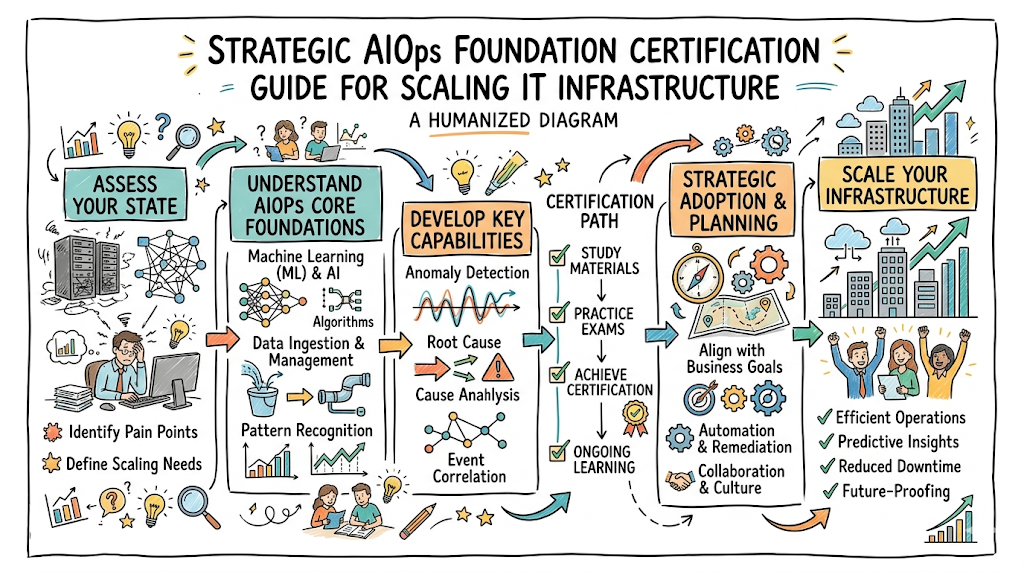
Modern infrastructure has reached a level of complexity where human intervention alone is no longer sufficient to maintain optimal uptime. This guide to the AIOps Foundation Certification is designed for professionals who recognize that the future of operations lies in the marriage of artificial intelligence and system administration. Whether you are an engineer looking to modernize your skill set or a manager aiming to reduce team burnout through intelligent automation, this roadmap clarifies the path forward. At Aiopsschool, the focus is on moving beyond traditional monitoring into the realm of predictive and self-healing systems. By the end of this guide, you will have a clear understanding of how to transition from reactive troubleshooting to proactive, data-driven system management.
What is the AIOps Foundation Certification?
The AIOps Foundation Certification represents a shift in how we approach the stability of large-scale distributed systems. It exists because traditional rule-based monitoring cannot keep up with the ephemeral nature of cloud-native and microservices architectures. This certification emphasizes real-world, production-focused learning, moving away from purely academic definitions of machine learning to focus on practical operational outcomes. It aligns with modern engineering workflows by teaching professionals how to integrate algorithmic insights directly into CI/CD pipelines and incident response frameworks. For the enterprise, it provides a standardized way to ensure that teams can handle the massive volumes of telemetry data generated by modern applications.
Who Should Pursue AIOps Foundation Certification?
This certification is highly beneficial for DevOps engineers, SREs, and cloud architects who are currently overwhelmed by alert fatigue and manual troubleshooting. Security professionals and data engineers will also find value in understanding how AI can be used to detect anomalies that traditional patterns might miss. Beginners in the tech industry can use this certification to leapfrog traditional roles and enter the market with a future-ready specialization. In India and across the global tech landscape, engineering managers are increasingly looking for this credential to lead digital transformation initiatives. It provides a common language for technical leaders to discuss the ROI of automation and intelligent system governance.
Why AIOps Foundation Certification is Valuable and Beyond
The demand for AIOps expertise is skyrocketing as organizations realize that manual operations do not scale with business growth. This certification offers long-term career longevity because it focuses on the fundamental principles of data-driven operations rather than specific, short-lived software tools. As companies adopt multi-cloud strategies, the ability to manage cross-platform telemetry using AI becomes a critical competitive advantage. It helps professionals stay relevant by shifting their focus from mundane maintenance to high-value architectural improvements. The return on time invested is significant, as it positions individuals for high-impact roles in the next generation of enterprise IT.
AIOps Foundation Certification Overview
The program is delivered via the official AIOps Foundation Certification and is hosted on the aiopsschool.com platform. The certification structure is designed to provide a comprehensive understanding of the AIOps lifecycle, from data ingestion to automated remediation. The assessment approach is practical, requiring candidates to demonstrate knowledge of how machine learning models can be applied to real-world IT datasets. Ownership of the program rests with industry veterans who ensure the content remains aligned with the latest advancements in the field. The structure is tiered, allowing professionals to start with foundational concepts before moving toward advanced architectural specializations.
AIOps Foundation Certification Tracks & Levels
The certification is organized into three primary levels to support long-term career progression: Foundation, Professional, and Advanced. The Foundation level focuses on core concepts such as noise reduction, anomaly detection, and the AIOps maturity model. The Professional level dives deeper into the technical implementation of specific algorithmic models for predictive analysis. The Advanced level is geared toward architects and leaders responsible for designing and scaling AIOps platforms across an entire organization. These tracks are designed to align with roles in DevOps, SRE, and FinOps, ensuring that specialized engineers can apply AI within their specific domain expertise.
Complete AIOps Foundation Certification Table
| Track | Level | Who it’s for | Prerequisites | Skills Covered | Recommended Order |
| Operations | Foundation | Engineers/Beginners | Basic IT Ops Knowledge | Anomaly Detection, Noise Reduction | First |
| Engineering | Professional | SREs/Seniors | 2+ Years Experience | Predictive Analytics, Root Cause | Second |
| Leadership | Advanced | Architects/Managers | 5+ Years Experience | Strategy, Scaling, AI Governance | Third |
| Specialized | Expert | Data/Security Leads | Professional Level | Deep Learning for Ops, NLP | Fourth |
Detailed Guide for Each AIOps Foundation Certification
AIOps Foundation Certification – Foundation Level
What it is
This certification validates the essential understanding of how AI and ML principles are applied to IT operations. It confirms the candidate can distinguish between traditional monitoring and intelligent observability.
Who should take it
Junior engineers, system administrators, and project managers who need to understand the vocabulary and the “why” behind AIOps initiatives. It is the perfect entry point for those new to the intersection of data science and operations.
Skills you’ll gain
- Understanding the difference between supervised and unsupervised learning in an Ops context.
- Techniques for alert noise reduction and event correlation.
- Fundamentals of anomaly detection in time-series data.
- Knowledge of the AIOps maturity model for enterprises.
Real-world projects you should be able to do
- Setting up a basic noise-reduction policy for a monitoring dashboard.
- Identifying patterns in historical incident data to predict future outages.
- Documenting an AIOps adoption strategy for a small-to-midsize team.
Preparation plan
- 7–14 days: Study the core terminology and watch the introductory video modules on the platform.
- 30 days: Engage with practice exams and complete the basic data ingestion labs.
- 60 days: Analyze real-world case studies provided in the course materials to understand failure patterns.
Common mistakes
- Treating AIOps as a “magic box” that solves all problems without data cleaning.
- Overlooking the cultural shift required for teams to trust automated insights.
Best next certification after this
- Same-track option: AIOps Professional Certification.
- Cross-track option: SRE Foundation.
- Leadership option: Technical Team Lead Essentials.
AIOps Foundation Certification – Professional Level
What it is
This certification validates the technical ability to implement and tune machine learning models for specific operational use cases. It focuses on the “how” of building automated remediation and predictive maintenance.
Who should take it
Senior DevOps engineers and SRE practitioners who are responsible for building and maintaining internal developer platforms and observability stacks. Candidates should have a strong grasp of Python or similar scripting languages.
Skills you’ll gain
- Implementing automated root cause analysis (RCA) frameworks.
- Tuning anomaly detection algorithms to reduce false positives.
- Developing self-healing scripts triggered by AI insights.
- Integrating AIOps tools with existing ITSM and CI/CD pipelines.
Real-world projects you should be able to do
- Building an automated remediation workflow for common disk-full or memory-leak incidents.
- Creating a predictive capacity planning model based on seasonal traffic data.
- Developing a custom dashboard that correlates business metrics with infrastructure health.
Preparation plan
- 7–14 days: Focus on specific ML algorithms like Random Forest and K-Means for Ops data.
- 30 days: Spend significant time in the sandbox environment configuring real-time data streams.
- 60 days: Finalize a capstone project that demonstrates a full loop from detection to remediation.
Common mistakes
- Focusing on complex algorithms when a simpler statistical model would be more effective.
- Neglecting the feedback loop required to improve model accuracy over time.
Best next certification after this
- Same-track option: AIOps Advanced Architect.
- Cross-track option: MLOps Specialist Certification.
- Leadership option: Strategic Engineering Manager.
AIOps Foundation Certification – Advanced level
What it is
This level validates the strategic and architectural expertise required to lead an organization-wide AIOps transformation. It covers governance, ethics in AI, and the financial impact of automated operations.
Who should take it
Principal architects, Directors of Engineering, and CTOs who need to design the blueprint for an intelligent enterprise. This is for leaders who manage budgets and cross-functional teams.
Skills you’ll gain
- Designing a scalable data lake for multi-cloud telemetry.
- Managing the ethics and transparency of AI-driven decisions in production.
- Calculating and presenting the ROI of AIOps to non-technical stakeholders.
- Leading organizational change to adopt an AI-first operations culture.
Real-world projects you should be able to do
- Architecting a global AIOps platform that spans multiple regions and cloud providers.
- Creating a governance framework for automated actions in high-compliance environments.
- Negotiating vendor contracts and tool selections based on an architectural roadmap.
Preparation plan
- 7–14 days: Review high-level architecture patterns and enterprise case studies.
- 30 days: Focus on the financial and legal aspects of AI in IT operations.
- 60 days: Develop a comprehensive five-year roadmap for an organization’s AIOps journey.
Common mistakes
- Trying to scale too fast without a solid foundational data strategy.
- Failing to align AIOps goals with the broader business objectives.
Best next certification after this
- Same-track option: Deep Learning Specialist.
- Cross-track option: FinOps Certified Practitioner.
- Leadership option: Chief Technology Officer Program.
Choose Your Learning Path
DevOps Path
The DevOps path focuses on the seamless integration of AI into the continuous integration and continuous deployment pipelines. For a DevOps professional, AIOps is a tool to speed up the feedback loop by identifying deployment risks before they reach production. You will learn how to use machine learning to analyze code changes and predict which commits are most likely to cause regressions. This path emphasizes the reduction of “mean time to detect” and the automation of the “shift-left” security and performance checks.
DevSecOps Path
In the DevSecOps path, the primary focus is on using AI to enhance the security posture of an organization. This involves using anomaly detection to identify potential breaches or unauthorized access patterns in real-time. AIOps helps security teams filter out the thousands of daily false-positive alerts, allowing them to focus on genuine threats. You will learn how to build automated responses to common security incidents, such as isolating a compromised container or rotating keys instantly upon detection of a leak.
SRE Path
The SRE path is perhaps the most natural fit for AIOps, as it focuses on the core principles of reliability and availability. SREs use AI to manage error budgets more effectively and to automate the reduction of toil. In this path, you will learn how to set more accurate SLIs and SLOs using historical data and predictive modeling. The goal is to move toward a “no-ops” environment where the system is capable of detecting and fixing its own common failures without human intervention.
AIOps Path
The dedicated AIOps path is for those who want to become specialists in the underlying technology of intelligent operations. This path focuses on the data science aspect of the field, including data ingestion, normalization, and model selection. You will spend time learning about different types of neural networks and how they can be applied to massive streams of log and metric data. This is a highly technical track designed for engineers who want to build the platforms that other teams will use.
MLOps Path
The MLOps path focuses specifically on the lifecycle of machine learning models themselves. As AIOps becomes more prevalent, the need to manage, version, and deploy the models used for operations becomes a task of its own. You will learn how to treat machine learning models as software artifacts, ensuring they are tested, monitored, and updated regularly. This path bridges the gap between the data scientist who builds the model and the engineer who keeps it running in production.
DataOps Path
The DataOps path is essential for ensuring that the data used by AIOps models is of the highest quality. Without clean, reliable data, machine learning insights are useless or, worse, misleading. This path focuses on building automated data pipelines that ingest, clean, and transform telemetry data at scale. You will learn how to manage data privacy and compliance while still providing the necessary access for AI models to learn and provide value to the organization.
FinOps Path
The FinOps path integrates financial accountability with technical operations through the power of AI. In this track, you will learn how to use predictive analytics to forecast cloud spending and identify areas of waste. AIOps can automatically suggest resizing instances or moving workloads to more cost-effective regions based on historical usage patterns. This path is crucial for organizations that want to ensure their technical scaling does not lead to an unsustainable financial burden.
Role → Recommended AIOps Foundation Certification Certifications
| Role | Recommended Certifications |
| DevOps Engineer | AIOps Foundation, SRE Professional |
| SRE | AIOps Professional, Chaos Engineering |
| Platform Engineer | AIOps Advanced, Kubernetes Certified |
| Cloud Engineer | AIOps Foundation, Cloud Architect |
| Security Engineer | DevSecOps Specialist, AIOps Foundation |
| Data Engineer | DataOps Specialist, AIOps Professional |
| FinOps Practitioner | FinOps Certified, AIOps Foundation |
| Engineering Manager | AIOps Advanced, Leadership Track |
Next Certifications to Take After AIOps Foundation Certification
Same Track Progression
Once you have mastered the foundational and professional levels of AIOps, the logical next step is to pursue deep specialization in Artificial Intelligence. This could include certifications in Deep Learning or Natural Language Processing (NLP) specifically applied to log analysis and incident communication. Moving toward an Architect-level certification ensures you can design the entire ecosystem of tools and data pipelines that an intelligent enterprise requires. This path is about becoming the definitive authority on how data-driven decisions should be made at the infrastructure level.
Cross-Track Expansion
Broadening your expertise into related disciplines like SRE or DevSecOps makes you a much more versatile and valuable professional. For instance, combining AIOps with a FinOps certification allows you to speak to both the technical health and the financial efficiency of a platform. Understanding the principles of Chaos Engineering alongside AI helps you build systems that are not only intelligent but also highly resilient to unknown failure modes. This cross-pollination of skills is what defines the “T-shaped” professional in the modern cloud era.
Leadership & Management Track
For those looking to move away from day-to-day engineering, the leadership track focuses on the strategic implementation of AIOps. This involves certifications in Engineering Management, Digital Transformation, and AI Governance. The goal here is to learn how to build and lead high-performing teams that can effectively leverage AI tools. You will focus on the business impact of automation, including talent acquisition, budget management, and setting the long-term technical vision for an organization. This is the transition from managing systems to leading people.
Training & Certification Support Providers for AIOps Foundation Certification
DevOpsSchool is a leading provider of high-end technical training, specifically focusing on the needs of the modern DevOps and SRE professional. Their approach is rooted in practical, hands-on experience, ensuring that students do not just learn the theory but can actually apply it in a production environment. They offer a range of courses that complement the AIOps journey, providing deep dives into automation and containerization. Their presence in the Indian market is significant, offering localized support and a community of thousands of alumni. For those pursuing an AIOps certification, their structured bootcamps provide a solid foundation and a clear path to mastery.
Cotocus provides specialized consulting and training services that focus on the architectural and strategic aspects of digital transformation. They are known for their high-quality content and their ability to bridge the gap between legacy systems and modern cloud-native practices. Their instructors are industry veterans who bring a wealth of real-world knowledge to the classroom. For candidates looking for a more personalized and deep-dive approach to AIOps, Cotocus offers tailored programs that align with specific organizational goals. They emphasize the long-term value of technical skills and the importance of a growth mindset in a rapidly changing industry.
Scmgalaxy is a massive community and knowledge base dedicated to software configuration management and DevOps practices. They offer a wealth of free and paid resources, including blogs, tutorials, and certification guides that are essential for anyone in the IT operations field. Their focus is on fostering a collaborative environment where professionals can learn from each other’s successes and failures. For someone pursuing an AIOps certification, Scmgalaxy provides the necessary community support and supplementary materials to ensure a well-rounded understanding of the field. They are a primary destination for staying updated on the latest trends and toolsets.
BestDevOps focuses on providing the most efficient and effective learning paths for the most in-demand certifications in the industry. Their training is designed to be concise and impactful, making it ideal for busy professionals who need to upskill quickly. They prioritize the core concepts that provide the highest return on investment for a candidate’s career. When it comes to AIOps, BestDevOps offers a clear and structured roadmap that takes the guesswork out of preparation. Their commitment to student success is reflected in their high pass rates and the positive feedback from their global community of learners.
devsecopsschool.com is the go-to resource for engineers who want to integrate security into every aspect of their operations. Their training programs are designed to teach the “security as code” philosophy, which is a perfect complement to the AIOps approach. By learning how to use AI for threat detection and automated compliance, students can become leaders in the emerging field of intelligent security. The platform offers a range of specialized certifications and workshops that focus on the practical implementation of DevSecOps in large-scale environments. Their focus is on building resilient and secure systems from the ground up.
sreschool.com provides a dedicated learning environment for everything related to Site Reliability Engineering. Given that AIOps is a key component of modern SRE, this platform offers essential training on how to manage uptime and performance at scale. Their curriculum covers everything from SLIs and SLOs to advanced incident response and chaos engineering. For those pursuing an AIOps certification, sreschool.com provides the necessary context on how AI fits into the broader reliability strategy of an organization. Their instructors are practitioners who deal with high-scale system challenges every day, bringing invaluable insights to the training.
aiopsschool.com is the primary hosting platform and authority for the AIOps certifications themselves. They offer the most direct and comprehensive training for the Foundation, Professional, and Advanced levels. The platform is designed to be a one-stop-shop for all AIOps learning needs, including official study guides, interactive labs, and practice exams. Their focus is entirely on the intersection of AI and IT operations, making them the leading experts in this specific niche. By training directly with the source, candidates can be confident that they are learning the most relevant and up-to-date material in the industry.
dataopsschool.com addresses the critical need for high-quality data management in the era of AI. Their training programs focus on the principles of DataOps, teaching students how to build robust and scalable data pipelines. This is an essential skill for anyone looking to implement AIOps, as the success of AI models depends entirely on the data they ingest. The platform provides hands-on experience with the latest data processing and orchestration tools, ensuring that students can handle the complexities of modern telemetry data. Their mission is to ensure that data is a reliable asset for every organization.
finopsschool.com focuses on the financial side of cloud-native engineering, providing the training needed to manage cloud costs effectively. As organizations scale their use of AI and cloud services, the ability to monitor and optimize spending becomes a critical skill. Their certification programs teach the principles of FinOps, including cost allocation, forecasting, and optimization. For AIOps professionals, understanding these financial metrics is key to justifying the investment in automation and AI tools. The platform offers a practical and data-driven approach to cloud financial management that is essential for modern technical leaders.
Frequently Asked Questions (General)
- What is the main difference between traditional monitoring and AIOps?
Traditional monitoring is rule-based and requires human intervention to set thresholds, whereas AIOps uses machine learning to automatically identify anomalies and patterns without manual input.
- How difficult is the AIOps Foundation Certification exam?
The foundation level is designed to be accessible for beginners with basic IT knowledge, while the professional and advanced levels require significant hands-on experience and technical depth.
- Are there any specific prerequisites for the foundation level?
There are no strict technical prerequisites, but a basic understanding of IT operations, monitoring concepts, and common infrastructure terminology will be very helpful.
- How long does it typically take to prepare for the certification?
Depending on your experience level, preparation can take anywhere from 30 days for the foundation level to 90 days for the more technical professional level.
- Does the certification focus on a specific vendor’s tools?
No, the certification is designed to be vendor-neutral, focusing on the core principles and methodologies that can be applied to any AIOps toolset or platform.
- What is the return on investment (ROI) for this certification in India?
India’s tech market is rapidly adopting AI-driven operations, and professionals with this certification are seeing a significant increase in salary and opportunities for leadership roles.
- Can I take the exam online, or do I need to go to a center?
The exam is conducted online via a proctored platform, allowing you to take it from the comfort of your home or office at a time that suits you.
- Is machine learning experience required before starting?
For the foundation level, no machine learning experience is required. For the professional level, a basic understanding of Python and data science concepts is recommended.
- How does AIOps benefit a DevOps professional?
AIOps helps DevOps teams by automating noise reduction, providing faster root cause analysis, and predicting potential deployment failures before they impact the user.
- Is the AIOps Foundation Certification recognized globally?
Yes, the certification is designed to meet global industry standards and is recognized by major technology companies and service providers around the world.
- What kind of hands-on labs are included in the training?
The training includes labs on data ingestion, configuring anomaly detection models, creating automated remediation scripts, and building custom observability dashboards.
- How often do I need to recertify?
The certification is typically valid for two to three years, after which you may need to take a refresher exam or demonstrate continued professional development in the field.
FAQs on AIOps Foundation Certification
- What specific types of data are covered in the AIOps Foundation Certification?
The certification covers the ingestion and analysis of logs, metrics, traces, and event data from a wide variety of infrastructure and application sources.
- Does the course cover both supervised and unsupervised learning?
Yes, the curriculum explains the use cases for both types of learning and how they are applied to different operational challenges like clustering and classification.
- How does AIOps help with incident management?
AIOps speeds up incident management by automatically correlating related events into a single incident, reducing alert fatigue and providing the context needed for faster resolution.
- Can I apply the principles of AIOps to on-premise environments?
Absolutely. While many examples are cloud-based, the core principles of AIOps are equally applicable to legacy on-premise data centers and hybrid environments.
- What is the role of Natural Language Processing (NLP) in AIOps?
NLP is used to analyze unstructured log data and to improve communication during incidents by summarizing complex technical details into human-readable reports.
- How does AIOps impact the role of a traditional System Administrator?
AIOps elevates the role by automating the mundane tasks of monitoring and troubleshooting, allowing the administrator to focus on more strategic architectural work.
- Is there a focus on the ethical use of AI in this certification?
Yes, the advanced levels specifically cover the ethical implications of automated decision-making and the importance of transparency in AI-driven operations.
- How do I start an AIOps pilot project in my company after getting certified?
The certification provides a roadmap for starting small, focusing on noise reduction first, and then gradually expanding into predictive analytics and automated remediation.
Conclusion
Stepping into the world of AIOps is not just about learning a new set of tools; it is about adopting a new mindset for how systems should be managed. In my decades of experience, I have seen many trends come and go, but the shift toward intelligent, data-driven operations is a fundamental change that is here to stay. This certification provides the structured learning and the industry validation needed to lead that change within your organization. It is a practical, experience-driven credential that focuses on the outcomes that matter to businesses: higher uptime, lower costs, and happier engineering teams. If you are ready to move beyond the limitations of traditional monitoring and embrace the future of IT, this certification is an investment that will pay dividends for years to come.