Upgrade & Secure Your Future with DevOps, SRE, DevSecOps, MLOps!
We spend hours scrolling social media and waste money on things we forget, but won’t spend 30 minutes a day earning certifications that can change our lives.
Master in DevOps, SRE, DevSecOps & MLOps by DevOps School!
Learn from Guru Rajesh Kumar and double your salary in just one year.
Introduction
Cloud Workload Protection Platforms (CWPP) are specialized security solutions designed to safeguard workloads running in cloud environments, including virtual machines, containers, and serverless functions. They provide real-time visibility, continuous monitoring, threat detection, and automated response across multi-cloud and hybrid infrastructures. In plain terms, CWPPs ensure that your cloud workloads are secure from configuration errors, vulnerabilities, and attacks while maintaining compliance with industry standards.
As organizations increasingly migrate workloads to cloud platforms, the risk landscape grows more complex. Misconfigured cloud resources, exposed APIs, and container vulnerabilities can create significant security gaps. CWPPs address these challenges by offering unified protection across diverse cloud environments. These platforms are particularly relevant in +, with AI-driven threat detection, automated response workflows, and integration with DevSecOps practices becoming essential for agile organizations.
Real-world use cases:
- Continuous security monitoring for AWS, Azure, and GCP workloads.
- Detecting vulnerabilities in containerized applications and Kubernetes clusters.
- Identifying misconfigurations and compliance gaps in multi-cloud environments.
- Protecting serverless workloads and microservices.
- Automated threat response and incident prioritization for DevSecOps teams.
Evaluation criteria buyers should consider:
- Cloud-native support for multiple public and private clouds.
- Container and serverless security capabilities.
- Real-time monitoring and automated threat response.
- Integration with DevSecOps pipelines and CI/CD tools.
- Compliance support (SOC 2, ISO 27001, HIPAA, GDPR).
- Ease of deployment and scalability.
- Risk scoring and prioritization capabilities.
- Reporting, dashboards, and alerting mechanisms.
- API availability and automation support.
Best for: Cloud security teams, DevSecOps engineers, IT administrators, CISOs, and large organizations with dynamic, multi-cloud workloads.
Not ideal for: Small organizations with limited cloud adoption, minimal workloads, or environments already secured through native cloud tools without complex workloads.
Key Trends in Cloud Workload Protection Platforms (CWPP)
- AI and Machine Learning Threat Detection: Predictive analytics to detect anomalies, zero-day vulnerabilities, and insider threats.
- Integration with DevSecOps Pipelines: Continuous security scanning and remediation during CI/CD workflows.
- Multi-Cloud and Hybrid Cloud Support: Unified monitoring for AWS, Azure, GCP, and on-prem hybrid environments.
- Container and Kubernetes Security: Deep inspection of container images, orchestration platforms, and runtime security.
- Serverless and Microservices Protection: Security controls for ephemeral workloads and event-driven architectures.
- Automated Remediation: Integration with ticketing, patch management, and response automation to reduce MTTR.
- Compliance and Audit Readiness: Built-in reporting for SOC 2, ISO 27001, HIPAA, and GDPR compliance.
- Threat Intelligence Integration: Enhanced threat context through feeds and external intelligence sources.
- Behavioral and Anomaly Detection: Detect suspicious activity beyond signature-based methods.
- Flexible Deployment and Pricing: Cloud-native, hybrid, and on-prem options with subscription or usage-based models.
How We Selected These Tools (Methodology)
- Evaluated market adoption and mindshare among cloud security and DevSecOps teams.
- Assessed feature completeness, including container, serverless, and multi-cloud workload coverage.
- Reviewed performance and reliability, minimizing false positives and ensuring runtime visibility.
- Analyzed security posture, including encryption, MFA, RBAC, and compliance alignment.
- Considered integration capabilities with CI/CD, SIEM, ticketing systems, and orchestration platforms.
- Assessed scalability for enterprise, mid-market, and SMB environments.
- Checked automation and remediation support to streamline response workflows.
- Evaluated reporting and dashboards for operational insights.
- Reviewed support and community resources for onboarding and troubleshooting.
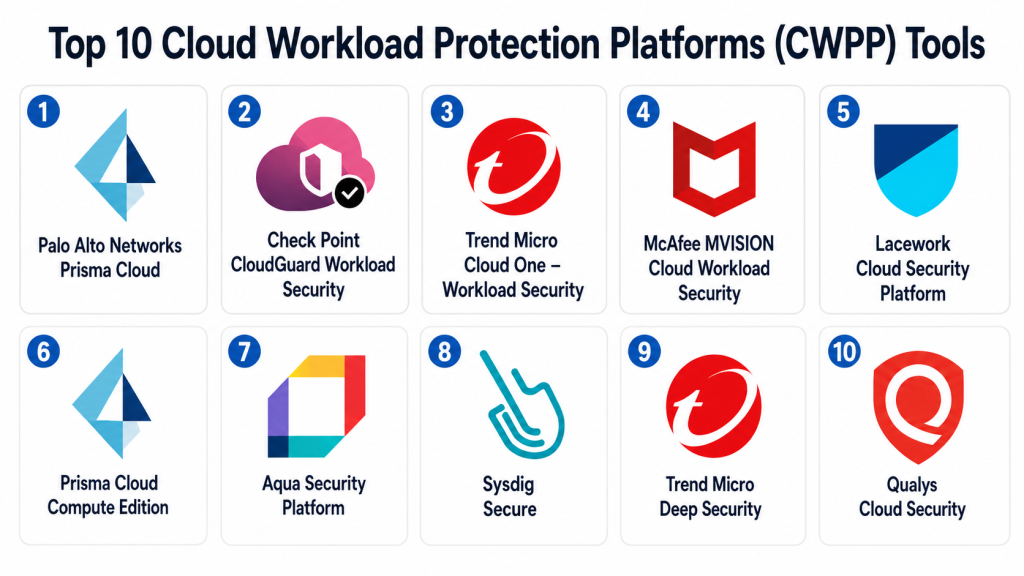
Top 10 Cloud Workload Protection Platforms (CWPP) Tools
#1 — Palo Alto Networks Prisma Cloud
Short description: Prisma Cloud offers comprehensive protection for cloud-native applications, containers, and serverless workloads. It provides continuous monitoring, compliance checks, and runtime threat detection for multi-cloud environments.
Key Features
- Cloud-native workload security across AWS, Azure, and GCP
- Container and Kubernetes security
- Serverless function protection
- Real-time threat detection and response
- Compliance and audit reporting
- CI/CD pipeline integration
Pros
- Enterprise-grade multi-cloud coverage
- Advanced threat intelligence and runtime protection
Cons
- Complex setup for beginners
- Premium pricing for small teams
Platforms / Deployment
- Web / Windows / Linux / macOS
- Cloud / Hybrid
Security & Compliance
- MFA, encryption, RBAC
- SOC 2, ISO 27001, GDPR
Integrations & Ecosystem
- SIEM, ticketing, DevSecOps tools
- REST APIs for automation
- Cloud-native orchestration integrations
Support & Community
- Professional support and training programs
- Extensive documentation and community resources
#2 — Check Point CloudGuard Workload Security
Short description: CloudGuard secures cloud workloads through runtime protection, posture management, and threat prevention, offering deep insights for both containerized and virtual environments.
Key Features
- Cloud workload security and runtime protection
- Continuous compliance monitoring
- Container image scanning
- Threat prevention and detection
- Integration with DevSecOps workflows
Pros
- Comprehensive cloud workload visibility
- Automated policy enforcement
Cons
- Requires advanced expertise to optimize policies
- Licensing can be costly
Platforms / Deployment
- Web / Windows / Linux
- Cloud / Hybrid
Security & Compliance
- Encryption, MFA, RBAC
- SOC 2, ISO 27001
Integrations & Ecosystem
- SIEM, CI/CD pipelines, ticketing
- API support for automation
Support & Community
- Professional support tiers
- Documentation and online resources
#3 — Trend Micro Cloud One – Workload Security
Short description: Provides layered protection for virtual, containerized, and cloud-native workloads. It detects threats, enforces compliance, and automates remediation across multi-cloud environments.
Key Features
- Malware and exploit detection for cloud workloads
- Container image and runtime security
- Host-based intrusion detection
- Compliance and audit reporting
- Integration with DevSecOps pipelines
Pros
- Comprehensive threat detection
- Cloud-native deployment simplicity
Cons
- UI can be overwhelming for new users
- Premium pricing for large deployments
Platforms / Deployment
- Web / Linux / Windows / macOS
- Cloud / Hybrid
Security & Compliance
- MFA, encryption, RBAC
- PCI DSS, ISO 27001, GDPR
Integrations & Ecosystem
- SIEM, CI/CD, ticketing
- APIs for automation and orchestration
Support & Community
- Professional support available
- Documentation and tutorials
#4 — McAfee MVISION Cloud Workload Security
Short description: MVISION Cloud Workload Security provides protection for workloads across public and private clouds, emphasizing runtime security, compliance, and threat detection for virtual machines and containers.
Key Features
- Continuous cloud workload monitoring
- Container and VM protection
- Automated compliance checks
- Threat prevention and response
- Policy-based enforcement
Pros
- Strong compliance and policy management
- Scales effectively across multi-cloud environments
Cons
- Initial setup can be complex
- Limited serverless coverage compared to competitors
Platforms / Deployment
- Web / Windows / Linux
- Cloud / Hybrid
Security & Compliance
- MFA, encryption, RBAC
- Not publicly stated
Integrations & Ecosystem
- SIEM, ticketing, orchestration
- API support for automation
Support & Community
- Professional support tiers
- Knowledge base and documentation
#5 — Lacework Cloud Security Platform
Short description: Lacework offers automated security for cloud workloads with AI-driven anomaly detection, threat intelligence, and compliance reporting for containers, VMs, and serverless workloads.
Key Features
- AI-driven anomaly detection
- Container and Kubernetes security
- Compliance and audit reporting
- Threat intelligence integration
- Runtime protection and alerting
Pros
- Advanced machine learning for threat detection
- Multi-cloud visibility
Cons
- Premium pricing
- Learning curve for AI features
Platforms / Deployment
- Web / Linux / Windows
- Cloud
Security & Compliance
- Not publicly stated
Integrations & Ecosystem
- SIEM, DevSecOps pipelines, ticketing
- API access for automation
Support & Community
- Professional support available
- Documentation and tutorials
#6 — Prisma Cloud Compute Edition
Short description: Focused on workload and container security, Compute Edition monitors runtime and build-time security for microservices, VMs, and serverless functions in hybrid cloud environments.
Key Features
- Runtime protection for containers and VMs
- Build-time scanning of images
- Serverless function security
- Automated remediation
- Compliance checks
Pros
- Strong container and microservices protection
- Integration with CI/CD pipelines
Cons
- Complex for small teams
- Premium pricing
Platforms / Deployment
- Web / Linux / Windows / macOS
- Cloud / Hybrid
Security & Compliance
- MFA, encryption, RBAC
- SOC 2, ISO 27001
Integrations & Ecosystem
- CI/CD pipelines, SIEM, ticketing
- API access for automation
Support & Community
- Professional support tiers
- Knowledge base and community forums
#7 — Aqua Security Platform
Short description: Aqua provides full lifecycle protection for containers, serverless functions, and VMs, including vulnerability scanning, runtime enforcement, and compliance monitoring.
Key Features
- Container image scanning
- Runtime security enforcement
- Serverless workload protection
- Vulnerability management
- Compliance monitoring
Pros
- Strong container and serverless support
- Automated remediation capabilities
Cons
- Complexity for non-containerized workloads
- Costly for SMBs
Platforms / Deployment
- Web / Linux / Windows / macOS
- Cloud / Hybrid
Security & Compliance
- Not publicly stated
Integrations & Ecosystem
- CI/CD, SIEM, ticketing integrations
- API support for automation
Support & Community
- Professional support tiers
- Active community and documentation
#8 — Sysdig Secure
Short description: Sysdig Secure provides visibility and security for containers, Kubernetes, and cloud-native workloads, integrating runtime protection with compliance and monitoring.
Key Features
- Kubernetes and container security
- Runtime threat detection
- Compliance reporting
- CI/CD pipeline integration
- Audit trails and visibility
Pros
- Strong Kubernetes and container security
- Real-time visibility and alerting
Cons
- Limited VM coverage
- Premium pricing
Platforms / Deployment
- Web / Linux / Windows
- Cloud / Hybrid
Security & Compliance
- Not publicly stated
Integrations & Ecosystem
- CI/CD pipelines, SIEM, ticketing
- API automation
Support & Community
- Documentation and tutorials
- Professional support tiers
#9 — Trend Micro Deep Security
Short description: Provides host-based protection for VMs, containers, and cloud workloads, integrating anti-malware, intrusion detection, and vulnerability shielding.
Key Features
- Anti-malware and IPS for workloads
- Container and VM protection
- Automated patch management
- Compliance checks
- Cloud workload monitoring
Pros
- Mature enterprise-grade security
- Broad workload coverage
Cons
- Less developer-centric
- Complexity for cloud-native deployments
Platforms / Deployment
- Web / Linux / Windows / macOS
- Cloud / Hybrid
Security & Compliance
- SOC 2, ISO 27001
- MFA, encryption
Integrations & Ecosystem
- CI/CD pipelines, SIEM, orchestration
- API access
Support & Community
- Professional support tiers
- Knowledge base and community
#10 — Qualys Cloud Security
Short description: Delivers cloud workload visibility, vulnerability management, and compliance monitoring, combining asset discovery and real-time risk insights.
Key Features
- Asset discovery and mapping
- Vulnerability management
- Compliance reporting
- Runtime monitoring
- Cloud-native protection
Pros
- Unified cloud workload protection
- Strong reporting and compliance features
Cons
- Higher learning curve
- Premium pricing
Platforms / Deployment
- Web / Linux / Windows / macOS
- Cloud / Hybrid
Security & Compliance
- SOC 2, ISO 27001
- MFA, encryption
Integrations & Ecosystem
- SIEM, DevSecOps pipelines, ticketing
- API for automation
Support & Community
- Professional support
- Knowledge base and tutorials
Comparison Table (Top 10)
| Tool Name | Best For | Platform(s) Supported | Deployment | Standout Feature | Public Rating |
|---|---|---|---|---|---|
| Prisma Cloud | Multi-cloud, container workloads | Web / Linux / Windows / macOS | Cloud / Hybrid | Comprehensive CWPP coverage | N/A |
| Check Point CloudGuard | Enterprise workloads | Web / Linux / Windows | Cloud / Hybrid | Policy enforcement and runtime security | N/A |
| Trend Micro Cloud One | Cloud-native apps | Web / Linux / Windows / macOS | Cloud / Hybrid | Layered workload protection | N/A |
| McAfee MVISION | Multi-cloud enterprise | Web / Linux / Windows | Cloud / Hybrid | Runtime threat detection | N/A |
| Lacework | Multi-cloud & SaaS environments | Web / Linux / Windows | Cloud | AI-driven anomaly detection | N/A |
| Prisma Cloud Compute Edition | Containers & microservices | Web / Linux / Windows / macOS | Cloud / Hybrid | CI/CD integrated runtime protection | N/A |
| Aqua Security | Containers & serverless | Web / Linux / Windows / macOS | Cloud / Hybrid | Full lifecycle container protection | N/A |
| Sysdig Secure | Kubernetes & cloud workloads | Web / Linux / Windows | Cloud / Hybrid | Runtime security and visibility | N/A |
| Trend Micro Deep Security | VMs & containers | Web / Linux / Windows / macOS | Cloud / Hybrid | Host-based workload protection | N/A |
| Qualys Cloud Security | Multi-cloud compliance | Web / Linux / Windows / macOS | Cloud / Hybrid | Unified asset and risk insights | N/A |
Evaluation & Scoring of Cloud Workload Protection Platforms
| Tool Name | Core (25%) | Ease (15%) | Integrations (15%) | Security (10%) | Performance (10%) | Support (10%) | Value (15%) | Weighted Total (0–10) |
|---|---|---|---|---|---|---|---|---|
| Prisma Cloud | 9 | 7 | 8 | 9 | 8 | 8 | 7 | 8.2 |
| Check Point CloudGuard | 8 | 7 | 7 | 8 | 8 | 7 | 7 | 7.7 |
| Trend Micro Cloud One | 9 | 7 | 8 | 8 | 8 | 7 | 7 | 8.0 |
| McAfee MVISION | 8 | 6 | 7 | 7 | 7 | 7 | 7 | 7.2 |
| Lacework | 8 | 7 | 7 | 7 | 7 | 7 | 6 | 7.1 |
| Prisma Cloud Compute Edition | 9 | 7 | 8 | 8 | 8 | 7 | 7 | 8.0 |
| Aqua Security | 8 | 7 | 7 | 7 | 7 | 7 | 6 | 7.1 |
| Sysdig Secure | 7 | 7 | 7 | 7 | 7 | 7 | 6 | 7.0 |
| Trend Micro Deep Security | 8 | 6 | 7 | 8 | 7 | 7 | 7 | 7.3 |
| Qualys Cloud Security | 8 | 6 | 7 | 8 | 7 | 7 | 7 | 7.3 |
Interpretation: Scores are comparative across core features, usability, integration, security, performance, support, and value. Weighted totals help organizations identify which CWPP solution aligns best with operational needs.
Which Cloud Workload Protection Platform Tool Is Right for You?
Solo / Freelancer
- Lightweight platforms like Sysdig Secure or Aqua Security for smaller workloads and container environments.
SMB
- Lacework or Prisma Cloud Compute Edition for multi-cloud protection without complex deployment overhead.
Mid-Market
- Trend Micro Cloud One or Check Point CloudGuard for integrated runtime security and compliance.
Enterprise
- Prisma Cloud, McAfee MVISION, or Qualys Cloud Security for comprehensive CWPP coverage and automation.
Budget vs Premium
- Smaller teams may use cost-effective or cloud-native solutions.
- Premium platforms offer advanced AI, automation, and multi-cloud support at higher costs.
Feature Depth vs Ease of Use
- Enterprise CWPP tools provide deep visibility, compliance, and runtime protection.
- Developer-focused platforms balance usability with essential container and cloud security.
Integrations & Scalability
- API-rich platforms allow seamless integration with DevSecOps pipelines, SIEMs, and ticketing systems.
- Cloud-native CWPP solutions scale effectively with dynamic workloads.
Security & Compliance Needs
- Organizations in regulated industries should prioritize Prisma Cloud, Check Point CloudGuard, or Trend Micro Cloud One.
- Smaller teams with limited compliance requirements can leverage Aqua Security or Sysdig Secure.
Frequently Asked Questions (FAQs)
H3: What workloads are protected by CWPP tools?
CWPP platforms protect VMs, containers, Kubernetes clusters, serverless functions, and multi-cloud environments.
H3: How often should cloud workloads be scanned?
Continuous monitoring is ideal; critical workloads should be monitored in real-time.
H3: Can CWPP tools integrate with DevSecOps pipelines?
Yes, most support CI/CD integration to detect vulnerabilities and misconfigurations during development.
H3: Are CWPP tools suitable for SMBs?
Yes, cloud-native and lightweight CWPP solutions scale according to team size and workload complexity.
H3: How do CWPP tools handle compliance?
Many provide built-in reports aligned with SOC 2, ISO
give me full blog pls
Top 10 Cloud Workload Protection Platforms (CWPP): Features, Pros, Cons & Comparison
Introduction
Cloud Workload Protection Platforms (CWPP) are specialized security solutions designed to protect cloud-based workloads, including virtual machines, containers, serverless functions, and microservices. They provide continuous monitoring, threat detection, vulnerability management, and compliance enforcement across multi-cloud and hybrid environments. Simply put, CWPPs help organizations maintain visibility and security over workloads that are dynamic, distributed, and often ephemeral, ensuring that every workload stays protected against cyber threats.
As cloud adoption continues to accelerate, the risk landscape grows more complex. Misconfigured cloud resources, exposed APIs, container vulnerabilities, and insecure serverless functions create potential entry points for attackers. CWPPs address these challenges by offering unified protection, continuous assessment, and automated remediation, making them critical in 2026+ for enterprises that prioritize security and compliance.
Real-world use cases:
- Continuous monitoring and protection of AWS, Azure, and GCP workloads.
- Vulnerability scanning and runtime protection for containers and Kubernetes clusters.
- Securing serverless workloads and microservices against misconfigurations and attacks.
- Automated compliance enforcement for standards like SOC 2, ISO 27001, and HIPAA.
- Integrating with DevSecOps workflows for CI/CD pipeline security.
Evaluation criteria buyers should consider:
- Cloud-native support across public and private clouds.
- Container, Kubernetes, and serverless security capabilities.
- Continuous monitoring and real-time threat detection.
- Integration with DevSecOps, SIEM, and ticketing systems.
- Automated remediation and incident response.
- Compliance reporting and audit readiness.
- Ease of deployment and scalability.
- Risk scoring, prioritization, and alerting.
- API availability and automation support.
Best for: Cloud security teams, DevSecOps engineers, IT administrators, and CISOs in large and medium organizations with dynamic multi-cloud workloads.
Not ideal for: Small organizations with minimal cloud adoption or simpler IT environments that can rely on native cloud security tools.
Key Trends in Cloud Workload Protection Platforms (CWPP) for 2026 and Beyond
- AI-Powered Threat Detection: Machine learning identifies anomalous activity, zero-day vulnerabilities, and insider threats.
- DevSecOps Pipeline Integration: Security scans integrated into CI/CD workflows to detect vulnerabilities early in development.
- Multi-Cloud and Hybrid Cloud Support: Unified monitoring for AWS, Azure, GCP, and on-prem workloads.
- Container and Kubernetes Security: Comprehensive scanning of container images, runtime protection, and orchestration security.
- Serverless & Microservices Protection: Safeguarding ephemeral workloads and event-driven architectures.
- Automated Remediation: Integration with ticketing and patch management to reduce mean time to respond (MTTR).
- Compliance and Audit Readiness: Built-in reporting for SOC 2, ISO 27001, HIPAA, and GDPR.
- Threat Intelligence Integration: Contextual threat enrichment from external intelligence sources.
- Behavioral and Anomaly Detection: Advanced analytics to detect threats beyond signature-based approaches.
- Flexible Deployment & Pricing Models: Cloud-native, hybrid, and on-prem options with subscription or usage-based pricing.
How We Selected These Tools (Methodology)
- Evaluated market adoption and mindshare among enterprise security and cloud teams.
- Assessed feature completeness, including multi-cloud, container, and serverless coverage.
- Reviewed performance and reliability, minimizing false positives and ensuring runtime visibility.
- Analyzed security posture, including encryption, MFA, RBAC, and compliance standards.
- Checked integration capabilities with CI/CD pipelines, SIEM, and ticketing systems.
- Evaluated scalability for SMB, mid-market, and enterprise environments.
- Reviewed automation and remediation support for operational efficiency.
- Assessed reporting, dashboards, and alerting capabilities.
- Considered support and community resources for onboarding, troubleshooting, and knowledge sharing.
Top 10 Cloud Workload Protection Platforms (CWPP) Tools
#1 — Palo Alto Networks Prisma Cloud
Short description: Prisma Cloud provides full-stack security across cloud-native applications, containers, and serverless workloads. It delivers continuous visibility, compliance checks, and runtime threat detection for multi-cloud environments, making it ideal for large enterprises with complex cloud infrastructures.
Key Features
- Cloud-native workload security across AWS, Azure, and GCP
- Container and Kubernetes runtime protection
- Serverless function monitoring
- Compliance and audit reporting
- Threat detection and automated remediation
- Integration with DevSecOps pipelines
Pros
- Enterprise-grade coverage across multi-cloud environments
- Advanced AI-driven threat intelligence and runtime protection
Cons
- Complex initial setup for beginners
- Higher cost for small teams
Platforms / Deployment
- Web / Linux / Windows / macOS
- Cloud / Hybrid
Security & Compliance
- MFA, encryption, RBAC
- SOC 2, ISO 27001, GDPR
Integrations & Ecosystem
- SIEM, ticketing, DevSecOps tools
- REST APIs for automation
- Cloud-native orchestration integrations
Support & Community
- Enterprise-level support and training
- Extensive documentation and community resources
#2 — Check Point CloudGuard Workload Security
Short description: CloudGuard provides runtime protection, posture management, and threat prevention for cloud workloads. It secures virtual machines, containers, and serverless functions while delivering deep insights and compliance reporting.
Key Features
- Runtime protection for workloads
- Continuous compliance monitoring
- Container image scanning and Kubernetes security
- Threat prevention and detection
- Integration with CI/CD and DevSecOps
Pros
- Comprehensive cloud workload visibility
- Automated policy enforcement
Cons
- Requires expertise to optimize policies
- Premium pricing
Platforms / Deployment
- Web / Linux / Windows
- Cloud / Hybrid
Security & Compliance
- MFA, encryption, RBAC
- SOC 2, ISO 27001
Integrations & Ecosystem
- CI/CD pipelines, SIEM, ticketing systems
- API support for automation
- Threat intelligence enrichment
Support & Community
- Professional support tiers
- Knowledge base and online tutorials
#3 — Trend Micro Cloud One – Workload Security
Short description: Provides layered protection for VMs, containers, and cloud-native workloads. Cloud One detects malware, exploits, and vulnerabilities while enforcing compliance and integrating with CI/CD pipelines.
Key Features
- Malware and exploit detection for workloads
- Container and Kubernetes runtime security
- Host-based intrusion detection
- Compliance and audit reporting
- CI/CD pipeline integration
Pros
- Strong threat detection and runtime protection
- Cloud-native deployment simplicity
Cons
- UI can be overwhelming for new users
- Higher cost for large-scale deployment
Platforms / Deployment
- Web / Linux / Windows / macOS
- Cloud / Hybrid
Security & Compliance
- MFA, encryption, RBAC
- PCI DSS, ISO 27001, GDPR
Integrations & Ecosystem
- SIEM, CI/CD tools, ticketing
- API support for automation
- Cloud orchestration integration
Support & Community
- Professional support tiers
- Tutorials and documentation
#4 — McAfee MVISION Cloud Workload Security
Short description: MVISION Cloud Workload Security provides runtime protection, automated compliance checks, and threat detection for VMs, containers, and serverless functions across multi-cloud environments.
Key Features
- Continuous cloud workload monitoring
- Container and VM protection
- Policy-based enforcement
- Threat detection and remediation
- Compliance reporting
Pros
- Strong policy management and compliance support
- Scales effectively in multi-cloud environments
Cons
- Initial setup can be complex
- Limited serverless coverage
Platforms / Deployment
- Web / Linux / Windows
- Cloud / Hybrid
Security & Compliance
- MFA, encryption, RBAC
- Not publicly stated
Integrations & Ecosystem
- SIEM, ticketing, DevSecOps integration
- API support for automation
Support & Community
- Professional support tiers
- Documentation and tutorials
#5 — Lacework Cloud Security
Short description: Lacework provides automated cloud workload security with AI-driven anomaly detection, compliance reporting, and runtime protection for containers, VMs, and serverless workloads.
Key Features
- AI-driven anomaly detection
- Container and Kubernetes security
- Runtime protection for cloud workloads
- Compliance and audit reporting
- Threat intelligence integration
Pros
- Advanced machine learning for threat detection
- Multi-cloud visibility and coverage
Cons
- Premium pricing
- Requires training to fully leverage AI features
Platforms / Deployment
- Web / Linux / Windows
- Cloud
Security & Compliance
- Not publicly stated
Integrations & Ecosystem
- CI/CD pipelines, SIEM, ticketing integration
- API automation support
Support & Community
- Professional support tiers
- Knowledge base and documentation
#6 — Prisma Cloud Compute Edition
Short description: Prisma Cloud Compute provides runtime and build-time security for containers, VMs, and serverless workloads. It protects microservices and integrates directly into CI/CD pipelines.
Key Features
- Runtime security for containers and VMs
- Build-time image scanning
- Serverless workload protection
- Automated remediation
- Compliance checks and audit reports
Pros
- Strong container and microservices coverage
- CI/CD integration simplifies DevSecOps workflows
Cons
- Complex setup for smaller teams
- Premium pricing
Platforms / Deployment
- Web / Linux / Windows / macOS
- Cloud / Hybrid
Security & Compliance
- MFA, encryption, RBAC
- SOC 2, ISO 27001
Integrations & Ecosystem
- CI/CD pipelines, SIEM, ticketing
- API support for automation
Support & Community
- Professional support tiers
- Documentation and community forums
#7 — Aqua Security
Short description: Aqua Security offers full lifecycle protection for containers, serverless functions, and VMs, including vulnerability scanning, runtime enforcement, and compliance monitoring.
Key Features
- Container image scanning
- Runtime security enforcement
- Serverless workload protection
- Vulnerability management
- Compliance monitoring
Pros
- Strong container and serverless coverage
- Automated remediation capabilities
Cons
- Complexity for non-container workloads
- Premium pricing
Platforms / Deployment
- Web / Linux / Windows / macOS
- Cloud / Hybrid
Security & Compliance
- Not publicly stated
Integrations & Ecosystem
- CI/CD pipelines, SIEM, ticketing
- API support for automation
Support & Community
- Professional support tiers
- Active community and documentation
#8 — Sysdig Secure
Short description: Sysdig Secure provides security and visibility for Kubernetes, containers, and cloud-native workloads with runtime protection, compliance enforcement, and monitoring.
Key Features
- Kubernetes and container runtime protection
- Runtime threat detection
- Compliance and audit reporting
- CI/CD pipeline integration
- Detailed monitoring and audit trails
Pros
- Strong Kubernetes and container security
- Real-time visibility and alerting
Cons
- Limited VM coverage
- Premium pricing
Platforms / Deployment
- Web / Linux / Windows
- Cloud / Hybrid
Security & Compliance
- Not publicly stated
Integrations & Ecosystem
- CI/CD pipelines, SIEM, ticketing
- API automation support
Support & Community
- Documentation and tutorials
- Professional support tiers
#9 — Trend Micro Deep Security
Short description: Provides host-based protection for VMs, containers, and cloud workloads, integrating malware prevention, intrusion detection, and vulnerability shielding.
Key Features
- Anti-malware and intrusion prevention
- Container and VM protection
- Patch management automation
- Compliance checks
- Cloud workload monitoring
Pros
- Mature enterprise-grade security
- Broad workload coverage
Cons
- Less developer-centric
- Complexity for cloud-native deployments
Platforms / Deployment
- Web / Linux / Windows / macOS
- Cloud / Hybrid
Security & Compliance
- SOC 2, ISO 27001
- MFA, encryption
Integrations & Ecosystem
- CI/CD pipelines, SIEM, orchestration
- API access
Support & Community
- Professional support tiers
- Knowledge base and community
#10 — Qualys Cloud Security
Short description: Delivers asset discovery, vulnerability management, and compliance monitoring for cloud workloads, combining risk intelligence with runtime protection.
Key Features
- Cloud asset discovery and mapping
- Vulnerability scanning and risk scoring
- Compliance reporting
- Runtime workload monitoring
- Cloud-native protection
Pros
- Unified cloud workload protection
- Strong reporting and compliance capabilities
Cons
- Learning curve for complex deployments
- Premium pricing
Platforms / Deployment
- Web / Linux / Windows / macOS
- Cloud / Hybrid
Security & Compliance
- SOC 2, ISO 27001
- MFA, encryption
Integrations & Ecosystem
- SIEM, CI/CD pipelines, ticketing
- API support for automation
Support & Community
- Professional support tiers
- Documentation and tutorials
Comparison Table (Top 10)
| Tool Name | Best For | Platform(s) Supported | Deployment | Standout Feature | Public Rating |
|---|---|---|---|---|---|
| Prisma Cloud | Multi-cloud, container workloads | Web / Linux / Windows / macOS | Cloud / Hybrid | Comprehensive CWPP coverage | N/A |
| Check Point CloudGuard | Enterprise workloads | Web / Linux / Windows | Cloud / Hybrid | Policy enforcement and runtime security | N/A |
| Trend Micro Cloud One | Cloud-native apps | Web / Linux / Windows / macOS | Cloud / Hybrid | Layered workload protection | N/A |
| McAfee MVISION | Multi-cloud enterprise | Web / Linux / Windows | Cloud / Hybrid | Runtime threat detection | N/A |
| Lacework | Multi-cloud & SaaS environments | Web / Linux / Windows | Cloud | AI-driven anomaly detection | N/A |
| Prisma Cloud Compute Edition | Containers & microservices | Web / Linux / Windows / macOS | Cloud / Hybrid | CI/CD integrated runtime protection | N/A |
| Aqua Security | Containers & serverless | Web / Linux / Windows / macOS | Cloud / Hybrid | Full lifecycle container protection | N/A |
| Sysdig Secure | Kubernetes & cloud workloads | Web / Linux / Windows | Cloud / Hybrid | Runtime security and visibility | N/A |
| Trend Micro Deep Security | VMs & containers | Web / Linux / Windows / macOS | Cloud / Hybrid | Host-based workload protection | N/A |
| Qualys Cloud Security | Multi-cloud compliance | Web / Linux / Windows / macOS | Cloud / Hybrid | Unified asset and risk insights | N/A |
Evaluation & Scoring of CWPP Tools
| Tool Name | Core (25%) | Ease (15%) | Integrations (15%) | Security (10%) | Performance (10%) | Support (10%) | Value (15%) | Weighted Total (0–10) |
|---|---|---|---|---|---|---|---|---|
| Prisma Cloud | 9 | 7 | 8 | 9 | 8 | 8 | 7 | 8.2 |
| Check Point CloudGuard | 8 | 7 | 7 | 8 | 8 | 7 | 7 | 7.7 |
| Trend Micro Cloud One | 9 | 7 | 8 | 8 | 8 | 7 | 7 | 8.0 |
| McAfee MVISION | 8 | 6 | 7 | 7 | 7 | 7 | 7 | 7.2 |
| Lacework | 8 | 7 | 7 | 7 | 7 | 7 | 6 | 7.1 |
| Prisma Cloud Compute Edition | 9 | 7 | 8 | 8 | 8 | 7 | 7 | 8.0 |
| Aqua Security | 8 | 7 | 7 | 7 | 7 | 7 | 6 | 7.1 |
| Sysdig Secure | 7 | 7 | 7 | 7 | 7 | 7 | 6 | 7.0 |
| Trend Micro Deep Security | 8 | 6 | 7 | 8 | 7 | 7 | 7 | 7.3 |
| Qualys Cloud Security | 8 | 6 | 7 | 8 | 7 | 7 | 7 | 7.3 |
Interpretation: Scores are comparative across core features, usability, integration, security, performance, support, and value. Weighted totals help identify which CWPP solution aligns best with organizational needs.
Which Cloud Workload Protection Platform Tool Is Right for You?
Solo / Freelancer
- Lightweight platforms like Sysdig Secure or Aqua Security for small workloads and container environments.
SMB
- Lacework or Prisma Cloud Compute Edition for multi-cloud protection with minimal setup.
Mid-Market
- Trend Micro Cloud One or Check Point CloudGuard for integrated runtime security and compliance reporting.
Enterprise
- Prisma Cloud, McAfee MVISION, or Qualys Cloud Security for comprehensive CWPP coverage, automation, and compliance.
Budget vs Premium
- Cost-effective solutions suffice for small teams; premium platforms provide advanced AI, automation, and multi-cloud support at higher costs.
Feature Depth vs Ease of Use
- Enterprise CWPP tools provide deep visibility, compliance enforcement, and runtime protection.
- Developer-focused platforms balance usability with essential container and cloud security.
Integrations & Scalability
- API-rich platforms integrate with DevSecOps pipelines, SIEM, and ticketing systems.
- Cloud-native solutions scale efficiently for dynamic workloads.
Security & Compliance Needs
- Regulated industries should prioritize Prisma Cloud, Check Point CloudGuard, or Trend Micro Cloud One.
- Smaller teams or cloud-native startups may leverage Aqua Security or Sysdig Secure.
Frequently Asked Questions (FAQs)
1: What workloads are protected by CWPP tools?
CWPP platforms protect virtual machines, containers, Kubernetes clusters, serverless functions, and multi-cloud environments.
2: How often should cloud workloads be scanned?
Continuous monitoring is ideal; critical workloads should be monitored in real-time.
3: Can CWPP tools integrate with DevSecOps pipelines?
Yes, most support CI/CD integration for early detection of vulnerabilities and misconfigurations.
4: Are CWPP tools suitable for SMBs?
Yes, cloud-native CWPP solutions scale according to workload size and team capacity.
5: How do CWPP tools enforce compliance?
Many platforms provide built-in templates and reporting aligned with SOC 2, ISO 27001, HIPAA, and GDPR.
6: Can CWPP tools secure serverless and microservices architectures?
Yes, modern CWPP platforms offer runtime monitoring and threat detection for ephemeral workloads.
7: How do CWPP tools prioritize security alerts?
Tools assign risk scores based on severity, exploitability, and potential business impact.
8: Do CWPP platforms require specialized knowledge to operate?
Advanced features may require cloud security expertise, though many platforms offer simplified dashboards.
9: Can CWPP tools provide automated remediation?
Yes, leading CWPP solutions integrate with patch management, SIEM, and orchestration for automated response.
10: How do CWPP tools handle multi-cloud environments?
They provide unified visibility and protection across AWS, Azure, GCP, and hybrid cloud workloads.
Conclusion
Cloud Workload Protection Platforms are essential for organizations seeking proactive security and compliance for modern cloud workloads. Selection depends on workload type, organizational size, compliance requirements, and budget. Small teams may benefit from developer-focused or lightweight solutions, while enterprises require comprehensive, automated CWPP platforms with deep visibility, multi-cloud coverage, and CI/CD integration. A practical approach involves shortlisting 2–3 tools, conducting pilot deployments, and evaluating alignment with operational workflows, automation, and compliance requirements. Continuous monitoring, anomaly detection, and automated remediation ensure workloads remain secure in dynamic cloud environments.
