Upgrade & Secure Your Future with DevOps, SRE, DevSecOps, MLOps!
We spend hours scrolling social media and waste money on things we forget, but won’t spend 30 minutes a day earning certifications that can change our lives.
Master in DevOps, SRE, DevSecOps & MLOps by DevOps School!
Learn from Guru Rajesh Kumar and double your salary in just one year.
Introduction
Network Detection & Response, commonly called NDR, is a cybersecurity platform that monitors network traffic, detects suspicious behavior, and helps security teams investigate and respond to threats faster. Unlike traditional tools that depend only on logs or endpoint alerts, NDR looks directly at network activity, including user behavior, device communication, cloud traffic, lateral movement, command-and-control activity, ransomware signals, and unusual data movement.
NDR matters now because modern attacks often move quietly across hybrid networks, cloud workloads, remote users, SaaS platforms, and internal systems. Security teams need better visibility beyond firewalls, SIEM, and endpoint tools.
Common use cases include threat detection, ransomware investigation, insider-risk monitoring, cloud network visibility, incident response, compliance reporting, and SOC modernization.
Buyers should evaluate detection accuracy, traffic visibility, AI analytics, integration support, deployment model, response automation, scalability, compliance controls, reporting, and total cost.
Best for: SOC teams, enterprises, regulated industries, cloud-heavy businesses, MSSPs, and organizations with complex networks.
Not ideal for: very small teams with simple infrastructure, businesses without security staff, or companies that only need basic firewall and endpoint protection.
Key Trends in Network Detection & Response Tools
- AI-driven behavioral analytics are becoming standard for detecting unknown threats and unusual traffic patterns.
- More NDR tools now support hybrid and multi-cloud visibility, not only on-premise packet monitoring.
- SOC teams want automated triage to reduce alert fatigue and speed up investigations.
- Integration with SIEM, SOAR, XDR, EDR, IAM, and ticketing platforms is now a key buying factor.
- Encrypted traffic analysis is becoming important as more network communication is encrypted.
- NDR platforms are shifting toward identity-aware detection by combining network activity with user and device context.
- Compliance reporting is becoming more important for banking, healthcare, government, telecom, and critical infrastructure.
- Pricing is moving toward flexible models based on traffic volume, sensors, users, or monitored assets.
- Cloud-native deployment and virtual sensors are becoming more common.
- Security teams prefer tools that provide explainable alerts, not only black-box AI detections.
How We Selected These Tools
The tools below were selected using a practical product-analysis approach:
- Strong recognition in the NDR and network security market.
- Depth of network visibility and threat detection capabilities.
- Support for enterprise, cloud, hybrid, and regulated environments.
- Integration strength with SIEM, SOAR, EDR, XDR, and cloud tools.
- Availability of investigation, threat hunting, and response workflows.
- Practical fit for different company sizes and security maturity levels.
- Vendor focus on security analytics, AI, automation, and SOC operations.
- Deployment flexibility across appliances, virtual sensors, cloud, and hybrid models.
- Support ecosystem, documentation, and enterprise onboarding strength.
- Clear value for SOC teams managing complex threat detection needs.
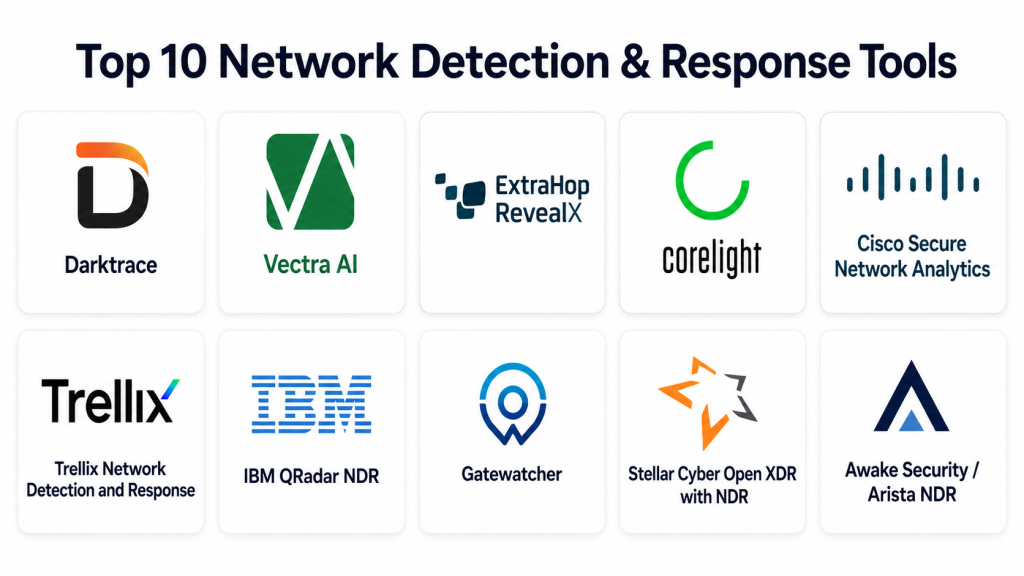
Top 10 Network Detection & Response Tools
#1 — Darktrace
Short description
Darktrace is an AI-driven cybersecurity platform known for network detection, anomaly detection, and autonomous response capabilities. It is useful for enterprises that want behavioral analytics across network, cloud, email, and operational technology environments. Darktrace focuses on learning normal activity and detecting deviations that may indicate threats. It is best suited for mature security teams that need advanced detection with automation support.
Key Features
- AI-based behavioral threat detection.
- Network visibility across hybrid environments.
- Autonomous response capabilities.
- Threat investigation and incident prioritization.
- Support for cloud, SaaS, email, and OT security use cases.
- Detection of lateral movement and unusual user behavior.
- Dashboards for SOC monitoring and response workflows.
Pros
- Strong AI and anomaly detection capabilities.
- Useful for complex and fast-changing environments.
- Helps reduce manual investigation workload.
Cons
- May require tuning for best results.
- Pricing can be high for smaller organizations.
- Advanced features may need trained security staff.
Platforms / Deployment
Cloud / Hybrid / Physical and virtual sensors.
Security & Compliance
SSO/SAML, MFA, encryption, audit logs, and RBAC are commonly expected in enterprise deployments. Specific certifications vary by product and region.
Integrations & Ecosystem
Darktrace integrates with security operations tools to support investigation, alerting, and response workflows.
- SIEM integrations.
- SOAR integrations.
- Cloud platform visibility.
- Email and SaaS security ecosystem.
- API-based extensibility.
- Incident response workflows.
Support & Community
Darktrace offers enterprise onboarding, customer support, documentation, and managed service options. Community strength is more vendor-led than open-source driven.
#2 — Vectra AI
Short description
Vectra AI is a well-known NDR platform focused on detecting attacker behavior across network, identity, cloud, and SaaS environments. It is designed for SOC teams that need strong signal quality and automated prioritization. Vectra is especially relevant for enterprises with Microsoft, cloud, and hybrid infrastructure. Its strength is behavior-based detection and attack progression visibility.
Key Features
- AI-based attacker behavior detection.
- Network, identity, cloud, and SaaS visibility.
- Prioritized threat scoring.
- Detection of lateral movement and privilege misuse.
- Support for SOC investigation workflows.
- Integration with SIEM, SOAR, and EDR tools.
- Threat hunting and metadata analysis.
Pros
- Strong focus on attacker behavior.
- Good fit for enterprise SOC teams.
- Helps reduce low-value alerts through prioritization.
Cons
- Better suited for mature security teams.
- Implementation may require planning.
- Pricing details are not always public.
Platforms / Deployment
Cloud / Hybrid / Physical and virtual sensors.
Security & Compliance
SSO/SAML, MFA, encryption, audit logs, and RBAC are generally expected in enterprise environments. Specific certifications should be verified during procurement.
Integrations & Ecosystem
Vectra AI works well in SOC ecosystems where network detection must connect with endpoint, identity, and SIEM workflows.
- SIEM platforms.
- SOAR tools.
- Microsoft security ecosystem.
- Cloud platforms.
- EDR/XDR tools.
- APIs and custom workflows.
Support & Community
Vectra provides enterprise support, product documentation, onboarding guidance, and partner-led services. Community activity is mainly vendor and practitioner focused.
#3 — ExtraHop RevealX
Short description
ExtraHop RevealX is a network detection and response platform focused on deep network visibility, real-time analytics, and investigation. It is widely used by enterprises that need packet-level insight, hybrid visibility, and security operations support. ExtraHop is useful for detecting threats, performance issues, ransomware activity, and suspicious internal movement. It is a strong choice for teams that want both security and network visibility.
Key Features
- Real-time network traffic analysis.
- Deep packet inspection and metadata visibility.
- Ransomware and lateral movement detection.
- Hybrid and cloud network monitoring.
- Threat investigation and forensics.
- Asset discovery and behavior analytics.
- Integration with security and IT operations tools.
Pros
- Strong network visibility and investigation depth.
- Useful for both security and network teams.
- Good fit for hybrid infrastructure.
Cons
- May require skilled users to use advanced analysis.
- Cost may be high for large traffic environments.
- Deployment design should be planned carefully.
Platforms / Deployment
Cloud / Hybrid / Physical and virtual appliances.
Security & Compliance
SSO/SAML, MFA, encryption, audit logs, and RBAC are commonly supported in enterprise security platforms. Specific compliance claims should be validated with the vendor.
Integrations & Ecosystem
ExtraHop has a strong ecosystem for SOC and IT operations teams.
- SIEM integrations.
- SOAR integrations.
- EDR/XDR platforms.
- Cloud platforms.
- Ticketing systems.
- API support.
Support & Community
ExtraHop provides documentation, customer success, enterprise support, and partner services. Its community is stronger among network security and enterprise SOC users.
#4 — Corelight
Short description
: Corelight is an NDR and network evidence platform built around Zeek-based network visibility. It is popular with advanced security teams that need rich network metadata, threat hunting, and forensic evidence. Corelight is well suited for enterprises, government, research, and mature SOC environments. It is especially strong when analysts want high-quality network data for investigation.
Key Features
- Zeek-based network metadata.
- Network evidence for threat hunting.
- Detection engineering support.
- Packet and protocol visibility.
- Cloud and on-premise deployment options.
- Integration with SIEM and data platforms.
- Strong forensic investigation support.
Pros
- Excellent for advanced analysts and threat hunters.
- Strong evidence quality and visibility.
- Works well with SIEM and data lake strategies.
Cons
- May be complex for beginner teams.
- Requires analyst knowledge to get full value.
- Less plug-and-play than some AI-first platforms.
Platforms / Deployment
Cloud / Self-hosted / Hybrid.
Security & Compliance
Enterprise controls such as RBAC, encryption, and audit logging are expected. Specific certifications should be checked directly during vendor review.
Integrations & Ecosystem
Corelight is strong for teams that want to feed rich network data into existing security workflows.
- SIEM tools.
- Security data lakes.
- Cloud storage and analytics platforms.
- Threat intelligence feeds.
- Detection engineering workflows.
- API and data export options.
Support & Community
Corelight benefits from the wider Zeek community and provides enterprise support, documentation, training, and technical guidance.
#5 — Cisco Secure Network Analytics
Short description
: Cisco Secure Network Analytics, formerly associated with Stealthwatch, is an enterprise network security analytics platform focused on visibility, anomaly detection, and threat response. It is a strong fit for organizations already using Cisco networking and security infrastructure. The platform helps detect suspicious traffic, policy violations, and internal threat movement. It is commonly used by large enterprises and regulated sectors.
Key Features
- Network behavior analytics.
- Flow-based visibility.
- Threat detection and anomaly monitoring.
- Integration with Cisco security ecosystem.
- Support for hybrid and enterprise networks.
- User and entity behavior insights.
- Security reporting and investigation workflows.
Pros
- Strong fit for Cisco-heavy environments.
- Enterprise-grade scalability.
- Useful for network and security collaboration.
Cons
- Best value often comes within Cisco ecosystem.
- May feel complex for smaller teams.
- Deployment and tuning can require expertise.
Platforms / Deployment
Cloud / Self-hosted / Hybrid.
Security & Compliance
Cisco enterprise security products commonly support SSO, MFA, encryption, RBAC, and audit controls. Certifications vary by product and deployment model.
Integrations & Ecosystem
Cisco Secure Network Analytics works strongly inside the broader Cisco ecosystem.
- Cisco security tools.
- SIEM integrations.
- Network infrastructure data.
- Cloud and hybrid monitoring.
- Threat intelligence sources.
- API-based workflows.
Support & Community
Cisco has strong enterprise support, partner ecosystem, documentation, training, and global professional services.
#6 — Trellix Network Detection and Response
Short description
: Trellix NDR focuses on detecting and investigating threats across network traffic, data centers, branches, cloud environments, and enterprise campuses. It is designed for organizations that need network visibility connected to broader security operations. Trellix is suitable for enterprise and government environments where layered security is important. It works best when integrated with other security tools and response workflows.
Key Features
- Network traffic monitoring and analytics.
- Multi-layer threat detection.
- Investigation and response support.
- Hybrid infrastructure visibility.
- Threat intelligence integration.
- Enterprise SOC workflow support.
- Detection aligned with attacker behavior.
Pros
- Good fit for enterprise security operations.
- Strong focus on layered threat detection.
- Useful for regulated and distributed environments.
Cons
- May be more than small businesses need.
- Best results require integration planning.
- Product packaging may vary by region.
Platforms / Deployment
Cloud / Self-hosted / Hybrid.
Security & Compliance
SSO/SAML, MFA, encryption, audit logs, and RBAC may be available depending on deployment. Specific certifications should be confirmed with Trellix.
Integrations & Ecosystem
Trellix NDR works best as part of a broader security operations stack.
- SIEM platforms.
- SOAR tools.
- Threat intelligence.
- Endpoint security tools.
- Cloud security tools.
- Trellix ecosystem integrations.
Support & Community
Trellix provides enterprise support, documentation, onboarding, and partner services. Community strength is mostly vendor and enterprise-customer focused.
#7 — IBM QRadar NDR
Short descriptio: IBM QRadar NDR is designed to analyze network activity and support detection, investigation, and response. It fits organizations already using IBM QRadar SIEM or broader IBM security products. The platform helps security teams enrich alerts with network visibility and behavior analytics. It is best for enterprises that want NDR connected with a mature SIEM-led SOC strategy.
Key Features
- Network activity analysis.
- Real-time threat detection.
- Integration with IBM QRadar ecosystem.
- Investigation and alert enrichment.
- Network visibility for SOC teams.
- Threat analytics and response support.
- Enterprise security operations alignment.
Pros
- Strong fit for IBM QRadar customers.
- Good for SIEM-centered security teams.
- Useful for enterprise-scale operations.
Cons
- Less attractive for teams outside IBM ecosystem.
- May require technical expertise.
- Pricing and packaging can be complex.
Platforms / Deployment
Cloud / Self-hosted / Hybrid.
Security & Compliance
IBM enterprise security products usually support enterprise controls such as SSO, MFA, encryption, RBAC, and audit logs. Specific compliance should be verified.
Integrations & Ecosystem
IBM QRadar NDR is strongest when used with IBM security operations tools.
- IBM QRadar SIEM.
- SOAR workflows.
- Threat intelligence.
- Cloud security tools.
- Endpoint security platforms.
- API-based integrations.
Support & Community
IBM offers enterprise support, professional services, documentation, and partner-led implementation assistance.
#8 — Gatewatcher
Short description: Gatewatcher is a network detection and response vendor focused on threat detection, network visibility, and cyber defense. It is often considered by organizations that need strong network monitoring and security analytics. Gatewatcher is relevant for enterprises, public-sector organizations, and regulated environments. It is useful for teams looking for NDR capabilities with strong detection and monitoring depth.
Key Features
- Network detection and response.
- Threat intelligence support.
- Network traffic monitoring.
- Anomaly and malicious activity detection.
- Investigation dashboards.
- Enterprise visibility.
- Support for security operations workflows.
Pros
- Good fit for regulated and public-sector environments.
- Strong focus on network cyber defense.
- Useful for threat monitoring teams.
Cons
- Global awareness may vary by region.
- Product details may require direct vendor validation.
- Smaller community compared with larger vendors.
Platforms / Deployment
Cloud / Self-hosted / Hybrid.
Security & Compliance
Not publicly stated. Enterprise controls should be validated during vendor evaluation.
Integrations & Ecosystem
Gatewatcher can support SOC workflows through integrations and data sharing.
- SIEM integrations.
- Threat intelligence feeds.
- Security monitoring tools.
- Reporting workflows.
- API-based connections.
- Incident investigation systems.
Support & Community
Support, onboarding, and documentation vary by region and customer package. Community presence is more vendor-led.
#9 — Stellar Cyber Open XDR with NDR
Short description: Stellar Cyber is an Open XDR platform that includes NDR capabilities as part of a broader detection and response approach. It is useful for organizations and MSSPs that want network, endpoint, cloud, identity, and log visibility in one security operations platform. Instead of being only a standalone NDR tool, it combines NDR with correlation and response workflows. It is suitable for teams seeking broad security visibility.
Key Features
- NDR capabilities inside Open XDR.
- Security data correlation.
- Threat detection and investigation.
- Support for MSSP and multi-tenant use cases.
- Cloud and hybrid visibility.
- SIEM-like analytics and response workflows.
- Automated alert prioritization.
Pros
- Good for teams wanting broader XDR coverage.
- Useful for MSSPs and managed security providers.
- Combines multiple security signals.
Cons
- May not be ideal for buyers wanting pure NDR only.
- Requires integration planning.
- Depth may vary by data source.
Platforms / Deployment
Cloud / Hybrid.
Security & Compliance
SSO, RBAC, encryption, and audit capabilities may be available depending on package. Specific certifications should be verified.
Integrations & Ecosystem
Stellar Cyber is designed around integrations across the security stack.
- SIEM and log sources.
- EDR tools.
- Cloud platforms.
- Identity providers.
- Firewalls and network tools.
- Ticketing and response workflows.
Support & Community
Stellar Cyber provides documentation, customer support, partner programs, and MSSP-focused onboarding resources.
#10 — Awake Security / Arista NDR
Short description: Awake Security, now part of Arista, provides network detection and response capabilities focused on network visibility, threat detection, and investigation. It is relevant for enterprises that need deep visibility into user, device, and network behavior. The platform is especially useful where network infrastructure and security operations are closely connected. It can help detect insider threats, lateral movement, and suspicious communications.
Key Features
- Network traffic visibility.
- Entity and behavior analytics.
- Threat detection and investigation.
- Device and user activity monitoring.
- Support for enterprise networks.
- Security operations dashboards.
- Integration with broader network and security tools.
Pros
- Strong network-focused visibility.
- Useful for enterprise environments.
- Good alignment with network operations.
Cons
- Product positioning may depend on Arista packaging.
- Best fit may be for larger enterprises.
- Public details may vary by region.
Platforms / Deployment
Cloud / Self-hosted / Hybrid.
Security & Compliance
Not publicly stated. Enterprise security controls should be confirmed directly during procurement.
Integrations & Ecosystem
Arista NDR capabilities can connect network visibility with SOC workflows.
- Network infrastructure tools.
- SIEM platforms.
- Threat intelligence.
- Security operations systems.
- APIs and data export.
- Incident investigation workflows.
Support & Community
Support is mainly vendor-led through Arista enterprise services, documentation, and customer support channels.
Comparison Table
| Tool Name | Best For | Platform(s) Supported | Deployment | Standout Feature | Public Rating |
|---|---|---|---|---|---|
| Darktrace | AI-driven enterprise detection | Web / Cloud sensors | Cloud / Hybrid | Autonomous response and behavioral AI | N/A |
| Vectra AI | Enterprise SOC teams | Web / Sensors | Cloud / Hybrid | Attacker behavior prioritization | N/A |
| ExtraHop RevealX | Network visibility and investigation | Web / Appliances / Sensors | Cloud / Hybrid | Deep packet and metadata analysis | N/A |
| Corelight | Threat hunting and network evidence | Web / Sensors | Cloud / Self-hosted / Hybrid | Zeek-based network evidence | N/A |
| Cisco Secure Network Analytics | Cisco-heavy enterprises | Web / Network sensors | Cloud / Self-hosted / Hybrid | Flow-based network analytics | N/A |
| Trellix NDR | Enterprise threat detection | Web / Sensors | Cloud / Self-hosted / Hybrid | Multi-layer network threat detection | N/A |
| IBM QRadar NDR | IBM QRadar customers | Web / Sensors | Cloud / Self-hosted / Hybrid | SIEM-connected network analytics | N/A |
| Gatewatcher | Regulated and public-sector teams | Web / Sensors | Cloud / Self-hosted / Hybrid | Network cyber defense monitoring | N/A |
| Stellar Cyber Open XDR | MSSPs and XDR-focused teams | Web / Cloud | Cloud / Hybrid | NDR inside Open XDR | N/A |
| Awake Security / Arista NDR | Enterprise network security teams | Web / Sensors | Cloud / Self-hosted / Hybrid | Entity and behavior analytics | N/A |
Evaluation & Scoring of Network Detection & Response Tools
| Tool Name | Core (25%) | Ease (15%) | Integrations (15%) | Security (10%) | Performance (10%) | Support (10%) | Value (15%) | Weighted Total |
|---|---|---|---|---|---|---|---|---|
| Darktrace | 9 | 8 | 8 | 8 | 8 | 8 | 7 | 8.15 |
| Vectra AI | 9 | 8 | 9 | 8 | 8 | 8 | 7 | 8.25 |
| ExtraHop RevealX | 9 | 8 | 8 | 8 | 9 | 8 | 7 | 8.25 |
| Corelight | 9 | 7 | 9 | 8 | 9 | 8 | 8 | 8.30 |
| Cisco Secure Network Analytics | 8 | 7 | 9 | 9 | 8 | 9 | 7 | 8.10 |
| Trellix NDR | 8 | 7 | 8 | 8 | 8 | 8 | 7 | 7.65 |
| IBM QRadar NDR | 8 | 7 | 9 | 9 | 8 | 9 | 7 | 8.10 |
| Gatewatcher | 7 | 7 | 7 | 7 | 8 | 7 | 7 | 7.10 |
| Stellar Cyber Open XDR | 8 | 8 | 9 | 8 | 8 | 8 | 8 | 8.15 |
| Awake Security / Arista NDR | 8 | 7 | 8 | 8 | 8 | 8 | 7 | 7.70 |
These scores are comparative, not absolute. A higher score does not mean the tool is best for every company. For example, Corelight may score well for advanced threat hunting, while Darktrace may be better for AI-driven anomaly detection. Buyers should use this table as a shortlist guide, then validate with a pilot, integration test, security review, and cost comparison.
Which Network Detection & Response Tool Is Right for You?
Solo / Freelancer
Most solo professionals do not need a full NDR platform unless they manage client security environments. For independent consultants, learning Corelight, Zeek concepts, or Stellar Cyber-style XDR workflows can be useful. If you only need basic protection, endpoint security, firewall logs, and cloud-native monitoring may be enough.
SMB
Small and mid-sized businesses should focus on ease of deployment, managed support, and clear alerting. Stellar Cyber may be useful for businesses that want broader XDR visibility. Darktrace and Vectra AI can also fit if the business has enough security maturity and budget.
Mid-Market
Mid-market companies usually need stronger detection, better integrations, and faster investigation. ExtraHop, Vectra AI, Darktrace, and Trellix are good options to evaluate. The best choice depends on whether the team values AI automation, packet-level visibility, or integration with existing SOC tools.
Enterprise
Large enterprises should evaluate scalability, deployment flexibility, compliance controls, and ecosystem fit. Cisco Secure Network Analytics is strong for Cisco environments. IBM QRadar NDR fits IBM-centered SOCs. Corelight is excellent for advanced threat hunting. ExtraHop and Vectra AI are strong for broad enterprise NDR use cases.
Budget vs Premium
Budget-sensitive teams should avoid buying the most advanced platform without clear use cases. They should first define traffic volume, number of monitored sites, integration needs, and staffing. Premium platforms are worth considering when risk exposure, compliance pressure, and attack surface are high.
Feature Depth vs Ease of Use
Darktrace and Stellar Cyber may feel easier for teams wanting guided workflows. Corelight offers deep technical value but requires stronger analyst skill. ExtraHop balances visibility with investigation usability. Vectra AI is strong when prioritization and attacker-behavior detection matter most.
Integrations & Scalability
For SIEM-heavy teams, Corelight, IBM QRadar NDR, Cisco, and ExtraHop are strong candidates. For XDR-style workflows, Stellar Cyber and Vectra AI may fit well. For cloud and hybrid scale, buyers should test sensor deployment, data retention, traffic throughput, and alert quality before purchase.
Security & Compliance Needs
Regulated industries should prioritize audit logs, RBAC, encryption, SSO, data residency, reporting, and vendor compliance documentation. Enterprises in banking, healthcare, telecom, energy, and government should run a formal security review before choosing any NDR platform.
Frequently Asked Questions
What is Network Detection & Response?
Network Detection & Response is a cybersecurity technology that monitors network traffic, detects suspicious behavior, and helps teams investigate and respond to threats. It gives visibility into activity that endpoint or firewall tools may miss.
How is NDR different from EDR?
EDR focuses on endpoint devices like laptops and servers. NDR focuses on network traffic between users, devices, applications, cloud systems, and external destinations. Many organizations use both together.
Is NDR suitable for small businesses?
It can be useful, but many small businesses may not need a full enterprise NDR platform. Smaller teams should consider managed detection services, endpoint protection, and firewall monitoring first.
How much does NDR software cost?
Pricing varies by vendor, traffic volume, deployment model, number of sensors, monitored assets, and support package. Many vendors do not publish standard pricing, so buyers should request a quote.
How long does NDR implementation take?
Implementation depends on network size, number of locations, cloud complexity, and integration needs. A small deployment may be faster, while enterprise rollouts require planning, tuning, and testing.
What are common mistakes when buying NDR tools?
Common mistakes include choosing based only on AI claims, ignoring integration needs, underestimating traffic volume, skipping pilot testing, and not involving SOC analysts during evaluation.
Does NDR replace SIEM?
No. NDR does not usually replace SIEM. NDR generates network-based detections and evidence, while SIEM collects and correlates logs from many systems. They work best together.
Can NDR detect ransomware?
Yes, many NDR tools can detect ransomware-related behavior such as lateral movement, unusual file access, command-and-control traffic, and abnormal data movement. Detection quality depends on visibility and tuning.
Is cloud network visibility included in NDR?
Many modern NDR tools support cloud and hybrid visibility, but coverage varies. Buyers should verify support for AWS, Azure, Google Cloud, Kubernetes, SaaS, and virtual network sensors.
What integrations matter most for NDR?
Important integrations include SIEM, SOAR, EDR, XDR, IAM, cloud platforms, firewalls, ticketing tools, and threat intelligence feeds. Integration quality can strongly affect SOC efficiency.
Can NDR help with compliance?
Yes, NDR can support compliance by improving visibility, investigation records, audit trails, and threat detection. However, it does not automatically make a company compliant.
What is the best alternative to NDR?
Alternatives include EDR, XDR, SIEM, firewall analytics, cloud-native security monitoring, and managed detection and response. The right choice depends on security maturity and visibility gaps.
Conclusion
Network Detection & Response has become an important part of modern cybersecurity because attackers often move through networks quietly before causing visible damage. The best NDR tool is not the same for every organization. Darktrace may suit teams looking for AI-driven anomaly detection, Vectra AI may fit SOC teams focused on attacker behavior, ExtraHop is strong for deep network visibility, Corelight is excellent for threat hunting, and Cisco or IBM may be better for organizations already using those ecosystems.
