Upgrade & Secure Your Future with DevOps, SRE, DevSecOps, MLOps!
We spend hours scrolling social media and waste money on things we forget, but won’t spend 30 minutes a day earning certifications that can change our lives.
Master in DevOps, SRE, DevSecOps & MLOps by DevOps School!
Learn from Guru Rajesh Kumar and double your salary in just one year.
Introduction
Cloud Security Posture Management (CSPM) platforms are specialized tools that help organizations monitor, assess, and maintain security across their cloud environments. In plain English, CSPM tools identify misconfigurations, compliance gaps, and potential vulnerabilities in cloud infrastructures, allowing security teams to proactively manage risk and prevent breaches. These platforms are essential as businesses increasingly migrate workloads to public and hybrid cloud models, where misconfigurations and policy drift can lead to significant exposure.
In and beyond, CSPM is crucial due to the growing complexity of multi-cloud deployments, the rise of DevSecOps practices, and increasing regulatory scrutiny. Modern CSPM platforms integrate AI, automation, and real-time monitoring to provide actionable insights, enabling organizations to maintain strong security hygiene without slowing down cloud operations.
Real-world use cases include:
- Continuously scanning cloud accounts (AWS, Azure, GCP) for misconfigurations.
- Monitoring compliance with GDPR, SOC 2, HIPAA, and ISO standards.
- Detecting public exposure of sensitive data or misconfigured storage buckets.
- Providing actionable remediation guidance for security and DevOps teams.
- Integrating with SIEM, ticketing, and DevOps pipelines for automated enforcement.
Key criteria buyers should evaluate:
- Cloud platform coverage and multi-cloud support.
- Real-time risk detection and remediation guidance.
- Automation and policy enforcement capabilities.
- Compliance reporting and audit support.
- AI-driven insights and anomaly detection.
- Integration with existing security and DevOps tools.
- Usability and onboarding ease.
- Scalability across multiple accounts and regions.
- Pricing models and licensing flexibility.
Best for: Security engineers, DevOps/SRE teams, cloud architects, enterprise organizations, and highly regulated industries such as finance, healthcare, and government.
Not ideal for: Small businesses with minimal cloud deployments or teams relying on manual security audits, as lightweight cloud security monitoring may suffice.
Key Trends in Cloud Security Posture Management (CSPM)
AI-Enhanced Risk Detection: Using machine learning to identify unusual configurations and misconfigurations faster.
- Automation & Remediation: Platforms increasingly allow automated enforcement of security policies to reduce human error.
- Multi-Cloud and Hybrid Cloud Support: Coverage for AWS, Azure, GCP, and hybrid deployments is now standard.
- Continuous Compliance Monitoring: Built-in regulatory templates for GDPR, SOC 2, HIPAA, ISO standards, and emerging regulations.
- Integration with DevOps Pipelines: Tight integration with CI/CD workflows for early detection of insecure deployments.
- Real-Time Alerts and Reporting: Notifications for high-risk misconfigurations and actionable remediation.
- Cloud-Native Security Posture: Full support for containerized and serverless architectures.
- Behavioral and Threat Intelligence Integration: CSPM platforms now leverage threat intelligence feeds for proactive defense.
- Flexible Deployment Models: Cloud-based SaaS offerings with multi-tenant support are common.
- Usage-Based Pricing: Subscription and per-account pricing models improve accessibility for SMBs and enterprises.
How We Selected These Tools (Methodology)
- Market adoption and visibility among enterprises and cloud security teams.
- Comprehensive feature coverage across misconfiguration detection, compliance, and automation.
- Performance and reliability based on uptime, scanning speed, and user feedback.
- Security posture, including SSO, MFA, encryption, RBAC, and compliance templates.
- Integration ecosystem with SIEM, ticketing systems, DevOps, and cloud monitoring tools.
- Customer fit across enterprise, mid-market, and SMB deployments.
- AI/automation capabilities for proactive cloud security management.
- Vendor support, documentation, and community engagement.
- Forward-looking relevance to + cloud security challenges.
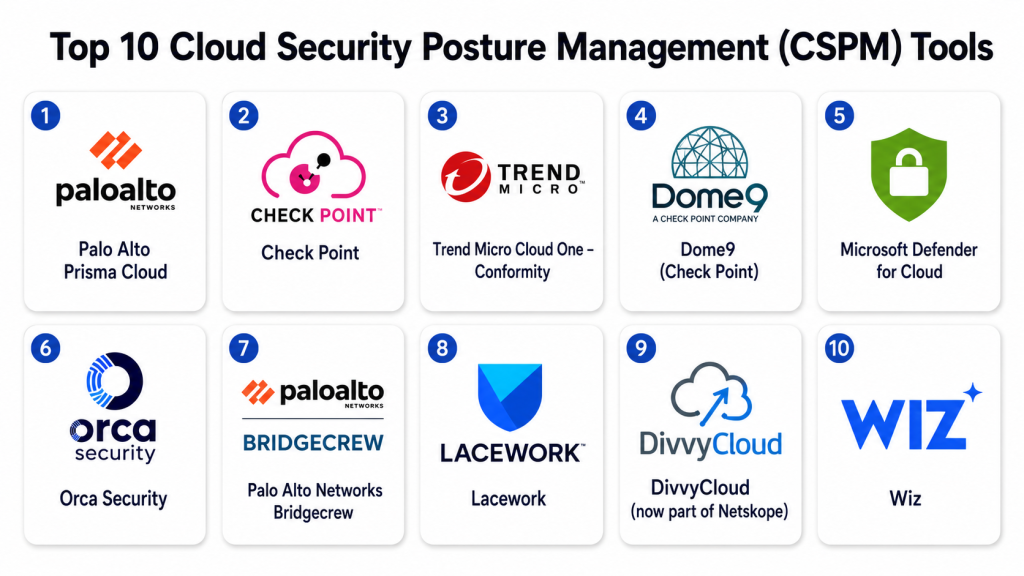
Top 10 Cloud Security Posture Management (CSPM) Tools
#1 — Palo Alto Prisma Cloud
Short description: Prisma Cloud offers enterprise-grade CSPM capabilities with continuous monitoring, real-time threat detection, and automated remediation across multi-cloud environments. It is ideal for large organizations with complex cloud operations and high compliance requirements.
Key Features
- Continuous cloud security monitoring across AWS, Azure, and GCP.
- Automated remediation for misconfigurations.
- Compliance and audit reporting templates.
- AI-driven anomaly detection.
- Role-based access control and identity monitoring.
Pros
- Enterprise-grade coverage and automation.
- Strong multi-cloud support and compliance features.
Cons
- Premium pricing may not suit SMBs.
- Can require dedicated onboarding and training.
Platforms / Deployment
- Web / Cloud.
Security & Compliance
- SSO/SAML, MFA, encryption, RBAC.
- SOC 2, ISO 27001, GDPR supported.
Integrations & Ecosystem
Supports CI/CD, SIEM, and ticketing integration.
- API access for custom workflows.
- Integration with AWS Security Hub, Azure Security Center.
- Extensible dashboards and alerting.
Support & Community
- Dedicated enterprise support.
- Extensive documentation and community forums.
- Webinars and training materials.
#2 — Check Point CloudGuard
Short description: CloudGuard delivers CSPM with advanced threat intelligence, automated compliance enforcement, and real-time visibility into cloud assets. It is tailored for organizations seeking robust cloud security controls and proactive risk management.
Key Features
- Continuous cloud security posture monitoring.
- Threat intelligence integration for proactive detection.
- Automated policy enforcement and remediation.
- Multi-cloud compliance dashboards.
- Real-time alerting and analytics.
Pros
- Advanced threat intelligence integration.
- Automated compliance enforcement reduces human error.
Cons
- Premium pricing for full features.
- Requires dedicated security expertise to leverage all capabilities.
Platforms / Deployment
- Web / Cloud.
Security & Compliance
- SSO/MFA, encryption.
- GDPR, ISO 27001 compliance supported.
Integrations & Ecosystem
- Integrates with SIEM, ticketing, and DevOps pipelines.
- API access for reporting.
- Extensible for custom workflows.
Support & Community
- Professional support provided.
- Documentation and online training available.
#3 — Trend Micro Cloud One – Conformity
Short description: Conformity provides continuous CSPM with automated remediation, compliance checks, and multi-cloud visibility, designed for enterprises and mid-market organizations with complex cloud deployments.
Key Features
- Continuous misconfiguration scanning.
- Automated compliance templates.
- Policy enforcement and remediation.
- Multi-cloud visibility and analytics.
- Role-based access control.
Pros
- Strong multi-cloud support.
- Automated compliance monitoring reduces manual effort.
Cons
- Premium pricing tier.
- Learning curve for new users.
Platforms / Deployment
- Web / Cloud.
Security & Compliance
- Not publicly stated.
Integrations & Ecosystem
- Integrates with AWS, Azure, and GCP.
- API for reporting and automation.
- Supports SIEM and DevOps pipeline integrations.
Support & Community
- Vendor support and documentation available.
- Community resources limited.
#4 — Dome9 (Check Point)
Short description: Dome9 provides CSPM capabilities for cloud security governance, automated remediation, and compliance enforcement across hybrid cloud environments. It suits enterprises requiring stringent security controls and policy automation.
Key Features
- Continuous compliance monitoring.
- Automated policy enforcement.
- Hybrid cloud visibility.
- Risk scoring and exposure analytics.
- Identity and access management auditing.
Pros
- Strong compliance and governance features.
- Supports hybrid and multi-cloud environments.
Cons
- Requires technical expertise for deployment.
- Advanced reporting limited in standard plans.
Platforms / Deployment
- Web / Cloud.
Security & Compliance
- SSO/MFA, encryption.
- SOC 2, ISO 27001 templates supported.
Integrations & Ecosystem
- Integrates with AWS, Azure, GCP.
- API access for workflow automation.
- Extensible dashboards.
Support & Community
- Vendor support available.
- Documentation and webinars provided.
#5 — Microsoft Defender for Cloud
Short description: Defender for Cloud provides CSPM with unified security management, threat detection, and compliance monitoring across Azure and hybrid cloud workloads. Ideal for Microsoft-centric enterprises.
Key Features
- Continuous cloud security posture monitoring.
- Integrated threat intelligence.
- Compliance assessment templates.
- Automated remediation.
- Security recommendations for workloads.
Pros
- Tight integration with Microsoft ecosystem.
- Real-time risk detection and automated guidance.
Cons
- Limited features for non-Microsoft clouds.
- Complexity for non-Azure users.
Platforms / Deployment
- Web / Cloud.
Security & Compliance
- SSO/MFA, encryption.
- SOC 2, ISO 27001, GDPR.
Integrations & Ecosystem
- Integrates with Azure Security Center, SIEM.
- API access for automation.
- Supports Microsoft 365 security ecosystem.
Support & Community
- Microsoft support channels.
- Extensive documentation and community forums.
#6 — Orca Security
Short description: Orca Security provides agentless CSPM with full cloud visibility, vulnerability prioritization, and automated risk remediation, designed for enterprises seeking fast deployment.
Key Features
- Agentless scanning across multi-cloud.
- Risk prioritization and remediation guidance.
- Compliance dashboards.
- Real-time monitoring and alerting.
- Identity and access insights.
Pros
- Quick deployment without agents.
- Prioritized actionable insights.
Cons
- Premium pricing.
- Limited offline/on-prem functionality.
Platforms / Deployment
- Web / Cloud.
Security & Compliance
- SSO/MFA, encryption.
- GDPR, SOC 2 supported.
Integrations & Ecosystem
- CI/CD pipeline integration.
- API for reporting and alerting.
- Integrates with SIEM and ticketing systems.
Support & Community
- Vendor support available.
- Documentation and training provided.
#7 — Palo Alto Networks Bridgecrew
Short description: Bridgecrew provides CSPM with code-first cloud security, integrating security checks into IaC pipelines to prevent misconfigurations before deployment.
Key Features
- IaC scanning for Terraform, CloudFormation, and Kubernetes.
- Automated remediation in CI/CD pipelines.
- Compliance as code templates.
- Multi-cloud visibility.
- Risk prioritization and analytics.
Pros
- Integrates security into development pipelines.
- Prevents misconfigurations before deployment.
Cons
- Requires DevOps familiarity.
- Advanced features require paid tier.
Platforms / Deployment
- Web / Cloud.
Security & Compliance
- Not publicly stated.
Integrations & Ecosystem
- Integrates with GitHub, GitLab, Jenkins.
- API access for automation.
- CI/CD workflow support.
Support & Community
- Vendor support included.
- Documentation and community forums.
#8 — Lacework
Short description: Lacework provides automated CSPM and runtime security for cloud workloads, delivering continuous compliance monitoring, threat detection, and risk analytics.
Key Features
- Continuous compliance and CSPM monitoring.
- Automated threat detection.
- Risk scoring and analytics.
- Multi-cloud support.
- Identity and access insights.
Pros
- Full-stack cloud security monitoring.
- Automated compliance and alerting.
Cons
- Premium pricing tier.
- Complexity for SMBs.
Platforms / Deployment
- Web / Cloud.
Security & Compliance
- SSO/MFA, encryption.
- SOC 2, ISO 27001 templates.
Integrations & Ecosystem
- API integrations with DevOps pipelines.
- SIEM and alerting integrations.
- Multi-cloud support.
Support & Community
- Vendor support available.
- Documentation provided.
#9 — DivvyCloud (now part of Netskope)
Short description: DivvyCloud offers CSPM with automated remediation, multi-cloud visibility, and policy enforcement, ideal for enterprises with large-scale cloud deployments.
Key Features
- Continuous misconfiguration detection.
- Automated policy enforcement.
- Compliance monitoring.
- Multi-cloud visibility and analytics.
- Remediation guidance.
Pros
- Enterprise-scale automation.
- Multi-cloud coverage.
Cons
- Premium pricing.
- Learning curve for complex environments.
Platforms / Deployment
- Web / Cloud.
Security & Compliance
- SSO/MFA, encryption.
- GDPR, SOC 2 supported.
Integrations & Ecosystem
- API access for automation.
- SIEM and DevOps integration.
- Workflow extensibility.
Support & Community
- Vendor support available.
- Documentation provided.
#10 — Wiz
Short description: Wiz provides CSPM and cloud workload protection with agentless scanning, risk prioritization, and compliance monitoring for enterprises with multi-cloud environments.
Key Features
- Agentless cloud scanning.
- Continuous CSPM monitoring.
- Risk prioritization and analytics.
- Compliance dashboards.
- Multi-cloud support.
Pros
- Rapid deployment with agentless scanning.
- Comprehensive risk insights.
Cons
- Premium pricing tier.
- Less suitable for small cloud deployments.
Platforms / Deployment
- Web / Cloud.
Security & Compliance
- SSO/MFA, encryption.
- GDPR, SOC 2 supported.
Integrations & Ecosystem
- API integration with DevOps pipelines.
- SIEM and workflow integration.
- Extensible dashboards.
Support & Community
- Vendor support included.
- Documentation and community forums.
Comparison Table (Top 10)
| Tool Name | Best For | Platform(s) Supported | Deployment | Standout Feature | Public Rating |
|---|---|---|---|---|---|
| Prisma Cloud | Enterprises | Web | Cloud | Multi-cloud continuous monitoring | N/A |
| CloudGuard | Enterprises | Web | Cloud | Threat intelligence integration | N/A |
| Trend Micro Conformity | Mid-market & enterprise | Web | Cloud | Automated compliance templates | N/A |
| Dome9 | Enterprise & hybrid cloud | Web | Cloud | Hybrid cloud governance | N/A |
| Microsoft Defender for Cloud | Microsoft-centric | Web | Cloud | Azure-native CSPM & compliance | N/A |
| Orca Security | Enterprise | Web | Cloud | Agentless scanning & risk prioritization | N/A |
| Bridgecrew | DevOps teams | Web | Cloud | IaC security & CI/CD integration | N/A |
| Lacework | Cloud-native workloads | Web | Cloud | Full-stack cloud security | N/A |
| DivvyCloud | Large enterprises | Web | Cloud | Automated multi-cloud remediation | N/A |
| Wiz | Multi-cloud enterprises | Web | Cloud | Agentless scanning & CSPM | N/A |
Evaluation & Scoring of CSPM Tools
| Tool Name | Core (25%) | Ease (15%) | Integrations (15%) | Security (10%) | Performance (10%) | Support (10%) | Value (15%) | Weighted Total (0–10) |
|---|---|---|---|---|---|---|---|---|
| Prisma Cloud | 9 | 7 | 8 | 9 | 8 | 8 | 7 | 8.2 |
| CloudGuard | 8 | 7 | 8 | 9 | 8 | 7 | 7 | 7.9 |
| Conformity | 8 | 8 | 7 | 8 | 8 | 7 | 7 | 7.8 |
| Dome9 | 8 | 7 | 7 | 8 | 7 | 7 | 7 | 7.5 |
| Defender for Cloud | 8 | 8 | 7 | 9 | 8 | 8 | 7 | 7.9 |
| Orca Security | 9 | 8 | 8 | 9 | 8 | 8 | 7 | 8.2 |
| Bridgecrew | 8 | 7 | 8 | 8 | 8 | 7 | 7 | 7.7 |
| Lacework | 8 | 7 | 8 | 9 | 8 | 8 | 7 | 7.9 |
| DivvyCloud | 8 | 7 | 7 | 8 | 7 | 7 | 7 | 7.5 |
| Wiz | 9 | 8 | 8 | 9 | 8 | 8 | 7 | 8.2 |
Interpretation: Scores are comparative, indicating overall balance of core features, ease of use, integrations, security, performance, support, and value. Higher weighted totals suggest broader suitability for complex cloud environments, though specific organizational needs may prioritize certain criteria.
Which CSPM Tool Is Right for You?
Solo / Freelancer
- Tools like Bridgecrew and Lacework provide lightweight agentless scanning and cloud visibility suitable for smaller teams or cloud-focused consultants.
SMB
- Trend Micro Conformity, Defender for Cloud, and Orca Security offer automated compliance and risk detection for mid-market organizations without dedicated cloud security teams.
Mid-Market
- Prisma Cloud, CloudGuard, and Wiz provide multi-cloud monitoring, automated remediation, and compliance templates, ideal for organizations with more complex cloud deployments.
Enterprise
- Large organizations should prioritize Prisma Cloud, Orca Security, and Lacework for comprehensive visibility, automation, and multi-cloud scalability.
Budget vs Premium
- Open-source or smaller solutions like Bridgecrew are budget-friendly.
- Premium platforms like Prisma Cloud, Orca Security, and Wiz provide advanced automation, AI-driven insights, and enterprise-level compliance support.
Feature Depth vs Ease of Use
- Platforms like Prisma Cloud and Orca Security offer deep functionality but require onboarding.
- Defender for Cloud and Lacework balance feature depth with usability for broader teams.
Integrations & Scalability
- Enterprise and mid-market organizations should select tools supporting API integrations with SIEM, ticketing systems, and CI/CD pipelines.
- Cloud-native deployment ensures scalability across multiple accounts and geographies.
Security & Compliance Needs
- Organizations in regulated sectors should prioritize tools offering SSO/MFA, encryption, RBAC, and compliance templates.
- Prisma Cloud, Defender for Cloud, and Orca Security are strong candidates.
Frequently Asked Questions (FAQs)
What pricing models do CSPM platforms offer?
Most use subscription-based SaaS models, with tiers based on accounts, workloads, and features.
Can these tools integrate with DevOps pipelines?
Yes, platforms like Bridgecrew and Prisma Cloud provide CI/CD integrations for automated checks.
How quickly can CSPM tools be deployed?
Deployment ranges from a few hours for agentless solutions to several weeks for full enterprise configurations.
Do these platforms support multi-cloud environments?
Yes, leading CSPM platforms cover AWS, Azure, GCP, and hybrid cloud architectures.
Are AI insights included?
Many platforms use AI to prioritize risks, detect anomalies, and recommend remediation.
Can CSPM platforms automate remediation?
Yes, automation is a key feature for proactive security enforcement and policy compliance.
Do these tools provide compliance reporting?
Yes, templates for SOC 2, ISO 27001, HIPAA, and GDPR are common.
Are CSPM platforms suitable for small teams?
Lightweight or agentless solutions like Bridgecrew and Lacework can be cost-effective for SMBs.
Can they track container and serverless workloads?
Yes, modern CSPM platforms support containers, Kubernetes, and serverless architectures.
What alternatives exist to CSPM platforms?
Manual auditing, cloud-native security controls, and vulnerability scanning tools can supplement CSPM for simpler environments.
Conclusion
Cloud Security Posture Management (CSPM) platforms are essential for organizations operating in multi-cloud environments, enabling continuous monitoring, compliance, and risk mitigation. Selection depends on organizational size, cloud complexity, budget, and compliance requirements. Small teams may benefit from tools like Bridgecrew or Lacework, mid-market organizations from Trend Micro Conformity or Defender for Cloud, while enterprises require robust solutions like Prisma Cloud, Orca Security, or Wiz. The next step is to shortlist 2–3 platforms aligned with your cloud architecture, conduct a pilot for usability and integration evaluation, and validate compliance and automation capabilities to ensure a strong, proactive cloud security posture.
