Upgrade & Secure Your Future with DevOps, SRE, DevSecOps, MLOps!
We spend hours scrolling social media and waste money on things we forget, but won’t spend 30 minutes a day earning certifications that can change our lives.
Master in DevOps, SRE, DevSecOps & MLOps by DevOps School!
Learn from Guru Rajesh Kumar and double your salary in just one year.
Introduction
Email marketing software helps businesses create, send, automate, personalize, and track email campaigns at scale. These platforms are used for newsletters, promotions, lead nurturing, onboarding, transactional messaging, customer retention, and lifecycle communication. Modern email marketing tools now include automation workflows, AI-assisted content generation, segmentation, analytics, and CRM integrations.
Email marketing remains one of the highest-return digital marketing channels because it gives businesses direct communication with customers without depending entirely on social media algorithms or paid advertising. In modern business environments, email marketing software is also becoming more intelligent with predictive personalization, AI-powered optimization, privacy controls, and omnichannel integration.
Common use cases include:
- Newsletter campaigns and announcements
- Lead nurturing and drip automation
- eCommerce promotions and cart recovery
- Customer onboarding and retention
- Event invitations and follow-up campaigns
Buyers should evaluate deliverability, automation depth, pricing model, integrations, segmentation, analytics, AI features, scalability, compliance support, ease of use, and customer support quality.
Best for: SMBs, enterprises, eCommerce businesses, SaaS companies, agencies, creators, marketing teams, and customer engagement teams.
Not ideal for: Businesses that rarely communicate with customers, teams needing only simple transactional notifications, or organizations without a structured customer engagement strategy.
Key Trends in Email Marketing Software
AI-generated email content and subject line optimization are becoming standard features.
- Predictive send-time optimization is improving engagement rates.
- Privacy-focused marketing and consent management are becoming critical due to global regulations.
- Omnichannel automation is blending email with SMS, push notifications, chat, and CRM workflows.
- More businesses are adopting first-party data strategies for personalization.
- Interactive emails and dynamic content are improving engagement experiences.
- Email deliverability monitoring and sender reputation tools are receiving more attention.
- Marketing automation and CRM integration are becoming buyer priorities.
- Usage-based pricing models are replacing simple subscriber-based pricing in some platforms.
- Advanced analytics and attribution reporting are helping teams measure campaign revenue impact.
How We Selected These Tools (Methodology)
The following tools were selected based on practical business evaluation criteria:
- Global market adoption and brand recognition
- Email automation and campaign management capabilities
- Deliverability reputation and infrastructure quality
- CRM and third-party integration ecosystem
- Ease of onboarding and campaign setup
- Reporting and analytics functionality
- AI-assisted features and workflow automation
- Security and compliance capabilities where publicly known
- Customer fit across SMB, mid-market, enterprise, and eCommerce segments
- Overall value relative to pricing and operational complexity
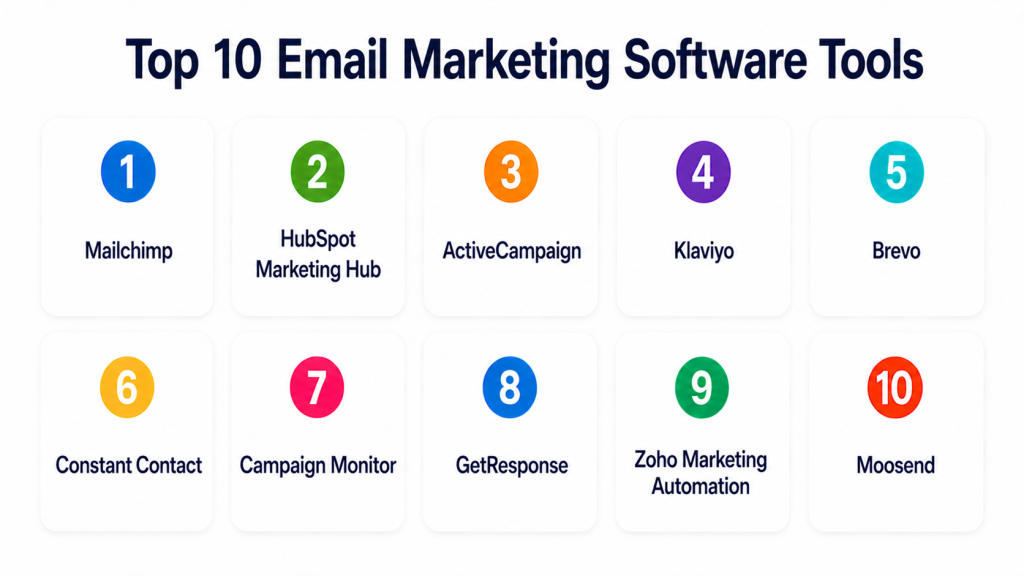
Top 10 Email Marketing Software Tools
#1 — Mailchimp
Short description= Mailchimp is one of the most widely recognized email marketing platforms, designed for small businesses, creators, startups, and growing brands. It combines email campaigns, automation, templates, segmentation, and basic CRM-style functionality.
Key Features
- Drag-and-drop email builder
- Customer journey automation
- Audience segmentation
- AI-assisted content recommendations
- Landing pages and forms
- Campaign analytics and reporting
- eCommerce marketing support
Pros
- Beginner-friendly interface
- Large template ecosystem
- Strong integration marketplace
Cons
- Advanced automation can feel limited for enterprises
- Costs may rise with audience growth
- CRM depth is limited compared with dedicated CRM tools
Platforms / Deployment
Web / iOS / Android
Cloud
Security & Compliance
Supports common security controls and GDPR-related features. Advanced enterprise compliance details vary by plan.
Integrations & Ecosystem
Mailchimp integrates with a wide range of small business and marketing platforms.
- eCommerce platforms
- CRM tools
- Social media tools
- Website builders
- Analytics platforms
- Forms and survey tools
Support & Community
Strong documentation, onboarding resources, templates, and community support for SMBs and creators.
#2 — HubSpot Marketing Hub
Short description = HubSpot Marketing Hub combines email marketing, CRM, automation, forms, landing pages, and campaign analytics into one platform. It is widely used by B2B teams and growth-focused businesses.
Key Features
- CRM-native email marketing
- Workflow automation
- Lead nurturing
- Segmentation and personalization
- Campaign reporting
- AI-assisted content features
- Landing pages and lead capture
Pros
- Unified CRM and marketing ecosystem
- Strong automation capabilities
- Easy-to-use interface
Cons
- Pricing can increase significantly at scale
- Advanced enterprise customization may require expertise
- Contact-based pricing needs monitoring
Platforms / Deployment
Web / iOS / Android
Cloud
Security & Compliance
Commonly supports MFA, SSO on selected plans, encryption, permissions, and GDPR-related tools.
Integrations & Ecosystem
HubSpot has a large ecosystem for marketing, sales, and customer support workflows.
- CRM integrations
- Webinar platforms
- Analytics tools
- Customer support tools
- eCommerce systems
- Advertising platforms
Support & Community
Strong learning resources, documentation, certifications, agency ecosystem, and partner support.
#3 — ActiveCampaign
Short description= ActiveCampaign focuses on automation-driven email marketing with CRM, behavioral targeting, and customer journey features. It is popular among SMBs and digital-first businesses.
Key Features
- Visual workflow builder
- Email automation
- CRM and sales automation
- Behavioral triggers
- Dynamic segmentation
- SMS marketing support
- Site tracking
Pros
- Strong automation flexibility
- Good balance of price and features
- Useful for lifecycle marketing
Cons
- Complex workflows may require maintenance
- Reporting depth may not satisfy enterprise teams
- Interface learning curve for advanced automation
Platforms / Deployment
Web / iOS / Android
Cloud
Security & Compliance
Supports common security and privacy controls. Specific certifications vary.
Integrations & Ecosystem
ActiveCampaign supports a broad SMB-focused integration ecosystem.
- CRM tools
- eCommerce platforms
- Webinar tools
- Lead capture systems
- Payment tools
- Analytics integrations
Support & Community
Provides onboarding resources, automation guides, documentation, and community support.
#4 — Klaviyo
Short description = Klaviyo is designed primarily for eCommerce businesses and direct-to-consumer brands. It combines email, SMS, customer data, and automation workflows.
Key Features
- eCommerce automation flows
- Customer segmentation
- Predictive analytics
- Revenue attribution
- SMS and email campaigns
- Behavioral triggers
- Personalized product recommendations
Pros
- Excellent eCommerce targeting capabilities
- Strong customer behavior tracking
- Revenue-focused reporting
Cons
- Less suited for traditional B2B marketing
- Costs can increase with contact growth
- Requires eCommerce strategy maturity
Platforms / Deployment
Web
Cloud
Security & Compliance
Supports common data protection and privacy features. Buyers should validate enterprise compliance needs directly.
Integrations & Ecosystem
Klaviyo integrates deeply into eCommerce ecosystems.
- Online store platforms
- Loyalty systems
- Review tools
- Payment systems
- Customer support tools
- Analytics platforms
Support & Community
Strong documentation and partner ecosystem for eCommerce marketers.
#5 — Brevo
Short description= Brevo combines email marketing, transactional messaging, automation, CRM-style tools, and SMS communication in one platform. It is designed for SMBs and digital businesses.
Key Features
- Email campaign management
- Marketing automation
- Transactional email support
- SMS campaigns
- Contact segmentation
- Landing pages
- CRM-style features
Pros
- Good value for multi-channel communication
- Useful transactional messaging support
- Flexible pricing structure
Cons
- Advanced enterprise analytics are limited
- Some advanced features vary by plan
- Less enterprise-oriented than larger competitors
Platforms / Deployment
Web
Cloud
Security & Compliance
Supports common account security and GDPR-related controls.
Integrations & Ecosystem
Brevo works well with customer communication and eCommerce tools.
- CMS platforms
- CRM tools
- eCommerce systems
- API integrations
- Payment systems
- Customer communication tools
Support & Community
Offers documentation, onboarding materials, and support tiers depending on subscription plans.
#6 — Constant Contact
Short description= Constant Contact is focused on simple email marketing for SMBs, nonprofits, local businesses, and event-driven organizations.
Key Features
- Email campaign builder
- Event marketing support
- Contact management
- Automation workflows
- Social campaign support
- Reporting dashboards
- Template library
Pros
- Easy onboarding experience
- Strong for local business marketing
- Good template selection
Cons
- Automation depth is limited compared with enterprise tools
- Reporting is less advanced than premium platforms
- Advanced segmentation may feel basic
Platforms / Deployment
Web
Cloud
Security & Compliance
Provides common security protections and account management controls.
Integrations & Ecosystem
Supports SMB-oriented integrations.
- Event management tools
- CRM systems
- eCommerce platforms
- Social platforms
- Survey tools
- Lead generation tools
Support & Community
Known for customer onboarding support and beginner-friendly documentation.
#7 — Campaign Monitor
Short description = Campaign Monitor focuses on visually appealing email campaigns, automation, and customer engagement workflows for businesses and agencies.
Key Features
- Email design tools
- Automation workflows
- Segmentation
- Customer journey support
- Analytics and reporting
- Template customization
- Dynamic content support
Pros
- Strong visual email design capabilities
- Good agency-focused workflow support
- Easy campaign creation
Cons
- Enterprise marketing depth is limited
- CRM functionality is minimal
- Advanced reporting options are limited
Platforms / Deployment
Web
Cloud
Security & Compliance
Common security protections are supported. Enterprise-level compliance details vary.
Integrations & Ecosystem
Campaign Monitor supports integrations for customer engagement and marketing workflows.
- CRM systems
- eCommerce platforms
- Analytics tools
- CMS integrations
- Lead capture systems
- API integrations
Support & Community
Offers onboarding support, design resources, templates, and customer help materials.
#8 — GetResponse
Short description= GetResponse combines email marketing, automation, webinars, landing pages, and eCommerce features in a single platform.
Key Features
- Email campaign automation
- Webinar hosting
- Landing pages
- Sales funnels
- AI-assisted content tools
- eCommerce integrations
- Segmentation and personalization
Pros
- Broad feature set for SMBs
- Webinar support included
- Good automation flexibility
Cons
- Interface may require learning time
- Enterprise governance features are limited
- Advanced analytics may not satisfy large enterprises
Platforms / Deployment
Web / iOS / Android
Cloud
Security & Compliance
Supports common security measures and privacy-related features.
Integrations & Ecosystem
GetResponse integrates with marketing and sales tools commonly used by SMBs.
- CRM platforms
- Webinar tools
- eCommerce systems
- Analytics tools
- Payment platforms
- Landing page systems
Support & Community
Provides educational resources, onboarding support, and documentation for marketing teams.
#9 — Omnisend
Short description= Omnisend is an email and SMS marketing platform built mainly for eCommerce businesses looking for automation and customer retention tools.
Key Features
- Email and SMS automation
- Cart abandonment workflows
- Customer segmentation
- Product recommendation emails
- Campaign reporting
- Multi-channel workflows
- eCommerce integrations
Pros
- Strong eCommerce workflow templates
- Useful SMS and email combination
- Good automation usability
Cons
- Limited fit for non-eCommerce businesses
- Enterprise-level governance features are limited
- Reporting depth varies by plan
Platforms / Deployment
Web
Cloud
Security & Compliance
Supports common security and privacy capabilities. Exact certifications vary.
Integrations & Ecosystem
Omnisend integrates well into online retail ecosystems.
- Storefront platforms
- Loyalty tools
- Payment systems
- CRM integrations
- Review tools
- Customer engagement tools
Support & Community
Strong onboarding support for eCommerce-focused businesses.
#10 — Moosend
Short description = Moosend is an affordable email marketing and automation platform aimed at SMBs, startups, and growing online businesses.
Key Features
- Automation workflows
- Email campaign builder
- Audience segmentation
- Analytics and reporting
- Landing pages
- Subscription forms
- Personalization tools
Pros
- Affordable pricing structure
- Simple automation setup
- Good usability for smaller teams
Cons
- Enterprise functionality is limited
- Smaller integration ecosystem
- Advanced reporting may be basic
Platforms / Deployment
Web
Cloud
Security & Compliance
Common security and account controls are supported. Specific compliance details vary.
Integrations & Ecosystem
Moosend supports practical SMB integrations and API access.
- CRM systems
- eCommerce platforms
- CMS integrations
- Analytics tools
- Lead generation tools
- API integrations
Support & Community
Offers onboarding resources, documentation, and customer support for SMB users.
Comparison Table (Top 10)
| Tool Name | Best For | Platform(s) Supported | Deployment | Standout Feature | Public Rating |
|---|---|---|---|---|---|
| Mailchimp | SMBs and creators | Web / iOS / Android | Cloud | Beginner-friendly email marketing | N/A |
| HubSpot Marketing Hub | B2B growth teams | Web / iOS / Android | Cloud | CRM-native marketing automation | N/A |
| ActiveCampaign | Automation-focused SMBs | Web / iOS / Android | Cloud | Visual workflow automation | N/A |
| Klaviyo | eCommerce brands | Web | Cloud | Revenue-focused segmentation | N/A |
| Brevo | Multi-channel SMB communication | Web | Cloud | Transactional plus marketing messaging | N/A |
| Constant Contact | Local businesses and nonprofits | Web | Cloud | Easy onboarding and templates | N/A |
| Campaign Monitor | Agencies and visual campaigns | Web | Cloud | Strong email design experience | N/A |
| GetResponse | SMBs needing webinars and automation | Web / iOS / Android | Cloud | Combined webinar and email workflows | N/A |
| Omnisend | Online retailers | Web | Cloud | eCommerce automation workflows | N/A |
| Moosend | Budget-conscious SMBs | Web | Cloud | Affordable automation | N/A |
Evaluation & Scoring of Email Marketing Software
| Tool Name | Core (25%) | Ease (15%) | Integrations (15%) | Security (10%) | Performance (10%) | Support (10%) | Value (15%) | Weighted Total (0–10) |
|---|---|---|---|---|---|---|---|---|
| Mailchimp | 8 | 9 | 8 | 7 | 8 | 8 | 8 | 8.05 |
| HubSpot Marketing Hub | 9 | 9 | 9 | 8 | 8 | 9 | 7 | 8.50 |
| ActiveCampaign | 8 | 8 | 8 | 7 | 8 | 8 | 9 | 8.00 |
| Klaviyo | 9 | 8 | 8 | 7 | 8 | 8 | 7 | 7.95 |
| Brevo | 7 | 8 | 7 | 7 | 8 | 7 | 9 | 7.55 |
| Constant Contact | 7 | 9 | 7 | 7 | 7 | 8 | 8 | 7.65 |
| Campaign Monitor | 7 | 8 | 7 | 7 | 7 | 7 | 7 | 7.15 |
| GetResponse | 8 | 8 | 8 | 7 | 8 | 8 | 8 | 7.95 |
| Omnisend | 8 | 8 | 8 | 7 | 8 | 8 | 8 | 7.95 |
| Moosend | 7 | 8 | 6 | 7 | 7 | 7 | 9 | 7.30 |
These scores are comparative rather than absolute. Enterprise-focused platforms tend to score higher in integrations and advanced capabilities, while SMB tools often score better for usability and affordability. Buyers should compare the scores against their own operational priorities instead of looking only at the final weighted number.
Which Email Marketing Software Tool Is Right for You?
Solo / Freelancer
Mailchimp, Constant Contact, and Moosend are practical choices for solo professionals and creators because they are easier to use and require minimal technical setup.
SMB
SMBs often benefit from ActiveCampaign, GetResponse, Brevo, and HubSpot because they provide a balance of automation, integrations, analytics, and affordability.
Mid-Market
Mid-market companies should evaluate HubSpot, ActiveCampaign, Klaviyo, and GetResponse for stronger automation, segmentation, CRM alignment, and reporting.
Enterprise
Enterprise organizations typically need advanced governance, CRM integration, security, and multi-team collaboration. HubSpot Enterprise and enterprise-oriented marketing platforms are more suitable here.
Budget vs Premium
Budget-focused buyers should compare Moosend, Brevo, and Constant Contact. Premium buyers needing advanced automation and analytics should evaluate HubSpot, Klaviyo, and ActiveCampaign.
Feature Depth vs Ease of Use
Mailchimp and Constant Contact prioritize usability, while ActiveCampaign and HubSpot provide deeper workflow automation. Klaviyo specializes in advanced eCommerce personalization.
Integrations & Scalability
Businesses with large marketing stacks should prioritize integration ecosystems, APIs, CRM synchronization, and automation scalability before purchasing.
Security & Compliance Needs
Organizations handling regulated customer data should validate encryption, permissions, audit logging, MFA, privacy controls, and vendor compliance documentation during procurement.
Frequently Asked Questions (FAQs)
1. What is email marketing software?
Email marketing software helps businesses send newsletters, promotions, onboarding campaigns, automated workflows, and customer engagement emails at scale.
2. How much does email marketing software cost?
Pricing usually depends on contacts, email volume, users, automation features, or advanced add-ons. Enterprise platforms often use custom pricing.
3. Which platform is best for beginners?
Mailchimp and Constant Contact are commonly considered beginner-friendly because of their templates and simpler onboarding process.
4. Which email marketing platform is best for eCommerce?
Klaviyo and Omnisend are strong options for eCommerce because of their customer segmentation, automation flows, and store integrations.
5. Can email marketing software improve sales?
Yes. Strong segmentation, personalization, automation, and customer lifecycle campaigns can improve conversions and retention when used properly.
6. Are these tools secure?
Most recognized vendors support standard security controls, but buyers should validate compliance, encryption, and governance features based on their requirements.
7. What is the biggest implementation mistake?
One major mistake is importing poor-quality contact lists without proper segmentation or consent management, which can hurt deliverability.
8. How important is email deliverability?
Deliverability is extremely important because poor sender reputation can reduce inbox placement and campaign effectiveness.
9. Can I migrate from one platform to another?
Yes. Most platforms support contact imports and migration, but automation workflows and templates often require manual rebuilding.
10. What integrations should buyers prioritize?
CRM integration, eCommerce connectivity, analytics tools, lead capture systems, and customer support platforms are usually high-priority integrations.
11. Do email marketing platforms support AI?
Many platforms now support AI-assisted subject lines, content suggestions, predictive analytics, and send-time optimization features.
12. How do I choose the right platform?
Start by identifying your business size, automation needs, CRM requirements, email volume, compliance expectations, and long-term growth plans.
Conclusion
Email marketing software continues to be one of the most valuable customer engagement technologies for businesses of all sizes. However, the right platform depends heavily on business goals, audience size, marketing maturity, automation complexity, integration requirements, and budget. A creator-focused business may prioritize simplicity and affordability, while an enterprise may focus on governance, scalability, analytics, and CRM alignment.
