Upgrade & Secure Your Future with DevOps, SRE, DevSecOps, MLOps!
We spend hours scrolling social media and waste money on things we forget, but won’t spend 30 minutes a day earning certifications that can change our lives.
Master in DevOps, SRE, DevSecOps & MLOps by DevOps School!
Learn from Guru Rajesh Kumar and double your salary in just one year.
Introduction
Marketing automation platforms help businesses plan, automate, personalize, and measure marketing activities across email, web, ads, CRM, social, landing pages, and customer journeys. Instead of manually sending campaigns or tracking leads in spreadsheets, teams can use these platforms to build automated workflows, score leads, segment audiences, nurture prospects, and improve customer engagement.
Marketing automation matters more now because buyers expect faster responses, personalized communication, privacy-safe data handling, and consistent brand experiences across channels. Modern platforms also include AI-assisted content, predictive scoring, journey optimization, customer data enrichment, and deeper CRM integrations.
Common use cases include:
- Lead nurturing and email drip campaigns
- Customer onboarding and lifecycle marketing
- Account-based marketing campaigns
- Event promotion and follow-up automation
- CRM-based sales and marketing alignment
Buyers should evaluate ease of use, CRM integration, workflow automation, segmentation, reporting, AI capabilities, compliance controls, pricing flexibility, scalability, support quality, and implementation effort.
Best for: Marketing teams, sales teams, growth teams, B2B companies, SaaS businesses, eCommerce brands, agencies, and enterprises that need structured campaign automation and better lead management.
Not ideal for: Very small teams that only need a simple newsletter tool, businesses without enough customer data, or teams that do not have time to maintain automation workflows.
Key Trends in Marketing Automation Platforms
AI-assisted campaign creation: Platforms are adding AI for subject lines, email copy, audience recommendations, and campaign optimization.
- Predictive lead scoring: More tools are using behavioral signals and CRM data to identify high-intent prospects.
- Journey orchestration: Businesses want full customer journey automation across email, SMS, ads, chat, web, and CRM.
- Privacy-first marketing: Consent management, GDPR support, preference centers, and data governance are becoming more important.
- CRM-native automation: Sales and marketing teams prefer platforms that connect deeply with CRM systems.
- No-code workflow builders: Marketers want visual automation builders that reduce dependency on technical teams.
- Revenue attribution: Teams need clearer reporting on which campaigns influence pipeline, revenue, and retention.
- Omnichannel personalization: Email alone is no longer enough; platforms now support multi-channel engagement.
- Composable marketing stacks: Many companies prefer tools that integrate well with CDPs, data warehouses, analytics tools, and customer support platforms.
- Usage-based and modular pricing: Buyers are becoming more careful about contact limits, email volume, AI add-ons, and feature packaging.
How We Selected These Tools
The tools were selected using a practical buyer-focused evaluation approach:
- Market adoption and brand recognition across B2B, B2C, SaaS, and enterprise marketing teams
- Breadth of automation features, including workflows, segmentation, email marketing, lead scoring, and analytics
- CRM and sales ecosystem strength
- Suitability for different company sizes, from SMB to enterprise
- Reporting, attribution, and campaign performance capabilities
- Security and compliance signals where commonly known
- Integration ecosystem and API flexibility
- Ease of onboarding and day-to-day usability
- Support resources, documentation, and partner ecosystem
- Overall value compared with complexity and cost
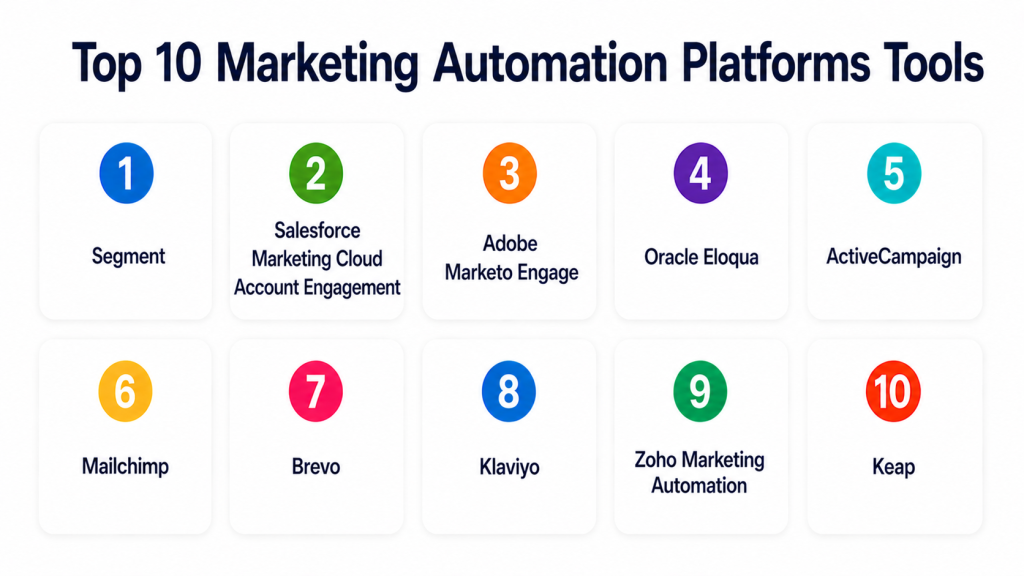
Top 10 Marketing Automation Platforms Tools
#1 — HubSpot Marketing Hub
Short description = HubSpot Marketing Hub is a popular marketing automation platform built around CRM, email marketing, landing pages, workflows, lead capture, and reporting. It is widely used by SMBs, mid-market companies, agencies, and growing B2B teams.
Key Features
- Visual workflow automation for lead nurturing and customer journeys
- Native CRM, forms, landing pages, email marketing, and contact management
- Lead scoring and audience segmentation
- Campaign reporting and attribution tools
- AI-assisted content and campaign features
- Ad management and social publishing capabilities
- Strong marketplace of integrations
Pros
- Easy to use compared with many enterprise-heavy platforms
- Strong all-in-one CRM and marketing experience
- Good fit for teams that want faster implementation
Cons
- Advanced features can become expensive as usage grows
- Enterprise-level customization may feel limited for complex organizations
- Contact-based pricing needs careful planning
Platforms / Deployment
Web / iOS / Android
Cloud
Security & Compliance
Commonly supports MFA, SSO on selected plans, role-based permissions, audit logging on advanced tiers, GDPR-related tools, and encryption. Specific certifications vary by product and plan.
Integrations & Ecosystem
HubSpot has a large integration marketplace and works well for teams that want marketing, sales, service, and CRM data in one system.
- CRM and sales tools
- Advertising platforms
- Webinar platforms
- Analytics tools
- Customer support tools
- eCommerce and payment tools
Support & Community
HubSpot has strong documentation, training content, certification-style learning resources, partner agencies, community forums, and tiered support options.
#2 — Salesforce Marketing Cloud Account Engagement
Short description= Salesforce Marketing Cloud Account Engagement, formerly known as Pardot, is focused on B2B marketing automation, lead nurturing, lead scoring, and Salesforce CRM alignment. It is best suited for Salesforce-heavy organizations.
Key Features
- B2B lead nurturing and campaign automation
- Salesforce CRM integration
- Lead scoring and grading
- Email marketing and landing pages
- Campaign influence and reporting
- Segmentation and personalization
- Sales handoff workflows
Pros
- Strong fit for Salesforce CRM users
- Good for B2B pipeline and lead management
- Useful for sales and marketing alignment
Cons
- Can require Salesforce expertise for best results
- Implementation may be complex for smaller teams
- Pricing and packaging can be difficult to compare
Platforms / Deployment
Web
Cloud
Security & Compliance
Salesforce commonly supports enterprise-grade security capabilities such as SSO, MFA, encryption options, audit controls, role-based access, and compliance programs. Exact availability depends on product edition and configuration.
Integrations & Ecosystem
The strongest ecosystem advantage is its connection with Salesforce CRM and related Salesforce products.
- Salesforce Sales Cloud
- Salesforce reports and dashboards
- Webinar tools
- Ad platforms
- Data and analytics tools
- Third-party marketing applications
Support & Community
Salesforce has extensive documentation, Trailhead learning resources, implementation partners, and enterprise support options. Smaller teams may need a consultant for setup.
#3 — Adobe Marketo Engage
Short description = Adobe Marketo Engage is an enterprise-grade marketing automation platform used for lead management, account-based marketing, email campaigns, journey automation, and revenue marketing. It is best for mature marketing teams with complex campaign needs.
Key Features
- Advanced lead management and scoring
- Email marketing and nurture programs
- Account-based marketing support
- Campaign analytics and attribution
- Personalization and audience segmentation
- CRM integrations
- Enterprise workflow automation
Pros
- Strong for complex B2B marketing operations
- Highly flexible campaign and lead management capabilities
- Suitable for large teams and advanced marketing operations
Cons
- Learning curve can be high
- Implementation and administration may require specialist skills
- May be more than what small teams need
Platforms / Deployment
Web
Cloud
Security & Compliance
Adobe enterprise products commonly include role-based access, security controls, privacy features, and compliance support. Specific certifications and controls should be validated by buyers.
Integrations & Ecosystem
Marketo Engage integrates with major CRM systems and Adobe ecosystem products, making it useful for enterprises with complex marketing stacks.
- CRM platforms
- Adobe Experience Cloud
- Webinar and event tools
- Data platforms
- Advertising tools
- Analytics platforms
Support & Community
Adobe offers enterprise support, documentation, implementation partners, and a strong marketing operations community.
#4 — Oracle Eloqua
Short description= Oracle Eloqua is an enterprise marketing automation platform designed for large B2B organizations with complex segmentation, campaign orchestration, and lead management needs.
Key Features
- Advanced campaign orchestration
- Lead scoring and nurturing
- Email marketing automation
- Segmentation and personalization
- CRM integration
- Campaign performance reporting
- Enterprise governance controls
Pros
- Strong enterprise marketing automation depth
- Good for complex global campaigns
- Suitable for mature marketing operations teams
Cons
- Can be complex to implement and manage
- Not ideal for small businesses
- Requires skilled administrators for best value
Platforms / Deployment
Web
Cloud
Security & Compliance
Oracle enterprise platforms commonly include security controls such as role-based access, encryption, audit capabilities, and compliance support. Exact details should be confirmed during procurement.
Integrations & Ecosystem
Oracle Eloqua fits well in larger enterprise ecosystems and can connect with CRM, analytics, and data platforms.
- CRM systems
- Oracle ecosystem products
- Data management tools
- Event platforms
- Analytics tools
- Sales enablement systems
Support & Community
Oracle provides enterprise documentation, support plans, and partner-led implementation services. Community strength is strongest among enterprise marketing operations users.
#5 — ActiveCampaign
Short description = ActiveCampaign combines email marketing, automation, CRM, customer journeys, and sales engagement features. It is popular with SMBs, agencies, eCommerce brands, and growing customer-facing teams.
Key Features
- Visual automation builder
- Email marketing and campaign templates
- CRM and sales automation
- Customer segmentation
- Site tracking and behavioral triggers
- SMS and messaging options on selected plans
- eCommerce automation features
Pros
- Strong automation features for the price
- Good balance of usability and flexibility
- Useful for small and mid-sized businesses
Cons
- Advanced reporting may not match enterprise platforms
- Can become complex as automations grow
- CRM may not replace dedicated enterprise CRM systems
Platforms / Deployment
Web / iOS / Android
Cloud
Security & Compliance
Commonly supports security basics such as account controls, permissions, and data protection measures. Specific certifications are not publicly stated here.
Integrations & Ecosystem
ActiveCampaign has a useful integration ecosystem for SMB marketing and sales stacks.
- eCommerce platforms
- CRM tools
- Landing page tools
- Payment systems
- Webinar platforms
- Customer support tools
Support & Community
ActiveCampaign provides documentation, onboarding resources, training, and support options. Community and agency ecosystem are strong among SMB users.
#6 — Mailchimp
Short description= Mailchimp is widely known for email marketing and has expanded into marketing automation, audience management, landing pages, customer journeys, and basic CRM-style features. It is best for small businesses, creators, and growing brands.
Key Features
- Email campaign creation
- Customer journey automation
- Audience segmentation
- Landing pages and forms
- Basic reporting and analytics
- AI-assisted content features
- eCommerce marketing integrations
Pros
- Beginner-friendly interface
- Good for small business email marketing
- Large template and integration ecosystem
Cons
- Advanced B2B automation is limited compared with enterprise tools
- Pricing can rise with audience size
- Not ideal for complex sales-led marketing operations
Platforms / Deployment
Web / iOS / Android
Cloud
Security & Compliance
Supports common account security and privacy-related features. Detailed enterprise compliance capabilities should be verified by buyers.
Integrations & Ecosystem
Mailchimp connects well with small business, creator, and eCommerce tools.
- eCommerce platforms
- Website builders
- CRM tools
- Social platforms
- Forms and landing pages
- Analytics tools
Support & Community
Mailchimp has broad documentation, tutorials, templates, and support options. Its community is strong among small businesses and creators.
#7 — Brevo
Short description= Brevo, formerly Sendinblue, is a marketing platform focused on email, SMS, automation, CRM, transactional messaging, and customer engagement. It is attractive for businesses that need practical automation with flexible pricing.
Key Features
- Email marketing campaigns
- SMS and WhatsApp-style communication options in supported markets
- Marketing automation workflows
- Contact segmentation
- Transactional email capabilities
- CRM-style contact management
- Forms and landing pages
Pros
- Good value for email and automation needs
- Supports both marketing and transactional communication
- Useful for SMBs and growing digital businesses
Cons
- May not match enterprise platforms for complex attribution
- Advanced customization can be limited
- Some features vary by region and plan
Platforms / Deployment
Web
Cloud
Security & Compliance
Supports common privacy and security controls. Specific certifications should be validated based on business requirements.
Integrations & Ecosystem
Brevo works well for businesses that need email, transactional messaging, and customer communication in one platform.
- eCommerce tools
- CMS platforms
- CRM systems
- API-based integrations
- Payment tools
- Forms and lead capture tools
Support & Community
Brevo provides help documentation, support resources, and onboarding materials. Support availability varies by plan.
#8 — Klaviyo
Short description = Klaviyo is a marketing automation platform strongly focused on eCommerce, customer data, email, SMS, segmentation, and lifecycle campaigns. It is especially popular with online retailers and direct-to-consumer brands.
Key Features
- Email and SMS marketing automation
- eCommerce customer segmentation
- Behavioral triggers and flows
- Product and purchase-based personalization
- Customer profile and event data
- Revenue reporting for campaigns
- Predictive analytics features
Pros
- Strong fit for eCommerce lifecycle marketing
- Deep segmentation based on customer behavior
- Useful revenue-focused reporting
Cons
- Less ideal for non-eCommerce B2B use cases
- Costs can grow with contact and message volume
- Advanced setup may require eCommerce marketing expertise
Platforms / Deployment
Web
Cloud
Security & Compliance
Supports common security and privacy controls. Specific compliance certifications should be confirmed during vendor review.
Integrations & Ecosystem
Klaviyo is strongest in eCommerce ecosystems and connects well with storefront, payment, and customer data tools.
- eCommerce platforms
- Review platforms
- Loyalty tools
- Helpdesk tools
- SMS tools
- Analytics and data platforms
Support & Community
Klaviyo has documentation, customer education, partner agencies, and a strong eCommerce marketing community.
#9 — Zoho Marketing Automation
Short description = Zoho Marketing Automation is part of the broader Zoho ecosystem and supports lead generation, journey automation, email campaigns, website tracking, and customer engagement. It is a practical choice for businesses already using Zoho products.
Key Features
- Journey automation builder
- Email marketing campaigns
- Lead scoring and segmentation
- Website visitor tracking
- Forms and landing pages
- CRM integration with Zoho CRM
- Campaign analytics
Pros
- Strong value for Zoho ecosystem users
- Good for SMBs and growing teams
- Broad business software ecosystem
Cons
- Best experience usually comes within the Zoho ecosystem
- Advanced enterprise marketing operations may need more depth
- Interface and setup may require learning time
Platforms / Deployment
Web / iOS / Android for selected Zoho apps
Cloud
Security & Compliance
Zoho commonly provides MFA, role-based access, encryption, and privacy controls across its ecosystem. Specific certification details should be verified.
Integrations & Ecosystem
Zoho Marketing Automation benefits from Zoho’s larger suite of business applications.
- Zoho CRM
- Zoho Campaigns
- Zoho Analytics
- Forms and survey tools
- Third-party CRM tools
- API integrations
Support & Community
Zoho offers documentation, customer support, partner services, and a broad user community. Support levels vary by plan.
#10 — Keap
Short description = Keap is a CRM and marketing automation platform designed mainly for small businesses, service providers, coaches, consultants, and sales-driven teams. It combines contact management, email automation, payments, and follow-up workflows.
Key Features
- CRM and contact management
- Email marketing automation
- Sales pipeline tracking
- Appointment and follow-up automation
- Forms and landing pages
- Payment and invoice support
- Small business workflow automation
Pros
- Good fit for service-based small businesses
- Combines CRM, marketing, and sales follow-up
- Helpful for teams that need simple client lifecycle automation
Cons
- Not ideal for large enterprise marketing operations
- Design flexibility may be limited compared with specialist tools
- Advanced analytics may not satisfy complex teams
Platforms / Deployment
Web / iOS / Android
Cloud
Security & Compliance
Common security controls are available, but specific compliance certifications are not publicly stated here.
Integrations & Ecosystem
Keap integrates with common small business and sales tools.
- Payment tools
- Scheduling platforms
- Forms
- Email tools
- Lead capture tools
- API and connector-based integrations
Support & Community
Keap provides onboarding, documentation, coaching-style resources, and support options. It has a strong small business user base.
Comparison Table (Top 10)
| Tool Name | Best For | Platform(s) Supported | Deployment | Standout Feature | Public Rating |
|---|---|---|---|---|---|
| HubSpot Marketing Hub | SMBs, mid-market teams, agencies | Web / iOS / Android | Cloud | All-in-one CRM and marketing automation | N/A |
| Salesforce Marketing Cloud Account Engagement | Salesforce-based B2B teams | Web | Cloud | Salesforce CRM alignment | N/A |
| Adobe Marketo Engage | Enterprise B2B marketing teams | Web | Cloud | Advanced lead management | N/A |
| Oracle Eloqua | Large enterprise marketing operations | Web | Cloud | Complex campaign orchestration | N/A |
| ActiveCampaign | SMBs and growth teams | Web / iOS / Android | Cloud | Flexible visual automation | N/A |
| Mailchimp | Small businesses and creators | Web / iOS / Android | Cloud | Beginner-friendly email marketing | N/A |
| Brevo | SMBs needing email, SMS, and transactional messaging | Web | Cloud | Marketing plus transactional communication | N/A |
| Klaviyo | eCommerce and DTC brands | Web | Cloud | eCommerce segmentation and revenue tracking | N/A |
| Zoho Marketing Automation | Zoho ecosystem users | Web / iOS / Android | Cloud | Affordable ecosystem integration | N/A |
| Keap | Small service businesses | Web / iOS / Android | Cloud | CRM plus follow-up automation | N/A |
Evaluation & Scoring of Marketing Automation Platforms
| Tool Name | Core (25%) | Ease (15%) | Integrations (15%) | Security (10%) | Performance (10%) | Support (10%) | Value (15%) | Weighted Total (0–10) |
|---|---|---|---|---|---|---|---|---|
| HubSpot Marketing Hub | 9 | 9 | 9 | 8 | 8 | 9 | 8 | 8.65 |
| Salesforce Marketing Cloud Account Engagement | 8 | 7 | 9 | 9 | 8 | 8 | 7 | 8.00 |
| Adobe Marketo Engage | 9 | 6 | 9 | 9 | 8 | 8 | 7 | 8.10 |
| Oracle Eloqua | 9 | 6 | 8 | 9 | 8 | 8 | 6 | 7.80 |
| ActiveCampaign | 8 | 8 | 8 | 7 | 8 | 8 | 9 | 8.05 |
| Mailchimp | 7 | 9 | 8 | 7 | 8 | 8 | 8 | 7.80 |
| Brevo | 7 | 8 | 7 | 7 | 8 | 7 | 9 | 7.55 |
| Klaviyo | 8 | 8 | 8 | 7 | 8 | 8 | 8 | 7.95 |
| Zoho Marketing Automation | 7 | 7 | 8 | 8 | 7 | 7 | 9 | 7.55 |
| Keap | 7 | 8 | 7 | 7 | 7 | 8 | 8 | 7.40 |
These scores are comparative, not absolute. A higher score does not mean the tool is automatically best for every business. Enterprise tools score well on depth and governance, while SMB tools often score better on ease and value. Buyers should use this table as a shortlist guide, then validate pricing, integrations, security, and workflow fit through a pilot.
Which Marketing Automation Platforms Tool Is Right for You?
Solo / Freelancer
Solo professionals usually need simple email automation, contact management, lead capture, and follow-up reminders. Mailchimp, Keap, Brevo, and ActiveCampaign are practical choices because they are easier to manage without a large marketing operations team.
SMB
SMBs should look for a balance of automation, CRM integration, ease of use, and cost control. HubSpot Marketing Hub, ActiveCampaign, Brevo, Zoho Marketing Automation, and Keap are strong options depending on whether the business is sales-led, service-based, or eCommerce-focused.
Mid-Market
Mid-market companies often need stronger segmentation, CRM alignment, lifecycle campaigns, analytics, and sales collaboration. HubSpot, Salesforce Marketing Cloud Account Engagement, ActiveCampaign, Klaviyo, and Marketo Engage can fit well depending on the industry and stack maturity.
Enterprise
Enterprises usually need governance, security controls, global campaign management, advanced attribution, CRM depth, and scalable workflows. Adobe Marketo Engage, Oracle Eloqua, Salesforce Marketing Cloud Account Engagement, and HubSpot Enterprise are common options for larger organizations.
Budget vs Premium
For budget-conscious teams, Brevo, Zoho Marketing Automation, Mailchimp, and ActiveCampaign can provide strong value. Premium platforms such as Marketo Engage, Oracle Eloqua, Salesforce Marketing Cloud Account Engagement, and HubSpot Enterprise are better when advanced workflows, reporting, and governance justify the cost.
Feature Depth vs Ease of Use
HubSpot and ActiveCampaign offer strong ease of use with good automation depth. Marketo Engage, Oracle Eloqua, and Salesforce Marketing Cloud Account Engagement offer deeper enterprise functionality but require more setup, training, and administration.
Integrations & Scalability
Choose Salesforce Marketing Cloud Account Engagement if Salesforce CRM is central to your sales process. Choose HubSpot if you want CRM, marketing, service, and content tools in one ecosystem. Choose Klaviyo if eCommerce integrations are the top priority.
Security & Compliance Needs
Enterprises should prioritize SSO, MFA, RBAC, audit logs, encryption, data residency needs, consent management, and vendor compliance documentation. Salesforce, Adobe, Oracle, and HubSpot are commonly considered for stricter enterprise environments, but every buyer should validate controls before purchase.
Frequently Asked Questions (FAQs)
1. What is a marketing automation platform?
A marketing automation platform helps businesses automate campaigns, email sequences, lead nurturing, segmentation, scoring, reporting, and customer journeys. It reduces manual work and improves consistency across marketing channels.
2. How much do marketing automation platforms cost?
Pricing varies widely. Some tools charge by contacts, email volume, users, features, or platform edition. Enterprise platforms usually require custom pricing, while SMB tools often have tier-based pricing.
3. Which marketing automation platform is best for small businesses?
Mailchimp, ActiveCampaign, Brevo, Keap, Zoho Marketing Automation, and HubSpot are often practical for small businesses. The right choice depends on budget, CRM needs, email volume, and automation complexity.
4. Which platform is best for enterprise marketing teams?
Adobe Marketo Engage, Oracle Eloqua, Salesforce Marketing Cloud Account Engagement, and HubSpot Enterprise are strong enterprise-oriented choices. Enterprises should evaluate governance, integrations, scalability, and support.
5. What is the biggest mistake companies make with marketing automation?
The biggest mistake is automating without a clear strategy. Poor segmentation, weak content, messy CRM data, and unclear lead scoring can make automation ineffective.
6. Do marketing automation platforms replace CRM software?
Not always. Some platforms include CRM features, while others work best when connected to a dedicated CRM. Sales-led teams should ensure strong CRM integration before choosing a platform.
7. Are marketing automation platforms secure?
Most recognized platforms offer common security controls, but capabilities vary by vendor and plan. Buyers should check SSO, MFA, encryption, RBAC, audit logs, data processing terms, and compliance documentation.
8. How long does implementation take?
Implementation depends on complexity. A small email automation setup can be quick, while enterprise migration with CRM integration, data cleanup, scoring models, and reporting can take much longer.
9. Can I switch from one marketing automation platform to another?
Yes, but switching requires careful planning. Teams need to export contacts, rebuild workflows, migrate templates, reconnect forms, validate consent records, and test CRM sync before going live.
10. What are alternatives to marketing automation platforms?
Alternatives include simple email marketing tools, CRM-native email features, customer engagement platforms, CDPs, newsletter tools, or custom workflows using integration platforms. The best alternative depends on your use case.
11. Do these platforms support AI features?
Many modern platforms now include AI-assisted content, recommendations, predictive scoring, send-time optimization, or reporting support. Availability varies by vendor and plan.
12. What should I check before buying?
Check CRM integration, contact limits, workflow builder quality, reporting, email deliverability, support, compliance controls, onboarding effort, pricing model, and long-term scalability.
Conclusion
Marketing automation platforms can improve lead nurturing, customer engagement, campaign consistency, sales alignment, and revenue visibility. However, there is no single best platform for every business. A small business may value simplicity and price, while an enterprise may prioritize governance, security, attribution, and advanced CRM integration. eCommerce brands may prefer Klaviyo, Salesforce users may prefer Account Engagement, and all-in-one growth teams may prefer HubSpot or ActiveCampaign.
