Upgrade & Secure Your Future with DevOps, SRE, DevSecOps, MLOps!
We spend hours scrolling social media and waste money on things we forget, but won’t spend 30 minutes a day earning certifications that can change our lives.
Master in DevOps, SRE, DevSecOps & MLOps by DevOps School!
Learn from Guru Rajesh Kumar and double your salary in just one year.
Introduction
Transitioning into a Solutions Architect role is the most significant leap a senior engineer can take, as it moves the focus from simply fixing problems to preventing them through better design. In my time watching the cloud evolve, I’ve learned that technical knowledge alone isn’t enough; you must be able to align complex Azure services with real business needs. This guide is designed to take you through the Azure Solutions Architect Expert journey, focusing on how to build systems that are not only powerful but also cost-effective and secure. For engineers and managers across the globe, from the tech hubs of India to international enterprises, this certification is the bridge to becoming a strategic leader who can navigate any architectural challenge.
What is the Azure Solutions Architect Expert Certification?
The Azure Solutions Architect Expert is the highest tier of Microsoft’s role-based certification for cloud infrastructure. It validates your ability to translate business requirements into secure, scalable, and reliable cloud solutions. This isn’t just about knowing how to create a Virtual Machine; it’s about knowing which compute, storage, and networking options fit the specific budget and performance needs of a global enterprise. It serves as a professional seal of approval that you can handle high-stakes digital transformations.
Detailed Certification Breakdown: AZ-305
What it is
The AZ-305 (Designing Microsoft Azure Infrastructure Solutions) exam is the core requirement for the Expert badge. It focuses heavily on “Design” rather than “Implementation,” testing your knowledge of architecture patterns, data residency, and high availability. It challenges you to think like a consultant, choosing the right services to meet specific business SLAs while keeping costs low.
Who should take it
This path is ideal for IT professionals with a solid foundation in Azure administration who want to move into high-level design roles. Senior Developers and Systems Engineers who are responsible for the overall health and scalability of cloud environments will find this most beneficial. It is also highly recommended for Technical Leads who need to mentor teams and make final decisions on infrastructure stacks.
Skills you’ll gain
- Identity & Governance: Master Azure AD (Entra ID), RBAC, and policy-driven compliance across multiple subscriptions.
- Data Storage: Learn to choose between SQL, NoSQL, and Data Lake solutions based on throughput and consistency needs.
- Business Continuity: Design sophisticated backup and disaster recovery strategies using Site Recovery and multi-region failover.
- Infrastructure Design: Architect compute, network, and application solutions that are resilient to regional outages and traffic spikes.
Real-world projects you should be able to do
- Global App Deployment: Design a low-latency architecture for a mobile app with users in Asia, Europe, and the US using Traffic Manager and Front Door.
- Legacy Migration: Create a step-by-step roadmap to move a monolithic on-premise ERP system to a microservices-based Azure Kubernetes (AKS) environment.
- Secure Banking Portal: Architect a “Zero Trust” environment for a financial app using Private Links, Key Vault, and Web Application Firewalls.
Preparation Plan
- 7–14 days: Best for experts who already manage large-scale Azure environments; focus on “the Microsoft way” of design and specific exam terminology.
- 30 days: The standard path for senior engineers; spend 1 hour daily on documentation and 1 hour on hands-on architecture labs.
- 60 days: Recommended for those new to Azure or transitioning from AWS/GCP; allows time to master the fundamental differences in Azure services.
Common Mistakes
- Over-Engineering: Adding unnecessary complexity or expensive features that the business requirements don’t actually demand.
- Ignoring Compliance: Forgetting to account for regional data laws (like GDPR) or industry-specific security standards in the design phase.
- Missing the “Admin” Foundation: Attempting the AZ-305 without a deep understanding of the AZ-104 (Administrator) concepts, which are vital for practical design.
Best next certification after this
1. Same Track: Azure Security Engineer Associate (AZ-500)
This is the best choice if you want to be the “Architect who builds fortresses.” While the AZ-305 touches on security, the AZ-500 goes deep into identity management, threat protection, and data encryption. In today’s world, an architect who can prove they design with a “Security First” mindset is incredibly valuable to any global enterprise. It solidifies your reputation as someone who protects the business as much as they enable it.
2. Cross-Track: Azure DevOps Engineer Expert (AZ-400)
If you want to master how your designs are actually deployed and managed, this is your next milestone. This track focuses on the “how” of delivery—pipelines, container strategies, and continuous integration. Moving from Architect to DevOps Expert makes you a “Full-Stack Cloud Leader” who understands both the blueprint and the construction process. It is highly recommended for those moving into Platform Engineering or SRE leadership roles.
3. Leadership: FinOps Certified Practitioner
For those looking to move toward the “Business” side of technology, focusing on Cloud Economics is a game-changer. This path teaches you how to manage the financial health of your cloud environment, ensuring that your architectural choices are always cost-effective. Being able to explain the ROI of a cloud migration to a CFO or Stakeholder is a rare and high-demand skill. It transforms you from a technical expert into a strategic business partner.
Certification Track Table
| Track | Level | Who it’s for | Prerequisites | Skills Covered | Recommended Order |
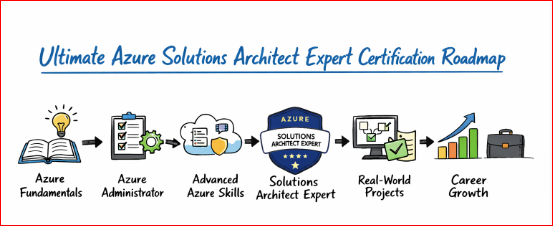
| Cloud Architecture | Expert | Senior Leads, Managers | AZ-104 (Admin) | Design, Migration, Governance | AZ-900 → AZ-104 → AZ-305 |
Choose Your Path: 6 Specialized Learning Tracks
1. The DevOps Path
This path focuses on “Infrastructure as Code” (IaC) and automating the entire delivery lifecycle. You will learn how to use tools like Terraform, Bicep, and Azure Pipelines to ensure that your architectures are repeatable and error-free. It is perfect for those who want to eliminate manual work and speed up the release of new software features.
2. The DevSecOps Path
In this track, security is woven into the very fabric of the architecture from day one. You’ll focus on automated security scanning, container security in AKS, and managing secrets without ever hard-coding them. This is the “gold standard” for architects working in regulated industries like healthcare or government.
3. The SRE (Site Reliability Engineering) Path
SREs focus on the balance between releasing new features and keeping the system stable. This track teaches you how to design for “Observability” using Azure Monitor and Log Analytics to catch issues before they affect users. You will learn to architect self-healing systems that can automatically scale or restart when errors occur.
4. The AIOps/MLOps Path
This modern track is for architects who need to support data scientists and AI models at scale. You’ll learn how to build the infrastructure required for machine learning training and deployment pipelines using Azure ML. It’s about ensuring that AI models have the compute power they need without breaking the bank.
5. The DataOps Path
DataOps is about treating data pipelines with the same rigor as software code. You will learn to architect environments using Azure Data Factory and Synapse Analytics to move data securely and efficiently. This path is essential for organizations that rely on real-time analytics to make business decisions.
6. The FinOps Path
FinOps is the practice of bringing financial accountability to the variable spend model of the cloud. You will learn to design architectures that use Reserved Instances, Spot VMs, and Auto-scaling to maximize every dollar spent. This is a high-demand skill as companies look to optimize their cloud budgets in a tight economy.
Role → Recommended Certifications Mapping
| Current or Target Role | Primary Certification | Secondary / Specialty Certification | Focus Area |
| DevOps Engineer | AZ-104 (Administrator) | AZ-400 (DevOps Engineer Expert) | Automation, CI/CD, and Governance |
| SRE (Site Reliability Engineer) | AZ-104 (Administrator) | AZ-305 (Solutions Architect) | Reliability, Monitoring, and Scaling |
| Platform Engineer | AZ-104 (Administrator) | AZ-700 (Network Engineer) | Infrastructure as Code and Networking |
| Cloud Engineer | AZ-900 (Fundamentals) | AZ-104 (Administrator Associate) | Day-to-day Cloud Ops and Maintenance |
| Security Engineer | AZ-104 (Administrator) | AZ-500 (Security Engineer Associate) | Zero Trust, Identity, and Threat Protection |
| Data Engineer | DP-203 (Data Engineering) | AZ-305 (Solutions Architect) | Data Pipelines, Storage, and Analytics |
| FinOps Practitioner | AZ-900 (Fundamentals) | AZ-305 (Solutions Architect Expert) | Cost Optimization and Resource Tagging |
| Engineering Manager | AZ-900 (Fundamentals) | AZ-305 (Solutions Architect Expert) | High-level Strategy and Budgeting |
Top Institutions for Training & Certification
DevOpsSchool As a premier destination for high-end technical training, DevOpsSchool offers a deep-dive curriculum that blends Azure architecture with practical DevOps principles. Their program is highly regarded for its live interactive sessions and a vast repository of projects that mirror the challenges faced by global enterprises.
Cotocus Cotocus is known for its intensive, lab-oriented approach that ensures candidates gain hands-on proficiency with Azure’s design tools. They focus on modern cloud-native strategies, making them an excellent choice for architects who need to stay ahead of rapidly evolving industry standards.
Scmgalaxy This institution serves as a massive knowledge hub, providing a community-driven learning environment rich with technical resources and expert blogs. Their training programs are designed by working professionals, ensuring that the architectural concepts taught are directly applicable to current market demands.
BestDevOps BestDevOps specializes in streamlined, result-oriented training designed specifically for busy professionals who need to master Azure architecture efficiently. They focus on high-impact learning modules and exam-specific patterns that help senior engineers achieve certification without unnecessary fluff.
devsecopsschool.com For architects who believe security is a non-negotiable foundation, this school provides specialized training in integrating security at the design level. Their courses cover everything from identity governance to automated threat protection within the Azure ecosystem.
sreschool.com Focusing on the pillars of reliability and performance, SRE School is ideal for architects who need to build “unbreakable” systems. They teach you how to design for high availability and observability, ensuring your Azure solutions can scale effortlessly.
aiopsschool.com As artificial intelligence becomes central to cloud operations, this institution helps architects bridge the gap between traditional infrastructure and AI-driven automation. They focus on designing the complex compute and data environments required for modern AIOps workloads.
dataopsschool.com This school is the go-to for architects specializing in data-heavy environments, focusing on the seamless flow and governance of information. They provide the technical depth needed to architect robust data lakes, warehouses, and real-time processing pipelines on Azure.
finopsschool.com In an era of rising cloud costs, FinOps School teaches architects how to design for maximum financial efficiency from day one. Their curriculum focuses on the intersection of technical design and cloud economics, ensuring your solutions are as cost-effective as they are powerful.
FAQs on Azure Solutions Architect Expert
1. How difficult is the AZ-305 exam?
It is widely considered an “Advanced” exam because it doesn’t just ask you what a service does; it asks you to choose the best service for a specific scenario. You need to understand the trade-offs between cost, speed, and reliability.
2. Do I need to be a coder to become a Solutions Architect?
While you don’t need to write production-level application code every day, you must be comfortable with JSON, YAML, and scripting (PowerShell/Bash). Understanding how applications are built allows you to design better homes for them in the cloud.
3. What is the value of this certification in the job market?
This certification acts as a powerful filter for recruiters looking for high-level talent. It can lead to roles like Principal Architect or Cloud Lead, which often come with significant salary increases and leadership responsibilities.
4. How long does the certification stay valid?
The badge is valid for one year, but Microsoft offers a free, unproctored online renewal assessment every year. This ensures that you stay up to date with the rapid changes in the Azure ecosystem.
5. Should I do AZ-104 before AZ-305?
Yes, this is the recommended path. The AZ-104 gives you the practical “how-to” knowledge that makes the high-level “design” concepts in the AZ-305 much easier to grasp.
6. Can I jump straight to the Expert level?
You can take the AZ-305 exam at any time, but Microsoft will not award you the “Expert” title until you have also passed the AZ-104 (Administrator) exam.
7. How much time should I dedicate daily for preparation?
If you have a full-time job, aim for 1-2 hours of focused study during the week and a longer 3-4 hour session on weekends. Consistency is more important than “cramming.”
8. Is the lab portion included in the exam?
Microsoft often includes labs where you must perform tasks in a live Azure portal. You should be prepared to actually configure services, not just answer multiple-choice questions.
8. Testimonials
“I had the technical skills, but I lacked the ‘architectural mindset’ until I went through the DevOpsSchool training. It changed how I view infrastructure—I now look at every project through the lens of cost and long-term maintenance.” — Vikram S., Cloud Lead
“The specialized FinOps and SRE tracks helped me carve out a niche in my company. I’m no longer just another engineer; I’m the person the VP of Engineering calls when they need to scale a project or reduce the cloud bill.” — Ananya R., Senior SRE
9. Conclusion
The path to becoming an Azure Solutions Architect Expert is a marathon, not a sprint. It requires a deep curiosity about how systems work and a commitment to continuous learning. In my years of experience, I’ve found that the best architects are those who can bridge the gap between technical complexity and business value. By following this guide and choosing the right training partners, you are setting yourself up for a career that is not only lucrative but also incredibly impactful.