Upgrade & Secure Your Future with DevOps, SRE, DevSecOps, MLOps!
We spend hours scrolling social media and waste money on things we forget, but won’t spend 30 minutes a day earning certifications that can change our lives.
Master in DevOps, SRE, DevSecOps & MLOps by DevOps School!
Learn from Guru Rajesh Kumar and double your salary in just one year.
Introduction
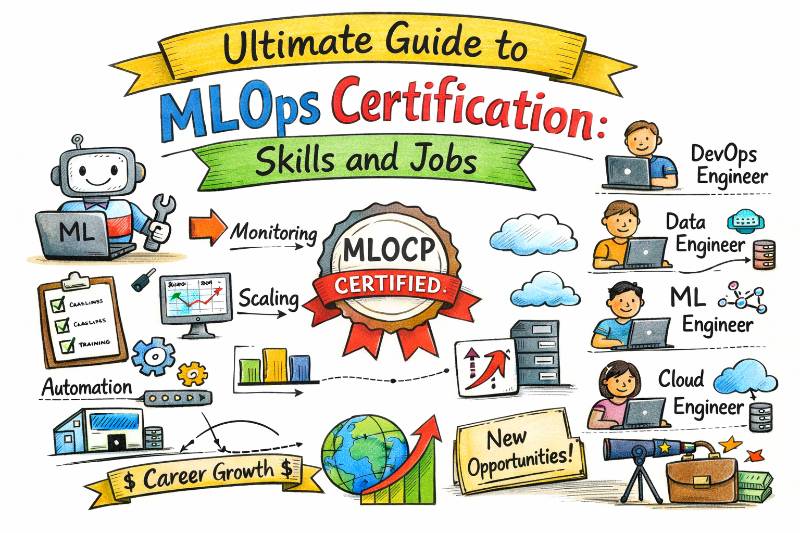
In today’s fast-paced tech world, MLOps (Machine Learning Operations) is becoming increasingly important as organizations look for ways to deploy, manage, and maintain machine learning models in production environments. If you’re an engineer or manager seeking to build expertise in MLOps, the MLOps Certified Professional (MLOCP) certification is a valuable credential that will set you apart in this rapidly growing field.
This guide aims to provide you with everything you need to know about the MLOCP certification. Whether you are new to MLOps or looking to formalize your skills, this guide will help you understand the certification process, what you’ll learn, and how it will impact your career.
What is the MLOps Certified Professional (MLOCP)?
The MLOCP certification program is designed to equip professionals with the skills needed to deploy, monitor, and manage machine learning models in production environments. The certification focuses on integrating machine learning with DevOps principles to automate the machine learning lifecycle, ensuring scalability, performance, and continuous delivery. By earning the MLOCP certification, professionals demonstrate their ability to bridge the gap between data science and operations, ensuring that models are production-ready and continuously maintained.
Who Should Take the MLOCP Certification?
The MLOCP certification is ideal for professionals who are working or interested in the following fields:
- Software Engineers looking to extend their skills into machine learning and operations.
- DevOps Engineers who want to learn how to integrate machine learning into their CI/CD pipelines.
- Machine Learning Engineers interested in mastering the operational aspects of machine learning.
- Data Engineers who wish to learn how to automate the process of deploying machine learning models.
- Managers and IT professionals responsible for overseeing the deployment and operationalization of machine learning models.
Skills You’ll Gain
After earning the MLOCP certification, you will have developed the following skills:
- Deploying ML models into production environments using modern DevOps practices.
- Integrating ML models with CI/CD pipelines to ensure continuous integration and delivery.
- Automating workflows for testing, deployment, and monitoring of machine learning models.
- Implementing model versioning, ensuring that different versions of ML models are properly managed and deployed.
- Monitoring and maintaining models post-deployment to ensure their performance and accuracy remain optimal.
- Collaborating across teams—working closely with data scientists, engineers, and business stakeholders.
Real-World Projects You Should Be Able to Do After MLOCP
After completing the MLOCP certification, you should be able to take on the following projects:
- End-to-End MLOps Pipeline: Implement an end-to-end machine learning pipeline that automates the process of data preparation, model training, deployment, and monitoring.
- Model Deployment in the Cloud: Deploy a machine learning model on a cloud platform like AWS, Azure, or GCP, ensuring that it can handle scalable requests in a production environment.
- Automated Model Monitoring and Versioning: Set up automated systems for monitoring the performance of deployed models and ensuring that model versions are tracked and easily updated.
- Integrating ML Models into CI/CD Pipelines: Ensure that your models are automatically tested, deployed, and integrated into continuous delivery pipelines.
These projects will not only solidify your learning but also provide the practical experience required to excel in the MLOps space.
Preparation Plan
The following preparation plan is designed to help you effectively prepare for the MLOCP certification exam:
7–14 Days (Quick Start)
- Focus on understanding the basics: Familiarize yourself with DevOps practices and their application to machine learning.
- Study core tools: Learn tools such as Jenkins, Docker, Kubernetes, and Kubeflow.
- Practice deploying small machine learning models into production environments.
30 Days (Intermediate)
- Work on hands-on projects: Set up a basic ML pipeline and integrate it with a CI/CD pipeline.
- Learn automation tools: Focus on automating key aspects of the model lifecycle.
- Deepen your cloud platform knowledge by deploying models on platforms like AWS or Azure.
60 Days (Advanced)
- Master advanced MLOps topics: Learn about scaling machine learning models, version control, and model monitoring.
- Integrate all aspects of MLOps: Build comprehensive end-to-end pipelines that include automated testing, monitoring, and scaling.
- Collaborate on projects: Work with teams and use real-world datasets to solve business challenges through MLOps.
By following this plan, you’ll build both the theoretical knowledge and hands-on experience needed to succeed in the MLOCP certification exam.
Common Mistakes to Avoid
When preparing for the MLOCP exam, here are some common mistakes to watch out for:
- Focusing only on theory: MLOps is a practical field. Hands-on experience with tools and real-world projects is crucial for success.
- Ignoring DevOps principles: MLOps requires a solid understanding of DevOps concepts like CI/CD and automation. Don’t skip these topics.
- Skipping model monitoring: Once your model is deployed, it’s essential to continuously monitor it to ensure performance and accuracy.
- Not utilizing cloud platforms: Many MLOps tasks require the use of cloud services for scalable deployments and integrations.
Best Next Certification After MLOCP
Once you’ve completed the MLOCP certification, consider these next steps to further your expertise:
- Same Track: Machine Learning Engineer Certification (MLE) – A deeper dive into the development and optimization of machine learning models.
- Cross-Track: DevSecOps Certified Professional (DSOCP) – Learn how to integrate security measures throughout the MLOps pipeline.
- Leadership: Certified DevOps Architect (CDA) – Take your DevOps and MLOps expertise to the next level by learning how to architect large-scale systems and teams.
Choose Your Path
MLOps is just one of many exciting career paths within the DevOps ecosystem. You can also explore these other learning tracks:
- DevOps: Focus on automating and improving the software development and deployment lifecycle.
- DevSecOps: Integrate security into every stage of the DevOps pipeline.
- SRE (Site Reliability Engineering): Build scalable, reliable systems to maintain uptime and performance.
- AIOps/MLOps: Use artificial intelligence and machine learning to improve operations and systems.
- DataOps: Ensure efficient and reliable data pipelines for data engineering and ML workflows.
- FinOps: Optimize cloud spending and financial operations within DevOps teams.
Role → Recommended Certifications in table
| Role | Recommended Certifications |
|---|---|
| DevOps Engineer | MLOps Certified Professional (MLOCP), DevOps Certified Professional (DCP) |
| SRE (Site Reliability Engineer) | Site Reliability Engineering Certified Professional (SRECP), MLOps Certified Professional (MLOCP) |
| Platform Engineer | MLOps Certified Professional (MLOCP), DevOps Architect (CDA) |
| Cloud Engineer | Cloud Certified Professional (CCP), MLOps Certified Professional (MLOCP) |
| Security Engineer | DevSecOps Certified Professional (DSOCP), MLOps Certified Professional (MLOCP) |
| Data Engineer | DataOps Certified Professional (DOCP), MLOps Certified Professional (MLOCP) |
| FinOps Practitioner | FinOps Certified Professional (FOCP), MLOps Certified Professional (MLOCP) |
| Engineering Manager | DevOps Architect (CDA), MLOps Certified Professional (MLOCP) |
Frequently Asked Questions (FAQs) for MLOps Certified Professional (MLOCP)
1. How difficult is the MLOCP exam?
The MLOCP exam is moderately challenging, testing both theoretical knowledge and practical experience in MLOps, including model deployment, CI/CD integration, and monitoring.
2. How long do I need to prepare for MLOCP?
Preparation usually takes 30 to 60 days, depending on prior experience. Those with DevOps or ML knowledge can prepare in 30 days; beginners may need 60 days.
3. What are the prerequisites for MLOCP?
You should have a basic understanding of DevOps, machine learning concepts, and experience with tools like Docker, Jenkins, and cloud platforms.
4. What is the recommended sequence for learning?
- Learn DevOps principles (CI/CD, automation).
- Study machine learning basics.
- Master MLOps tools (Kubeflow, MLflow, Jenkins).
- Focus on monitoring and scaling models.
- Work on hands-on projects integrating all components.
5. What value does the MLOCP certification offer?
MLOCP enhances your credibility, boosts career prospects, and validates your skills in deploying and managing ML models in production environments.
6. What career outcomes can I expect?
After MLOCP, you can pursue roles such as MLOps Engineer, Machine Learning Engineer, DevOps Engineer with an MLOps focus, and Data Engineer.
7. How is MLOCP different from other ML certifications?
MLOCP focuses on operationalizing machine learning models—deploying, managing, and monitoring models in production—while other certifications may focus on development or data science.
8. Is there a job guarantee after MLOCP?
While no job is guaranteed, MLOCP significantly boosts your chances of landing roles in MLOps, a rapidly growing field with high demand.
9. What are some common mistakes to avoid?
- Skipping DevOps basics (essential for MLOps).
- Not practicing hands-on with tools like Kubeflow and MLflow.
- Neglecting model monitoring after deployment.
10. How long is the MLOCP certification valid?
MLOCP is valid for 2 years. After that, you may need to recertify to stay current with evolving tools and practices.
11. Can I take the MLOCP exam online?
Yes, the exam is proctored online, allowing you to take it from anywhere with a stable internet connection.
12. What are the key tools used in MLOps?
Essential tools include Kubeflow, MLflow, Jenkins, Docker, Kubernetes, and cloud platforms like AWS, GCP, and Azure.
FAQs
1. What exactly is MLOps?
MLOps, or Machine Learning Operations, is the practice of deploying, monitoring, and maintaining machine learning models in production. It integrates machine learning workflows with DevOps principles to ensure seamless operations across the ML lifecycle.
2. How hard is the MLOCP exam?
The MLOCP exam is moderately challenging. It tests both theoretical knowledge and hands-on experience with MLOps tools and best practices. Proper preparation, including practical exercises and real-world projects, will help you succeed.
3. How long does it take to prepare for MLOCP?
Preparation for MLOCP generally takes 30 to 60 days. However, if you’re already familiar with DevOps or machine learning, you may be able to prepare in a shorter time.
4. What are the prerequisites for taking the MLOCP exam?
To take the MLOCP exam, you should have a solid understanding of DevOps principles and machine learning concepts. Familiarity with tools like Docker, Kubernetes, Jenkins, and cloud platforms is recommended.
5. What skills will I gain with MLOCP?
By earning MLOCP, you’ll learn how to:
- Deploy and manage machine learning models in production.
- Integrate machine learning workflows with CI/CD pipelines.
- Automate testing, monitoring, and scaling of machine learning models.
6. What career outcomes can I expect from earning MLOCP?
MLOCP will open up various career opportunities, such as:
- MLOps Engineer
- Machine Learning Engineer
- DevOps Engineer focusing on MLOps
- Data Engineer
7. Is there any job guarantee after completing MLOCP?
While there’s no job guarantee, earning MLOCP significantly improves your job prospects. MLOps professionals are in high demand across industries like tech, finance, healthcare, and e-commerce.
8. What are the best resources for preparing for the MLOCP exam?
Effective resources include:
- Online courses and webinars offered by leading providers like DevOpsSchool.
- Hands-on practice with tools like Kubeflow, MLflow, and Jenkins.
- Community forums where professionals share insights and real-world scenarios.
Top Institutions Offering Training & Support for MLOps Certified Professional (MLOCP)
Below is a curated list of trusted institutions that provide training, hands‑on learning, project work, and certification preparation support for the MLOps Certified Professional (MLOCP) program. These providers help learners transform theoretical knowledge into real implementation skills, empowering them to confidently apply MLOps practices in real‑world environments.
1. DevOpsSchool
DevOpsSchool is one of the most recognized training providers for MLOps and DevOps certifications. Their programs emphasize practical learning through real‑world projects, expert mentorship, and a strong focus on integrating machine learning workflows into DevOps pipelines. The curriculum aligns closely with industry expectations, making it ideal for engineers and managers seeking career growth in MLOps.
2. Cotocus
Cotocus offers comprehensive MLOps and DevOps training designed to bridge the gap between theory and implementation. Their courses include hands‑on labs, real use‑case scenarios, and exam‑oriented preparation. Cotocus focuses on helping learners build scalable and reliable MLOps pipelines using modern tools and industry best practices.
3. Scmgalaxy
Scmgalaxy specializes in professional training for DevOps and MLOps practices. Their programs emphasize deep practical exposure to tools like Jenkins, Docker, Kubernetes, MLflow, and Kubeflow. The training includes guided projects that help learners understand how to deploy and monitor ML models at scale, making it a strong choice for those preparing for MLOCP certification.
4. BestDevOps
BestDevOps offers structured training for engineers transitioning into MLOps roles. Their curriculum spans key areas such as automation, CI/CD integration with machine learning models, deployment patterns, and monitoring strategies. Participants benefit from interactive sessions and project work that build confidence in managing end‑to‑end MLOps workflows.
5. DevSecOpsSchool
DevSecOpsSchool focuses on combining security principles with DevOps and MLOps practices. As machine learning workflows increasingly involve sensitive data and critical decision‑making systems, adding security to the pipeline becomes essential. Their training emphasizes secure deployments, compliance considerations, and protection of ML systems in production.
6. SRESchool
SRESchool specializes in Site Reliability Engineering concepts and applies them to MLOps training. Their programs guide learners in building reliable and highly available ML systems, focusing on observability, reliability best practices, and automation. This makes SRESchool a great choice for those who want to combine reliability principles with MLOps implementation.
7. AIOpsSchool
AIOpsSchool blends artificial intelligence with operational excellence. Their training covers how machine learning can improve IT operations and how automated feedback loops can optimize system performance. The MLOps offerings emphasize end‑to‑end lifecycle management of ML systems and intelligent operational enhancements.
8. DataOpsSchool
DataOpsSchool specializes in streamlining data workflows and data engineering practices that support MLOps success. Their training focuses on managing data pipelines, ensuring quality and governance, and integrating data workflows into machine learning lifecycle pipelines. This is ideal for learners who want strong foundational skills in both data management and MLOps.
9. FinOpsSchool
FinOpsSchool focuses on financial optimization and cost management for cloud‑based operations, including MLOps deployments. As organizations deploy ML models at scale, managing cloud costs and operational efficiency becomes critical. Their training helps learners understand how to optimize resource use, reduce costs, and make financially sound decisions in MLOps environments.
Conclusion
MLOps Certified Professional (MLOCP) certification is a powerful way to validate your expertise in managing machine learning models from development to deployment in production environments. As organizations increasingly rely on machine learning to drive innovation, the demand for skilled professionals who can ensure smooth integration between machine learning and DevOps processes is growing rapidly. By earning the MLOCP certification, you’ll gain the necessary skills to automate workflows, scale models, and maintain their performance, setting yourself up for success in the booming field of MLOps and opening up new career opportunities in this high-demand industry.