Upgrade & Secure Your Future with DevOps, SRE, DevSecOps, MLOps!
We spend hours scrolling social media and waste money on things we forget, but won’t spend 30 minutes a day earning certifications that can change our lives.
Master in DevOps, SRE, DevSecOps & MLOps by DevOps School!
Learn from Guru Rajesh Kumar and double your salary in just one year.
Introduction
Security Information & Event Management, commonly called SIEM, helps security teams collect, centralize, analyze, and respond to security events from across an organization. In simple words, a SIEM works like a security command center. It brings logs and alerts from cloud systems, servers, endpoints, networks, identity tools, firewalls, applications, and security platforms into one place so teams can detect suspicious activity faster.
SIEM matters because modern businesses now operate across cloud, hybrid infrastructure, SaaS tools, remote users, APIs, containers, and distributed systems. As attacks become more automated and identity-focused, security teams need better visibility, faster correlation, and smarter alert handling.
Common SIEM use cases include:
- Threat detection and investigation
- Security monitoring across cloud and on-premises systems
- Compliance reporting and audit support
- Insider threat detection
- Incident response and alert triage
Buyers should evaluate:
- Log ingestion flexibility
- Detection rules and analytics
- Cloud and SaaS coverage
- Threat intelligence support
- Automation and response workflows
- Dashboard and reporting quality
- Pricing model and data volume limits
- Ease of deployment and tuning
- Integration with SOAR, EDR, IAM, and ticketing tools
- Long-term scalability and support
Best for: Security operations teams, SOC analysts, compliance teams, cloud security teams, managed security service providers, mid-market companies, and enterprises that need centralized security monitoring.
Not ideal for: Very small teams with limited log volume, businesses without security staff, or organizations that only need basic endpoint protection. In those cases, managed detection and response, endpoint detection tools, or cloud-native monitoring may be simpler options.
Key Trends in Security Information & Event Management SIEM Tools
AI-assisted investigation is becoming standard. SIEM platforms are adding AI summaries, alert explanations, natural language search, and guided investigation to help analysts move faster.
- Cloud-native SIEM is growing fast. More organizations prefer SIEM tools that scale in the cloud instead of requiring heavy on-premises infrastructure.
- Identity security is now central to SIEM. Modern attacks often target users, access tokens, privileged accounts, and cloud permissions, so identity integrations are more important than ever.
- Detection engineering is becoming more mature. Teams are focusing on rule quality, detection-as-code, reusable content, and better tuning instead of simply collecting more logs.
- SIEM and SOAR are becoming more connected. Buyers expect built-in automation for enrichment, ticket creation, containment, and response playbooks.
- Cost control is a major buying factor. Since SIEM pricing often depends on data volume, organizations are looking for smart data routing, filtering, tiered storage, and lower-cost search options.
- Open and flexible data models matter more. Security teams want better support for APIs, custom logs, third-party tools, and multi-cloud environments.
- Compliance reporting remains a core driver. Regulated industries still need SIEM for audit trails, log retention, access monitoring, and incident reporting.
- Managed SIEM adoption is increasing. Companies without large SOC teams often prefer vendor-managed or partner-managed SIEM services.
- SIEM platforms are moving toward security data lakes. Some tools now combine SIEM, threat hunting, analytics, and long-term security data storage into a broader security operations platform.
How We Selected These Tools Methodology
The tools below were selected using practical buyer-focused criteria, not vendor claims alone. The evaluation logic includes:
- Market adoption and visibility among security teams
- SIEM-specific feature completeness
- Log management, correlation, detection, and investigation capabilities
- Fit for enterprise, mid-market, cloud-first, and hybrid environments
- Integration strength with EDR, IAM, cloud, network, DevOps, and ticketing tools
- Automation, alert triage, and response workflow maturity
- Scalability for high-volume event ingestion
- Support for compliance reporting and audit workflows
- Security posture signals such as RBAC, audit logging, access controls, and encryption support
- Practical value for SOC teams, not just feature count
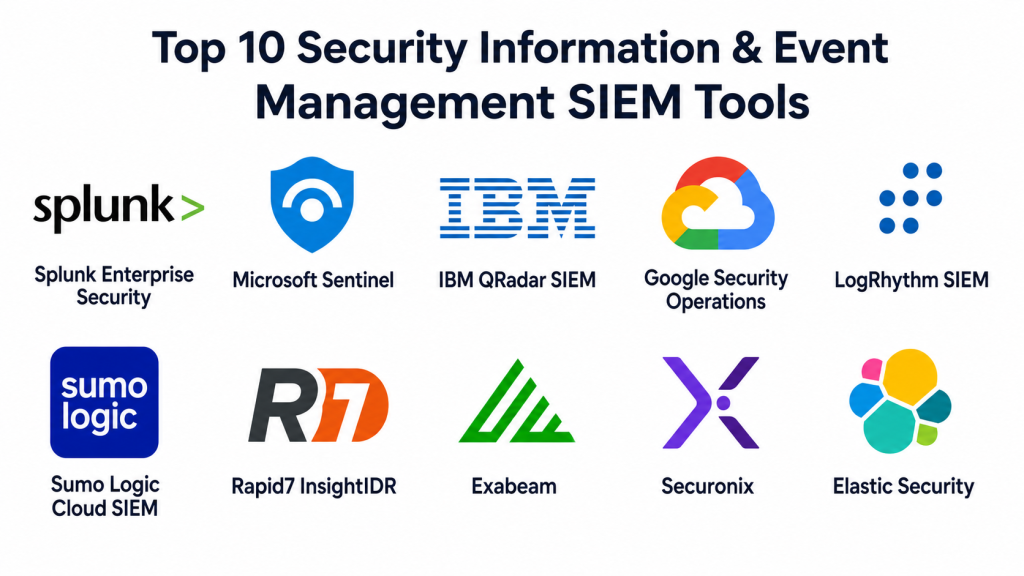
Top 10 Security Information & Event Management SIEM Tools
#1 — Splunk Enterprise Security
Short description: Splunk Enterprise Security is one of the most recognized SIEM platforms for large organizations, mature SOC teams, and complex security environments. It helps teams collect and analyze logs from a wide range of systems, build correlation searches, investigate threats, and create security dashboards. It is especially useful for enterprises that need deep customization, large-scale data analytics, and advanced security monitoring. Splunk is often selected by organizations with skilled security and data teams that can manage tuning, content development, and operational complexity.
Key Features
- Advanced log search and security analytics
- Correlation rules and notable event management
- Dashboards for SOC monitoring and executive reporting
- Strong support for custom data sources
- Threat intelligence and risk-based alerting capabilities
- Flexible investigation workflows
- Broad integration ecosystem
Pros
- Very strong analytics and search flexibility
- Suitable for large and complex enterprise environments
- Mature ecosystem with many integrations and skilled professionals available
Cons
- Can be costly at high data volumes
- Requires skilled teams for setup, tuning, and optimization
- May feel complex for smaller security teams
Platforms / Deployment
Web / Cloud / Self-hosted / Hybrid
Security & Compliance
Supports enterprise security controls such as RBAC, audit logs, encryption, and access management features. SSO/SAML and MFA support are commonly available through enterprise configurations. Specific compliance certifications vary by deployment and service model.
Integrations & Ecosystem
Splunk has one of the strongest ecosystems in the SIEM market. It integrates with cloud platforms, endpoint tools, firewalls, IAM systems, DevOps platforms, and ticketing systems.
- Cloud platforms
- Endpoint detection tools
- Firewalls and network tools
- Identity and access tools
- Threat intelligence feeds
- IT service management platforms
Support & Community
Splunk has strong documentation, training options, partner support, and a large professional community. Enterprise support tiers are available, but onboarding and implementation may require expert assistance.
#2 — Microsoft Sentinel
Short description: Microsoft Sentinel is a cloud-native SIEM and SOAR platform designed for organizations using Microsoft security, identity, cloud, and productivity tools. It works well for teams already invested in Microsoft Defender, Entra ID, Azure, and Microsoft 365. Sentinel helps collect security data, detect threats, run analytics, automate response, and manage incidents from a central console. It is a strong fit for cloud-first security teams and Microsoft-heavy environments.
Key Features
- Cloud-native SIEM and SOAR capabilities
- Strong Microsoft security ecosystem integration
- Analytics rules and incident management
- Automation playbooks for response workflows
- Threat intelligence support
- Scalable cloud-based log analytics
- Workbooks and dashboards for reporting
Pros
- Strong choice for Microsoft-centric organizations
- Good cloud scalability and built-in automation options
- Useful integration with Microsoft identity and endpoint tools
Cons
- Best value is usually seen in Microsoft-heavy environments
- Pricing can require careful planning
- Non-Microsoft integrations may need extra configuration
Platforms / Deployment
Web / Cloud
Security & Compliance
Supports enterprise-grade access controls, RBAC, audit logging, encryption, and integration with Microsoft identity services. SSO and MFA are commonly supported through Microsoft identity controls. Specific compliance coverage depends on Microsoft cloud service configuration and customer environment.
Integrations & Ecosystem
Sentinel integrates strongly with Microsoft security products and also supports third-party data connectors.
- Microsoft Defender products
- Microsoft Entra ID
- Microsoft 365
- Azure services
- Threat intelligence feeds
- Third-party security tools
Support & Community
Microsoft offers extensive documentation, partner services, training resources, and enterprise support. Community content, detection rules, and playbooks are widely available.
#3 — IBM QRadar SIEM
Short description: IBM QRadar SIEM is an enterprise-focused platform designed for threat detection, log correlation, security monitoring, and compliance reporting. It is commonly used by larger organizations with mature security needs and hybrid environments. QRadar helps teams centralize event data, identify suspicious activity, prioritize offenses, and support investigation workflows. It is a strong option for regulated industries and companies that need structured security operations.
Key Features
- Event correlation and offense management
- Network and log activity visibility
- Threat intelligence support
- Compliance-oriented reporting
- User behavior and anomaly detection capabilities
- Integration with IBM and third-party security tools
- Scalable enterprise deployment options
Pros
- Strong fit for enterprise SOC environments
- Good compliance and reporting capabilities
- Mature SIEM capabilities with structured workflows
Cons
- Can require experienced administrators
- Implementation may be complex
- User experience may feel heavy for smaller teams
Platforms / Deployment
Web / Cloud / Self-hosted / Hybrid
Security & Compliance
Supports RBAC, audit logs, encryption, and enterprise access controls. SSO/SAML support is commonly available in enterprise environments. Specific compliance certifications depend on deployment model and IBM service configuration.
Integrations & Ecosystem
QRadar integrates with many security, network, endpoint, cloud, and compliance systems.
- IBM security ecosystem
- Endpoint tools
- Firewalls and network devices
- Cloud services
- Threat intelligence sources
- Case management and ticketing tools
Support & Community
IBM provides enterprise documentation, support plans, partner services, and implementation guidance. The community is more enterprise-oriented than open-source-style.
#4 — Google Security Operations
Short description: Google Security Operations, built around Chronicle technology, is designed for security data analytics, threat detection, investigation, and large-scale log search. It is suitable for organizations that need fast security search, long-term data analysis, and cloud-scale detection workflows. The platform is often considered by teams looking for a modern security operations experience with strong data processing capability. It can be useful for cloud-first and large security teams handling high-volume telemetry.
Key Features
- Security data analytics at cloud scale
- Fast search across large security datasets
- Threat detection and investigation workflows
- Threat intelligence enrichment
- Support for security operations use cases
- Integration with Google Cloud and third-party tools
- Long-term security data analysis capabilities
Pros
- Strong for large-scale security data search
- Useful for threat hunting and investigation
- Good fit for cloud-forward security teams
Cons
- May require planning for data onboarding and normalization
- Best suited for teams with mature security operations needs
- Pricing and packaging may vary by use case
Platforms / Deployment
Web / Cloud
Security & Compliance
Supports enterprise cloud security controls such as access management, encryption, and audit logging. Specific security and compliance details may vary by service configuration. Use “Not publicly stated” where details are not confirmed for a specific deployment.
Integrations & Ecosystem
Google Security Operations supports security telemetry ingestion from cloud, endpoint, network, and third-party tools.
- Google Cloud services
- Endpoint and network security tools
- Threat intelligence sources
- Identity systems
- Security data feeds
- APIs and partner integrations
Support & Community
Google provides documentation and enterprise support options. Community strength is growing, especially among cloud security and threat hunting teams.
#5 — LogRhythm SIEM
Short description: LogRhythm SIEM is a security operations platform focused on threat detection, log management, compliance, and response workflows. It is used by organizations that want structured SIEM capabilities without building everything from scratch. LogRhythm is often considered by mid-market and enterprise teams that need centralized monitoring, prebuilt content, and security analytics. It can support both operational security and compliance-driven use cases.
Key Features
- Log collection and event correlation
- Security analytics and threat detection
- Compliance reporting support
- Case and incident management
- File integrity monitoring capabilities in some offerings
- Prebuilt rules and dashboards
- Response workflow support
Pros
- Practical SIEM option for structured SOC workflows
- Good compliance and reporting orientation
- Useful prebuilt security content
Cons
- May require tuning to reduce alert noise
- Interface and deployment experience can vary by version
- Smaller teams may still need managed support
Platforms / Deployment
Web / Cloud / Self-hosted / Hybrid
Security & Compliance
Supports access controls, audit logging, encryption, and role-based administration features. SSO/SAML and MFA support may depend on deployment and configuration. Specific compliance certifications are Not publicly stated for all use cases.
Integrations & Ecosystem
LogRhythm integrates with common enterprise security and IT systems.
- Firewalls and network devices
- Endpoint security tools
- Cloud platforms
- Identity systems
- Threat intelligence feeds
- Ticketing tools
Support & Community
Documentation, support services, and partner-led implementation are available. Community size is moderate compared with the largest SIEM platforms.
#6 — Sumo Logic Cloud SIEM
Short description: Sumo Logic Cloud SIEM is a cloud-native SIEM designed for security monitoring, threat detection, and analytics across modern cloud and application environments. It is suitable for teams that want SaaS-based security operations without managing heavy infrastructure. Sumo Logic is often used by cloud-first organizations, DevOps-aligned teams, and companies that need log analytics with security use cases. It supports detection workflows, dashboards, and investigation across different data sources.
Key Features
- Cloud-native log analytics and SIEM
- Threat detection and security monitoring
- Dashboards and investigation workflows
- Cloud and application observability alignment
- Prebuilt security content
- Scalable data ingestion
- Support for modern DevOps and cloud environments
Pros
- Good fit for cloud-native and SaaS-first teams
- Easier infrastructure management than self-hosted SIEM
- Useful for organizations combining logs, security, and observability
Cons
- Pricing must be planned around data volume
- Advanced SIEM workflows may need tuning
- Some enterprise use cases may require additional integrations
Platforms / Deployment
Web / Cloud
Security & Compliance
Supports enterprise controls such as access management, encryption, audit logging, and role-based permissions. SSO/SAML and MFA are commonly supported in enterprise SaaS configurations. Specific compliance details vary by plan and service configuration.
Integrations & Ecosystem
Sumo Logic integrates with cloud services, applications, infrastructure tools, and security platforms.
- AWS, Azure, and Google Cloud environments
- Kubernetes and container systems
- Endpoint and network tools
- DevOps platforms
- Threat intelligence feeds
- APIs and collectors
Support & Community
Sumo Logic provides documentation, onboarding resources, support plans, and partner services. Community support is strongest among cloud, DevOps, and SaaS users.
#7 — Rapid7 InsightIDR
Short description: Rapid7 InsightIDR is a SIEM and XDR-style detection platform focused on threat detection, user behavior analytics, endpoint visibility, deception technology, and incident investigation. It is a good fit for teams that want faster deployment and practical detection workflows. InsightIDR is often selected by mid-market organizations and lean security teams that need strong detection without heavy SIEM administration. It combines security analytics with Rapid7’s broader security ecosystem.
Key Features
- SIEM and detection analytics
- User behavior analytics
- Endpoint and network visibility
- Attacker behavior detection
- Incident investigation timelines
- Deception technology capabilities
- Integration with Rapid7 security products
Pros
- Faster to adopt than some traditional SIEM tools
- Useful for lean SOC teams
- Strong focus on practical detection and investigation
Cons
- May not offer the same customization depth as larger SIEM platforms
- Best value improves when using the Rapid7 ecosystem
- Advanced enterprise reporting needs may require review
Platforms / Deployment
Web / Cloud
Security & Compliance
Supports enterprise access controls, encryption, audit logs, and role-based permissions. SSO/SAML and MFA are commonly available in enterprise SaaS environments. Specific compliance certifications are Not publicly stated for every customer use case.
Integrations & Ecosystem
InsightIDR connects with endpoints, identity tools, cloud systems, network devices, and Rapid7 products.
- Rapid7 vulnerability and security tools
- Endpoint systems
- Identity providers
- Cloud services
- Firewalls and network devices
- Ticketing and response workflows
Support & Community
Rapid7 offers strong documentation, onboarding services, support options, and an active security community. It is generally approachable for teams that do not want deep SIEM engineering overhead.
#8 — Exabeam
Short description: Exabeam is a security operations platform known for user and entity behavior analytics, threat detection, investigation, and security analytics. It is often used by organizations that want to improve alert quality and detect abnormal behavior across users, devices, and systems. Exabeam can help SOC teams prioritize incidents, investigate attack timelines, and reduce manual analysis. It is a strong fit for teams focused on insider threats, compromised accounts, and behavior-based detection.
Key Features
- User and entity behavior analytics
- Risk-based alert prioritization
- Threat detection and investigation timelines
- Security analytics and correlation
- Incident management workflows
- Cloud and hybrid telemetry support
- Detection content and analytics models
Pros
- Strong behavior analytics capabilities
- Useful for identity-driven threat detection
- Helps improve investigation context
Cons
- May require careful data onboarding
- Best results depend on good identity and log coverage
- Pricing and packaging may vary by deployment
Platforms / Deployment
Web / Cloud / Hybrid
Security & Compliance
Supports enterprise security controls such as RBAC, access management, encryption, and audit logging. SSO/SAML and MFA support may be available depending on configuration. Specific certifications should be verified directly; otherwise use Not publicly stated.
Integrations & Ecosystem
Exabeam integrates with identity, endpoint, cloud, network, and SIEM-related security tools.
- Identity and access platforms
- Endpoint detection tools
- Cloud logs
- Network security devices
- Threat intelligence feeds
- Case and workflow systems
Support & Community
Exabeam provides documentation, customer support, professional services, and security content resources. Community strength is solid among behavior analytics and SOC teams.
#9 — Securonix
Short description: Securonix is a cloud-native SIEM and security analytics platform focused on threat detection, user behavior analytics, insider threat monitoring, and security operations. It is suitable for enterprises and regulated organizations that need scalable analytics and risk-based detection. Securonix helps security teams detect threats across users, cloud systems, endpoints, and business applications. It is often considered for advanced analytics, compliance use cases, and large-scale security monitoring.
Key Features
- Cloud-native SIEM and analytics
- User and entity behavior analytics
- Insider threat detection
- Risk scoring and alert prioritization
- Threat hunting workflows
- Compliance reporting support
- Integrations with enterprise security tools
Pros
- Strong analytics and risk-based detection
- Good fit for large and regulated organizations
- Useful for insider threat and identity-focused monitoring
Cons
- May require skilled implementation and tuning
- Better suited for mature security programs
- Pricing and packaging may not fit very small teams
Platforms / Deployment
Web / Cloud / Hybrid
Security & Compliance
Supports enterprise access controls, audit logging, encryption, RBAC, and identity integration options. SSO/SAML and MFA support are commonly expected in enterprise deployments. Specific compliance certifications may vary and should be treated as Not publicly stated unless confirmed.
Integrations & Ecosystem
Securonix supports integrations across cloud, identity, endpoint, network, and business applications.
- Identity providers
- Cloud platforms
- Endpoint tools
- Network security systems
- Business applications
- Threat intelligence sources
Support & Community
Securonix provides enterprise support, professional services, and documentation. Community presence is more enterprise-focused than developer-led.
#10 — Elastic Security
Short description: Elastic Security combines SIEM, endpoint security, threat hunting, and search-driven investigation using the Elastic Stack. It is popular with teams that value flexible search, open data models, and strong visibility across logs, endpoints, and infrastructure. Elastic Security can fit both cloud and self-managed environments. It is especially useful for organizations with technical teams that want control, customization, and scalable search.
Key Features
- SIEM and security analytics
- Endpoint security options
- Detection rules and alerting
- Threat hunting with powerful search
- Open and flexible data ingestion
- Dashboards and investigation timelines
- Cloud and self-managed deployment options
Pros
- Flexible and developer-friendly
- Strong search and data exploration capabilities
- Good option for teams that want deployment control
Cons
- Requires technical skills for best results
- Tuning and maintenance can take effort
- Enterprise features may depend on plan and deployment
Platforms / Deployment
Web / Windows / macOS / Linux / Cloud / Self-hosted / Hybrid
Security & Compliance
Supports RBAC, audit logging, encryption, and access management features depending on deployment and subscription. SSO/SAML and MFA support may depend on configuration. Specific compliance certifications are Not publicly stated for every deployment scenario.
Integrations & Ecosystem
Elastic Security integrates with many log sources, infrastructure tools, endpoint systems, and cloud platforms.
- Elastic Agent and Beats
- Cloud platforms
- Endpoint systems
- Network logs
- Threat intelligence feeds
- APIs and custom data pipelines
Support & Community
Elastic has strong documentation, a large technical community, and commercial support options. It is especially attractive for engineering-driven security teams.
Comparison Table Top 10
| Tool Name | Best For | Platform(s) Supported | Deployment Cloud/Self-hosted/Hybrid | Standout Feature | Public Rating |
|---|---|---|---|---|---|
| Splunk Enterprise Security | Large enterprises and mature SOC teams | Web | Cloud / Self-hosted / Hybrid | Deep search and analytics flexibility | N/A |
| Microsoft Sentinel | Microsoft-centric cloud security teams | Web | Cloud | Native Microsoft ecosystem integration | N/A |
| IBM QRadar SIEM | Enterprise SOC and compliance-heavy environments | Web | Cloud / Self-hosted / Hybrid | Structured offense management | N/A |
| Google Security Operations | Cloud-scale threat hunting and security analytics | Web | Cloud | Large-scale security data search | N/A |
| LogRhythm SIEM | Mid-market and enterprise security operations | Web | Cloud / Self-hosted / Hybrid | Compliance-focused SIEM workflows | N/A |
| Sumo Logic Cloud SIEM | Cloud-native and DevOps-aligned teams | Web | Cloud | SaaS-based security analytics | N/A |
| Rapid7 InsightIDR | Lean SOC teams and mid-market companies | Web | Cloud | Fast detection and investigation workflows | N/A |
| Exabeam | Behavior analytics and identity-focused detection | Web | Cloud / Hybrid | User and entity behavior analytics | N/A |
| Securonix | Large-scale analytics and insider threat monitoring | Web | Cloud / Hybrid | Risk-based security analytics | N/A |
| Elastic Security | Technical teams needing flexible SIEM and search | Web / Windows / macOS / Linux | Cloud / Self-hosted / Hybrid | Open and flexible security search | N/A |
Evaluation & Scoring of SIEM Tools
The scoring below is comparative and practical. It is not a universal ranking for every company. A higher score means the tool is generally stronger across the listed criteria, but the best choice still depends on your team size, budget, data volume, existing security stack, and compliance needs.
| Tool Name | Core 25% | Ease 15% | Integrations 15% | Security 10% | Performance 10% | Support 10% | Value 15% | Weighted Total 0–10 |
|---|---|---|---|---|---|---|---|---|
| Splunk Enterprise Security | 10 | 7 | 10 | 9 | 9 | 9 | 7 | 8.75 |
| Microsoft Sentinel | 9 | 8 | 9 | 9 | 9 | 9 | 8 | 8.70 |
| IBM QRadar SIEM | 9 | 7 | 8 | 9 | 8 | 9 | 7 | 8.10 |
| Google Security Operations | 8 | 8 | 8 | 9 | 9 | 8 | 8 | 8.25 |
| LogRhythm SIEM | 8 | 7 | 8 | 8 | 8 | 8 | 8 | 7.80 |
| Sumo Logic Cloud SIEM | 8 | 8 | 8 | 8 | 8 | 8 | 8 | 8.00 |
| Rapid7 InsightIDR | 8 | 9 | 8 | 8 | 8 | 8 | 8 | 8.15 |
| Exabeam | 8 | 7 | 8 | 8 | 8 | 8 | 7 | 7.65 |
| Securonix | 8 | 7 | 8 | 8 | 8 | 8 | 7 | 7.65 |
| Elastic Security | 8 | 7 | 9 | 8 | 8 | 8 | 9 | 8.15 |
These scores should be used as a shortlist guide, not a final buying decision. For example, Splunk may score very high for depth but may not be the easiest or lowest-cost option. Rapid7 InsightIDR may be easier for lean teams, while Elastic Security may offer strong value for technical teams. Microsoft Sentinel becomes especially strong when the organization already uses Microsoft security products.
Which SIEM Tool Is Right for You?
Solo / Freelancer
Most solo users and freelancers do not need a full enterprise SIEM unless they manage security for clients. A lightweight log monitoring tool, endpoint security platform, or managed detection service may be enough.
If a SIEM is still needed, consider:
- Elastic Security for flexible technical control
- Sumo Logic Cloud SIEM for cloud-based log visibility
- Rapid7 InsightIDR if managed-style detection is preferred
The priority should be low administration, simple dashboards, and predictable cost.
SMB
Small and medium businesses usually need a SIEM that is easier to deploy and does not require a large SOC team. The best choice should reduce alert fatigue, provide prebuilt detections, and integrate with existing cloud, endpoint, and identity tools.
Good options include:
- Rapid7 InsightIDR for practical detection workflows
- Microsoft Sentinel for Microsoft-heavy SMBs
- Sumo Logic Cloud SIEM for cloud-first companies
- LogRhythm SIEM for compliance-driven SMBs
SMBs should avoid overbuying complex SIEM platforms unless they have the staff to operate them.
Mid-Market
Mid-market companies often need stronger reporting, better integrations, cloud visibility, and support for incident response. They may have a small SOC or outsourced security partner.
Strong choices include:
- Microsoft Sentinel for Microsoft environments
- Sumo Logic Cloud SIEM for SaaS and cloud teams
- Rapid7 InsightIDR for detection and response simplicity
- Elastic Security for technical teams
- LogRhythm SIEM for structured security monitoring
The key is choosing a SIEM that can scale without creating heavy operational overhead.
Enterprise
Enterprises need advanced analytics, large-scale ingestion, compliance reporting, strong integrations, and mature security operations workflows. They often need customization, multi-region support, role-based access, and strong vendor support.
Strong enterprise options include:
- Splunk Enterprise Security for deep analytics and customization
- IBM QRadar SIEM for structured enterprise SOC workflows
- Microsoft Sentinel for Microsoft cloud ecosystems
- Google Security Operations for cloud-scale security analytics
- Securonix or Exabeam for behavior analytics and risk-based detection
Enterprises should run a pilot with real data before final selection.
Budget vs Premium
Budget-sensitive teams should pay close attention to ingestion volume, retention cost, and storage pricing. Lower upfront pricing can become expensive if log volume grows quickly.
- Budget-conscious technical teams may consider Elastic Security.
- Microsoft-heavy teams may find Sentinel efficient if they already use Microsoft tools.
- Premium enterprise teams may prefer Splunk, QRadar, Securonix, or Exabeam for deeper capabilities.
The best value depends on data volume, staffing, and required features.
Feature Depth vs Ease of Use
Feature-rich SIEM platforms are powerful, but they can require more setup, tuning, and expertise.
- For deep customization: Splunk Enterprise Security or Elastic Security
- For easier cloud-first adoption: Microsoft Sentinel, Sumo Logic Cloud SIEM, or Rapid7 InsightIDR
- For structured enterprise workflows: IBM QRadar SIEM or LogRhythm SIEM
- For behavior analytics: Exabeam or Securonix
Choose depth only if your team can operate it properly.
Integrations & Scalability
Integration quality is one of the most important SIEM buying factors. A SIEM that cannot connect with your cloud platforms, identity tools, endpoint systems, and ticketing workflows will create blind spots.
Prioritize:
- Cloud connectors
- Identity provider integrations
- Endpoint and EDR integrations
- Firewall and network device support
- Ticketing and case management tools
- APIs and custom log ingestion
For scalability, test ingestion volume, search speed, retention options, and alert performance during a pilot.
Security & Compliance Needs
Regulated organizations should evaluate SIEM tools carefully for audit logs, RBAC, encryption, retention controls, access reviews, compliance reports, and incident evidence management.
Industries such as finance, healthcare, government, SaaS, and insurance may need stronger compliance support. In these cases, shortlist enterprise-grade options and validate controls directly with the vendor before purchase.
Frequently Asked Questions FAQs
1. What is a SIEM tool?
A SIEM tool collects and analyzes security data from different systems. It helps teams detect threats, investigate alerts, support compliance, and respond to incidents from one central platform.
2. How is SIEM different from log management?
Log management focuses mainly on collecting, storing, and searching logs. SIEM adds security analytics, correlation rules, threat detection, alerting, investigation workflows, and compliance reporting.
3. How much does a SIEM tool cost?
SIEM pricing varies widely. Common models include data ingestion volume, users, endpoints, assets, storage retention, and feature tiers. If pricing is unclear, treat it as Varies / N/A.
4. Is SIEM only for large enterprises?
No. Mid-market and smaller companies also use SIEM tools, especially when they need compliance, cloud monitoring, or centralized security visibility. However, very small teams may prefer managed security services.
5. How long does SIEM implementation take?
Implementation depends on log sources, data volume, integrations, detection rules, and team maturity. Basic setup may be quick, but proper tuning, alert design, and workflow setup usually take more effort.
6. What are common SIEM implementation mistakes?
Common mistakes include collecting too much unnecessary data, ignoring alert tuning, failing to map use cases, skipping identity logs, and not defining response workflows before alerts go live.
7. Does SIEM replace EDR or XDR?
No. SIEM does not fully replace EDR or XDR. EDR focuses on endpoint detection and response, while SIEM centralizes events from many systems. Many teams use them together.
8. Can SIEM help with compliance?
Yes. SIEM tools can support compliance by keeping logs, creating audit reports, monitoring access, detecting suspicious activity, and preserving investigation records. Exact compliance support depends on the tool and configuration.
9. What integrations matter most for SIEM?
Important integrations include cloud platforms, identity providers, endpoint tools, firewalls, SaaS applications, vulnerability scanners, threat intelligence feeds, ticketing systems, and SOAR platforms.
10. Is cloud SIEM better than self-hosted SIEM?
Cloud SIEM is easier to scale and reduces infrastructure management. Self-hosted SIEM gives more control. The right option depends on security requirements, data residency, budget, and internal expertise.
Conclusion
Security Information & Event Management tools remain important because modern security teams need centralized visibility, faster investigation, compliance support, and better detection across cloud, identity, endpoint, network, and application environments. However, there is no single best SIEM for every organization. Splunk Enterprise Security is powerful for large enterprises, Microsoft Sentinel is strong for Microsoft-focused teams, IBM QRadar fits structured enterprise SOC needs, Google Security Operations supports large-scale cloud analytics, and tools like Rapid7 InsightIDR, Sumo Logic Cloud SIEM, Elastic Security, Exabeam, Securonix, and LogRhythm each serve different buyer profiles.The best next step is to shortlist two or three SIEM tools based on your environment, run a pilot with real log sources, validate detection quality, test integrations, review security controls, and estimate long-term cost before making a final decision.
