Upgrade & Secure Your Future with DevOps, SRE, DevSecOps, MLOps!
We spend hours scrolling social media and waste money on things we forget, but won’t spend 30 minutes a day earning certifications that can change our lives.
Master in DevOps, SRE, DevSecOps & MLOps by DevOps School!
Learn from Guru Rajesh Kumar and double your salary in just one year.
Introduction
GRC (Governance, Risk & Compliance) Fraud Detection Platforms are specialized software solutions designed to help organizations identify, prevent, and respond to fraudulent activity across business operations. In plain terms, these platforms monitor transactions, workflows, and user behavior in real time, using AI and analytics to detect anomalies, mitigate risks, and ensure regulatory compliance.
In +, businesses face increasingly sophisticated fraud schemes, ranging from financial fraud and identity theft to internal policy violations. Fraud detection platforms are essential for maintaining operational integrity, reducing losses, and meeting stringent compliance requirements across industries.
Real-world use cases:
- Detecting financial fraud and unauthorized transactions in real time.
- Monitoring employee activity for potential internal policy violations.
- Identifying suspicious patterns in customer behavior or accounts.
- Ensuring compliance with anti-money laundering (AML) and Know Your Customer (KYC) regulations.
- Providing audit trails and reports for regulatory inspections and risk management.
Evaluation criteria buyers should consider:
- Real-time monitoring and alerting
- AI and machine learning-driven anomaly detection
- Integration with ERP, CRM, and GRC systems
- Automated reporting and audit trail generation
- Multi-channel fraud detection (transactions, communications, workflows)
- Customizable rules and thresholds
- Scalability for enterprise operations
- Role-based access control and security
- Ease of use and user interface
- Analytics and visualization dashboards
Best for: Risk managers, compliance officers, financial institutions, large enterprises, and organizations with high transaction volumes.
Not ideal for: Small organizations with low transaction risk or minimal fraud exposure, where manual monitoring may suffice.
Key Trends in Fraud Detection Platforms
- AI-Driven Detection: Machine learning models identify abnormal behavior and predict potential fraud.
- Real-Time Monitoring: Continuous surveillance of transactions and user actions.
- Integration with GRC Systems: Streamlining compliance reporting and risk management.
- Cloud-Native Platforms: Centralized monitoring for global operations and distributed teams.
- Behavioral Analytics: Detecting subtle deviations from typical user or transactional patterns.
- Automated Alerts and Workflows: Immediate notification of suspicious activity and automated incident response.
- Fraud Risk Scoring: Prioritizing high-risk events and accounts.
- Multi-Channel Detection: Monitoring emails, payments, network activity, and system access.
- Enhanced Dashboards: Executive-level insights and risk visualization.
- Continuous Regulatory Updates: Ensuring alignment with evolving compliance and anti-fraud regulations.
How We Selected These Tools (Methodology)
- Reviewed market adoption and mindshare among risk and compliance teams.
- Assessed feature completeness including AI detection, workflow automation, and reporting.
- Evaluated performance and reliability for enterprise-scale monitoring.
- Analyzed security posture, including encryption, access controls, and audit trails.
- Examined integration capabilities with ERP, CRM, ITSM, and GRC systems.
- Considered customer fit across SMB, mid-market, and large enterprises.
- Reviewed real-time monitoring and alerting capabilities.
- Evaluated dashboard analytics and risk visualization.
- Assessed support and training resources for onboarding and incident handling.
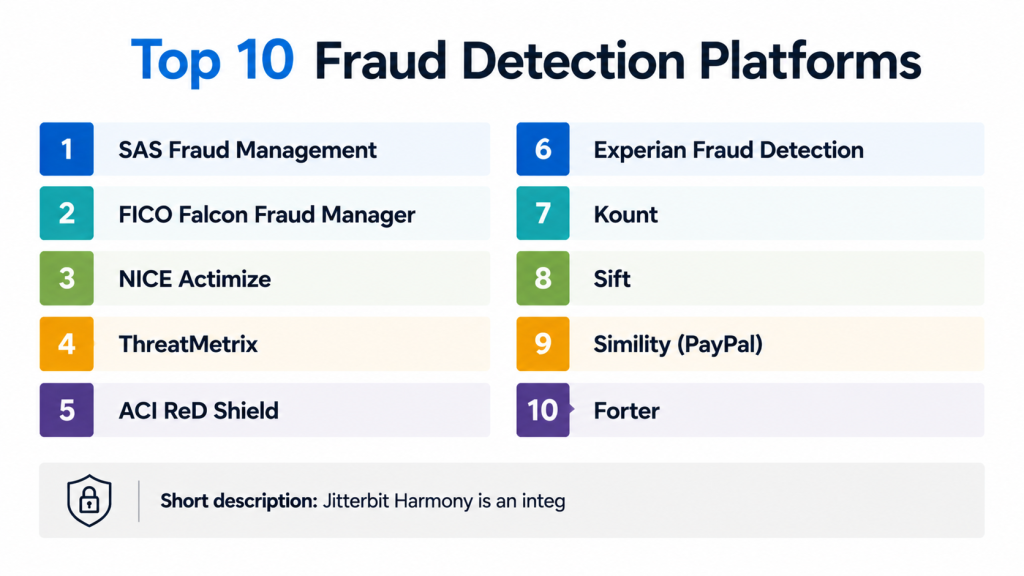
Top 10 Fraud Detection Platforms
#1 — SAS Fraud Management
Short description: SAS Fraud Management is a leading platform offering real-time monitoring, AI-powered analytics, and automated alerts for financial and operational fraud. It is designed for large enterprises with high transaction volumes.
Key Features
- Real-time fraud detection
- AI and machine learning models
- Multi-channel monitoring (payments, accounts, communications)
- Automated alerts and workflows
- Risk scoring and prioritization
- Audit trails and compliance reporting
Pros
- Highly accurate detection models
- Scalable for large enterprises
Cons
- Complex implementation
- Premium pricing
Platforms / Deployment
- Web / Windows
- Cloud / Hybrid
Security & Compliance
- Encryption, MFA, RBAC
- SOC 2, ISO 27001, GDPR
Integrations & Ecosystem
- ERP, CRM, GRC systems
- API integrations
- Third-party analytics tools
Support & Community
- Enterprise support tiers
- Extensive documentation and user community
#2 — FICO Falcon Fraud Manager
Short description: Falcon Fraud Manager uses predictive analytics and AI to detect credit card and transaction fraud, with real-time alerts and automated investigation workflows.
Key Features
- Predictive fraud scoring
- Real-time monitoring of transactions
- Automated workflow for alerts and investigations
- Risk visualization dashboards
- Multi-channel fraud detection
- Regulatory compliance reporting
Pros
- Industry-leading fraud detection algorithms
- Strong reporting capabilities
Cons
- Expensive for small organizations
- Implementation complexity
Platforms / Deployment
- Web / Cloud
- Cloud-native
Security & Compliance
- Encryption, MFA
- SOC 2, PCI-DSS, GDPR
Integrations & Ecosystem
- Core banking systems
- CRM platforms
- API for workflow automation
Support & Community
- 24/7 professional support
- Knowledge base and tutorials
#3 — NICE Actimize
Short description: NICE Actimize provides comprehensive fraud prevention for banking, payments, and digital channels, offering real-time detection and automated case management.
Key Features
- AI and analytics-driven fraud detection
- Real-time alerts and automated workflows
- Multi-channel monitoring
- Case management and investigation tools
- Risk scoring and prioritization
- Regulatory compliance reporting
Pros
- Strong banking and financial fraud expertise
- Scalable for global operations
Cons
- High cost and complexity
- Requires specialized training
Platforms / Deployment
- Web / Windows / Linux
- Cloud / Hybrid
Security & Compliance
- MFA, encryption, RBAC
- SOC 2, ISO 27001, GDPR
Integrations & Ecosystem
- Core banking, payment systems
- ERP and GRC integration
- API support
Support & Community
- Enterprise-level support
- Documentation and training programs
#4 — ThreatMetrix
Short description: ThreatMetrix offers digital identity-based fraud detection, analyzing device, location, and behavior patterns to prevent online and payment fraud.
Key Features
- Digital identity verification
- Behavioral analytics
- Device and location tracking
- Real-time transaction monitoring
- Risk scoring
- Integration with payment and banking systems
Pros
- Strong online and e-commerce fraud detection
- Cloud-native and scalable
Cons
- Limited on-prem deployment
- High subscription cost
Platforms / Deployment
- Web / Cloud
- Cloud-native
Security & Compliance
- MFA, encryption
- SOC 2, GDPR
Integrations & Ecosystem
- Payment gateways
- E-commerce platforms
- API integration for workflow automation
Support & Community
- 24/7 support
- Knowledge base
#5 — ACI ReD Shield
Short description: ACI ReD Shield provides real-time fraud detection for card payments and online transactions, combining rules-based and AI-based approaches for risk mitigation.
Key Features
- Real-time transaction monitoring
- AI-based risk scoring
- Fraud pattern recognition
- Multi-channel transaction coverage
- Automated alerts and case management
- Regulatory compliance reporting
Pros
- Strong in card payment fraud detection
- Multi-channel coverage
Cons
- Complex integration
- Premium pricing
Platforms / Deployment
- Web / Cloud
- Cloud-native
Security & Compliance
- MFA, encryption, RBAC
- SOC 2, PCI-DSS
Integrations & Ecosystem
- Banking and payment systems
- ERP integration
- API for alerts and workflows
Support & Community
- Professional support tiers
- Documentation and tutorials
#6 — Experian Fraud Detection
Short description: Experian’s platform uses identity verification, credit risk assessment, and behavioral analytics to detect potential fraudulent activities in financial services.
Key Features
- Identity verification
- Behavioral analytics
- Transaction monitoring
- Risk scoring and alerts
- Regulatory compliance dashboards
- Integration with financial systems
Pros
- Accurate identity-based fraud detection
- Cloud-native deployment
Cons
- Limited customization
- Cost may be high for smaller organizations
Platforms / Deployment
- Web / Cloud
- Cloud-native
Security & Compliance
- MFA, encryption
- SOC 2, GDPR
Integrations & Ecosystem
- Core banking systems
- CRM and GRC integration
- API for alerts and workflows
Support & Community
- Professional support
- Knowledge base
#7 — Kount
Short description: Kount provides AI-driven fraud prevention for online transactions, combining device fingerprinting, behavioral analysis, and machine learning.
Key Features
- Device fingerprinting
- Behavioral analytics
- Real-time transaction monitoring
- AI-based risk scoring
- Automated alerts and case management
- Integration with payment systems
Pros
- Strong e-commerce and online payment coverage
- AI-driven insights
Cons
- Limited on-prem options
- High subscription costs
Platforms / Deployment
- Web / Cloud
- Cloud-native
Security & Compliance
- MFA, encryption
- SOC 2, GDPR
Integrations & Ecosystem
- Payment gateways
- E-commerce platforms
- API for workflow automation
Support & Community
- 24/7 support
- Knowledge base
#8 — Sift
Short description: Sift leverages machine learning to prevent payment and account fraud, focusing on e-commerce and SaaS platforms.
Key Features
- Machine learning-based fraud detection
- Real-time transaction monitoring
- Behavioral analytics
- Risk scoring and alerts
- Automated case management
- Regulatory compliance dashboards
Pros
- Cloud-native and scalable
- Strong SaaS and e-commerce focus
Cons
- High learning curve
- Subscription cost may be high
Platforms / Deployment
- Web / Cloud
- Cloud-native
Security & Compliance
- MFA, encryption
- SOC 2, GDPR
Integrations & Ecosystem
- Payment and SaaS platforms
- API integration for alerts
- ERP and GRC system support
Support & Community
- Professional support
- Knowledge base and community
#9 — Simility (PayPal)
Short description: Simility offers real-time fraud prevention, using behavioral analytics, risk scoring, and machine learning to detect suspicious transactions.
Key Features
- AI-driven fraud scoring
- Behavioral analytics
- Real-time monitoring
- Transaction and account risk scoring
- Automated alerts and workflows
- Integration with payment systems
Pros
- Strong analytics capabilities
- Cloud-native deployment
Cons
- Premium pricing
- Limited on-premise flexibility
Platforms / Deployment
- Web / Cloud
- Cloud-native
Security & Compliance
- MFA, encryption
- SOC 2, GDPR
Integrations & Ecosystem
- Payment platforms
- SaaS applications
- API for workflow automation
Support & Community
- Professional support
- Documentation and training
#10 — Forter
Short description: Forter provides AI-based fraud prevention for online merchants, with real-time transaction analysis, risk scoring, and automated decisioning.
Key Features
- Real-time transaction monitoring
- AI-based fraud scoring
- Behavioral analytics
- Automated decisioning
- Multi-channel coverage
- Compliance dashboards
Pros
- AI-driven real-time detection
- Cloud-native and scalable
Cons
- Limited on-prem options
- Subscription cost may be high
Platforms / Deployment
- Web / Cloud
- Cloud-native
Security & Compliance
- MFA, encryption
- SOC 2, GDPR
Integrations & Ecosystem
- E-commerce and payment platforms
- API integration
- ERP and GRC integration
Support & Community
- Professional support
- Knowledge base
Comparison Table (Top 10)
| Tool Name | Best For | Platform(s) Supported | Deployment | Standout Feature | Public Rating |
|---|---|---|---|---|---|
| SAS Fraud Management | Enterprise transactions | Web / Windows | Cloud / Hybrid | AI & ML fraud detection | N/A |
| FICO Falcon | Financial institutions | Web / Cloud | Cloud-native | Predictive analytics | N/A |
| NICE Actimize | Banking & payments | Web / Windows / Linux | Cloud / Hybrid | Multi-channel fraud detection | N/A |
| ThreatMetrix | Online transactions | Web / Cloud | Cloud-native | Digital identity & behavioral analytics | N/A |
| ACI ReD Shield | Card payments | Web / Cloud | Cloud-native | Real-time transaction monitoring | N/A |
| Experian Fraud Detection | Identity & credit risk | Web / Cloud | Cloud-native | Identity-based detection | N/A |
| Kount | E-commerce & SaaS | Web / Cloud | Cloud-native | Device fingerprinting & ML | N/A |
| Sift | Online merchants | Web / Cloud | Cloud-native | ML-based fraud prevention | N/A |
| Simility | PayPal transactions | Web / Cloud | Cloud-native | Behavioral analytics & risk scoring | N/A |
| Forter | Online merchants | Web / Cloud | Cloud-native | AI-based real-time decisioning | N/A |
Evaluation & Scoring of Fraud Detection Tools
| Tool Name | Core (25%) | Ease (15%) | Integrations (15%) | Security (10%) | Performance (10%) | Support (10%) | Value (15%) | Weighted Total |
|---|---|---|---|---|---|---|---|---|
| SAS Fraud Management | 9 | 7 | 8 | 9 | 9 | 8 | 7 | 8.2 |
| FICO Falcon | 9 | 7 | 8 | 9 | 8 | 8 | 7 | 8.1 |
| NICE Actimize | 9 | 7 | 8 | 9 | 8 | 8 | 7 | 8.1 |
| ThreatMetrix | 8 | 8 | 7 | 8 | 8 | 7 | 7 | 7.8 |
| ACI ReD Shield | 8 | 8 | 7 | 8 | 8 | 7 | 7 | 7.8 |
| Experian Fraud Detection | 8 | 8 | 7 | 8 | 8 | 7 | 7 | 7.8 |
| Kount | 8 | 8 | 7 | 8 | 8 | 7 | 7 | 7.8 |
| Sift | 8 | 7 | 7 | 8 | 8 | 7 | 7 | 7.7 |
| Simility | 8 | 7 | 7 | 8 | 8 | 7 | 7 | 7.7 |
| Forter | 8 | 7 | 7 | 8 | 8 | 7 | 7 | 7.7 |
Interpretation: Weighted totals provide a comparative overview of platform capabilities, usability, integrations, security, performance, support, and overall value for informed selection.
Which Fraud Detection Tool Is Right for You?
Solo / Freelancer
- Smaller e-commerce or fintech teams may explore Sift or Kount for cloud-native, easy-to-deploy solutions.
SMB
- ThreatMetrix or Experian Fraud Detection for mid-market organizations handling online transactions.
Mid-Market
- ACI ReD Shield or Simility for scalable fraud detection across multiple payment channels.
Enterprise
- SAS Fraud Management, FICO Falcon, or NICE Actimize for high-volume transactions and global operations.
Budget vs Premium
- SMBs can leverage subscription-based, cloud-native tools; enterprises require premium platforms with AI, ML, and multi-channel capabilities.
Feature Depth vs Ease of Use
- Enterprise platforms offer comprehensive AI-driven insights, while mid-market tools focus on usability and rapid adoption.
Integrations & Scalability
- Enterprise solutions integrate with ERP, CRM, ITSM, and GRC systems, scaling across global operations.
Security & Compliance Needs
- Financial institutions and highly regulated industries should prioritize SAS Fraud Management, FICO Falcon, or NICE Actimize for audit trails, regulatory compliance, and robust AI detection.
Frequently Asked Questions (FAQs)
1: What is a fraud detection platform?
A software solution that identifies, prevents, and monitors fraudulent activity across business operations using AI, analytics, and automation.
2: Can these tools monitor real-time transactions?
Yes, most platforms offer continuous monitoring and immediate alerts for suspicious activities.
3: Are these solutions suitable for SMBs?
Cloud-native solutions like Sift, Kount, or Experian Fraud Detection are ideal for mid-market adoption.
4: Do these platforms provide audit trails?
Yes, they maintain logs for all monitored transactions, alerts, and investigations to support compliance.
5: Can these platforms detect multi-channel fraud?
Yes, enterprise-grade tools monitor payments, accounts, communications, and digital activities.
6: Do these tools integrate with ERP or CRM systems?
Most enterprise solutions provide API and native integrations to connect with existing business systems.
7: Are these platforms secure?
Yes, encryption, MFA, role-based access, and audit logs are standard to protect sensitive data.
8: How do I choose the right fraud detection software?
Consider organizational size, transaction volume, AI capabilities, integration needs, and compliance requirements.
9: Can these platforms handle global operations?
Yes, cloud-native and hybrid platforms scale to support multi-country and multi-entity operations.
10: Do these tools support mobile access?
Many modern solutions provide mobile or responsive interfaces for remote monitoring and alerts.
Conclusion
Fraud detection platforms are critical in mitigating financial and operational risks, preventing losses, and ensuring compliance. Enterprise organizations benefit from SAS Fraud Management, FICO Falcon, or NICE Actimize for comprehensive, AI-powered, and multi-channel fraud detection. Mid-market organizations can leverage Sift, Kount, or Experian Fraud Detection for cloud-native, user-friendly solutions. Organizations should shortlist 2–3 platforms, pilot deployments, and assess integration, AI capabilities, and reporting to ensure secure and effective fraud management.
