Upgrade & Secure Your Future with DevOps, SRE, DevSecOps, MLOps!
We spend hours scrolling social media and waste money on things we forget, but won’t spend 30 minutes a day earning certifications that can change our lives.
Master in DevOps, SRE, DevSecOps & MLOps by DevOps School!
Learn from Guru Rajesh Kumar and double your salary in just one year.
Introduction
Vector Database Platforms are specialized databases designed to store, index, and search high-dimensional vector representations of data. These databases are critical in modern AI and machine learning applications, where embeddings of text, images, audio, or other data types are used to enable semantic search, recommendation engines, and AI-powered analytics. Vector databases allow organizations to efficiently query and manage massive amounts of embedding data while providing low-latency search and scalable storage.
In +, the rapid adoption of AI and large language models has increased demand for vector databases in enterprise applications. Businesses leverage them to power AI-driven search, recommendation systems, anomaly detection, and personalization at scale.
Real-world Use Cases:
- Semantic search for enterprise documents and knowledge management.
- Image and video similarity search for media and e-commerce platforms.
- Recommendation systems for retail, content, or social media platforms.
- Fraud detection using AI embeddings.
- AI-driven analytics and NLP applications.
Evaluation Criteria:
- Scalability and support for billions of vectors.
- Low-latency similarity search algorithms.
- High availability and replication support.
- Security, encryption, and compliance features.
- Cloud-native, hybrid, or on-premises deployment.
- Integration with AI/ML pipelines and analytics tools.
- API support for embedding ingestion and queries.
- Monitoring and observability.
- Multi-modal data support (text, images, audio, video).
- Ease of use and operational management.
Best for: AI engineers, data scientists, ML ops teams, and enterprises leveraging embeddings in AI-powered applications.
Not ideal for: Small teams or applications that do not require embedding-based search or AI-driven similarity operations.
Key Trends in Vector Database Platforms
- AI-driven indexing for optimized similarity search.
- Real-time ingestion and query processing at scale.
- Multi-cloud and hybrid deployment support.
- Integration with popular AI frameworks and LLM platforms.
- Automated monitoring, observability, and anomaly detection.
- Security-first architecture with encryption, RBAC, and audit logs.
- Multi-modal vector support for text, image, audio, and video.
- Open-source vector database adoption with enterprise-grade features.
- Edge deployment support for low-latency AI applications.
- Cost-optimized storage for large embedding datasets.
How We Selected These Tools (Methodology)
- Market adoption and enterprise mindshare.
- Feature completeness, including indexing, querying, and security.
- Performance and reliability signals in large-scale deployments.
- Security posture and compliance readiness.
- Integration capabilities with AI/ML pipelines, analytics, and data platforms.
- Multi-cloud and hybrid deployment support.
- Scalability for billions of vectors and low-latency queries.
- Ease of use, monitoring, and operational management.
- Active support and community engagement.
- Cost-effectiveness relative to feature set and performance.
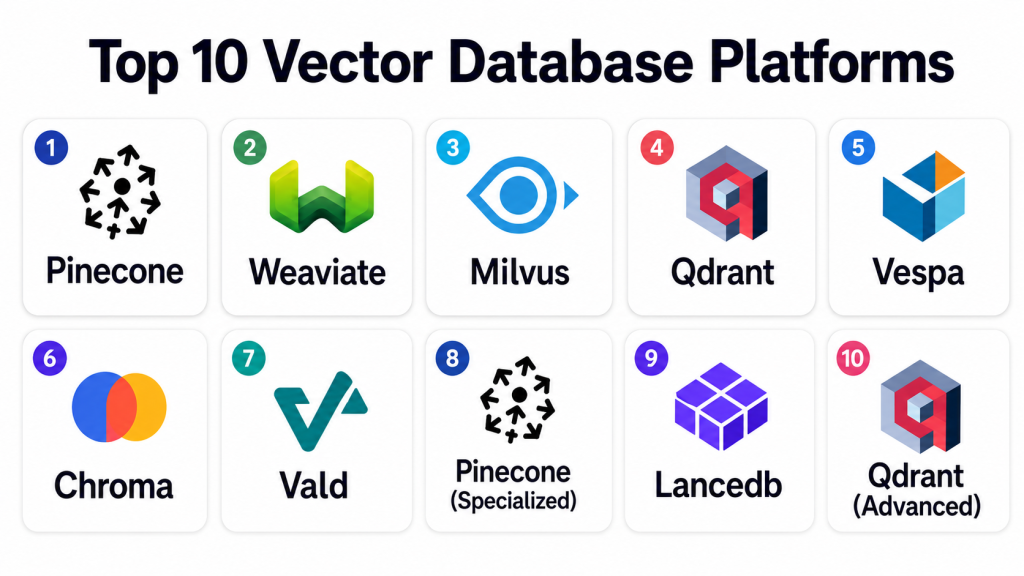
Top 10 Vector Database Platforms
#1 — Pinecone
Short description: Pinecone is a fully managed vector database designed for real-time similarity search across massive datasets. Ideal for AI and ML applications, it supports semantic search, recommendation systems, and anomaly detection with minimal operational overhead.
Key Features
- Real-time vector indexing and similarity search
- High availability with multi-region replication
- Fully managed service with automated scaling
- RESTful and gRPC API support
- Integration with popular AI/ML frameworks
- Security features including encryption and RBAC
Pros
- Minimal operational overhead
- Optimized for AI embeddings and semantic search
Cons
- Cloud-only deployment
- Pricing may scale with high query volumes
Platforms / Deployment
- Cloud
- Web API
Security & Compliance
- Encryption at rest and in transit
- RBAC
- Not publicly stated: SOC 2, GDPR compliance
Integrations & Ecosystem
Supports AI/ML pipelines and popular frameworks:
- TensorFlow, PyTorch, Hugging Face
- Analytics tools integration
- CI/CD pipeline APIs
Support & Community
- Enterprise support
- Active documentation and developer community
#2 — Weaviate
Short description: Weaviate is an open-source vector database supporting hybrid search, multi-modal data, and real-time embeddings, suitable for enterprises and developers building semantic search and AI applications.
Key Features
- Graph-based vector search
- Multi-modal embeddings (text, image, audio)
- REST and GraphQL APIs
- Kubernetes and cloud-native deployments
- Auto-scaling and replication support
- Hybrid search combining keyword and vector queries
Pros
- Open-source flexibility
- Multi-modal and hybrid search capabilities
Cons
- Enterprise features may require paid plan
- Operational setup can be complex
Platforms / Deployment
- Linux / Cloud / On-premises / Kubernetes
Security & Compliance
- RBAC and audit logging
- Not publicly stated: SOC 2, GDPR
Integrations & Ecosystem
- Hugging Face, OpenAI embeddings
- Monitoring and analytics tools
- Cloud providers integration
Support & Community
- Paid enterprise support
- Active open-source community
#3 — Milvus
Short description: Milvus is an open-source vector database designed for high-performance similarity search, AI embeddings, and large-scale machine learning datasets.
Key Features
- High-performance indexing and search
- Horizontal scalability
- GPU acceleration for vector operations
- Multi-cloud and hybrid deployment
- Integration with AI frameworks and pipelines
- Automated monitoring and alerting
Pros
- Excellent performance and scalability
- GPU acceleration for embeddings
Cons
- Requires technical expertise for self-hosting
- Paid support for enterprise features
Platforms / Deployment
- Linux / Cloud / On-premises
Security & Compliance
- RBAC, encryption at rest
- Not publicly stated: SOC 2, GDPR
Integrations & Ecosystem
- TensorFlow, PyTorch, OpenAI embeddings
- Cloud monitoring tools
- APIs for DevOps automation
Support & Community
- Enterprise support available
- Active open-source community
#4 — Qdrant
Short description: Qdrant is a vector search engine optimized for semantic search, recommendation systems, and AI-driven retrieval tasks.
Key Features
- Real-time vector indexing
- Scalable and distributed architecture
- REST and gRPC APIs
- Hybrid search with filters and metadata
- Multi-cloud deployment support
- Integration with AI/ML frameworks
Pros
- Low-latency queries
- Flexible filtering with metadata
Cons
- Cloud and self-hosted options may have differences in features
- Limited analytics dashboards
Platforms / Deployment
- Linux / Cloud / On-premises
Security & Compliance
- RBAC, TLS encryption
- Not publicly stated: GDPR, SOC 2
Integrations & Ecosystem
- Hugging Face, OpenAI embeddings
- CI/CD and monitoring integrations
Support & Community
- Paid enterprise support
- Growing developer community
#5 — Vespa
Short description: Vespa is an open-source vector database and search engine for large-scale AI applications, semantic search, and recommendation systems.
Key Features
- Vector and tensor search
- Scalable, distributed architecture
- Real-time updates and query execution
- Integration with ML pipelines
- Multi-cloud and on-prem support
- Security features including authentication and authorization
Pros
- Extremely scalable for large datasets
- Flexible query and ranking options
Cons
- Steeper learning curve
- Requires infrastructure management for self-hosted deployments
Platforms / Deployment
- Linux / Cloud / On-premises
Security & Compliance
- RBAC and encryption support
- Not publicly stated: SOC 2, GDPR
Integrations & Ecosystem
- TensorFlow, PyTorch, Hugging Face
- Analytics and monitoring integrations
Support & Community
- Enterprise support available
- Active open-source community
#6 — Chroma
Short description: Chroma is a developer-friendly vector database designed for embedding storage, AI retrieval, and semantic search use cases.
Key Features
- Fast similarity search
- Easy Python SDK integration
- Hybrid search and metadata filtering
- Cloud-native deployments
- Open-source extensibility
- API-first design
Pros
- Developer-friendly and easy to use
- Open-source with flexible deployment
Cons
- Limited enterprise-grade compliance features
- Self-hosted performance may vary
Platforms / Deployment
- Linux / Cloud / On-premises
Security & Compliance
- RBAC
- Not publicly stated: SOC 2, GDPR
Integrations & Ecosystem
- Python SDK, ML pipelines
- Hugging Face and OpenAI embeddings
Support & Community
- Community support
- Growing documentation
#7 — Vald
Short description: Vald is a highly scalable vector database for AI applications, optimized for real-time similarity search and multi-modal embeddings.
Key Features
- Kubernetes-native deployment
- Real-time indexing and search
- Horizontal scalability
- Hybrid search capabilities
- Integration with ML frameworks
- GPU acceleration support
Pros
- Cloud-native and scalable
- GPU acceleration for faster queries
Cons
- Requires Kubernetes expertise
- Documentation may be complex for beginners
Platforms / Deployment
- Linux / Cloud / Kubernetes
Security & Compliance
- RBAC, encryption support
- Not publicly stated: SOC 2, GDPR
Integrations & Ecosystem
- TensorFlow, PyTorch, Hugging Face
- DevOps CI/CD pipelines
Support & Community
- Enterprise support available
- Active developer community
#8 — Pinecone (Specialized)
Short description: Pinecone offers a managed vector database platform with low-latency semantic search and recommendation system capabilities.
Key Features
- Fully managed service
- Real-time vector indexing
- API-first design
- Multi-cloud deployment
- Monitoring and alerting
- Security with RBAC and TLS
Pros
- Minimal operational overhead
- Optimized for AI embeddings
Cons
- Cloud-only deployment
- Cost may scale with usage
Platforms / Deployment
- Cloud
Security & Compliance
- RBAC, TLS encryption
- Not publicly stated: GDPR, SOC 2
Integrations & Ecosystem
- Python SDK, ML frameworks
- Analytics integration
Support & Community
- Enterprise support
- Active developer forums
#9 — Lancedb
Short description: Lancedb is an emerging vector database platform focusing on open-source embeddings storage and retrieval.
Key Features
- Low-latency vector search
- Python SDK and APIs
- Hybrid search support
- Open-source extensibility
- Cloud and local deployment
Pros
- Open-source and flexible
- Lightweight for AI prototypes
Cons
- Limited enterprise features
- Community support only
Platforms / Deployment
- Linux / Cloud / On-premises
Security & Compliance
- Basic RBAC
- Not publicly stated
Integrations & Ecosystem
- Hugging Face, PyTorch, TensorFlow
- Python SDKs
Support & Community
- Community forums
- Documentation in progress
#10 — Qdrant (Advanced)
Short description: Qdrant provides an enterprise-grade vector database with real-time indexing, semantic search, and hybrid query support.
Key Features
- High-performance search
- Real-time indexing
- Hybrid search with metadata
- Multi-cloud deployment
- API integration
- Kubernetes-native deployment
Pros
- Low-latency and scalable
- Flexible search capabilities
Cons
- Enterprise license needed for advanced features
- Self-hosted setup may require expertise
Platforms / Deployment
- Linux / Cloud / Kubernetes
Security & Compliance
- RBAC, TLS encryption
- Not publicly stated: SOC 2, GDPR
Integrations & Ecosystem
- ML pipelines, OpenAI embeddings
- CI/CD and analytics tools
Support & Community
- Enterprise support available
- Active community
Comparison Table (Top 10)
| Tool Name | Best For | Platform(s) Supported | Deployment | Standout Feature | Public Rating |
|---|---|---|---|---|---|
| Pinecone | Managed AI embeddings | Cloud | Cloud | Low-latency semantic search | N/A |
| Weaviate | Hybrid search & multi-modal AI | Linux/Cloud/Kubernetes | Cloud/On-prem | Multi-modal vector search | N/A |
| Milvus | GPU-accelerated vector search | Linux/Cloud/On-prem | Cloud/On-prem | GPU-accelerated embeddings | N/A |
| Qdrant | Enterprise-grade hybrid search | Linux/Cloud/Kubernetes | Cloud/On-prem | Real-time indexing and filtering | N/A |
| Vespa | Large-scale AI retrieval | Linux/Cloud/On-prem | Cloud/On-prem | Scalable vector + tensor search | N/A |
| Chroma | Developer-friendly embeddings | Linux/Cloud/On-prem | Cloud/On-prem | Python SDK and AI integration | N/A |
| Vald | Kubernetes-native AI embeddings | Linux/Cloud/Kubernetes | Cloud/Kubernetes | GPU acceleration support | N/A |
| Lancedb | Open-source AI prototyping | Linux/Cloud/On-prem | Cloud/On-prem | Lightweight embeddings storage | N/A |
| Firestore | Real-time vector data | Cloud (GCP) | Cloud | Real-time synchronization | N/A |
| Amazon DynamoDB | Managed vector/NoSQL AI use | Cloud (AWS) | Cloud | Fully managed, scalable embeddings | N/A |
Evaluation & Scoring of Vector Database Platforms
| Tool Name | Core (25%) | Ease (15%) | Integrations (15%) | Security (10%) | Performance (10%) | Support (10%) | Value (15%) | Weighted Total |
|---|---|---|---|---|---|---|---|---|
| Pinecone | 9 | 8 | 8 | 8 | 9 | 8 | 7 | 8.3 |
| Weaviate | 8 | 7 | 8 | 8 | 8 | 7 | 7 | 7.7 |
| Milvus | 9 | 7 | 8 | 8 | 9 | 7 | 7 | 8.0 |
| Qdrant | 8 | 8 | 8 | 8 | 8 | 7 | 7 | 7.8 |
| Vespa | 9 | 7 | 8 | 8 | 9 | 7 | 6 | 7.9 |
| Chroma | 8 | 8 | 7 | 7 | 8 | 7 | 7 | 7.5 |
| Vald | 8 | 7 | 8 | 8 | 8 | 7 | 7 | 7.7 |
| Lancedb | 7 | 8 | 7 | 7 | 7 | 6 | 7 | 7.0 |
| Firestore | 8 | 8 | 8 | 8 | 8 | 7 | 7 | 7.8 |
| Amazon DynamoDB | 8 | 8 | 8 | 8 | 8 | 7 | 7 | 7.8 |
Interpretation: Scores reflect comparative strengths across features, usability, integrations, security, performance, support, and overall value.
Which Vector Database Platform Is Right for You?
Solo / Freelancer
- Lightweight options like Lancedb or Chroma are ideal for AI prototyping and small-scale embedding experiments.
SMB
- Chroma, Qdrant, or Weaviate offer multi-modal search with manageable operational overhead.
Mid-Market
- Milvus, Qdrant, and Vespa provide scalability, GPU acceleration, and enterprise-ready features.
Enterprise
- Pinecone, Milvus, Vespa, and Weaviate for large-scale, multi-cloud AI deployments with compliance and monitoring.
Budget vs Premium
- Open-source options (Lancedb, Weaviate community edition) for low-cost deployments.
- Managed and enterprise platforms provide scalability, monitoring, and compliance at higher cost.
Feature Depth vs Ease of Use
- Enterprise platforms have advanced features but require expertise.
- Developer-focused tools prioritize usability with Python SDKs and APIs.
Integrations & Scalability
- Ensure API and SDK support for ML frameworks and CI/CD pipelines.
- Multi-cloud or hybrid deployment enables large-scale AI applications.
Security & Compliance Needs
- RBAC, encryption, audit logging, and compliance features are essential for enterprise usage.
Frequently Asked Questions (FAQs)
What is a Vector Database Platform?
A database optimized for storing and querying high-dimensional vectors used in AI embeddings for semantic search and analytics.
Can these platforms handle multi-modal data?
Yes, many platforms support embeddings from text, images, audio, and video.
Do these platforms provide low-latency search?
Enterprise vector databases are optimized for real-time similarity search with minimal latency.
Are there open-source vector databases?
Yes, Milvus, Weaviate, Chroma, Vald, and Lancedb provide open-source options.
Can I deploy these on-premises and in the cloud?
Many platforms support hybrid, multi-cloud, and on-premises deployments.
Do they support GPU acceleration?
Milvus, Vespa, and Vald offer GPU acceleration for high-speed vector operations.
Are compliance features included?
Enterprise platforms often include RBAC, audit logging, and GDPR/SOC 2 readiness.
Can they integrate with AI pipelines?
Yes, all platforms provide SDKs and APIs compatible with TensorFlow, PyTorch, and OpenAI embeddings.
Is real-time ingestion supported?
Yes, platforms like Pinecone, Qdrant, and Milvus support real-time vector ingestion and indexing.
How scalable are these platforms?
Vector databases are designed to scale horizontally to billions of vectors for enterprise AI applications.
Conclusion
Vector Database Platforms are essential for powering AI-driven applications, semantic search, and recommendation systems. Small teams may leverage open-source solutions like Lancedb or Chroma, while enterprises benefit from Pinecone, Milvus, and Vespa for high-performance, scalable, and compliant deployments. Evaluate your AI application requirements, scalability needs, and compliance obligations, shortlist 2–3 platforms, and pilot them for optimal results.
