Upgrade & Secure Your Future with DevOps, SRE, DevSecOps, MLOps!
We spend hours scrolling social media and waste money on things we forget, but won’t spend 30 minutes a day earning certifications that can change our lives.
Master in DevOps, SRE, DevSecOps & MLOps by DevOps School!
Learn from Guru Rajesh Kumar and double your salary in just one year.
Introduction
Graph database platforms are specialized databases designed to store and query data using nodes, edges, and properties. Unlike traditional relational databases, graph databases focus on relationships between data points, enabling organizations to efficiently analyze complex networks. In plain English, they allow businesses to see how data is connected, uncover patterns, and gain insights that are difficult to achieve with standard SQL databases.
In and beyond, graph databases are increasingly critical for enterprises and growing companies. Their adoption is driven by the rise of social networks, influencer marketing platforms, recommendation engines, fraud detection systems, and knowledge graphs. They provide a flexible schema, high-performance relationship querying, real-time analytics, and scalability for large datasets.
Use cases include:
- Mapping social media and influencer networks for marketing campaigns.
- Fraud detection and compliance monitoring in financial services.
- Building recommendation engines for e-commerce platforms.
- Creating enterprise knowledge graphs for enhanced search and analytics.
- Analyzing supply chain networks to identify bottlenecks and inefficiencies.
When evaluating graph database platforms, buyers should consider the following criteria:
- Performance and scalability for large, highly connected datasets.
- Query language support (Cypher, Gremlin, SPARQL).
- Deployment flexibility (cloud, on-premises, hybrid).
- Security and compliance, including encryption, access controls, and audit logs.
- Integration capabilities with BI, analytics, and AI/ML tools.
- Cost and licensing flexibility.
- Community and vendor support.
- Visualization and analytics tools.
- Ease of onboarding and usability.
- Reliability and uptime guarantees.
Best for:
Data engineers, data scientists, IT teams, social media analysts, marketing teams using influencer analytics, and compliance officers in finance. Suitable for organizations of all sizes that rely on relationship-driven data.
Not ideal for:
Organizations with small or simple datasets where a relational database is sufficient. In such cases, relational or NoSQL databases may be a simpler, more cost-effective solution.
Key Trends in Graph Database Platforms
- AI and ML integration to predict relationships and detect patterns automatically.
- Cloud-native and multi-cloud support for enterprise flexibility and global scaling.
- Enhanced security protocols, including encryption, audit logs, and SOC 2 compliance.
- Real-time analytics dashboards for visualization of graph data.
- Influencer network mapping to optimize marketing campaigns.
- Hybrid models, combining graph, relational, and document data for complex workloads.
- Optimized multi-hop queries for faster relationship analysis.
- Subscription-based and usage-based pricing replacing traditional licensing.
- Open-source adoption for cost-efficient, customizable graph databases.
- Automated indexing and pattern recognition to reduce manual analytics efforts.
How We Selected These Tools (Methodology)
Our methodology for selecting the Top 10 Graph Database Platforms included:
- Evaluating market adoption and enterprise mindshare.
- Reviewing feature completeness for advanced graph analytics.
- Assessing performance and reliability in real-world deployments.
- Examining security and compliance features, including encryption and access control.
- Reviewing integration capabilities with BI, analytics, and AI/ML pipelines.
- Considering community support and vendor resources.
- Checking scalability across cloud, on-premises, and hybrid environments.
- Comparing licensing models and cost structures.
- Assessing ease of onboarding and documentation quality.
- Ensuring suitability for influencer marketing, social analytics, fraud detection, and recommendations.
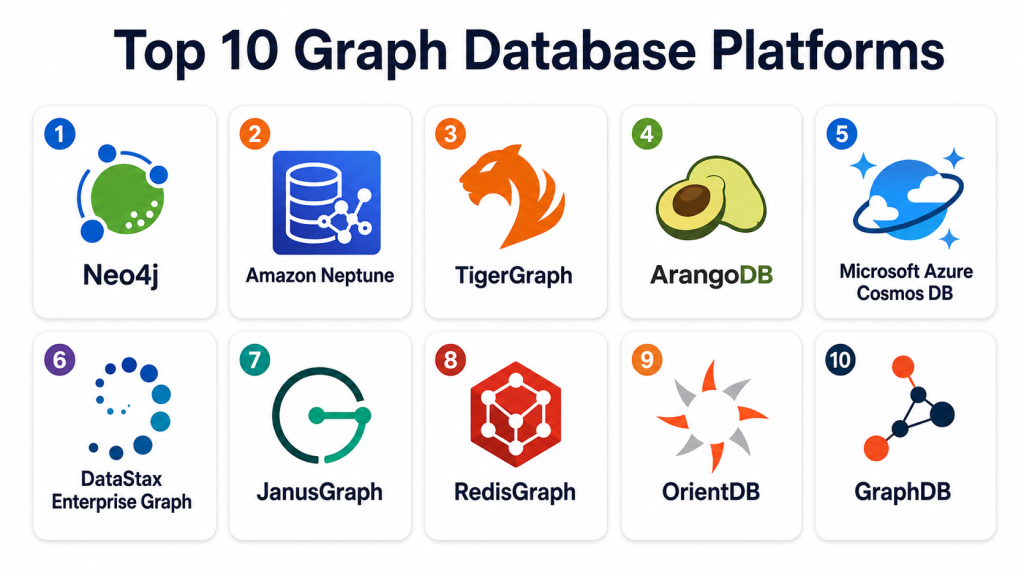
Top 10 Graph Database Platforms
#1 — Neo4j
Short description:
Neo4j is a leading graph database that excels in relationship analytics. Widely used in social networks, fraud detection, and recommendation systems, Neo4j offers Cypher query language, visualization tools, and graph data science libraries.
Key Features
- Native graph storage and processing
- Cypher query language
- Real-time analytics and transactional support
- AI/ML integration
- Visualization dashboards
- Multi-cloud and hybrid deployment
Pros
- High performance for complex graph queries
- Active community and documentation
Cons
- Enterprise licensing can be expensive
- Steep learning curve for Cypher
Platforms / Deployment
- Web / Windows / macOS / Linux
- Cloud / Self-hosted / Hybrid
Security & Compliance
- Role-based access control, encryption, audit logs
- Not publicly stated for SOC 2 or ISO certifications
Integrations & Ecosystem
Neo4j integrates with analytics, ETL, and AI tools:
- Apache Kafka
- Spark
- Python and Java SDKs
- Tableau, Power BI
Support & Community
- Extensive documentation
- Enterprise support tiers
- Active developer community
#2 — Amazon Neptune
Short description:
Amazon Neptune is a fully managed graph database supporting property graph and RDF models. Ideal for cloud-based applications and influencer network analytics.
Key Features
- Supports Gremlin and SPARQL
- Multi-AZ replication for high availability
- Encryption at rest and in transit
- AWS service integrations
- Automated backups and scaling
- Multi-region read replicas
Pros
- Fully managed, low maintenance
- Deep integration with AWS ecosystem
Cons
- AWS-only cloud deployment
- Some advanced features require other AWS services
Platforms / Deployment
- Cloud only
- Web via AWS console
Security & Compliance
- VPC, IAM, encryption
- SOC 1/2/3, ISO 27001, GDPR
Integrations & Ecosystem
- Amazon S3, Redshift
- Lambda, Kinesis
- Analytics and AI tools
Support & Community
- AWS support plans
- Extensive documentation and tutorials
- Community forums
#3 — TigerGraph
Short description:
TigerGraph is optimized for large-scale, real-time graph analytics and recommendation engines. Commonly used in influencer marketing platforms and social network analysis.
Key Features
- Native parallel graph engine
- GSQL query language
- Real-time updates
- AI/ML integration
- Cloud/on-premises scalability
- Multi-hop query efficiency
Pros
- Fast analytics on large graphs
- Efficient multi-hop queries
Cons
- GSQL learning curve
- Smaller community than Neo4j
Platforms / Deployment
- Web / Linux
- Cloud / Self-hosted / Hybrid
Security & Compliance
- SSO, MFA, encryption
- Not publicly stated for SOC or ISO
Integrations & Ecosystem
- Spark, Kafka, Python SDKs
- Tableau, Power BI
Support & Community
- Enterprise support
- Technical documentation
- Growing community
#4 — ArangoDB
Short description:
ArangoDB is a multi-model database combining graph, document, and key-value data. It suits influencer marketing, recommendation systems, and hybrid workloads.
Key Features
- Multi-model architecture
- AQL query language
- ACID transactions
- Sharding and clustering
- Graph analytics
- Cloud/on-premises deployment
Pros
- Flexible data modeling
- Good performance for mid-size datasets
Cons
- Complex for large clusters
- Smaller ecosystem
Platforms / Deployment
- Web / Windows / macOS / Linux
- Cloud / Self-hosted / Hybrid
Security & Compliance
- SSL/TLS encryption
- Not publicly stated
Integrations & Ecosystem
- REST API, drivers for multiple languages
- BI tool connectors
Support & Community
- Documentation, tutorials
- Community forums
- Paid support
#5 — Microsoft Azure Cosmos DB
Short description:
Cosmos DB supports graph models via the Gremlin API, ideal for globally distributed applications and real-time influencer analytics.
Key Features
- Gremlin API
- Multi-region replication
- Auto-scaling, high availability
- Global distribution
- AI/analytics integration
- ACID transactions
Pros
- Fully managed
- Global scalability
Cons
- High cost at scale
- Requires Azure adoption
Platforms / Deployment
- Cloud only
- Web/Azure portal
Security & Compliance
- Encryption at rest/in transit
- ISO 27001, SOC 2, HIPAA
Integrations & Ecosystem
- Azure Data Factory, Synapse Analytics
- Power BI
- Azure ML pipelines
Support & Community
- Azure support plans
- Documentation, tutorials
- Developer community
#6 — DataStax Enterprise Graph
Short description:
DataStax Enterprise provides a distributed graph database built on Cassandra, suitable for social networks and real-time analytics.
Key Features
- Gremlin API
- Horizontal scalability
- Real-time analytics and search
- Cloud/on-premises
- Security/encryption
- ACID-like consistency
Pros
- Scales horizontally
- High availability
Cons
- Cassandra expertise required
- Enterprise licensing cost
Platforms / Deployment
- Linux / Cloud / On-premises / Hybrid
Security & Compliance
- TLS, authentication, RBAC
- Not publicly stated for SOC 2/ISO
Integrations & Ecosystem
- Spark, Kafka, BI tools
- Java, Python SDKs
Support & Community
- Enterprise support
- Documentation, forums
#7 — JanusGraph
Short description:
JanusGraph is an open-source, scalable graph database for developers and startups needing flexible analytics.
Key Features
- Open-source, extensible
- TinkerPop/Gremlin support
- ACID transactions (Cassandra/HBase backend)
- Cloud/on-premises deployment
- Multi-tenancy
- Real-time analytics
Pros
- Free, open-source
- Flexible backend support
Cons
- Complex setup
- Smaller community
Platforms / Deployment
- Linux/Windows/Cloud/Self-hosted/Hybrid
Security & Compliance
- Varies / N/A
Integrations & Ecosystem
- Spark, Kafka
- Graph analytics frameworks
Support & Community
- Community support
- Documentation
- Third-party paid support
#8 — RedisGraph
Short description:
RedisGraph is a module for Redis, optimized for real-time graph queries and influencer scoring.
Key Features
- In-memory graph storage
- Cypher query support
- Real-time performance
- Lightweight, cloud-ready
- Horizontal scaling
Pros
- Extremely fast
- Easy deployment
Cons
- Limited durability for very large datasets
- Smaller community
Platforms / Deployment
- Linux / Cloud / On-premises
Security & Compliance
- Not publicly stated
Integrations & Ecosystem
- Redis ecosystem
- Python, Java, Node.js APIs
Support & Community
- Community forums
- Paid Redis Labs support
#9 — OrientDB
Short description:
OrientDB is a multi-model graph/document database suitable for influencer analytics and hybrid workloads.
Key Features
- Graph + document
- SQL-like queries
- Multi-master replication
- ACID transactions
- Cloud/on-premises
- Indexing and analytics
Pros
- Flexible data modeling
- Mature open-source
Cons
- Complex for large clusters
- Smaller enterprise adoption
Platforms / Deployment
- Linux/Windows/Cloud/Hybrid
Security & Compliance
- TLS encryption
- Not publicly stated
Integrations & Ecosystem
- REST API, Python, Java
- BI connectors
Support & Community
- Community forums
- Documentation
#10 — GraphDB
Short description:
GraphDB is a semantic graph database for knowledge graphs and RDF data, useful for influencer analytics and semantic reasoning.
Key Features
- RDF data model
- SPARQL query support
- Semantic reasoning
- Cloud/on-premises
- Data integration and mapping
- Scalable
Pros
- Excellent for semantic queries
- Strong data modeling
Cons
- Limited real-time analytics
- Enterprise features costly
Platforms / Deployment
- Web/Linux/Cloud/Hybrid
Security & Compliance
- Not publicly stated
Integrations & Ecosystem
- SPARQL endpoints
- BI integration
Support & Community
- Vendor support
- Documentation
Comparison Table (Top 10)
| Tool Name | Best For | Platform(s) Supported | Deployment | Standout Feature | Public Rating |
|---|---|---|---|---|---|
| Neo4j | Enterprise analytics, social graphs | Web/Windows/macOS/Linux | Cloud/Self-hosted/Hybrid | Cypher query & graph data science | N/A |
| Amazon Neptune | Cloud-native analytics | Web | Cloud | Managed AWS graph DB | N/A |
| TigerGraph | Large-scale real-time analytics | Web/Linux | Cloud/Self-hosted/Hybrid | Parallel graph engine | N/A |
| ArangoDB | Multi-model graph + document | Web/Windows/macOS/Linux | Cloud/Self-hosted/Hybrid | Multi-model flexibility | N/A |
| Cosmos DB | Distributed graph | Cloud | Cloud | Global distribution | N/A |
| DataStax Enterprise | Cassandra-backed distributed | Linux | Cloud/Self-hosted/Hybrid | Horizontal scalability | N/A |
| JanusGraph | Open-source analytics | Linux/Windows | Cloud/Self-hosted/Hybrid | Flexible backend | N/A |
| RedisGraph | Real-time graph | Linux | Cloud/On-premises | In-memory speed | N/A |
| OrientDB | Hybrid model | Linux/Windows | Cloud/Hybrid | Multi-model support | N/A |
| GraphDB | Semantic knowledge graphs | Web/Linux | Cloud/Hybrid | SPARQL semantic queries | N/A |
Evaluation & Scoring
| Tool Name | Core (25%) | Ease (15%) | Integrations (15%) | Security (10%) | Performance (10%) | Support (10%) | Value (15%) | Weighted Total |
|---|---|---|---|---|---|---|---|---|
| Neo4j | 9 | 8 | 8 | 7 | 9 | 8 | 7 | 8.2 |
| Amazon Neptune | 8 | 8 | 7 | 8 | 8 | 7 | 7 | 7.7 |
| TigerGraph | 9 | 7 | 7 | 7 | 9 | 7 | 6 | 7.6 |
| ArangoDB | 8 | 8 | 7 | 6 | 7 | 7 | 7 | 7.1 |
| Cosmos DB | 8 | 8 | 8 | 8 | 8 | 7 | 6 | 7.5 |
| DataStax Enterprise | 8 | 7 | 7 | 7 | 8 | 7 | 6 | 7.1 |
| JanusGraph | 7 | 6 | 6 | 6 | 7 | 6 | 8 | 6.5 |
| RedisGraph | 7 | 8 | 6 | 6 | 8 | 6 | 7 | 6.8 |
| OrientDB | 7 | 7 | 6 | 6 | 7 | 6 | 7 | 6.6 |
| GraphDB | 7 | 7 | 6 | 6 | 6 | 6 | 6 | 6.3 |
Interpretation: Scores are comparative. Higher weighted totals indicate stronger capabilities. Selection depends on specific requirements, dataset sizes, and use cases.
Which Graph Database Platform Is Right for You?
Solo / Freelancer
Neo4j or RedisGraph are ideal for small projects and rapid prototyping.
SMB
ArangoDB or JanusGraph provide flexibility and cost-effective deployment for medium workloads.
Mid-Market
TigerGraph or DataStax Enterprise Graph scale well for large influencer networks and analytics.
Enterprise
Neo4j Enterprise, Amazon Neptune, or Cosmos DB support global-scale analytics, real-time data, and compliance.
Budget vs Premium
Open-source options (JanusGraph, OrientDB) are low-cost; premium options (Neo4j Enterprise, TigerGraph) provide advanced analytics, support, and SLA guarantees.
Feature Depth vs Ease of Use
Neo4j, TigerGraph, and Neptune offer deep analytics; RedisGraph and ArangoDB balance simplicity with sufficient functionality.
Integrations & Scalability
Cosmos DB and DataStax Enterprise excel in enterprise integration and scalable deployment.
Security & Compliance Needs
Neo4j, Amazon Neptune, and Cosmos DB provide robust encryption, access control, and audit features.
Frequently Asked Questions (FAQs)
1: What is a graph database platform?
A graph database stores data as nodes and edges to represent relationships, ideal for connected data analysis.
2: How does it differ from relational databases?
Graph databases focus on relationships rather than tables, enabling faster traversal and pattern recognition.
3: Are graph databases suitable for influencer marketing?
Yes. They map networks, identify high-impact influencers, and track engagement patterns efficiently.
4: What is the learning curve?
Neo4j and TigerGraph have proprietary query languages; RedisGraph and JanusGraph may be easier for developers familiar with programming languages.
5: Can I deploy on-premises and in the cloud?
Most top platforms support hybrid deployment; some are cloud-only.
6: Are they secure for enterprise use?
Many platforms provide encryption, authentication, role-based access, and audit logs. Check vendor compliance.
7: How do integrations work?
Platforms offer APIs, SDKs, and connectors to BI tools, analytics frameworks, and AI pipelines.
8: What are the typical costs?
Open-source platforms are free; enterprise subscriptions vary based on features and support.
9: Can they handle large datasets?
Yes. Neo4j, TigerGraph, and DataStax Enterprise support high-volume, real-time graph analytics.
10: Are these platforms future-proof?
Yes. They continue evolving with AI integration, multi-cloud support, real-time analytics, and hybrid data models.
Conclusion
Graph database platforms are indispensable for organizations that rely on highly connected data, such as influencer marketing, social networks, recommendation engines, and fraud detection. Choosing the right platform depends on scale, use case, deployment preference, security needs, and budget.
