Upgrade & Secure Your Future with DevOps, SRE, DevSecOps, MLOps!
We spend hours scrolling social media and waste money on things we forget, but won’t spend 30 minutes a day earning certifications that can change our lives.
Master in DevOps, SRE, DevSecOps & MLOps by DevOps School!
Learn from Guru Rajesh Kumar and double your salary in just one year.
Introduction
Data Lake Platforms provide a centralized repository for storing structured, semi-structured, and unstructured data at scale. Unlike traditional data warehouses, data lakes allow ingestion of large volumes of raw data without requiring predefined schemas. This flexibility makes them highly effective for analytics, machine learning, and business intelligence workflows.
Organizations are increasingly adopting data lakes to unify fragmented datasets, enable advanced analytics, and generate actionable insights across marketing, sales, product, and operations. These platforms are critical for managing influencer marketing campaigns, integrating social media metrics, and analyzing large datasets to optimize ROI.
Real-world use cases include:
- Tracking and analyzing influencer campaign performance across multiple social channels.
- Centralizing customer data from e-commerce platforms, CRM, and engagement tools.
- Machine learning model training using unstructured content such as images, videos, and text.
- Monitoring IoT and web traffic data in real-time for trend analysis.
- Aggregating multi-source marketing and sales data for predictive analytics.
Key evaluation criteria for buyers:
- Scalability to handle large datasets
- Support for multiple data types (structured, unstructured)
- Real-time and batch data processing capabilities
- Integration with BI and ML tools
- Security and compliance certifications
- Cost efficiency and resource management
- Automation of ETL/ELT pipelines
- Cloud, hybrid, and multi-cloud deployment options
Best for: Data engineers, marketing analysts, data scientists, AI/ML teams, and medium to large enterprises managing diverse datasets.
Not ideal for: Small teams with minimal data, organizations using only relational databases, or those requiring basic reporting without advanced analytics.
Key Trends in Data Lake Platforms
- AI-driven query optimization to reduce processing time.
- Real-time streaming data support for rapid insights.
- Multi-cloud and hybrid deployments for operational flexibility.
- Enhanced governance, auditing, and compliance features.
- Integration with machine learning pipelines and analytics tools.
- Automation of data ingestion, ETL, and data workflows.
- Adoption of open-source file formats for interoperability.
- Cost optimization via pay-as-you-go models.
- Integration with legacy data warehouses for seamless workflows.
- Advanced monitoring and data lineage tracking for observability.
How We Selected These Tools (Methodology)
- Reviewed market adoption and industry mindshare.
- Evaluated feature completeness for ingestion, storage, processing, and analytics.
- Assessed performance and reliability on large-scale workloads.
- Reviewed security features including encryption, access control, and compliance certifications.
- Checked integration capabilities with BI, ML, and ETL tools.
- Considered cloud, hybrid, and on-prem deployment support.
- Analyzed scalability and cost efficiency.
- Evaluated customer fit across solo users, SMBs, mid-market, and enterprise.
- Prioritized platforms with strong documentation, community support, and active development.
- Assessed automation and AI/ML readiness for analytics workflows.
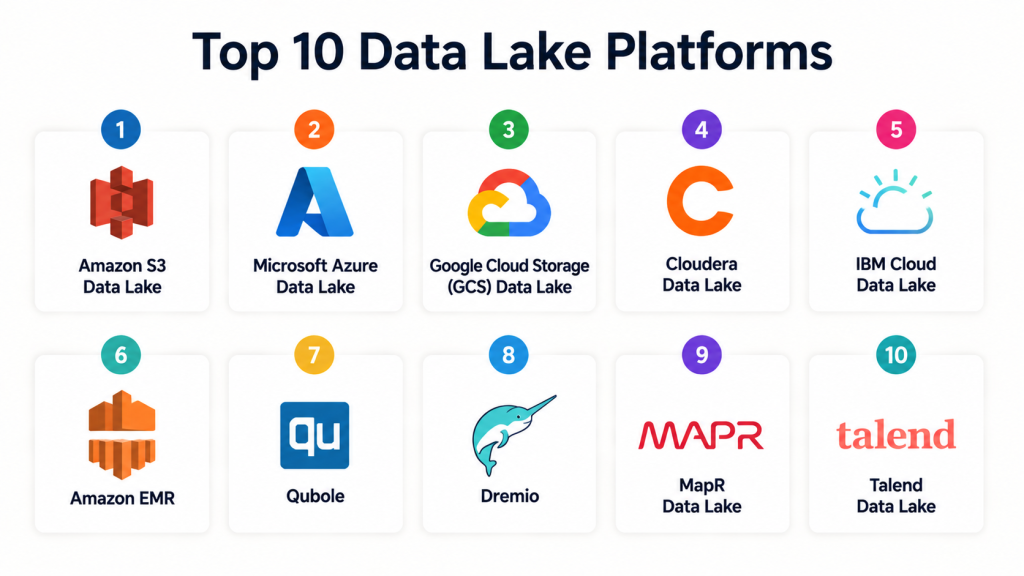
Top 10 Data Lake Platforms
#1 — Amazon S3 Data Lake
Short description: Amazon S3 provides scalable object storage for enterprises building data lakes. Ideal for organizations managing structured and unstructured data across analytics and AI workflows.
Key Features
- Virtually unlimited storage scalability
- Integration with AWS analytics and ML tools
- Lifecycle management for cost optimization
- Fine-grained IAM-based access control
- High durability and availability
Pros
- Highly scalable and reliable
- Seamless integration with AWS ecosystem
Cons
- Requires knowledge of AWS for optimal use
- Querying raw data often requires Athena or Redshift
Platforms / Deployment
- Web / Linux / Windows
- Cloud
Security & Compliance
- SSO/SAML, encryption at rest and in transit
- SOC 2, ISO 27001, HIPAA, GDPR
Integrations & Ecosystem
- Analytics: Redshift, Athena, EMR
- Machine Learning: SageMaker
- ETL: Glue, Airflow, Fivetran
- REST APIs for custom workflows
Support & Community
- Comprehensive AWS documentation
- Enterprise support plans
- Large active user community
#2 — Microsoft Azure Data Lake
Short description: Azure Data Lake enables hierarchical storage optimized for big data analytics. It supports batch and real-time workloads, making it suitable for enterprise analytics and influencer marketing insights.
Key Features
- Hierarchical namespace for structured organization
- Integration with Azure Synapse and ML pipelines
- Optimized for large-scale analytics workloads
- Role-based access control and governance
- Lifecycle management for cost efficiency
Pros
- Tight integration with Microsoft ecosystem
- Efficient scaling for large datasets
Cons
- Limited on-premises support
- Learning curve for new users
Platforms / Deployment
- Web / Windows / Linux
- Cloud
Security & Compliance
- SSO/SAML, encryption, RBAC
- SOC 2, ISO 27001, HIPAA, GDPR
Integrations & Ecosystem
- BI: Power BI, Synapse
- ML: Azure Machine Learning
- ETL: Data Factory, Databricks
- APIs for custom integration
Support & Community
- Extensive documentation
- Enterprise support options
- Active partner and developer community
#3 — Google Cloud Storage (GCS) Data Lake
Short description: Google Cloud Storage offers unified object storage for data lakes, ideal for analytics and AI/ML workloads. Supports diverse datasets from multiple sources including social, CRM, and IoT systems.
Key Features
- Object storage for structured and unstructured data
- Integration with BigQuery and Vertex AI
- Multi-region replication for durability
- Lifecycle and tiered storage for cost efficiency
- High availability and disaster recovery
Pros
- Strong Google Cloud integration
- Globally accessible and highly reliable
Cons
- Limited outside GCP ecosystem
- Requires additional services for complex queries
Platforms / Deployment
- Web / Linux / Windows
- Cloud
Security & Compliance
- SSO/SAML, encryption, IAM-based access
- SOC 2, ISO 27001, GDPR
Integrations & Ecosystem
- Analytics: BigQuery, Dataflow
- ML: Vertex AI
- ETL: DataPrep, Data Fusion
- REST APIs
Support & Community
- Detailed GCP documentation
- Enterprise support options
- Active developer community
#4 — Cloudera Data Lake
Short description: Cloudera provides an enterprise-ready data lake combining Hadoop storage with modern analytics and ML capabilities. Suitable for large organizations requiring governance and advanced processing.
Key Features
- Unified storage for batch and streaming data
- Integration with Spark, Hive, and Impala
- Governance and access control management
- Machine learning and AI-ready
- Lifecycle management
Pros
- Enterprise-grade analytics and governance
- Scales for large workloads
Cons
- Complex setup and administration
- Requires skilled technical staff
Platforms / Deployment
- Web / Linux
- Cloud / Hybrid / On-prem
Security & Compliance
- SSO/SAML, encryption, RBAC
- SOC 2, ISO 27001, HIPAA
Integrations & Ecosystem
- Spark, Hive, Impala
- BI: Tableau, Power BI
- ML frameworks
Support & Community
- Enterprise support available
- Comprehensive documentation and training
- Active technical community
#5 — IBM Cloud Data Lake
Short description: IBM Cloud Data Lake offers scalable cloud storage with integrated analytics and AI, ideal for enterprises requiring secure, multi-format data handling.
Key Features
- Object and hierarchical storage
- Integrated analytics and AI pipelines
- Role-based access and governance
- Multi-format data ingestion
- High availability and disaster recovery
Pros
- Strong security and compliance
- Integrated analytics and AI services
Cons
- Cloud-only, limited hybrid deployment
- Costs increase with scale
Platforms / Deployment
- Web / Linux / Windows
- Cloud
Security & Compliance
- SSO/SAML, encryption, audit logs
- SOC 2, ISO 27001, HIPAA, GDPR
Integrations & Ecosystem
- BI: Cognos, Watson Analytics
- ML: Watson Studio
- ETL: DataStage, DataOps
Support & Community
- IBM enterprise support
- Training and knowledge base
- Active community
#6 — Amazon EMR
Short description: Amazon EMR is a managed Hadoop and Spark platform for processing large-scale datasets, enabling batch and real-time analytics for influencer marketing data.
Key Features
- Managed Hadoop, Spark, Presto clusters
- Scalability for big data workloads
- Cost-efficient auto-scaling
- Integration with S3 and AWS analytics
- Supports multiple programming frameworks
Pros
- Simplifies cluster management
- High-performance data processing
Cons
- AWS-specific, limited multi-cloud options
- Requires technical expertise
Platforms / Deployment
- Web / Linux / Windows
- Cloud
Security & Compliance
- Encryption at rest and in transit
- IAM-based access control
- SOC 2, ISO 27001
Integrations & Ecosystem
- AWS analytics: Athena, Redshift
- Machine learning: SageMaker
- ETL: Glue
Support & Community
- AWS documentation and forums
- Enterprise support plans
#7 — Qubole
Short description: Qubole is a cloud-native data lake platform providing managed big data analytics and AI/ML pipelines for enterprises.
Key Features
- Auto-scaling compute clusters
- Supports batch and streaming workloads
- Multi-format storage and ingestion
- Integrated ML workflows
- Workflow automation
Pros
- Simplifies large-scale data processing
- Flexible cloud deployment
Cons
- Cloud-only platform
- Requires familiarity with cloud services
Platforms / Deployment
- Web / Linux
- Cloud
Security & Compliance
- SSO/SAML, encryption, audit logs
- SOC 2, ISO 27001, GDPR
Integrations & Ecosystem
- Spark, Presto
- ETL: Airflow, Talend
- BI: Tableau, Power BI
Support & Community
- Enterprise support available
- Documentation and community forum
#8 — Dremio
Short description: Dremio is a self-service data lake platform for fast analytics with query acceleration and integration with BI and ML tools.
Key Features
- Data virtualization
- Columnar caching for performance
- SQL-based query acceleration
- Integration with BI and ML tools
- Real-time analytics support
Pros
- Fast queries over large datasets
- Easy integration with analytics tools
Cons
- Requires configuration for optimal performance
- Enterprise support can be costly
Platforms / Deployment
- Web / Linux
- Cloud / Hybrid
Security & Compliance
- SSO/SAML, encryption
- SOC 2, GDPR
Integrations & Ecosystem
- Tableau, Power BI, Looker
- Spark, ML frameworks
- REST APIs
Support & Community
- Active community
- Paid enterprise support
#9 — MapR Data Lake
Short description: MapR Data Lake supports both real-time and batch workloads with unified analytics and storage. Ideal for large enterprises processing multi-source marketing data.
Key Features
- Unified storage and analytics
- Real-time streaming capabilities
- Governance and security controls
- Multi-format data support
- Scalable for large datasets
Pros
- Flexible and high-performance
- Strong real-time data handling
Cons
- Complex management
- Requires skilled administrators
Platforms / Deployment
- Web / Linux
- Cloud / Hybrid / On-prem
Security & Compliance
- SSO/SAML, encryption
- SOC 2, ISO 27001
Integrations & Ecosystem
- BI: Tableau, Power BI
- Spark, Hive
- ML frameworks
Support & Community
- Enterprise support available
- Active community forums
#10 — Talend Data Lake
Short description: Talend provides ETL-driven data lake capabilities with automated ingestion and transformation pipelines, suitable for influencer marketing analytics.
Key Features
- ETL automation and orchestration
- Multi-format data ingestion
- Cloud and hybrid deployment support
- Data governance and quality checks
- Integration with BI and ML tools
Pros
- Simplifies ETL and transformation
- Supports multiple cloud providers
Cons
- Limited advanced analytics features
- May require Talend expertise
Platforms / Deployment
- Web / Linux / Windows
- Cloud / Hybrid
Security & Compliance
- Encryption and access control
- SOC 2, ISO 27001
Integrations & Ecosystem
- BI: Tableau, Power BI
- ML: Spark, Python
- REST APIs
Support & Community
- Documentation and tutorials
- Enterprise support
Comparison Table (Top 10)
| Tool Name | Best For | Platform(s) Supported | Deployment | Standout Feature | Public Rating |
|---|---|---|---|---|---|
| Amazon S3 | Scalable storage | Web / Linux / Windows | Cloud | Durable object storage | N/A |
| Azure Data Lake | Microsoft ecosystem | Web / Windows / Linux | Cloud | Hierarchical namespace | N/A |
| Google Cloud Storage | Cloud analytics & AI | Web / Linux / Windows | Cloud | BigQuery integration | N/A |
| Cloudera | Enterprise analytics | Web / Linux | Cloud / Hybrid / On-prem | Hadoop-based analytics | N/A |
| IBM Cloud Data Lake | Secure enterprise cloud | Web / Linux / Windows | Cloud | Integrated analytics and AI | N/A |
| Amazon EMR | Big data processing | Web / Linux / Windows | Cloud | Managed Hadoop/Spark clusters | N/A |
| Qubole | Cloud-native analytics | Web / Linux | Cloud | Auto-scaling clusters | N/A |
| Dremio | Self-service analytics | Web / Linux | Cloud / Hybrid | Query acceleration | N/A |
| MapR | Real-time & batch workloads | Web / Linux | Cloud / Hybrid / On-prem | Unified analytics & storage | N/A |
| Talend Data Lake | ETL & integration | Web / Linux / Windows | Cloud / Hybrid | Automated ETL pipelines | N/A |
Evaluation & Scoring
| Tool Name | Core | Ease | Integrations | Security | Performance | Support | Value | Weighted Total |
|---|---|---|---|---|---|---|---|---|
| Amazon S3 | 9 | 8 | 8 | 9 | 9 | 8 | 8 | 8.7 |
| Azure Data Lake | 8 | 8 | 8 | 9 | 8 | 8 | 7 | 8.0 |
| Google Cloud Storage | 8 | 8 | 8 | 8 | 8 | 7 | 7 | 7.8 |
| Cloudera | 8 | 7 | 8 | 8 | 8 | 7 | 7 | 7.7 |
| IBM Cloud Data Lake | 8 | 7 | 7 | 9 | 8 | 7 | 7 | 7.7 |
| Amazon EMR | 7 | 6 | 7 | 7 | 8 | 6 | 7 | 7.0 |
| Qubole | 8 | 7 | 7 | 7 | 8 | 7 | 7 | 7.5 |
| Dremio | 7 | 7 | 7 | 7 | 7 | 7 | 7 | 7.0 |
| MapR | 7 | 6 | 7 | 7 | 7 | 6 | 7 | 6.9 |
| Talend Data Lake | 7 | 7 | 7 | 7 | 7 | 7 | 7 | 7.0 |
Interpretation: Weighted totals indicate comparative strength. Higher scores reflect suitability for enterprise-scale analytics and influencer marketing data analysis.
Which Data Lake Platform Is Right for You?
Solo / Freelancer
- Open-source or cloud trial options like Dremio, Qubole, or Amazon S3 for experimentation.
SMB
- Azure Data Lake or Google Cloud Storage offer simple cloud-managed solutions.
Mid-Market
- Cloudera, IBM Cloud Data Lake, and Amazon EMR provide scalable analytics and governance.
Enterprise
- Amazon S3, Azure, IBM Cloud, Cloudera for multi-cloud, compliance, and security.
Budget vs Premium
- Open-source or trial platforms for cost-conscious teams.
- Managed services for automation, analytics, and enterprise support.
Feature Depth vs Ease of Use
- Deep features: Cloudera, IBM Cloud, Amazon EMR
- Ease of use: Azure Data Lake, Google Cloud Storage
Integrations & Scalability
- Enterprise: Amazon S3, Azure, IBM Cloud
- Mid-market: Qubole, Dremio, Talend
Security & Compliance Needs
- Prioritize SOC 2, ISO 27001, HIPAA, GDPR certifications
- IBM Cloud, Amazon S3, Azure Data Lake are leaders
Frequently Asked Questions (FAQs)
What is a Data Lake Platform?
A centralized repository for structured, semi-structured, and unstructured data, enabling analytics, AI, and machine learning workflows.
How much do these platforms cost?
Pricing varies by storage, compute, and data transfer. Cloud-managed platforms use pay-as-you-go models.
Can I deploy on-premises?
Some platforms like Cloudera, MapR, and Talend support hybrid or on-prem; others are cloud-native.
Which platform is best for AI/ML workloads?
IBM Cloud Data Lake, Amazon S3 + SageMaker, and Google Cloud Storage + Vertex AI are ideal.
Are these platforms secure?
Enterprise platforms offer encryption, SSO/SAML, RBAC, and meet SOC 2, ISO 27001, GDPR, HIPAA.
How do these platforms handle real-time data?
Amazon EMR, Cloudera, and Qubole support streaming ingestion for real-time insights.
Can small teams benefit from data lakes?
Yes, cloud-based and open-source platforms allow cost-effective experimentation.
How do I integrate with BI tools?
Most platforms support Tableau, Power BI, Looker, and APIs for custom integration.
Is multi-cloud supported?
Amazon S3, Azure Data Lake, and Cloudera provide multi-cloud flexibility.
Can data lakes replace warehouses?
They complement or replace warehouses when advanced analytics and AI are required.
Conclusion
Data Lake Platforms provide a foundation for analytics, AI, and influencer marketing insights. Choosing the right platform depends on team size, expertise, ecosystem alignment, and budget. Solo developers can leverage trial or open-source options, SMBs benefit from managed cloud platforms, and enterprises require secure, multi-cloud solutions. Shortlisting 2–3 platforms and running pilot projects before full-scale adoption ensures integration, compliance, and performance validation.
