Upgrade & Secure Your Future with DevOps, SRE, DevSecOps, MLOps!
We spend hours scrolling social media and waste money on things we forget, but won’t spend 30 minutes a day earning certifications that can change our lives.
Master in DevOps, SRE, DevSecOps & MLOps by DevOps School!
Learn from Guru Rajesh Kumar and double your salary in just one year.
Introduction
MLOps platforms help teams manage the full machine learning lifecycle, from experiment tracking and model training to deployment, monitoring, governance, and continuous improvement. In plain English, MLOps brings DevOps-style discipline to machine learning so models do not stay stuck in notebooks or fail silently after deployment.
MLOps matters in and beyond because companies are using more AI models in real business workflows. These models need version control, monitoring, security, audit trails, rollback options, and collaboration between data science, engineering, security, and business teams.
Common use cases include:
- Model deployment and serving
- Experiment tracking
- Feature management
- Model monitoring
- Governance and compliance
- CI/CD for machine learning
Buyers should evaluate:
- Experiment tracking
- Model registry
- Deployment support
- Monitoring and observability
- Security and access control
- Integration with cloud and data tools
- Governance and auditability
- Ease of use
- Scalability
- Pricing flexibility
Best for: data scientists, ML engineers, DevOps teams, AI platform teams, enterprises, SaaS companies, banks, healthcare companies, retailers, and cloud-native organizations.
Not ideal for: small teams running only occasional experiments, companies without production ML needs, or teams that only need basic analytics dashboards instead of model lifecycle management.
Key Trends in MLOps Platforms
- MLOps is expanding from classical ML into generative AI and large language model operations.
- Model monitoring now includes drift, bias, data quality, performance, and cost tracking.
- Enterprises are demanding stronger governance, approval workflows, and audit logs.
- Cloud-native MLOps platforms are growing because teams want scalable infrastructure.
- Open-source MLOps tools remain important for flexibility and avoiding vendor lock-in.
- Feature stores and model registries are becoming standard parts of ML platforms.
- Security teams are becoming more involved in model deployment decisions.
- Hybrid and self-hosted options are important for regulated industries.
- ML pipelines are becoming more automated with CI/CD and GitOps-style workflows.
- Cost control is becoming a key buying factor as training and inference workloads grow.
How We Selected These Tools
These MLOps platforms were selected based on practical buyer-focused criteria:
- Strong market adoption and industry mindshare
- Support for multiple stages of the ML lifecycle
- Experiment tracking and model registry capabilities
- Deployment, serving, and monitoring support
- Integration with cloud, data, and DevOps ecosystems
- Security and governance features where clearly available
- Suitability for startups, SMBs, mid-market, and enterprise teams
- Documentation quality and ecosystem maturity
- Flexibility for both managed and open-source workflows
- Practical usefulness for production ML teams
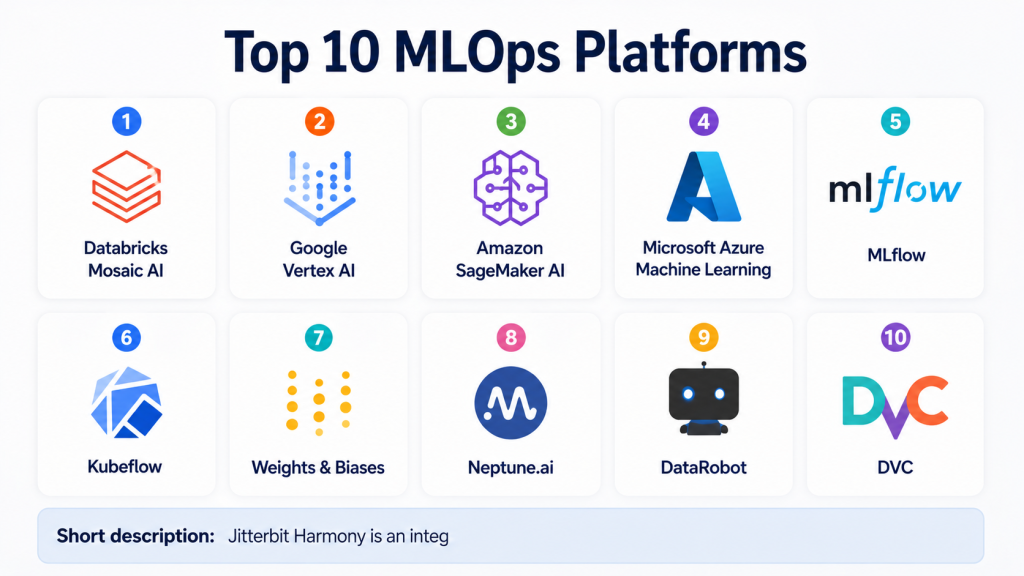
Top 10 MLOps Platforms
#1 — Databricks Mosaic AI
Short description: Databricks Mosaic AI is an MLOps and AI platform built around the Databricks Lakehouse ecosystem.
It helps teams build, train, govern, deploy, and monitor machine learning and AI models.
It is especially useful for organizations that already use Databricks for data engineering, analytics, and AI workloads.
The platform supports experiment tracking, model management, feature engineering, and production workflows.
It is suitable for data scientists, ML engineers, data engineers, and enterprise AI teams.
Databricks also supports open-source MLflow, making it familiar for many ML practitioners.
It works well for companies that want data, ML, and AI operations in one environment.
It is a strong choice for large-scale AI programs where data governance and collaboration matter.
Key Features
- Experiment tracking and model lifecycle management
- Model registry and governance workflows
- Feature engineering and feature serving support
- Integration with lakehouse data architecture
- Support for generative AI and classical ML workflows
- Scalable training and deployment capabilities
- Strong collaboration between data and AI teams
Pros
- Strong fit for data-heavy enterprises
- Good integration between data engineering and ML workflows
- MLflow ecosystem support is a major advantage
Cons
- Best value comes when already using Databricks
- Can be complex for smaller teams
- Cost management needs careful planning
Platforms / Deployment
Cloud / Hybrid
Security & Compliance
Supports enterprise-grade access control, identity integration, encryption, audit logs, and governance capabilities. Specific compliance availability depends on deployment and contract configuration.
Integrations & Ecosystem
Databricks Mosaic AI fits strongly into modern data and AI ecosystems.
- MLflow
- Apache Spark
- Cloud storage
- Data warehouses
- BI tools
- DevOps and CI/CD workflows
Support & Community
Strong enterprise support, extensive documentation, training resources, and a large data engineering and ML community.
#2 — Google Vertex AI
Short description: Google Vertex AI is a managed AI and MLOps platform for building, deploying, and managing machine learning models on Google Cloud.
It supports experiment tracking, model training, feature management, pipelines, model registry, and model monitoring.
The platform is useful for teams that want a unified cloud environment for machine learning and AI operations.
It supports both AutoML and custom model development.
Vertex AI is suitable for data scientists, developers, ML engineers, and enterprise AI teams.
It is especially strong for organizations using Google Cloud data services.
The platform can support classical ML, deep learning, and generative AI workflows.
It is a strong option for cloud-native ML lifecycle management.
Key Features
- Managed model training and deployment
- Vertex AI Pipelines for workflow automation
- Model registry and metadata tracking
- Feature management capabilities
- Model monitoring and evaluation tools
- AutoML and custom training support
- Integration with Google Cloud data services
Pros
- Strong cloud-native MLOps capabilities
- Good fit for Google Cloud users
- Useful for both AutoML and custom ML teams
Cons
- Best suited for Google Cloud environments
- Advanced usage requires cloud knowledge
- Pricing can vary based on compute and usage
Platforms / Deployment
Cloud
Security & Compliance
Supports IAM, encryption, access control, audit logging, private networking options, and Google Cloud security controls. Specific compliance depends on configuration.
Integrations & Ecosystem
Vertex AI connects with Google Cloud’s data and AI stack.
- BigQuery
- Cloud Storage
- Dataflow
- Looker
- Vertex AI Pipelines
- Google Cloud APIs
Support & Community
Strong documentation, cloud support plans, learning resources, and a large developer ecosystem.
#3 — Amazon SageMaker AI
Short description: Amazon SageMaker AI is AWS’s managed machine learning platform for building, training, deploying, and monitoring models.
It provides a broad set of MLOps capabilities for experiment tracking, pipelines, model registry, deployment, and governance.
The platform is designed for teams that already use AWS infrastructure and data services.
It supports both beginner-friendly and advanced ML engineering workflows.
SageMaker is useful for data scientists, ML engineers, platform teams, and cloud teams.
It can support production-grade ML pipelines at scale.
The platform also integrates with AWS security, monitoring, storage, and compute services.
It is a strong choice for AWS-first organizations building serious ML systems.
Key Features
- Managed training and deployment
- Model registry and experiment management
- SageMaker Pipelines for ML workflow automation
- Model monitoring capabilities
- Integration with AWS data and compute services
- Support for custom models and AutoML
- Scalable infrastructure for production ML
Pros
- Strong fit for AWS users
- Broad MLOps feature coverage
- Scalable for enterprise workloads
Cons
- Can feel complex for new users
- Requires AWS knowledge for best results
- Cost visibility needs careful monitoring
Platforms / Deployment
Cloud
Security & Compliance
Supports IAM, encryption, VPC configuration, audit logging, access control, and AWS security features. Compliance depends on AWS configuration and service usage.
Integrations & Ecosystem
SageMaker AI integrates deeply with AWS services.
- Amazon S3
- AWS Glue
- Amazon Redshift
- AWS Lambda
- CloudWatch
- AWS Step Functions
Support & Community
Strong AWS documentation, enterprise support options, training resources, and broad community adoption.
#4 — Microsoft Azure Machine Learning
Short description: Microsoft Azure Machine Learning is a managed ML and MLOps platform for developing, training, deploying, and managing models on Azure.
It supports experiment tracking, model registry, automated ML, pipelines, monitoring, and responsible AI workflows.
The platform is useful for enterprises already using Microsoft cloud, data, identity, and DevOps services.
It supports both no-code, low-code, and code-first workflows.
Azure ML is suitable for data scientists, developers, ML engineers, and enterprise AI teams.
It provides strong integration with Microsoft security and governance tools.
It is useful for regulated and enterprise environments that need control and scale.
It is a strong option for Microsoft-first organizations.
Key Features
- Experiment tracking and model registry
- ML pipelines and workflow automation
- Managed training and deployment
- Responsible AI and model interpretability tools
- Automated ML support
- Integration with Azure DevOps and GitHub
- Enterprise identity and governance support
Pros
- Strong fit for Microsoft ecosystem users
- Good governance and identity integration
- Supports both simple and advanced workflows
Cons
- Best value comes inside Azure
- Advanced workflows can require technical skill
- Pricing depends on compute and service usage
Platforms / Deployment
Cloud / Hybrid
Security & Compliance
Supports role-based access, identity integration, encryption, private networking, audit capabilities, and Microsoft cloud security controls. Compliance depends on configuration.
Integrations & Ecosystem
Azure Machine Learning fits into Microsoft’s cloud and development ecosystem.
- Azure Data Lake
- Azure Synapse
- Microsoft Fabric
- Power BI
- GitHub
- Azure DevOps
Support & Community
Strong documentation, enterprise support, Microsoft learning resources, and a large developer community.
#5 — MLflow
Short description: MLflow is an open-source platform for managing the machine learning lifecycle.
It supports experiment tracking, model packaging, model registry, and deployment workflows.
MLflow is widely used by data scientists and ML engineers because it is flexible and framework-friendly.
It works with many ML libraries and can be used in cloud, local, or self-managed environments.
MLflow is a strong choice for teams that want control and portability.
It is often used as a foundation for custom MLOps platforms.
It is suitable for startups, research teams, engineering teams, and enterprises.
MLflow is especially valuable when teams want open-source MLOps without heavy vendor lock-in.
Key Features
- Experiment tracking
- Model registry
- Model packaging and reproducibility support
- Framework-agnostic design
- API and CLI support
- Deployment workflow support
- Strong open-source ecosystem
Pros
- Flexible and widely adopted
- Good fit for custom MLOps stacks
- Works with many ML frameworks
Cons
- Requires setup and maintenance
- Enterprise governance depends on implementation
- Not a complete managed platform by itself
Platforms / Deployment
Windows / macOS / Linux / Cloud / Self-hosted / Hybrid
Security & Compliance
Not publicly stated for the open-source version. Security depends on deployment architecture, access controls, hosting environment, and enterprise configuration.
Integrations & Ecosystem
MLflow works with many ML and data science tools.
- Python
- R
- scikit-learn
- TensorFlow
- PyTorch
- Spark
Support & Community
Strong open-source documentation, wide community adoption, and enterprise support options through commercial platforms.
#6 — Kubeflow
Short description: Kubeflow is an open-source MLOps platform designed to run machine learning workflows on Kubernetes.
It helps teams build portable, scalable, and containerized ML pipelines.
Kubeflow is best suited for engineering-heavy teams that already understand Kubernetes.
It supports pipeline orchestration, training workflows, notebooks, model serving, and workflow automation.
The platform is popular with teams that want cloud portability and infrastructure control.
Kubeflow is not usually the simplest option for beginners.
It is powerful when ML workloads need to run across Kubernetes-based environments.
It fits platform teams, ML engineers, and organizations with strong DevOps maturity.
Key Features
- Kubernetes-native ML workflows
- Pipeline orchestration
- Notebook support
- Model training and serving workflows
- Portable infrastructure design
- Support for containerized ML workloads
- Open-source extensibility
Pros
- Strong for Kubernetes-based teams
- Avoids heavy vendor lock-in
- Highly customizable for platform engineering
Cons
- Requires Kubernetes expertise
- Setup and maintenance can be complex
- Not ideal for non-technical users
Platforms / Deployment
Linux / Cloud / Self-hosted / Hybrid
Security & Compliance
Not publicly stated as a general open-source platform. Security depends on Kubernetes configuration, identity setup, network policies, access controls, and deployment practices.
Integrations & Ecosystem
Kubeflow integrates with Kubernetes-native and cloud-native ecosystems.
- Kubernetes
- Docker containers
- CI/CD pipelines
- Cloud storage
- Notebooks
- Model serving tools
Support & Community
Strong open-source community and documentation, but implementation support depends on internal expertise or third-party vendors.
#7 — Weights & Biases
Short description: Weights & Biases is an MLOps platform focused on experiment tracking, model evaluation, collaboration, dataset and model workflows, and ML observability.
It is popular among data scientists, ML engineers, and AI research teams.
The platform helps teams compare runs, visualize metrics, track artifacts, and collaborate across experiments.
It is especially useful when teams run many experiments and need clarity on model performance.
Weights & Biases also supports modern AI workflows, including evaluation and monitoring use cases.
It works well with popular ML frameworks and developer workflows.
It can be used by startups, research teams, and enterprises.
It is a strong option for teams that care deeply about experiment visibility and collaboration.
Key Features
- Experiment tracking
- Model and artifact tracking
- Visual dashboards
- Collaboration tools
- Model evaluation workflows
- Framework integrations
- Reports and team visibility
Pros
- Excellent experiment tracking experience
- Strong collaboration features
- Popular with ML research and engineering teams
Cons
- Not always a full end-to-end MLOps replacement
- Costs can grow with team and usage scale
- Production deployment may require other tools
Platforms / Deployment
Cloud / Self-hosted / Hybrid
Security & Compliance
Enterprise security features may include SSO, access controls, and private deployment options. Specific compliance details should be verified with the vendor.
Integrations & Ecosystem
Weights & Biases integrates with many ML frameworks and workflows.
- PyTorch
- TensorFlow
- Hugging Face
- Keras
- Jupyter
- CI/CD workflows
Support & Community
Strong documentation, active community, enterprise support options, and broad adoption among ML teams.
#8 — Neptune.ai
Short description: Neptune.ai is an experiment tracking and model metadata management platform for machine learning teams.
It helps users track experiments, compare model runs, log metadata, organize results, and improve collaboration.
The platform is useful for teams that need lightweight but structured experiment management.
It supports data scientists and ML engineers working across different frameworks and environments.
Neptune.ai is often used when teams want better visibility without adopting a heavy enterprise platform.
It can fit research teams, startups, and growing ML teams.
It also supports model registry-style workflows and metadata organization.
It is a practical choice for teams focused on reproducibility and experiment clarity.
Key Features
- Experiment tracking
- Model metadata management
- Run comparison and visualization
- Collaboration features
- API-first workflow
- Framework integrations
- Model registry-style organization
Pros
- Lightweight and flexible
- Good for experiment visibility
- Works across different ML environments
Cons
- Not a complete deployment platform
- Advanced enterprise needs may require additional tools
- Some workflows depend on team implementation
Platforms / Deployment
Cloud / Self-hosted / Hybrid
Security & Compliance
Security features may vary by plan and deployment. Specific compliance details are not publicly stated here.
Integrations & Ecosystem
Neptune.ai works with common ML tools and frameworks.
- Python
- PyTorch
- TensorFlow
- scikit-learn
- Jupyter
- ML pipelines
Support & Community
Good documentation, practical guides, and support options. Community strength is solid among experiment tracking users.
#9 — DataRobot
Short description: DataRobot is an enterprise AI platform that includes MLOps capabilities for model deployment, monitoring, governance, and lifecycle management.
It is designed for organizations that need production AI with controls, visibility, and business alignment.
DataRobot supports both automated model development and operational management of models.
It is useful for financial services, healthcare, insurance, retail, and large enterprises.
The platform helps teams manage risk, performance, governance, and monitoring across AI assets.
It is especially relevant when business teams and technical teams need to collaborate.
DataRobot is often chosen by enterprises that want managed AI operations.
It is less focused on open-source flexibility and more focused on enterprise AI delivery.
Key Features
- Model deployment and monitoring
- AI governance workflows
- Automated machine learning support
- Model performance tracking
- Explainability capabilities
- Collaboration features
- Enterprise lifecycle management
Pros
- Strong enterprise governance focus
- Useful for production AI management
- Good fit for regulated industries
Cons
- May be expensive for smaller teams
- Can be more platform-heavy than developer-first tools
- Flexibility depends on deployment and licensing model
Platforms / Deployment
Cloud / Hybrid / Varies
Security & Compliance
Enterprise security features are available, including access control and governance capabilities. Specific certifications should be verified with the vendor.
Integrations & Ecosystem
DataRobot connects with enterprise data, analytics, and operational systems.
- Data warehouses
- Cloud platforms
- BI tools
- APIs
- Enterprise identity systems
- Model deployment workflows
Support & Community
Strong enterprise support, onboarding resources, documentation, and customer success programs.
#10 — DVC
Short description: DVC is an open-source tool focused on data versioning, model versioning, experiment management, and reproducible ML workflows.
It is designed for developers and ML teams that want Git-like practices for machine learning projects.
DVC helps track datasets, models, pipelines, and experiment outputs without storing large files directly in Git.
It is especially useful for teams that care about reproducibility and version control.
DVC is not a full managed MLOps platform by itself, but it is a strong building block.
It works well with existing developer workflows and CI/CD systems.
It is suitable for technical teams that want open-source control.
DVC fits teams building custom MLOps stacks with strong engineering discipline.
Key Features
- Data and model versioning
- Pipeline tracking
- Experiment management
- Git-based workflow alignment
- Remote storage support
- Reproducibility support
- Open-source design
Pros
- Strong fit for developer-first ML teams
- Good for reproducible ML workflows
- Flexible and open-source
Cons
- Requires technical setup
- Not a complete managed MLOps platform
- Production monitoring and deployment need additional tools
Platforms / Deployment
Windows / macOS / Linux / Self-hosted / Cloud storage integration
Security & Compliance
Not publicly stated for the open-source version. Security depends on storage backend, access controls, repository practices, and infrastructure configuration.
Integrations & Ecosystem
DVC fits well into developer and ML engineering workflows.
- Git
- GitHub
- GitLab
- Bitbucket
- Cloud storage
- CI/CD pipelines
Support & Community
Strong documentation, open-source community, and commercial support options through related offerings.
Comparison Table
| Tool Name | Best For | Platform(s) Supported | Deployment | Standout Feature | Public Rating |
|---|---|---|---|---|---|
| Databricks Mosaic AI | Data-heavy enterprise AI teams | Web | Cloud / Hybrid | Lakehouse-native MLOps | N/A |
| Google Vertex AI | Google Cloud ML teams | Web | Cloud | Unified cloud AI lifecycle platform | N/A |
| Amazon SageMaker AI | AWS-first ML teams | Web | Cloud | Broad AWS-native MLOps capabilities | N/A |
| Microsoft Azure Machine Learning | Microsoft ecosystem enterprises | Web | Cloud / Hybrid | Enterprise ML with Azure integration | N/A |
| MLflow | Open-source ML lifecycle management | Windows / macOS / Linux | Cloud / Self-hosted / Hybrid | Flexible experiment tracking and registry | N/A |
| Kubeflow | Kubernetes-native ML platform teams | Linux | Cloud / Self-hosted / Hybrid | Kubernetes-based ML pipelines | N/A |
| Weights & Biases | Experiment tracking and collaboration | Web / API-based workflows | Cloud / Self-hosted / Hybrid | Strong experiment visibility | N/A |
| Neptune.ai | Lightweight experiment management | Web / API-based workflows | Cloud / Self-hosted / Hybrid | Flexible metadata tracking | N/A |
| DataRobot | Enterprise AI governance | Web | Cloud / Hybrid / Varies | Production AI governance | N/A |
| DVC | Data and model versioning | Windows / macOS / Linux | Self-hosted / Cloud storage integration | Git-like ML versioning | N/A |
Evaluation & Scoring of MLOps Platforms
| Tool Name | Core (25%) | Ease (15%) | Integrations (15%) | Security (10%) | Performance (10%) | Support (10%) | Value (15%) | Weighted Total (0–10) |
|---|---|---|---|---|---|---|---|---|
| Databricks Mosaic AI | 9 | 8 | 9 | 9 | 9 | 9 | 8 | 8.65 |
| Google Vertex AI | 9 | 8 | 9 | 9 | 9 | 9 | 8 | 8.65 |
| Amazon SageMaker AI | 9 | 7 | 9 | 9 | 9 | 9 | 8 | 8.55 |
| Microsoft Azure Machine Learning | 9 | 8 | 9 | 9 | 8 | 9 | 8 | 8.55 |
| MLflow | 8 | 8 | 8 | 6 | 8 | 8 | 9 | 7.85 |
| Kubeflow | 8 | 6 | 8 | 7 | 9 | 7 | 8 | 7.55 |
| Weights & Biases | 8 | 9 | 8 | 8 | 8 | 8 | 8 | 8.10 |
| Neptune.ai | 7 | 8 | 8 | 7 | 8 | 7 | 8 | 7.55 |
| DataRobot | 8 | 8 | 8 | 9 | 8 | 9 | 7 | 8.05 |
| DVC | 7 | 7 | 8 | 6 | 7 | 7 | 9 | 7.25 |
These scores are comparative and should be interpreted as a practical buyer guide, not as a universal ranking. Enterprise platforms score higher in governance, managed infrastructure, and support. Open-source tools score well in flexibility and value but may need more engineering effort. The right score for your team may change based on cloud preference, internal skills, security needs, budget, and deployment model.
Which MLOps Platform Is Right for You?
Solo / Freelancer
Solo users should usually start with lightweight or open-source tools. MLflow and DVC are practical choices because they help manage experiments, models, and versioning without forcing a large platform commitment. Neptune.ai and Weights & Biases can also be useful if you want clean experiment dashboards with less setup.
For freelancers, the best choice depends on the work type. If you deliver models to clients, MLflow and DVC help with reproducibility. If you run many experiments and need visual comparisons, Weights & Biases or Neptune.ai may be better.
SMB
SMBs should focus on ease of use, cost control, and integration with existing cloud tools. If the company already uses AWS, SageMaker AI may be a natural fit. If it uses Azure, Azure Machine Learning is practical. If it uses Google Cloud, Vertex AI can be a strong option.
For SMBs with technical teams, MLflow plus DVC can provide strong value. For teams that need collaboration and dashboards, Weights & Biases or Neptune.ai can reduce confusion around experiments and model performance.
Mid-Market
Mid-market companies often need stronger governance, repeatable pipelines, and production deployment support. Databricks Mosaic AI, Vertex AI, SageMaker AI, Azure Machine Learning, DataRobot, and Weights & Biases are strong candidates depending on existing infrastructure.
At this stage, teams should avoid choosing tools only for experimentation. They should evaluate deployment, monitoring, security, access control, audit logs, cost visibility, and integration with CI/CD systems.
Enterprise
Enterprises should prioritize governance, security, scalability, identity management, auditability, and support. Databricks Mosaic AI, Google Vertex AI, Amazon SageMaker AI, Microsoft Azure Machine Learning, and DataRobot are strong enterprise options.
Large organizations should involve platform engineering, security, compliance, legal, data governance, and business stakeholders before final selection. The platform must support not only model training but also production monitoring, approvals, access controls, and long-term maintenance.
Budget vs Premium
For budget-sensitive teams, MLflow, DVC, and Kubeflow offer strong open-source value, but they require engineering effort. Neptune.ai and Weights & Biases can provide faster experiment visibility without building everything manually.
Premium platforms such as Databricks Mosaic AI, SageMaker AI, Vertex AI, Azure Machine Learning, and DataRobot are better when teams need managed infrastructure, enterprise support, security controls, and production-grade governance.
Feature Depth vs Ease of Use
Feature-rich platforms are powerful, but they can also be harder to adopt. Kubeflow offers deep control but requires Kubernetes expertise. SageMaker AI, Vertex AI, and Azure Machine Learning provide broad capabilities but work best when teams understand the cloud ecosystem.
Weights & Biases and Neptune.ai are easier for experiment tracking. MLflow is flexible and familiar for many ML teams. DataRobot may be easier for enterprise teams that want packaged AI governance and lifecycle workflows.
Integrations & Scalability
Choose the platform that fits your current stack. AWS users may prefer SageMaker AI. Azure users may prefer Azure Machine Learning. Google Cloud users may prefer Vertex AI. Databricks users may prefer Databricks Mosaic AI.
For open and flexible stacks, MLflow, Kubeflow, and DVC can integrate well into custom pipelines. However, teams must plan storage, deployment, security, monitoring, and maintenance carefully.
Security & Compliance Needs
Regulated companies should check SSO, role-based access control, audit logs, encryption, private networking, data residency, model approval workflows, and monitoring. Enterprise managed platforms are often stronger in this area.
Open-source tools can be secure, but security depends heavily on implementation. If your company has strict compliance needs, involve security teams early and test the platform using real governance requirements.
Frequently Asked Questions
1. What is an MLOps platform?
An MLOps platform helps teams manage the machine learning lifecycle from experimentation to production. It usually supports tracking, versioning, pipelines, model registry, deployment, monitoring, and governance.
2. Why do companies need MLOps?
Companies need MLOps because models can fail after deployment due to data drift, changing business conditions, poor monitoring, or weak version control. MLOps makes machine learning more reliable, repeatable, and production-ready.
3. How are MLOps platforms priced?
Pricing varies by vendor. Cloud platforms often charge based on compute, storage, training, deployment, and usage. Enterprise tools may use subscriptions, seat-based pricing, usage-based pricing, or custom contracts.
4. How long does MLOps implementation take?
A simple setup can be done quickly for experiment tracking or versioning. A full enterprise implementation can take longer because it includes security, pipelines, deployment, monitoring, governance, and team training.
5. What are common mistakes when choosing an MLOps platform?
Common mistakes include choosing a tool only for experimentation, ignoring deployment needs, underestimating security requirements, skipping cost planning, and not checking integrations with existing data and DevOps systems.
6. Is open-source MLOps enough for production?
Open-source MLOps can be enough for skilled engineering teams. Tools like MLflow, Kubeflow, and DVC are powerful, but teams must manage hosting, security, monitoring, upgrades, and support themselves.
7. Which MLOps platform is best for cloud-native teams?
The best choice depends on the cloud stack. AWS teams may prefer SageMaker AI, Azure teams may prefer Azure Machine Learning, and Google Cloud teams may prefer Vertex AI. Databricks users may prefer Databricks Mosaic AI.
8. What security features should buyers check?
Buyers should check SSO, RBAC, encryption, audit logs, private networking, secrets management, approval workflows, and compliance support. For regulated industries, security review should happen before final purchase.
9. Can MLOps platforms support generative AI?
Many modern MLOps platforms are expanding into generative AI workflows. Buyers should check whether the platform supports model evaluation, prompt tracking, LLM monitoring, governance, safety testing, and cost visibility.
10. How important is model monitoring?
Model monitoring is very important because model performance can decline after deployment. Monitoring helps detect drift, data quality problems, prediction issues, latency changes, and business performance gaps.
Conclusion
MLOps platforms are now essential for teams that want machine learning models to move safely from experimentation to production. The best tool depends on your company size, cloud stack, security needs, technical maturity, and budget. Databricks Mosaic AI, Google Vertex AI, Amazon SageMaker AI, and Microsoft Azure Machine Learning are strong choices for cloud and enterprise teams. MLflow, Kubeflow, and DVC are valuable for open-source and engineering-led teams. Weights & Biases and Neptune.ai are excellent for experiment tracking and collaboration. DataRobot is a strong option for enterprise AI governance.
