Upgrade & Secure Your Future with DevOps, SRE, DevSecOps, MLOps!
We spend hours scrolling social media and waste money on things we forget, but won’t spend 30 minutes a day earning certifications that can change our lives.
Master in DevOps, SRE, DevSecOps & MLOps by DevOps School!
Learn from Guru Rajesh Kumar and double your salary in just one year.
Introduction
Robotics simulation tools are software platforms that allow engineers, developers, and researchers to model, test, and optimize robots in a virtual environment before deploying them in the real world. These toolkits simulate physical behaviors, sensor inputs, and control algorithms, enabling safe experimentation without the cost or risk of hardware failures. They are essential for designing robots, autonomous vehicles, drones, and industrial automation systems efficiently.
In , robotics simulation has become even more critical due to the rapid advancement of AI-driven robotics, the integration of multi-robot systems, and the push for remote testing and digital twins. Modern simulation tools support complex 3D environments, realistic physics engines, and cloud-based collaboration, making them indispensable for innovation.
Real-world use cases:
- Testing autonomous vehicles and drones in various environmental conditions.
- Optimizing robotic arms and manufacturing processes before physical deployment.
- Training AI models for object recognition, navigation, and manipulation.
- Conducting research in swarm robotics or collaborative robot systems.
- Simulating human-robot interactions safely in healthcare or service robotics.
Evaluation criteria buyers should consider:
- Physics realism and accuracy
- AI and sensor simulation capabilities
- Multi-robot and swarm support
- Integration with ROS, Gazebo, or other frameworks
- Cloud or local deployment flexibility
- Ease of use and learning curve
- Community support and documentation
- Licensing costs and value
- Security and data compliance
Best for: Robotics engineers, AI researchers, automation teams, industrial manufacturers, and universities. Suited for small startups to large enterprises.
Not ideal for: Users who only need simple 2D simulations, hobbyists without programming experience, or teams seeking pre-built robot models without customization needs.
Key Trends in Robotics Simulation Tools
- Increasing adoption of AI-driven simulation for predictive analytics and autonomous behavior testing.
- Integration with cloud platforms for collaborative, multi-user simulation environments.
- Support for digital twins, allowing real-time synchronization between simulated and real-world robots.
- Advanced physics engines that model friction, collision, and material properties with high fidelity.
- Expanded support for ROS, ROS2, and other open-source robotics frameworks.
- Enhanced multi-robot and swarm simulation capabilities.
- Virtual reality (VR) and augmented reality (AR) support for immersive testing.
- Subscription-based pricing models for flexibility and enterprise scalability.
- Emphasis on secure data handling, including role-based access and encryption.
- Plug-and-play integrations with AI, ML, and IoT platforms for automated testing pipelines.
How We Selected These Tools (Methodology)
- Market adoption and industry mindshare.
- Completeness and range of simulation features.
- Reliability and performance benchmarks in real-world deployments.
- Security posture and compliance with industry standards.
- Integration capability with ROS, AI/ML pipelines, and cloud platforms.
- Flexibility for solo, SMB, mid-market, and enterprise users.
- Quality of support, onboarding, and community engagement.
- Extensibility and plugin ecosystem.
- User feedback, testimonials, and case studies.
- Value for cost relative to features and scalability.
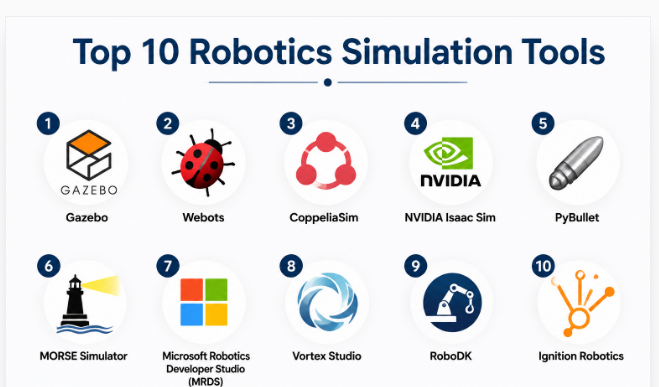
Top 10 Robotics Simulation Tools
#1 — Gazebo
Short description: Gazebo is an open-source 3D robotics simulator used widely for testing and developing robot algorithms. It supports complex environments, sensor simulations, and is compatible with ROS, making it ideal for research and development teams.
Key Features
- High-fidelity physics simulation
- Multi-robot support
- Sensor and actuator modeling
- Integration with ROS and ROS2
- Realistic environmental modeling
- Plugin-based extensibility
Pros
- Free and open-source
- Strong community support
- Highly extensible with plugins
Cons
- Steeper learning curve for beginners
- Requires setup and ROS knowledge
- Limited commercial support
Platforms / Deployment
- Linux / macOS / Windows (via Docker)
- Self-hosted / Cloud (via containers)
Security & Compliance
- Not publicly stated
Integrations & Ecosystem
Gazebo integrates seamlessly with ROS and a variety of control algorithms.
- ROS/ROS2
- Python/C++ APIs
- Machine learning pipelines
- Cloud simulation platforms
Support & Community
- Extensive documentation and tutorials
- Community forums
- Academic and industrial adoption
- Varies / Not publicly stated for commercial support
#2 — Webots
Short description: Webots is a professional-grade robotics simulator for industrial and research applications. It allows users to simulate mobile robots, drones, and robotic arms with accurate physics and sensor modeling.
Key Features
- 3D multi-robot simulation
- Realistic physics engine
- Integrated IDE for programming
- Cross-platform support
- Large library of robot models
- Export to real hardware
Pros
- User-friendly interface
- Strong educational and industrial use
- Supports real-time simulation
Cons
- Paid license for commercial use
- Limited advanced AI integration compared to open-source
Platforms / Deployment
- Windows / macOS / Linux
- Cloud / Self-hosted / Hybrid
Security & Compliance
- Not publicly stated
Integrations & Ecosystem
Webots offers APIs for common languages and can interface with ROS.
- ROS/ROS2 integration
- Python, C, C++ APIs
- Custom plugin support
Support & Community
- Dedicated support for commercial licenses
- Community forums
- Tutorials and academic examples
#3 — CoppeliaSim
Short description: CoppeliaSim (formerly V-REP) is a versatile robotics simulation platform supporting a wide range of robots, automation systems, and collaborative scenarios. Ideal for advanced R&D teams and AI model training.
Key Features
- Multi-robot simulation
- Customizable physics engines
- Remote API support
- Sensor and actuator modeling
- Scripting with Python and Lua
- ROS integration
Pros
- Powerful and flexible
- Supports complex robotic scenarios
- Scripting enables automation and AI integration
Cons
- Commercial license required for full features
- Moderate learning curve
- UI can feel complex
Platforms / Deployment
- Windows / macOS / Linux
- Self-hosted / Cloud
Security & Compliance
- Not publicly stated
Integrations & Ecosystem
CoppeliaSim integrates with ROS, AI pipelines, and industrial controllers.
- ROS/ROS2
- Python, C++, Lua APIs
- Cloud-based simulation pipelines
Support & Community
- Active forums
- Professional support options
- Documentation and example models
#4 — NVIDIA Isaac Sim
Short description: NVIDIA Isaac Sim is a simulation platform for AI-powered robots using photorealistic rendering and high-fidelity physics. It is geared toward enterprises developing autonomous robots and digital twins.
Key Features
- PhysX physics engine
- AI-powered simulation
- Photorealistic rendering
- Omniverse integration
- Sensor modeling
- Multi-robot coordination
Pros
- Cutting-edge graphics and physics
- Strong AI support
- Enterprise-grade platform
Cons
- High system requirements
- Learning curve for non-NVIDIA users
- License costs for enterprise features
Platforms / Deployment
- Windows / Linux
- Cloud / Self-hosted / Hybrid
Security & Compliance
- Not publicly stated
Integrations & Ecosystem
- Omniverse platform
- ROS/ROS2
- AI/ML pipelines
- SDK for custom robot control
Support & Community
- Enterprise support available
- Active developer community
- Tutorials and SDK documentation
#5 — PyBullet
Short description: PyBullet is a Python-based physics engine for robotics, reinforcement learning, and AI simulations. It is popular for AI-driven robotics research and lightweight simulations.
Key Features
- Real-time physics simulation
- Python API for robotics and AI
- Reinforcement learning support
- Multi-robot support
- Sensor and collision detection
Pros
- Lightweight and fast
- Ideal for AI/ML research
- Open-source and free
Cons
- Limited GUI visualization
- Less suitable for industrial-scale simulation
Platforms / Deployment
- Windows / macOS / Linux
- Self-hosted / Cloud (via Python)
Security & Compliance
- Not publicly stated
Integrations & Ecosystem
- TensorFlow, PyTorch
- ROS integration
- Python scripting and automation
Support & Community
- Open-source community support
- Documentation and tutorials
#6 — MORSE Simulator
Short description: MORSE is an open-source robotic simulator focusing on academic and research use. It supports ROS integration and is ideal for multi-robot scenarios and AI experiments.
Key Features
- 3D physics simulation
- Multi-robot environment
- ROS integration
- Python scripting
- Sensor and actuator modeling
Pros
- Open-source and free
- Academic and research oriented
- Flexible for AI experimentation
Cons
- Less polished UI
- Limited commercial support
Platforms / Deployment
- Linux / Windows via compatibility layers
- Self-hosted / Cloud
Security & Compliance
- Not publicly stated
Integrations & Ecosystem
- ROS/ROS2
- Python APIs
- Academic AI tools
Support & Community
- Community forums
- Documentation and example projects
#7 — Microsoft Robotics Developer Studio (MRDS)
Short description: MRDS is a robotics simulation environment supporting service robots and industrial applications, including 3D modeling and AI testing.
Key Features
- Visual simulation editor
- AI and sensor integration
- Multi-robot support
- C# programming environment
- Service robotics templates
Pros
- Integrated development environment
- Microsoft ecosystem support
- Strong industrial robotics focus
Cons
- Limited recent updates
- Windows-only platform
- Smaller community than ROS-based tools
Platforms / Deployment
- Windows
- Self-hosted
Security & Compliance
- Not publicly stated
Integrations & Ecosystem
- .NET framework
- ROS via plugins
- Azure IoT integration
Support & Community
- Documentation
- Limited community forums
#8 — Vortex Studio
Short description: Vortex Studio is a professional robotics simulation platform designed for heavy machinery, industrial robots, and autonomous vehicles, with high-fidelity physics and real-time simulation.
Key Features
- Realistic physics and dynamics
- Multi-robot support
- Remote control simulation
- Sensor and actuator modeling
- VR integration
Pros
- High realism for industrial applications
- Supports complex machinery
- Enterprise-ready
Cons
- Commercial license required
- Complex setup
- Hardware-intensive
Platforms / Deployment
- Windows / Linux
- Self-hosted / Cloud
Security & Compliance
- Not publicly stated
Integrations & Ecosystem
- APIs for custom robot control
- ROS integration
- VR/AR devices
Support & Community
- Professional support available
- Documentation and training resources
#9 — RoboDK
Short description: RoboDK is a simulation and offline programming platform for industrial robots. It allows users to design, test, and generate robot programs without physical hardware.
Key Features
- Offline programming
- Robot path simulation
- Multi-robot support
- CAD integration
- Python scripting
Pros
- Reduces hardware testing costs
- Compatible with many robot brands
- Easy to use
Cons
- Paid license for commercial use
- Limited advanced AI features
Platforms / Deployment
- Windows / macOS / Linux
- Self-hosted / Cloud
Security & Compliance
- Not publicly stated
Integrations & Ecosystem
- CAD tools integration
- ROS/ROS2 support
- Python APIs
Support & Community
- Professional support available
- Tutorials and documentation
#10 — Ignition Robotics
Short description: Ignition Robotics is a next-generation open-source robotics simulation platform emphasizing modularity, physics fidelity, and multi-robot systems. Ideal for research and collaborative development.
Key Features
- Modular simulation architecture
- Realistic physics engine
- Multi-robot and multi-environment
- ROS/ROS2 integration
- Sensor and actuator modeling
- Python and C++ support
Pros
- Open-source and extensible
- High realism
- Strong community and documentation
Cons
- Learning curve for beginners
- Requires ROS knowledge
Platforms / Deployment
- Linux / Windows / macOS
- Self-hosted / Cloud
Security & Compliance
- Not publicly stated
Integrations & Ecosystem
- ROS/ROS2
- Python/C++ APIs
- Cloud simulation support
Support & Community
- Active community
- Comprehensive tutorials
- Varies / Not publicly stated for commercial support
Comparison Table (Top 10)
| Tool Name | Best For | Platform(s) Supported | Deployment | Standout Feature | Public Rating |
|---|---|---|---|---|---|
| Gazebo | Research, multi-robot scenarios | Linux / macOS / Windows | Self-hosted / Cloud | ROS integration, plugin extensibility | N/A |
| Webots | Industrial, educational use | Windows / macOS / Linux | Cloud / Self-hosted / Hybrid | User-friendly IDE and prebuilt robots | N/A |
| CoppeliaSim | Advanced R&D, AI training | Windows / macOS / Linux | Self-hosted / Cloud | Multi-robot, scripting support | N/A |
| NVIDIA Isaac Sim | Enterprise, autonomous robots | Windows / Linux | Cloud / Self-hosted / Hybrid | AI simulation, photorealistic rendering | N/A |
| PyBullet | AI/ML research, lightweight sim | Windows / macOS / Linux | Self-hosted / Cloud | Python-based, reinforcement learning | N/A |
| MORSE Simulator | Academic research | Linux / Windows via compatibility | Self-hosted / Cloud | Open-source, ROS support | N/A |
| MRDS | Service robotics, industrial | Windows | Self-hosted | Visual simulation editor | N/A |
| Vortex Studio | Heavy machinery, industrial | Windows / Linux | Self-hosted / Cloud | High-fidelity physics | N/A |
| RoboDK | Industrial robot programming | Windows / macOS / Linux | Self-hosted / Cloud | Offline programming, CAD integration | N/A |
| Ignition Robotics | Research, collaborative R&D | Linux / Windows / macOS | Self-hosted / Cloud | Modular, realistic physics | N/A |
Evaluation & Scoring of Robotics Simulation Tools
| Tool Name | Core (25%) | Ease (15%) | Integrations (15%) | Security (10%) | Performance (10%) | Support (10%) | Value (15%) | Weighted Total (0–10) |
|---|---|---|---|---|---|---|---|---|
| Gazebo | 9 | 7 | 8 | 7 | 8 | 7 | 9 | 8.2 |
| Webots | 8 | 8 | 7 | 7 | 8 | 8 | 8 | 7.9 |
| CoppeliaSim | 9 | 7 | 8 | 7 | 8 | 7 | 8 | 8.0 |
| NVIDIA Isaac Sim | 10 | 7 | 9 | 7 | 9 | 8 | 7 | 8.3 |
| PyBullet | 7 | 8 | 8 | 7 | 8 | 7 | 9 | 7.9 |
| MORSE Simulator | 7 | 7 | 7 | 7 | 7 | 6 | 8 | 7.1 |
| MRDS | 6 | 7 | 6 | 6 | 7 | 6 | 7 | 6.5 |
| Vortex Studio | 9 | 6 | 8 | 7 | 9 | 7 | 6 | 7.8 |
| RoboDK | 8 | 8 | 7 | 7 | 8 | 7 | 8 | 7.9 |
| Ignition Robotics | 9 | 7 | 8 | 7 | 8 | 7 | 8 | 8.0 |
Interpretation: Higher weighted totals indicate better overall capability considering core features, ease of use, integration, security, performance, support, and value. Scores are comparative and meant to guide selection based on context and organizational needs.
Which Robotics Simulation Tool Is Right for You?
Solo / Freelancer
- Lightweight options like PyBullet or Gazebo are ideal for individual developers and AI researchers.
SMB
- Tools like Webots or CoppeliaSim offer a balance between usability and advanced features suitable for small teams.
Mid-Market
- NVIDIA Isaac Sim or RoboDK provide scalable simulation with AI support and CAD integrations for growing companies.
Enterprise
- Vortex Studio or Ignition Robotics offer enterprise-grade fidelity, cloud deployment, and multi-robot capabilities.
Budget vs Premium
- Open-source options like Gazebo, PyBullet, and MORSE Simulator suit tight budgets.
- Commercial platforms like Vortex Studio, NVIDIA Isaac Sim, and Webots Enterprise provide premium features worth higher investment.
Feature Depth vs Ease of Use
- Beginners benefit from Webots or RoboDK for intuitive interfaces.
- Advanced research and AI-focused projects prefer CoppeliaSim or Ignition Robotics.
Integrations & Scalability
- ROS/ROS2 and Python/C++ support are critical for multi-robot and AI-heavy simulations.
- Cloud-compatible tools enhance collaboration and distributed simulation.
Security & Compliance Needs
- Ensure platforms support secure access, encryption, and compliance with enterprise IT policies.
- Open-source platforms may require additional setup for secure deployments.
Frequently Asked Questions (FAQs)
1. What are the pricing models for robotics simulation tools?
Most tools offer free open-source versions (Gazebo, PyBullet) and commercial licenses (Webots, Vortex Studio). Pricing often depends on deployment type, number of users, and advanced feature access.
2. How easy is onboarding and implementation?
Ease varies; beginner-friendly platforms include Webots and RoboDK. Tools like Gazebo or CoppeliaSim require familiarity with ROS or scripting.
3. Can I simulate multiple robots at once?
Yes, most modern platforms support multi-robot simulation, including Gazebo, CoppeliaSim, and Ignition Robotics.
4. How realistic is the physics simulation?
Physics fidelity varies; Vortex Studio, NVIDIA Isaac Sim, and Ignition Robotics offer high realism, while PyBullet and MORSE focus on speed over detailed accuracy.
5. Are these tools suitable for AI and reinforcement learning?
Yes, PyBullet, CoppeliaSim, and NVIDIA Isaac Sim have strong support for AI-driven training and reinforcement learning scenarios.
6. How secure are these platforms for enterprise use?
Security depends on deployment; commercial platforms provide controlled access and encryption, while open-source tools may need additional configuration.
7. Can I integrate these tools with ROS or ROS2?
Most platforms support ROS/ROS2 integration for control, sensor input, and communication between simulated robots.
8. What are common mistakes when using these tools?
- Underestimating hardware requirements
- Skipping physics engine tuning
- Ignoring multi-robot communication complexities
9. Can these tools run in the cloud?
Several platforms, including NVIDIA Isaac Sim, Webots Cloud, and Ignition Robotics, support cloud deployments for collaboration and high-performance simulation.
10. Are there alternatives to these simulation tools?
Alternatives include specialized CAD-based robot programming tools or simplified educational platforms, but they may lack advanced AI, physics, and multi-robot capabilities.
Conclusion
Choosing the right robotics simulation tool depends on your team size, project complexity, budget, and required integrations. Open-source platforms like Gazebo and PyBullet are excellent for solo developers and research, while commercial platforms like Webots, NVIDIA Isaac Sim, and Vortex Studio suit mid-market and enterprise needs.
