Upgrade & Secure Your Future with DevOps, SRE, DevSecOps, MLOps!
We spend hours scrolling social media and waste money on things we forget, but won’t spend 30 minutes a day earning certifications that can change our lives.
Master in DevOps, SRE, DevSecOps & MLOps by DevOps School!
Learn from Guru Rajesh Kumar and double your salary in just one year.
Introduction
Recommendation System Toolkits are software libraries, frameworks, and platforms designed to help teams build, deploy, and maintain recommendation engines. In plain English, these tools help businesses suggest the right products, content, influencers, connections, or experiences to users based on patterns in data. Recommendation systems power everything from movie suggestions and product upsells to personalized content feeds and influencer matchmaking.
In and beyond, recommendation systems have become central to digital experiences because personalization drives engagement, retention, and revenue. With modern AI models, real‑time data, and hybrid recommendation approaches (combining collaborative filtering, content‑based filtering, embeddings, and graph techniques), teams can tailor experiences that feel intelligent and contextually relevant. As companies face higher expectations for personalization, scalable and maintainable recommendation toolkits are necessary.
Real‑world use cases include:
- E‑commerce product suggestions and upselling
- Content personalization on media platforms
- Social graph and influencer recommendations
- Music and video streaming suggestions
- Personalized news feeds and alerts
- Job and skill recommendations
- Customer churn prediction suggestions
What buyers should evaluate:
- Support for collaborative and content‑based filtering
- Real‑time vs batch recommendation support
- Integration with existing data and AI pipelines
- Scalability for large user bases
- Ease of deployment and machine learning workflows
- Monitoring, A/B testing, and versioning capabilities
- Security, data privacy, and compliance support
- Support for explainability and fairness
- Performance and latency for production systems
- Community, documentation, and enterprise support
Best for: AI/ML teams, data scientists, product teams, customer experience teams, marketing teams, and enterprises wanting to improve personalization.
Not ideal for: very small datasets where personalization has limited value, teams without data infrastructure, or organizations that only need simple static rules rather than learning models.
Key Trends in Recommendation System Toolkits
- Hybrid Recommendation Models: combining collaborative, content‑based, graph, and deep learning approaches for better accuracy.
- Real‑Time Personalization: support for streaming data and immediate model updates to adapt to user behavior instantly.
- Explainable Recommendations: users and regulators want transparency into why something was suggested.
- AI‑Driven Feature Engineering: automated feature transformations and embeddings powered by modern AI.
- Privacy‑Preserving Methods: federated learning and differential privacy to recommend while protecting user data.
- Multi‑Modal Recommendations: blending text, image, behavior, and metadata signals for richer suggestions.
- Edge Deployment: serving recommendations closer to user (mobile or edge systems) for low latency.
- AutoML Integration: automated model selection and hyperparameter tuning for recommendation pipelines.
- Interoperability with AI Platforms: easy integration with generative AI and large embedding stores.
- Pricing Flexibility: cloud toolkits shifting to usage‑based and inference‑credit billing for scalability.
How We Selected These Tools
- Market adoption and influence across industries (e‑commerce, media, social platforms).
- Feature breadth (multi‑algorithm support, scalability, real‑time capabilities).
- Performance signals in production deployments (latency, throughput, resilience).
- Security and privacy posture (data access control, encryption, compliance).
- Integration with AI ecosystems (ML frameworks, data platforms, analytics).
- Support for both development workflows and operating production systems.
- Fit for diverse company sizes (solo developers to enterprise personalization teams).
- Documentation quality, community engagement, and support resources.
- Track record of evolution (updates, features added to meet modern use cases).
- Openness and extensibility (open‑source or flexible APIs).
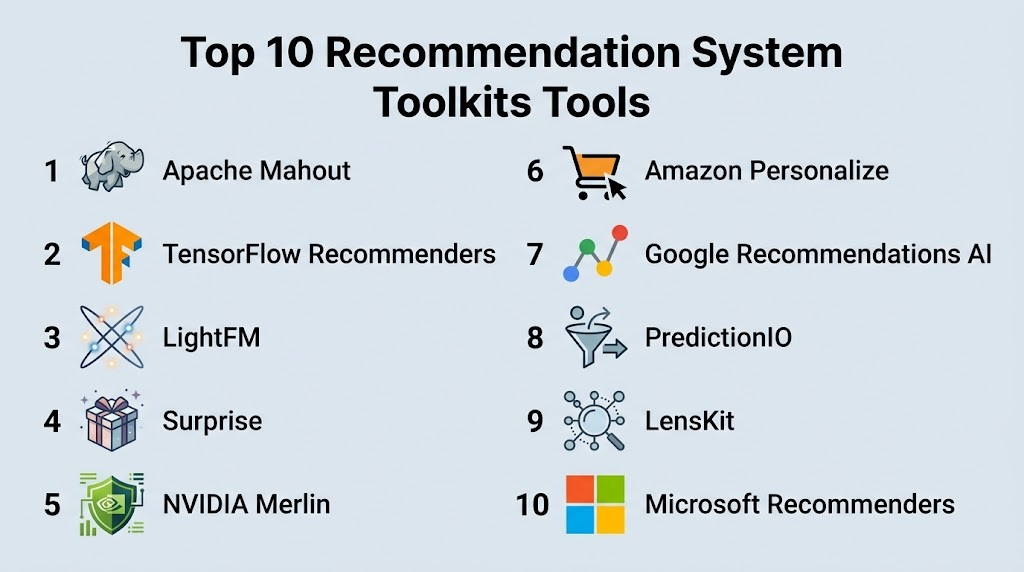
Top 10 Recommendation System Toolkits
#1 — Apache Mahout
Short description
Apache Mahout is an open‑source machine learning library focused on scalable algorithms, including recommendation engines. Mahout excels for teams building collaborative filtering and matrix factorization engines on large datasets. It is often used by data engineers and ML practitioners familiar with big data frameworks like Hadoop or Spark. Mahout’s focus has been on creating scalable, distributed learning models for recommendations and clustering. It supports batch and incremental learning. This toolkit is useful for organizations with existing Hadoop or Spark infrastructure seeking scalable recommendations.
Key Features
- Scalable collaborative filtering algorithms
- Batch recommendation workflows
- Integration with distributed processing frameworks
- Support for matrix factorization and clustering
- Algorithm library for personalization tasks
- Command‑line and programmatic interfaces
Pros
- Scales well on big data infrastructures
- Strong open‑source community history
- Useful for classic recommendation algorithms
Cons
- Less focus on real‑time recommendations
- Requires data infrastructure expertise
- Fewer modern AI/embedding features
Platforms / Deployment
Linux / Cloud / Self‑hosted
Security & Compliance
Not publicly stated
Integrations & Ecosystem
Mahout integrates with big data and workflow tools:
- Hadoop and HDFS
- Spark data processing
- ETL pipelines
- Java applications
Support & Community
Open‑source community support, documentation, and forums. Enterprise support typically requires internal expertise.
#2 — TensorFlow Recommenders
Short description
TensorFlow Recommenders (TFRS) is a library built on TensorFlow for building, evaluating, and deploying recommendation models. It provides components for retrieval, ranking, and evaluation tasks. TFRS is aimed at data scientists and machine learning engineers building deep learning‑powered recommendation systems that leverage embeddings, multi‑task learning, and modern neural architectures. It excels for teams that want tight integration with TensorFlow ecosystems and the flexibility to experiment with custom models at scale.
Key Features
- Retrieval and ranking model components
- Embedding support for users, items, and context
- Integration with TensorFlow pipelines
- Support for deep learning‑based recommenders
- Evaluation and metrics tools
- Flexible customization and model experimentation
Pros
- Highly flexible for deep learning recommenders
- Integration with TensorFlow ecosystem
- Facilitates research and production workflows
Cons
- Requires TensorFlow expertise
- Not turnkey for non‑developers
- Infrastructure management needed for large production systems
Platforms / Deployment
Windows / macOS / Linux / Cloud (via TensorFlow)
Security & Compliance
Varies / N/A
Integrations & Ecosystem
Built to work with TensorFlow and ML data pipelines alike:
- TensorFlow data loaders
- Cloud AI training pipelines
- Serving with TensorFlow Serving
- Vector embeddings workflows
- Monitoring and A/B testing frameworks
Support & Community
Strong documentation, active community, and tutorials. Enterprise support may come from internal teams or consulting partners.
#3 — PyTorch Lightning + TorchRec
Short description
TorchRec is PyTorch’s library for recommendation systems, often used with PyTorch Lightning to simplify training loops. It is designed for developers building deep neural recommenders with embeddings, attention mechanisms, and large datasets. TorchRec provides high‑performance features for dense and sparse user/item representations, sharding, and distributed training. It is useful for teams bringing research‑driven models into production with PyTorch toolchains.
Key Features
- Embedding collections and sparse operations
- Modular recommendation components
- Support for retrieval and ranking models
- Distributed training optimizations
- Integration with PyTorch Lightning
- Evaluation metrics support
Pros
- Flexible and research‑friendly
- Strong tensor and deep learning support
- Production‑ready with PyTorch ecosystem
Cons
- Requires deep learning expertise
- No turnkey recommendation engine
- Deployment infrastructure is developer’s responsibility
Platforms / Deployment
Windows / macOS / Linux / Cloud
Security & Compliance
Varies / N/A
Integrations & Ecosystem
Fits within PyTorch ecosystems:
- PyTorch data loaders
- TorchServe for model serving
- Logging and monitoring tools
- Distributed compute environments
- Custom recommendation workflows
Support & Community
Active community maintained around PyTorch and TorchRec. Documentation growing with research examples.
#4 — LightFM
Short description
LightFM is a Python library for building hybrid recommendation models using both collaborative and content‑based filtering. It is ideal when user/item metadata is available, and personalization can benefit from combining behavioral and descriptive signals. LightFM provides models like WARP and BPR that are effective on implicit feedback datasets. It is suitable for Python developers and data scientists building mid‑scale recommendation systems without heavy deep learning infrastructure.
Key Features
- Hybrid recommendation algorithms
- Implicit and explicit feedback support
- Fast training and prediction
- Feature integration for side information
- Python‑friendly API
- Evaluation metrics included
Pros
- Great balance of simplicity and performance
- Works well with user and item metadata
- Easy to integrate in Python ML workflows
Cons
- Not designed for deep learning or embeddings at massive scale
- Limited built‑in real‑time capabilities
- Smaller ecosystem than major frameworks
Platforms / Deployment
Linux / Cloud / Self‑hosted
Security & Compliance
Varies / N/A
Integrations & Ecosystem
LightFM fits common Python ML stacks:
- Pandas and NumPy datasets
- Scikit‑learn workflows
- Evaluation metrics utilities
- CI/CD pipelines
Support & Community
Open‑source project with community support and documentation. Commercial support is project‑specific.
#5 — Microsoft Recommenders (Azure ML)
Short description
Microsoft Recommenders is an open‑source toolkit with example pipelines and models for building recommendation engines across common patterns like collaborative filtering, content‑based recommendations, and ranking. It is particularly useful for teams working within Azure Machine Learning or Microsoft data ecosystems. It includes components for feature engineering, model training, evaluation, and deployment.
Key Features
- End‑to‑end recommender examples
- Collaborative and content‑based recipes
- Evaluation and metrics standards
- Azure Machine Learning integration
- Deployment workflows
- Model explainability components
Pros
- Practical pipelines and templates
- Integrates with enterprise MLops tools
- Useful for teams adopting Azure ecosystems
Cons
- Best experience tied to Azure services
- Requires Azure infrastructure knowledge
- Not a standalone turnkey engine
Platforms / Deployment
Cloud (Azure) / Hybrid
Security & Compliance
Not publicly stated
Integrations & Ecosystem
Strong connections to Microsoft/enterprise services:
- Azure Machine Learning
- Data warehouse and analytics services
- Enterprise identity and access systems
- Cloud deployment and scaling workflows
Support & Community
Documentation and examples provided. Community discussions around Azure ML usage.
#6 — Amazon Personalize
Short description
Amazon Personalize is a fully managed recommendation service that enables teams to build and deploy personalized experiences without deep algorithm expertise. It automates feature extraction, model training, evaluation, and serving. It supports real‑time and batch recommendations. Personalize is suitable for teams that want cloud‑managed recommendation systems with little overhead. Use cases include product recommendations, personalized search results, and targeted marketing content.
Key Features
- Managed model training and evaluation
- Real‑time and batch recommendations
- Personalization workflows
- Automatic feature extraction
- Performance metrics and tuning
Pros
- Fully managed, no infrastructure overhead
- Fast setup for personalized experiences
- Scales with workloads
Cons
- AWS dependency
- Less control over model internals
- Cost varies with usage
Platforms / Deployment
Cloud
Security & Compliance
Uses AWS security controls including IAM, encryption, and cloud compliance frameworks. Specific certifications vary by configuration.
Integrations & Ecosystem
Deep integration with AWS:
- Cloud data stores
- Analytics systems
- Application services
- Identity systems
- API endpoints for recommendations
Support & Community
AWS support plans, documentation, and community engagement.
#7 — Google Recommendations AI
Short description
Google Recommendations AI is a cloud‑managed recommendation service focused on retail and personalized experiences. It combines advanced machine learning with Google Cloud infrastructure to suggest products, content, and offers. It provides features like autoscaling, real‑time inference, and business rules integration. It is suitable for enterprises, e‑commerce platforms, and content publishers seeking a scalable managed recommendation service.
Key Features
- Managed recommendation models
- Real‑time predictions
- Integration with business rules
- Scalable cloud infrastructure
- Data ingestion and feature pipelines
- Built‑in evaluation metrics
Pros
- Scales with enterprise traffic
- Managed model maintenance
- Business rule integration
Cons
- Cloud dependency on one provider
- Less control over model customization
- Pricing varies with usage
Platforms / Deployment
Cloud
Security & Compliance
Not publicly stated
Integrations & Ecosystem
Designed for Google Cloud:
- Data pipelines
- BigQuery analytics
- Cloud storage and compute
- Application APIs
Support & Community
Cloud support tiers, documentation, and enterprise resources.
#8 — H2O.ai Driverless AI (Recommender Extensions)
Short description
H2O.ai Driverless AI is an automated machine learning platform that includes capabilities for building recommendation models as part of broader predictive workflows. It uses automated feature engineering, model selection, hyperparameter tuning, and model explanation. It can be applied to collaborative and content‑enhanced recommenders with minimal manual model coding. It is suitable for data science teams that want automated pipelines and interpretability.
Key Features
- AutoML for recommendation modeling
- Feature engineering and selection
- Explainability reports
- Model tuning and validation
- Scalable training workflows
Pros
- Minimal manual effort for model building
- Reduces data science workload
- Provides explainability
Cons
- Not solely focused on recommender systems
- Licensing and platform costs vary
- May require enterprise resource planning
Platforms / Deployment
Cloud / On‑premises / Hybrid
Security & Compliance
Not publicly stated
Integrations & Ecosystem
Fits broader MLops pipelines:
- Data sources
- Analytics tools
- Deployment targets
- Monitoring frameworks
Support & Community
Documentation, enterprise support tiers, and training resources.
#9 — Scikit‑Surprise
Short description
Scikit‑Surprise is a Python library for building and testing recommendation algorithms, especially on smaller datasets and research workflows. It includes classic collaborative filtering methods, evaluation metrics, and dataset handling. It is commonly used by data scientists for experimentation, research, and smaller personalization projects.
Key Features
- Collaborative filtering algorithms
- Evaluation metrics
- Dataset modules and cross‑validation
- Easy Python integration
- Lightweight library
Pros
- Quick setup and experimentation
- Good for learning and prototypes
- Simple API
Cons
- Not designed for large scale or real‑time workloads
- Limited modern algorithms
- Community usage smaller than major frameworks
Platforms / Deployment
Linux / Cloud / Self‑hosted
Security & Compliance
Varies / N/A
Integrations & Ecosystem
Common in Python research stacks:
- Pandas, NumPy
- Scikit‑learn workflows
- Evaluation utilities
Support & Community
Open‑source project with documentation and examples.
#10 — LensKit
Short description
LensKit is an open‑source toolkit for building, evaluating, and experimenting with recommendation algorithms. It supports collaborative filtering, neighborhood methods, and evaluation metrics. It is suitable for academic and research settings, as well as prototyping recommendation systems before production implementation.
Key Features
- Recommendation algorithm implementations
- Evaluation metrics
- Python and Java libraries
- Easy experiment configurations
- Algorithm comparisons
Pros
- Useful for research and prototyping
- Algorithm diversity
- Configurable experiments
Cons
- Not production‑ready out of the box
- Limited real‑time support
- Smaller community than larger ecosystems
Platforms / Deployment
Linux / Cloud / Self‑hosted
Security & Compliance
Varies / N/A
Integrations & Ecosystem
Fits research workflows and prototypes.
Support & Community
Documentation exists; community impact is research‑oriented.
Comparison Table
| Tool Name | Best For | Platform(s) Supported | Deployment | Standout Feature | Public Rating |
|---|---|---|---|---|---|
| Apache Mahout | Scalable batch recommendations | Linux / Cloud | Self‑hosted / Hybrid | Distributed algorithms | N/A |
| TensorFlow Recommenders | Deep learning recommenders | Linux / Cloud | Cloud / Self‑hosted | Flexible embeddings | N/A |
| TorchRec | ML engineering with PyTorch | Linux / Cloud | Cloud / Self‑hosted | High‑performance embeddings | N/A |
| LightFM | Hybrid recommenders | Linux / Cloud | Self‑hosted | Side information models | N/A |
| Microsoft Recommenders | Enterprise pipelines | Cloud | Cloud / Hybrid | End‑to‑end templates | N/A |
| Amazon Personalize | Managed recommendations | Cloud | Cloud | Automated deployment | N/A |
| Google Recommendations AI | Retail personalization | Cloud | Cloud | Business rules & scaling | N/A |
| H2O.ai Driverless AI | AutoML recommenders | Cloud / Hybrid | Cloud / Hybrid | Auto feature and model tuning | N/A |
| Scikit‑Surprise | Prototyping and research | Linux / Cloud | Self‑hosted | Lightweight Python API | N/A |
| LensKit | Academic experimentation | Linux / Cloud | Self‑hosted | Experimentation focus | N/A |
Evaluation & Scoring of Recommendation System Toolkits
| Tool Name | Core (25%) | Ease (15%) | Integrations (15%) | Security (10%) | Performance (10%) | Support (10%) | Value (15%) | Weighted Total (0–10) |
|---|---|---|---|---|---|---|---|---|
| Apache Mahout | 7 | 6 | 7 | 6 | 7 | 6 | 7 | 6.75 |
| TensorFlow Recommenders | 9 | 6 | 8 | 7 | 8 | 7 | 7 | 7.85 |
| TorchRec | 9 | 5 | 8 | 7 | 8 | 7 | 7 | 7.65 |
| LightFM | 7 | 8 | 7 | 7 | 7 | 7 | 8 | 7.45 |
| Microsoft Recommenders | 8 | 7 | 8 | 7 | 7 | 7 | 7 | 7.60 |
| Amazon Personalize | 8 | 9 | 8 | 8 | 8 | 8 | 7 | 8.25 |
| Google Recommendations AI | 8 | 9 | 8 | 8 | 8 | 8 | 7 | 8.25 |
| H2O.ai Driverless AI | 7 | 7 | 7 | 7 | 7 | 7 | 7 | 7.25 |
| Scikit‑Surprise | 6 | 8 | 6 | 6 | 6 | 6 | 8 | 6.85 |
| LensKit | 6 | 6 | 6 | 6 | 6 | 6 | 7 | 6.45 |
These scores are comparative based on key criteria. Higher totals indicate tools that balance core features, ease of use, integrations, and value more effectively for typical recommendation system needs. Scores are not absolute endorsements but practical signals for evaluation.
Which Recommendation System Toolkit Is Right for You?
Solo / Freelancer
Individual developers and small teams should focus on tools that require minimal setup and enable quick experimentation. LightFM, Scikit‑Surprise, and LensKit are accessible without heavy infrastructure. TensorFlow Recommenders and TorchRec can be used if the developer is already familiar with deep learning frameworks.
SMB
Small and medium businesses that want real personalization without deep AI expertise may find Amazon Personalize and Google Recommendations AI most suitable because they manage infrastructure and model training. Microsoft Recommenders is useful if the SMB is already invested in Azure.
Mid‑Market
Mid‑market companies usually have some internal data science capabilities and need real‑time or data‑driven personalization. TensorFlow Recommenders, TorchRec, and Microsoft Recommenders balance customization with integration capabilities. LightFM works well when side information is available.
Enterprise
Enterprises need scalable, secure, integrated solutions. Managed services (Amazon Personalize, Google Recommendations AI) provide ready‑to‑use systems, while TensorFlow Recommenders and TorchRec offer deep customization. H2O.ai Driverless AI is valuable if AutoML pipelines are desired alongside recommenders.
Budget vs Premium
Budget‑focused projects often start with LightFM, Scikit‑Surprise, or LensKit. Premium cloud offerings like Amazon Personalize and Google Recommendations AI may cost more but reduce operational burden and bring enterprise support. Open‑source deep learning libraries sit in the middle—they require effort but provide flexibility.
Feature Depth vs Ease of Use
Tools like TensorFlow Recommenders and TorchRec have depth but require expertise. Amazon Personalize and Google Recommendations AI prioritize ease of use and managed workflows.
Integrations & Scalability
Managed cloud tools often integrate smoothly with analytics, identity, and application platforms. On‑prem tools are best when data cannot leave controlled environments.
Security & Compliance Needs
Teams with strict security or compliance requirements should evaluate managed cloud controls (IAM, encryption, auditing) or choose self‑hosted toolkits where they control the environment.
Frequently Asked Questions
1. What is a recommendation system toolkit?
A recommendation system toolkit provides APIs, algorithms, and workflows for building systems that suggest items or content to users based on patterns in data. They optimize personalization and engagement.
2. What types of algorithms are used in recommendation systems?
Common algorithm types include collaborative filtering, content‑based filtering, hybrid methods, matrix factorization, neural recommenders, and graph‑based systems.
3. How long does it take to build a recommendation engine?
Prototype recommendation systems can be built quickly with tools like LightFM or managed services. Production‑grade systems with real‑time features, A/B testing, and monitoring can take several weeks or more.
4. Are cloud‑managed recommendation services worth it?
Cloud services simplify infrastructure and maintenance, enabling teams to focus on personalization logic. They’re worth it if you want faster deployment and integrated scaling.
5. Could recommendation engines produce bias?
Yes. Teams must monitor for bias (e.g., popularity bias or fairness issues) and apply evaluation metrics and fairness controls during model training and evaluation.
6. Do these toolkits support real‑time recommendations?
Some do (Amazon Personalize, Google Recommendations AI). Others, like TensorFlow Recommenders and TorchRec, can support real‑time serving with additional infrastructure.
7. How do I evaluate a recommendation model?
Evaluation uses metrics like precision, recall, NDCG, MAP, and AUC. Tools often provide built‑in metrics or integration with evaluation frameworks.
8. What data do recommendation systems need?
They typically use user interactions, item metadata, contextual features, and behavioral signals to learn patterns and provide recommendations.
9. Can recommendation systems predict churn?
Yes. While not strictly recommenders, similar modeling approaches and feature patterns can signal churn and trigger recommendations for retention actions.
10. Do these toolkits require AI expertise?
Some (managed services) require minimal expertise. Deep learning libraries and open‑source frameworks typically require data science or machine learning knowledge.
Conclusion
Recommendation systems remain essential in for delivering personalized experiences that drive business outcomes. Whether you choose a managed, cloud‑native service like Amazon Personalize or Google Recommendations AI, or a flexible deep learning toolkit like TensorFlow Recommenders or TorchRec, the right tool depends on your team’s expertise, deployment needs, data infrastructure, and personalization goals.
